Wednesday, April 3, 2013

Tuesday, April 2, 2013
Berkeley Lab Researchers Release Guide to Financing Energy Upgrade for K-12 School Districts
APRIL 02, 2013
510-486-4210 a_chen@lbl.gov
9
News Release
Energy costs K-12 schools in the U.S. $6 billion dollars annually. Spending less money on energy costs would leave more for funding-constrained school districts to spend on educating their students, according to researchers at the U.S. Department of Energy’s Lawrence Berkeley National Laboratory (Berkeley Lab).Public and private financing is available, but navigating the complicated landscape of grants, bonds, leasing arrangements and other types of financing can be difficult for school administrators and facilities managers, who are not necessarily experts in financing for energy efficiency and renewables.

Researchers Merrian Borgeson and Mark Zimring, in Berkeley Lab’s Environmental Energy Technologies Division (EETD), have released a guide on planning and financing comprehensive energy upgrades that involve multiple measures and are targeted toward achieving significant and persistent energy savings.
Written for school district administrators
The guide is written explicitly for school administrators, facilities managers, and others in K-12 education management. It covers different options for public and private financing approaches, and contains numerous case studies of school district projects. The authors provide explanations of financial terms and mechanisms.

EETD's Merrian Borgeson
Another significant benefit is that energy efficiency upgrades result in modernized infrastructure and lower maintenance costs—for example, through improved heating and cooling systems, energy-efficient windows and roofs, and better ventilation.
These energy upgrades also improve the comfort, health and safety of school buildings. Fixing the hot and cold spots, leaky walls and roofs, and broken windows not only reduces energy costs, it improves the indoor environmental quality of the building, and enhances the ability of students to learn and teachers to teach. Chosen carefully, energy-efficient equipment, for example, can be quieter, and do a better job at removing indoor pollutants that can affect human cognitive ability. Removing mold and toxic materials provides a safer learning environment.
Case studies provide guidance to overcoming obstacles
Six case studies drawn from the experience of school districts around the U.S. tell the stories of how district policymakers overcame obstacles, built consensus, and chose funding mechanisms for energy efficiency upgrades that were widely accepted by their districts’ stakeholders—parents, taxpayers, political leadership.
Williamson County School District in Tennessee, for example, entered into an energy savings performance contract (ESPC) with an energy services company (ESCO) and completed a $5.7 million lease-purchase agreement to fund a range of energy-related improvements across 27 school facilities.
The lease-purchase agreement helped reduce the barrier of up-front costs of the upgrades, and re-financing a year later benefitted both the district and taxpayers. The project will pay for itself in six and a half years, and continue saving money for the district long after that time.
Douglas County School District, Nevada, used a combination of financial mechanisms to fund $10.7 million in upgrades. They tapped into federal Qualified School Construction Bonds, an American Recovery and Reinvestment Act grant, and voter-approved General Obligation bonds to fund a range of equipment and facility improvements.
“Most schools already have access to many of the financing tools they need to invest in these improvements,” says Borgeson, “We think that every school has the potential to become a high performance school, one that has an improved student learning environment, and saves energy, resources, and money. They just need to understand what the opportunities are, and tap into those opportunities.”
“Financing Energy Upgrades for K-12 School Districts,” by Merrian Borgeson and Mark Zimring, is available for free download here. The work was funded by the U.S. Department of Energy’s Office of Energy Efficiency and Renewable Energy, and the American Recovery and Reinvestment Act.
# # #
Lawrence Berkeley National Laboratory addresses the world’s most urgent scientific challenges by advancing sustainable energy, protecting human health, creating new materials, and revealing the origin and fate of the universe. Founded in 1931, Berkeley Lab’s scientific expertise has been recognized with 13 Nobel prizes. The University of California manages Berkeley Lab for the U.S. Department of Energy’s Office of Science. For more, visit www.lbl.gov.
Monday, April 1, 2013
GE’s LED Refrigerated Display Lighting will mean $600,000 Annual Savings for Specialty Grocer
GE Press Release:

GE’s LED Refrigerated Display Lighting will mean $600,000 Annual Savings for Specialty Grocer
April 1, 2013
EAST CLEVELAND, Ohio — April 1, 2013 — (NYSE:GE) — When specialty frozen food retailer M&M Meat Shops began developing a new strategy to become more competitive, it explored various store improvement projects that would enhance shopper experience, build the bottom line, and could be replicated across its 430 franchise locations as part of a multi-year renovation mandate. The grocer found one cost-cutting answer inGE’s ImmersionTM RV40 LED refrigerated display lighting for reach-in cases. The energy-efficient LED retail lighting systems will save M&M Meat Shops about $600,000 in lighting costs annually once installations are complete.
Light where it should be
M&M Meat Shops conducted an evaluation of three competitive LED products for vertical cases and preferred GE’s Immersion RV40 LED system:
“With its 5000-degree Kelvin temperature, GE’s new LED system creates beautiful, bright, white light. It brings out the crispness of our signature white boxes, making them really pop in the vertical cases and impact the visual appeal of the entire store.” said Dianne Chalmers, senior manager of construction at M&M Meat Shops. “Franchisees don’t want their stores looking dark, dingy and tired, and you can see such a difference with these lights. Some stores look 20 years younger. It shows our customers we’re bright, clean and modern. It’s all about the ‘wow’ factor.”
An energy management mandate
As part of an eight-year cycle that mandates LED lighting upgrades be made at the time of each store renovation, franchises are replacing T10 fluorescent lights with Immersion RV40 LED lighting systems. A typical location containing 15 glass freezer doors will reduce direct energy consumption by nearly 6,000 kilowatt hours (kWhs) a year, while also using less indirect energy as the result of fewer freezer compressor cycles—an additional 2,700 kWh reduction. At a $.10 kWh rate and 12 hours of operation a day, the average M&M Meat Shops location will save about $870 a year in lighting energy costs alone.
GE’s LED refrigerated display lighting solution will also eliminate the maintenance cost of replacement ballasts and high-output fluorescent lamps. With Immersion RV40 LED lighting carrying an expected five-year service life, M&M Meat Shops anticipates annual upkeep will be reduced 97 percent as the result of virtually no bulb and ballast replacements—an approximate $525 savings per store.
This brings combined energy and maintenance reductions to nearly $1,400 for each franchisee to complete its lighting upgrade. To date, 150 M&M Meat Shops locations have made the switch to GE’s ecomagination℠ LED technology, a combined $210,000 annual lighting cost savings. These savings will grow to about $600,000 a year across all 430 stores when the renovation cycle is complete.
Lighting systems with local support
M&M Meat Shops worked with Canadian distributor HD Supply Litemor to develop the program and source GE’s LED retail lighting systems. “We’ve been working with M&M Meat Shops for years, and we knew their lighting system was getting too expensive to maintain,” said George Thomson, sales manager for HD Supply.
“The old T10 fluorescents are not as efficient, and they’re labor-intensive. We knew GE’s LED systems would do a nice job of making the packaging look good. Plus, fluorescents don’t typically perform well in cold environments, but LED lights love the cold. It was a no-brainer.”
Franchisees are further saving on labor costs due to the easy installation of GE’s Immersion LED RV40 product. Most installations have been completed within one day, by only one or two electricians. Additionally, shelving and food products remain in place while the retrofit is being made.
Chalmers added that some franchisees are applying their energy cost savings toward financing the new LED lighting, and then once the financing period has ended, the savings will convert to positive cash flow. Provincial and local power rebates also help shorten each store’s payback, for example, in Nova Scotia the rebate savings are up to 80 percent.
“The rebates have really helped us get a jump on the renovations and encouraged some franchises to make updates before their mandated time.” Chalmers said. “The money franchises are saving on energy costs are helping to pay for the renovations themselves. Plus, the updates are making the stores more valuable and giving them more worth. We’re really happy with this program.”
For more information about the GE Lighting products used in this project, visit www.gelighting.com. To learn more about GE’s commitment to innovative solutions to today’s environmental challenges while driving economic growth, visit www.ecomagination.com.
About M&M Meat ShopsEstablished in 1980, M&M Meat Shops is Canada's largest retail chain of specialty frozen foods, featuring hundreds of delicious thaw-and-serve and heat-and-serve products. With more than 430 franchise locations coast-to-coast, M&M Meat Shops delivers high-quality flash-frozen products and friendly customer service in a convenient, one-aisle store environment. For more information, visit www.mmmeatshops.com.
About HD Supply LitemorLighting specialists since 1969, HD Supply Litemor is Canada’s largest commercial lighting distributor, supplying energy efficient lamps, ballasts, fixtures and more through its network of 11 branches across Canada. As part of HD Supply Canada, Litemor branches in Toronto, Calgary, Edmonton, Ottawa, London, Winnipeg, Halifax, Saskatoon, Quebec City, Gatineau and Montreal carry a full spectrum of electrical products with a focus on store, general and accent lighting. For more information, visit www.litemor.ca.
About GE LightingGE Lighting invents with the vigor of its founder Thomas Edison to develop energy-efficient solutions that change the way people light their world in commercial, industrial, municipal and residential settings. The business employs about 15,000 people in more than 100 countries, and sells products under the Reveal® and Energy Smart® consumer brands, and Evolve™, GTx™, Immersion™, Infusion™, Lumination™, Albeo™ and Tetra® commercial brands, all trademarks of GE. General Electric (NYSE: GE) works on things that matter to build a world that works better. For more information, visit www.gelighting.com.
50 Years of LED InnovationOct. 9, 1962, GE scientist Dr. Nick Holonyak, Jr., invented the first practical visible-spectrum light-emitting diode (LED). In the 50 years since, GE has been on the forefront of LED innovation. The company has released inspired LED products for both residential and commercial settings, from the first ENERGY STAR®-qualified A19-shaped LED bulb to LED street lighting that illuminates cityscapes the world over.
Swords to Plowshares: Engineering Plants for More Biofuel Sugars
APRIL 01, 2013
(510) 486-5375 lcyarris@lbl.gov
0
Science Short
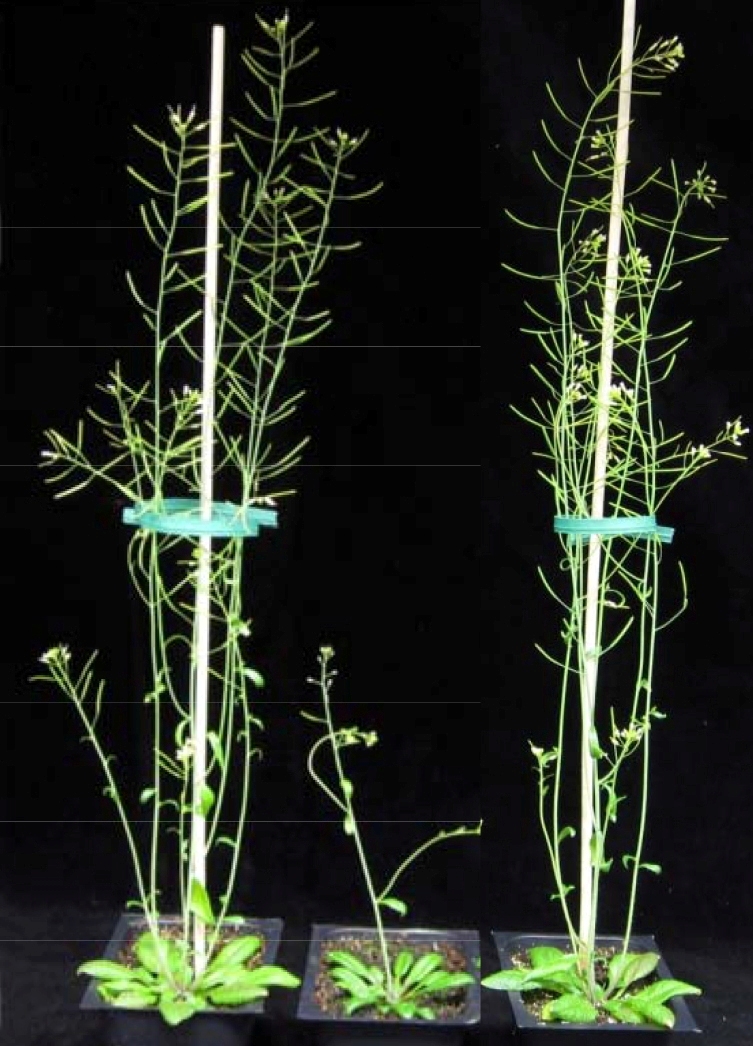
On the right is an Arabidopsis plant engineered to reduce the xylan content while preserving the structural integrity of its cell walls. It compares favorably to wild type plant on the far left. In the middle is a xylan-deficient mutant.
Researchers at the U.S. Department of Energy (DOE)’s Joint BioEnergy Institute (JBEI) are using the tools of synthetic biology to beat this double-edged sword into plowshares. In one study, they engineered plants with more extractable xylan. Now they have engineered plants with low xylan content and a higher proportion of cellulose in the biomass.
“We’ve shown that it is possible to obtain plants that have reduced amounts of xylan in their cell walls while still preserving the structural integrity of the xylem vessels that the plants use for nutrient transport,” says Henrik Scheller, who heads JBEI’s Feedstocks Division and directs its Cell Wall Biosynthesis group, and also holds an appointment with Berkeley Lab.
Working with the model plant, Arabidopsis, as a demonstration tool, Scheller and his collaborators used three mutant lines known to be xylan-deficient to engineer plants with up to 23-percent reduced levels of xylan compared to wild type plants. In addition, following a hot water pre-treatment the engineered plants also realized a 42-percent increase in saccharification yield – the breakdown of carbohydrates into fermentable sugars that is key to more efficient production of advanced biofuels.
“We’ve shown that spatial and temporal deposition of xylan in the secondary cell wall ofArabidopsis can be manipulated by using the promoter regions of vessel-specific genes to express xylan biosynthetic genes,” Scheller says. “This engineering approach has the potential to yield future bioenergy crop plants that are more easily deconstructed and fermented into biofuels.”
Working with Scheller on this research were Pia Damm Petersen, Jane Lau, Berit Ebert, Fan Yang, Yves Verhertbruggen, Jin Sun Kim, Patanjali Varanasi, Anongpat Suttangkakul, Manfred Auer and Dominique Loqué.
Additional Information
A paper describing this work appeared in the open-access journal Biotechnology for Biofuels. The paper is titled “Engineering of plants with improved properties as biofuels feedstocks by vessel-specific complementation of xylan biosynthesis mutants.” It can be downloaded here
Subscribe to:
Posts (Atom)