Search This Blog

Showing posts with label thermal. Show all posts

Tuesday, May 8, 2012

New 3U VPX Single Board Computer from GE Improves Throughput While Reducing Thermal Footprint

Press release:

08 May 2012
New 3U VPX Single Board Computer from GE Improves Throughput While Reducing Thermal Footprint
 

  • SBC325 takes advantage of new3rd Generation Intel® Core™ quad core processor technology
  • x16 PCI Express® GPGPU connectivity allows development of High Performance Embedded Computing (HPEC) applications
  • Cost-effective upgrade path for existing users

HUNTSVILLE, AL — May 8, 2012— GE Intelligent Platforms today announced a new rugged single board computer (SBC) based on the latest 3rd Generation Intel® Core™ quad core processor technology. The SBC325 brings substantially increased processing performance to customers using the 3U VPX form factor to develop and deploy demanding industrial and mil/aero applications such as command/control, ISR (intelligence, surveillance, reconnaissance), radar/sonar and signal processing.

3rd Generation Intel Core processors not only offer enhanced performance per watt but can also maintain full performance at more elevated temperatures than the previous generation – offering an opportunity for the development of new capabilities in small form factor applications.

Provision of either a mezzanine XMC/PMC site for optimum flexibility and expandability or a quad fat-pipe (x16 PCI Express®) for highest performance connectivity to GPGPUs makes the SBC325 an exceptionally versatile platform suitable for a wide range of High Performance Embedded Computing (HPEC) applications.

“Many of our customers are working on demanding applications that are highly constrained in terms of size, weight and power – and the 3U VPX SBC325 provides an outstanding solution,” said Rod Rice, General Manager, Military & Aerospace Products, GE Intelligent Platforms. “The improved thermal performance of the new Intel processor helps to deliver improved response times and throughput and reduce the thermal footprint of a solution - or reduce the number of boards required in a system, minimizing its size and weight.”

The new OpenVPX platform – which is 100% compatible with the previous two generations in GE’s 3U VPXcel3 family - makes for a cost-effective, straightforward upgrade path for existing users.

The SBC325 is available in five build levels, from benign (air cooled) to fully rugged (conduction cooled) to provide customers with optimum price/performance.

The SBC325 is offered initially with the 2.1GHz Intel Core i7-3612QE processor featuring Intel Advanced Vector Extensions (Intel AVX), up to 8GBytes of DDR3 memory and a solid state disk drive of up to 32GBytes capacity. These enhanced capabilities are complemented by a broad range of I/O options including Gigabit Ethernet, SATA, USB and audio.

Supported operating systems include Windows® 7, Open Linux®, Wind River Linux and VxWorks®.
About GE
GE (NYSE: GE) works on things that matter. The best people and the best technologies taking on the toughest challenges. Finding solutions in energy, health and home, transportation and finance. Building, powering, moving and curing the world. Not just imagining. Doing. GE works. For more information, visit the company's website at www.ge.com.
###

Monday, March 26, 2012

GE’s Jenbacher Cogeneration Technology Set to Power Urban District Energy Project in Melbourne

26 March 2012
GE’s Jenbacher Cogeneration Technology Set to Power Urban District Energy Project in Melbourne
 

  • 2-Megawatt (MW) Jenbacher Unit to Help Cogent Energy Supply Power, Heat and Cooling for Dandenong Commercial District
  • Cogeneration Plant Could be Expanded Up to 6 MW to Meet Melbourne’s Growing Energy Needs

MELBOURNE, AUSTRALIA—March 26, 2012—One of GE’s (NYSE: GE) natural gas-fired Jenbacher gas engines will be powering a cogeneration plant that will provide reliable electricity and thermal energy for a major urban revitalization initiative in Dandenong, Victoria. Built by Cogent Energy, the plant will play a pivotal role in the VicUrban-lead Revitalising Central Dandenong (RCD) initiative that is rejuvenating the south-east region of Melbourne.
The collaboration marks GE’s first urban district energy project in Australia.Clarke Energy Australia, GE’s authorized distributor for Jenbacher gas engines in Australia, will supply project owner Cogent Energy with a 2-MW,J612 Jenbacher cogeneration unit for Phase 1 of the new power facility, which could be expanded to 6 MW.
GE’s ecomagination-qualified Jenbacher system was shipped to the Dandenong site in January, with commercial operation set to begin this year. The gas engine is expected to save the equivalent of about 9,900 tons of carbon emissions a year, which equals the removal of more than 5,500 cars from the road.
The cogeneration plant is set to dramatically reduce the emissions and energy use of the Dandedong Commercial District by reducing its reliance on energy from the grid. The plant also will have the capacity to produce surplus hot water, which Cogent Energy will then sell back to local commercial buildings to provide cooling via building owner-supplied absorption chillers.
“Helping central Dandenong transform itself into a vibrant, 21st century retail and services district will require a reliable, cleaner, cost-effective supply of energy to meet the growing needs of the area’s business and residential communities,” said Blair Healy, manager of Cogent Energy. “GE’s Jenbacher technology offers the optimal energy efficiency we required to make this project successful.”
“Australia represents an important growth region for GE as more customers embrace various distributed power applications—including industrial cogeneration—to bring the sources of energy production closer to end-users,” said Rafael Santana, CEO and president—Gas Engines for GE Energy.
GE is helping customers worldwide to generate reliable on-site electricity and heat at or near the point of use through its comprehensive suite of distributed power solutions ranging in size from 119 kilowatts to 100 MW. The fuel flexibility of GE’s Jenbacher gas engines and its other distributed energy technologies also promotes greater regional energy and economic security by enabling countries to use more of their own energy resources to meet their domestic needs.
The Dandenong project builds on GE’s commitment to supporting Australia’s energy goals. The company’s involvement in Australia dates back to 1902 when GE installed one of the electric motors in Sydney to open the Pyrmont Bridge over Darling Harbour.
More recently, in September 2011, GE announced it would supply an integrated solution of on-site power and water filtration equipment to a consortium that is building a water treatment plant on behalf of Australian coal seam gas company QGC. The project, located at QGC’s Kenya site near Chinchilla in Queensland, integrates GE’s Jenbacher and Waukesha gas engines for the first time. The units will generate on-site power for GE’s advanced membrane and thermal water treatment technologies that will desalinate water produced during the extraction of coal seam gas.
GE’s Jenbacher gas engines are designed to run soley on a variety of gases, which results in high levels of generator efficiency, reliability and environmental performance.
Many of GE’s Jenbacher products are ecomagination-qualified, providing customers with products that improve their operating performance and reduce environmental impact. Ecomagination is GE’s business strategy to help meet customers’ demand for products that improve their bottom line and reduce their impact on the environment. Ecomagination reflects GE’s commitment to invest in a future that creates innovative solutions to environmental challenges.
About GE
GE (NYSE: GE) works on things that matter. The best people and the best technologies taking on the toughest challenges. Finding solutions in energy, health and home, transportation and finance. Building, powering, moving and curing the world. Not just imagining. Doing. GE works. For more information, visit the company's website at www.ge.com.
GE Energy works connecting people and ideas everywhere to create advanced technologies for powering a cleaner, more productive world. With more than 100,000 employees in over 100 countries, our diverse portfolio of product and service solutions and deep industry expertise help our customers solve their challenges locally. We serve the energy sector with technologies in such areas as natural gas, oil, coal and nuclear energy; wind, solar, biogas and water processing; energy management; and grid modernization. We also offer integrated solutions to serve energy- and water-intensive industries such as mining, metals, marine, petrochemical, food & beverage and unconventional fuels.
Follow GE Energy on Twitter @GE_Energy.

Tuesday, February 14, 2012

Thermal Storage Gets More Solar on the Grid

From the National Renewable Energy Laboratory (NREL):


Thermal Storage Gets More Solar on the Grid

February 14, 2012

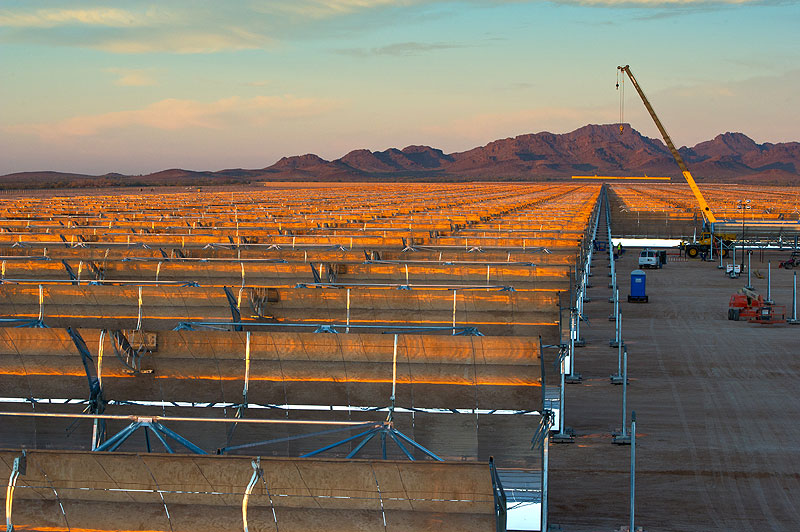
This photo taken at dusk shows gleaming rows of mirrors in front of darkening desert mountains. Enlarge image
Abengoa is erecting more than 3,200 mirrored parabolic troughs at its Solana plant near Gila Bend, Ariz. When at full operation, the CSP plant will serve more than 70,000 homes.
Credit: Dennis Schroeder

It's 4:45 on a sweltering August afternoon, and the rooftop solar panels are starting to lose juice. The sun's lower angles and that huge cottonwood tree are interfering with the efficient photon-to-electricity transfer.
What is an environmentally conscious — but air-conditioning-loving — homeowner to do?

Peak demand for electricity in the United States typically hits between 4 p.m. and 8 p.m., which doesn't quite line up with the sun's schedule. It's fortunate that the sun is high in the sky during many of the hours when the air conditioning is in demand. But in summer, people tend to need air conditioning during the dinner hour and beyond, when kitchen appliances are whirring, lights are on, and TVs are blaring.

To the rescue comes concentrating solar power (CSP), a technology being tested and deployed by utilities in America's deserts and southern Spain.

New analysis at the U.S. Department of Energy's (DOE) National Renewable Energy Laboratory (NREL) has found that CSP, with its greater grid flexibility and ability to store energy for as long as 15 hours, can enhance total solar power generation and actually give photovoltaic (PV) systems a greater presence on the grid.

PV panels convert photons from the sun directly into electrons for electricity — and are grabbing real estate on rooftops across the Americas, Europe, and Asia.

CSP technologies use mirrors to reflect and concentrate sunlight onto receivers that collect the sun's heat. This thermal energy can then be used to drive a steam turbine that produces electricity for utilities.

Thermal Storage Can Even Out the Bumps

In this photo, mirrors in the foreground gleam orange from the sun, while mountains dominate the background. Enlarge image
Crews work around the clock installing mirrored parabolic trough collectors — built on site — that will cover 3 square miles at Abengoa's Solana Plant. When finished, the plant will generate 280 megawatts of clean, sustainable power.
Credit: Dennis Schroeder

Like Edison and Tesla or Dempsey and Tunney, the two major solar energy technologies never meant to play nice. Each had its niche — and its dreams of market share.

But that's changing, said NREL analyst Paul Denholm, co-author with Mark Mehos of the study "Enabling Greater Penetration of Solar Power via Use of CSP with Thermal Energy StoragePDF."

Think of power from PV as a roller coaster of highs and lows, and power from CSP, via thermal energy storage, as a gently rolling train.

PV panels and wind turbines contribute electricity to the grid, but without the ability to store that power, they cannot supply the grid after the sun sets, or after the wind dies. Even passing clouds can cause drops in the amount of solar energy that gets on the grid.

Large fossil-fueled and nuclear power plants can't be quickly stopped or started to accommodate variable energy sources such as solar and wind energy.

CSP can even out these ebbs and flows because it can store power and ramp up output when the amount of direct wind or solar power drops.

Grid Flexibility is the Key

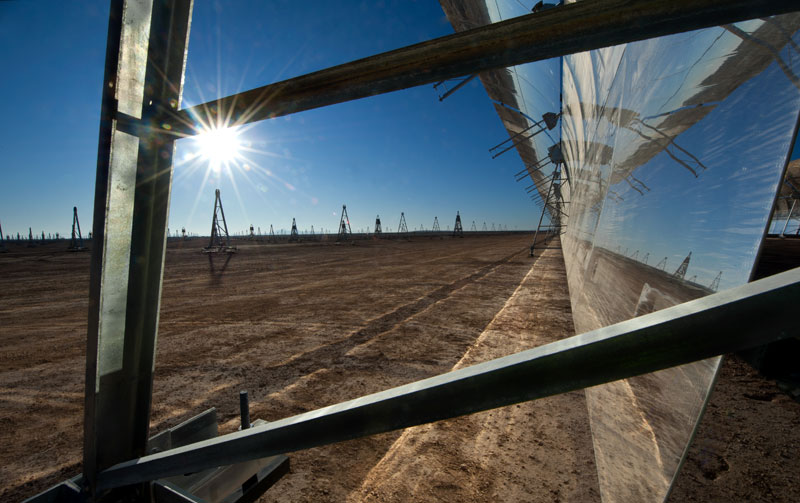
This photo is a close-up of one mirror and its supporting beams, with the sun gleaming above one of the cross beams. In the background are other structures on the Solana Plant and the mountains further back. Enlarge image
Light is reflected in a 25-foot-wide, 500-foot-long, and 10-foot-high parabolic trough collector at Abengoa's Solana Plant.
Credit: Dennis Schroeder

"It all gets down to grid flexibility," Denholm said. "What sets of grid technologies do you deploy to make the grid respond faster and over a greater range to the input of variable energy such as solar and wind?

"If you can't respond quickly, you end up potentially throwing away wind and solar energy.

"We know that the more wind and solar you add to the grid, the harder it is to balance the grid and maintain reliability."

A CSP plant works by heating a heat transfer fluid that is used to boil water to make steam. But because of thermal inertia, by the time that fluid gets through the system's pipes to the power plant, perhaps 10 or 15 minutes have passed.

When a cloud passes over a PV panel, the drop in energy production is immediate. But because of the 10 or 15 minutes of thermal inertia, a cloud passing over a CSP tower doesn't cause this immediate drop. Nor is there the immediate surge when sunlight returns.

"The change is more gradual," Denholm said. "That's one reason CSP can bring a greater quality to the grid."

Still, the greater potential for CSP — and for CSP helping PV to expand its role on the grid — is its capacity to store the energy it captures from the sun for several hours, making it a source of reliable energy after the sun sets.

"CSP can fill in that gap in the evening when there's peak demand for electricity," Denholm said. "Together, the solar resource can provide all that peak demand. And together they can reduce or eliminate the need to build new power plants for those peak periods."

Molten Salts a Low-Cost Solution

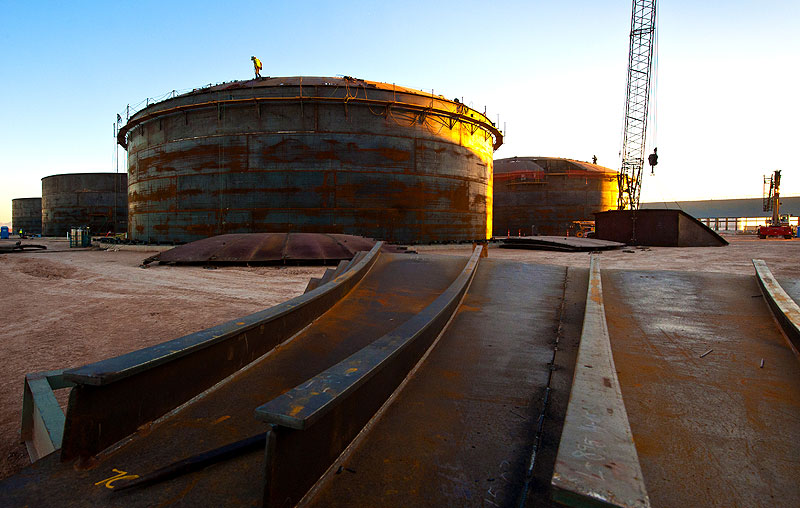
This photo shows a squat, cylindrical tank dwarfing the men working on its roof, with a crane and another tank in the background, and steel construction beams in the foreground. Enlarge image
The tanks that hold the molten salts at Abengoa's Solana Plant are enormous. The salts can keep the solar-heated fluids very hot for several hours, so they can be transferred to turbines to produce electricity even when the sun isn't shining.
Credit: Dennis Schroeder

Thermal energy storage at CSP plants "is low-cost because it's not exotic," Denholm said. "It's some large tanks with some media to store energy before you use it to boil the water." The best medium for storage available today is molten salt, NREL's Greg Glatzmaier said.

Molten salts are abundant and not very costly. They behave themselves, neither decomposing nor volatizing at the high temperature needed in a CSP plant — about 565 degrees Celsius (°C).

At a typical molten-salt CSP plant, the salts are stored in two tanks, one much hotter than the other.
In the case of a power tower CSP plant, in which the mirrors focus the sun's rays on one receiver atop a tower, the lower-temperature tank is at about 293°C, while the higher-temperature tank is at 565°C, Glatzmaier said.

The salt is pumped from the "cold" tank to the power tower, where it collects the solar energy that's focused on the receiver, raising its average temperature. The salts then descend into the "hot" tank, where they can maintain this very hot temperature for several days, though typically they are used within hours.

The salt in the hot tank is then sent to a heat exchanger that generates the steam needed to turn the turbines at a power plant. The turbines generate electricity that goes to homes and businesses.

As they exit the steam generator, the salts cool, and by the time they return to the cold tank, they measure at about 293°C.

When the sun is shining, the CSP plant can take the salts out of the cold tank, heat them up at the tower's receiver, and then dump them into the hot tank for storage, Glatzmaier said. "If you come to the end of the day and the hot tank is pretty full, you can keep generating electricity by withdrawing the salts from the hot tank to generate steam."

It's a continual balancing act. If all the salt is in the cold tank, no stored energy is available. If it's all in the hot tank, there's plenty of energy stored for later use, but nothing to replenish the system.

Molten salts tend to freeze at about 200°C, so as long as the two tanks range between 293°C and 565°C, the salts are in no danger of reverting to a solid state. At room temperature, the salts look like powdery white table salt. At the higher temperatures in a CSP plant, the salts look like water.

The molten salts used for storage are a mix of sodium nitrate and potassium nitrate. Sodium nitrate is mined from dry lake beds in Chile, in surroundings similar to the Utah salt flats. Potassium nitrate also occurs in nature and is mined in Chile, Ethiopia, and elsewhere.

Plants with Storage in Spain, Nevada, Arizona, California

Abengoa Solar is building a 250-megawatt CSP plant near Gila Bend, Ariz., that will cover 1,900 acres and use 900,000 mirrors to direct sunlight to heat a working fluid inside its tubes. The plant's six hours of thermal storage mean it can deliver electricity after the sun sets to approximately 70,000 homes.

The 19.9-megawatt power tower run by Gemasolar near Granada in southern Spain is configured to store enough energy during the summer to provide solar-generated electricity 24 hours a day, Glatzmaier said. In the winter, when there's less sunshine, electricity comes from more conventional sources a few hours each day. The system aims to power 25,000 homes and reduce carbon dioxide emissions by more than 30,000 tons a year.

SolarReserve is building the 110-megawatt Crescent Dunes Solar Energy Project near Tonopah, Nev., which will use molten salt to store the sun's energy as heat for several hours. It will include more than 17,000 mirrors to focus the sun's light on a tower 640 feet high.

BrightSource is building an even larger CSP project in the Mojave Desert near Needles, Calif., that will have storage for just a couple of hours a day — but this will be enough to serve more than 140,000 homes during peak hours. Company executives say the plant will reduce carbon dioxide emissions by more than 400,000 tons per year.

PV/CSP Symbiosis Makes Economic Sense

The cost of PV has been plummeting, and it has a cost advantage over CSP. But CSP has the advantage of storage, and so teamed with PV can improve the benefits and bottom lines of both technologies. Storage does raise the price of a CSP plant, but "if you're running your turbine more hours in a day, you're amortizing your turbine cost over more generation time, and there's a real cost benefit there," Glatzmaier said. The bottom line: when storage is added to a CSP plant, it increases the value of its electricity — both its energy value and its capacity value.

Solar plants also can store energy in batteries, but at least for now, that approach is quite expensive. Other thermal storage technologies being investigated by researchers include phase-change or thermal-chemical storage.


Denholm and Mehos caution that the preliminary analysis in their study will require more advanced grid simulations to verify the actual ability of CSP to help wind and PV gain a larger presence on the grid. An important next step, they say, would be more complete simulations using utility-grade software. That will answer questions on the realistic performance of the generation fleet, transmission constraints, and actual CSP operations.

Learn more about NREL's solar energy research and analysis.
— Bill Scanlon


Tuesday, January 17, 2012

New Thermal Window Technology

U.S. Dept of Energy blog post:


Hit the Road, Jack! New Thermal Window Technology Lessens Menace of Jack Frost

January 17, 2012


The frost patterns on your window might be pretty, but they're not helping you save any energy. Energy efficient windows provide an effective barrier from inclement weather. | Photo courtesy of <a href="http://www.flickr.com/photos/machineisorganic/4174555202/"> Callie Reed</a>. The frost patterns on your window might be pretty, but they're not helping you save any energy. Energy efficient windows provide an effective barrier from inclement weather. | Photo courtesy of Callie Reed.
Say what you want about the joys of Jack Frost nipping at your nose, but when it comes to winter wonderlands, I like mine outdoors. Etching icy messages on the insides of my windows is not exactly cozy. Therefore, I'm thankful for technology that provides an efficient and effective barrier from inclement weather.

Traco, a division of Kawneer and window manufacturer since the early 1940s, recently partnered with the Energy Department’s Office of Energy Efficiency and Renewable Energy to utilize funds from the Recovery Act to develop new window technology. These OptiQ™ Ultra Thermal Windows can reduce energy loss by up to 40 percent compared to the efficient, commercially available double-pane low-emissivity windows that are already on the market.

Each year, windows account for an estimated 4 quadrillion Btu of energy lost in U.S. buildings, totaling over $35 billion in heating and air conditioning costs. Future window systems like the OptiQ™ Ultra Thermal Windows will eventually outperform the best-insulated walls or roofs in terms of annual energy performance, peak demand reduction, and costs. This new innovation holds promise to boost both savings and comfort.

What makes these new energy efficient windows really innovative is that they include a thermally optimized frame design, enhanced frame cavities, wider thermal breaks, and high performance glazing. The combination of these and other technologies has allowed an aluminum framed window to achieve more energy savings than ever before, all while maintaining its structural integrity. Also, these windows stand up to moisture and exposure, making them good fits for many applications, such as hospitals and schools, because they won't rot or get moldy.

The fact that windows like these are available today gives me a warm feeling about the advances the industry is making. This innovation brings us closer to meeting the Department’s goal of improving the energy performance of windows by 60 percent by 2020 -- all while keeping Mr. Frost outside.

Tuesday, January 3, 2012

Building Storehouses for the Sun's Energy, for Use After Dark

The following was gleaned from a January 3 New York Times article with the above title.


Building Storehouses for the Sun’s Energy, for Use After Dark

The solar power industry must overcome a major stumbling block: finding a way to store it for use when the sun isn’t shining.

Solar thermal power makes electricity by using the sun’s heat to boil water. The water can be used to heat salt that stores the energy until later, when the sun is no longer shining.

The U.S. Energy Department recently gave a $737 million loan guarantee to a solar thermal company for a plant that will generate 110 megawatts at peak and store enough heat to run for eight to 10 hours when the sun is not shining.

One advantage of adding storage capacity has to do with the equipment that makes electricity being the most expensive part of a solar thermal system.  If it is connected to storage technology, it can run almost twice as many hours as a plant without storage. That means the unit cost of electricity drops.

Another has to do with the arcane economics of electricity. A utility must assure a supply of electricity in two forms: energy and capacity. The difference has never meant much to most consumers, who directly pay only for energy, as measured in kilowatt-hours.

But capacity, the dependable ability to produce power, is becoming more important as renewable energy forms a larger and larger part of the grid.

Wind and sun provide a lot of energy but not much capacity. Today, backup capacity for wind and solar power comes in the form of expensive gas-fired generators, which sit idle most of the year but operate when the wind stops blowing or the sun stops shining.

Storage could cut costs by 4 cents a kilowatt-hour, Mr. Denholm calculates — a considerable benefit for a commodity that retails for an average of 11 cents. A big part of the savings is not having to build the gas-fired generators for backup.