Search This Blog

Wednesday, May 14, 2014

Boeing, Embraer to Open Joint Research Center for Sustainable Aviation Biofuel - May 12, 2014

SAO PAULOMay 12, 2014 /PRNewswire/ -- Boeing [NYSE: BA] and Embraer S.A. (BM&F Bovespa: EMBR3, NYSE: ERJ) today announced that they will open a joint research center to advance a sustainable aviation biofuel industry in Brazil.
Under a memorandum of understanding, the two companies will perform joint biofuel research, as well as fund and coordinate research with Brazilian universities and other institutions. The research will focus on technologies that address gaps in a supply chain for sustainable aviation biofuel in Brazil, such as feedstock production and processing technologies. The companies' biofuel research center will be located in Sao Jose dos Campos Technology Park.


Boeing, Embraer to Open Joint Research Center for Sustainable Aviation Biofuel - May 12, 2014

Tuesday, May 13, 2014

NREL Hosts Race to Zero-Energy Homes

NREL News Release:

NREL Hosts Race to Zero-Energy Homes

May 12, 2014
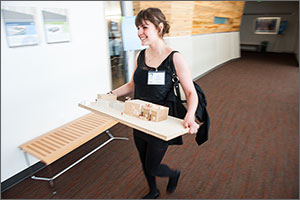
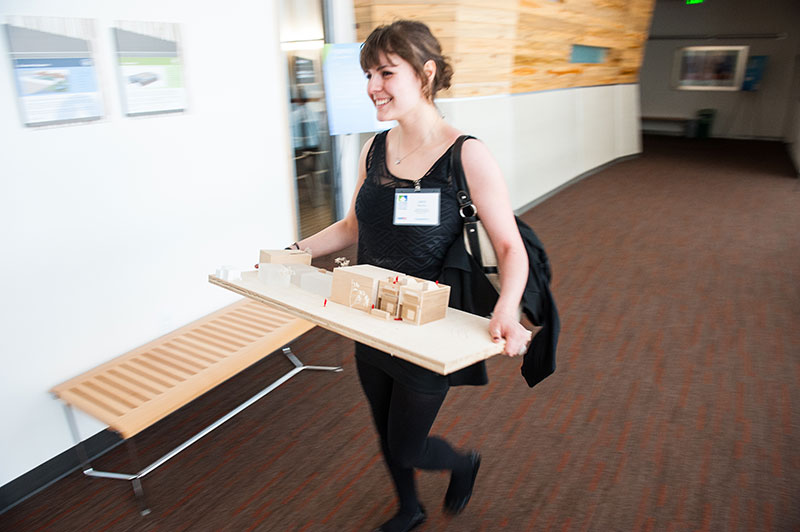
Photo of a young woman holding a home model.Enlarge image
Anya Barmina with the Utah Lab House team from the University of Utah School of Architecture carries her team's model to the next round of judging.
Photo by Dennis Schroeder, NREL
The campus of the Energy Department's National Renewable Energy Laboratory (NREL) sprang to life on a late April weekend as 28 teams of university students and building industry experts converged at the lab for the Challenge Home Student Design Competition.
During the inaugural competition, funded by the Energy Department's Building Technologies Office, teams of students presented their zero-energy-ready home design and construction plans to juries of national experts including the leading high-performance builders in the industry, building science professionals, and researchers.
"Buildings are critically important when it comes to reducing U.S. energy use, as they represent more than 70% of our electricity consumption and about 40% of our carbon emissions," said NREL Center Director for Buildings and Thermal Systems Chuck Kutscher. "How we build in the future will determine how successful we are at addressing climate change. NREL is very pleased to host and support this design competition because it is a way for students to learn the techniques and strategies that will be necessary to make sure that the buildings of the future get designed and built properly."

Preparing the Sustainable Building Leaders of the Future
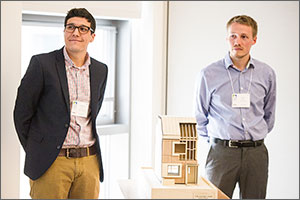
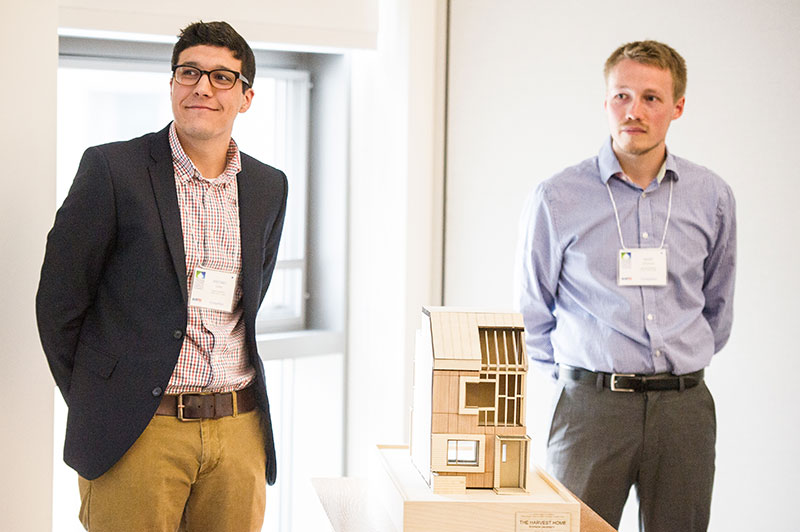
Photo of two men standing with a small-scale model home.Enlarge image
Antonio Cunha and Mark Grimsrud present a model of the design by the Urban Harvest team from Ryerson University in Toronto, Ontario.
Photo by Dennis Schroeder, NREL
The Challenge Home Student Design Competition aims to inspire the next generation of architects, engineers, and construction managers to be able to design and construct zero-energy-ready homes that are affordable and market ready. Each team included students and their faculty advisors. Teams were encouraged to be multidisciplinary in makeup and to work as closely as possible with industry professionals to help inform their decision-making process.
On the Energy.gov blog, Chief Architect for the Building Technologies Office Sam Rashkin noted: "Each year, thousands of college and university students major in construction-related fields, including architecture, engineering, and construction management. These students enter into a competitive workforce that is increasingly demanding advanced knowledge and skills essential to delivering high-performance homes and buildings.
"The Challenge Home Student Design Competition will provide students with the skills and experience to start careers in clean energy and make them leaders in the movement to create truly sustainable homes."
Student teams were asked to develop cost-effective designs that mainstream homebuilders can start using and homebuyers can start buying today.
"As an engineer in this field, I only wish that there had been a program like this available to me when I was a student," said NREL Residential Buildings Research and Outreach Coordinator Cheryn Metzger. "The team concept has them working on a project, with different disciplines collaborating just as they will in the real world, all while working closely with experienced industry partners to help guide them through the process. The experience and knowledge gained by these students through their participation is priceless."

And the Winners Are
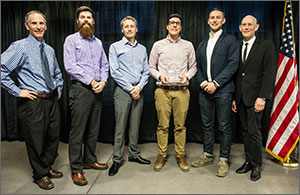
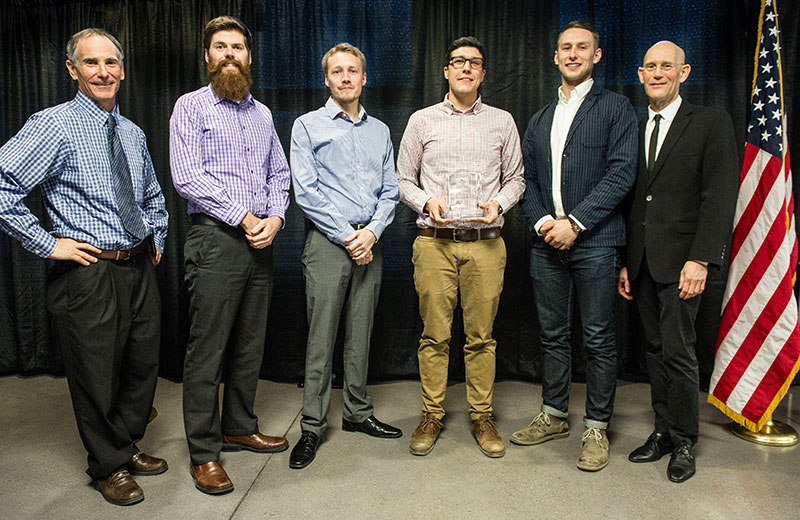
Photo of the six men, including the winning Urban Harvest team from Ryerson University.Enlarge image
Ryerson University's Urban Harvest team won one of two Grand Awards at the Challenge Home Student Design Competition. Left to right: the Energy Department's Sam Rashkin; Ryerson's Patrick Andres, Mark Grimsrud, Antonio Cunha, and Matthew Tokarik; and Thomas Kenney of Home Innovation Research Labs.
Photo by Dennis Schroeder, NREL
The team design presentations were followed by intense deliberation by the jurors. The industry experts judging the competition then presented two Grand Awards to the best overall designs.
The first award was given to the Montage Builders Northern Forest team. Montage Builders was a collaborative effort of students from three Syracuse, New York, area schools: Onondaga Community College, SUNY College of Environmental Science, and Syracuse University.
The Montage team developed an adaptable and accessible craftsman-style single-family detached home that embodied responsible development. The team demonstrated leadership in the sustainable redevelopment of a community in Syracuse by presenting an affordable design based on the median family household income for the area.
"We had an amazing experience participating in this competition," said team member Michelle Tinner, a graduate student in Sustainable Construction Management at SUNY College of Environmental Science. "It was a unique collaboration, building a team with diverse backgrounds from three different schools. But it was that diversity of experience and perspective that was the key to our success."
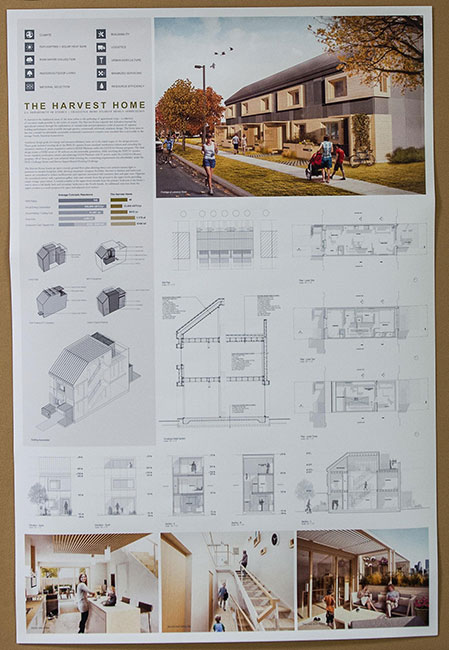
The Urban Harvest team from Ryerson University in Toronto, Ontario, was presented with the second Grand Award. The team developed a high-performance single-family attached townhome design that would fit well in any urban environment. The team addressed every aspect of the design requirements and integrated all systems artfully and effectively.
The Urban Harvest design was also recently selected to be a part of the Denver Super-Efficient Housing Challenge, and boasts a 90% reduction in annual energy consumption compared to an average Colorado residence. The design—along with homes by four other Challenge Home Student Design Competition teams—is slated to be constructed at the Denver Sustainability Park in Denver's Curtis Park neighborhood in late 2014.
"The opportunity to do this design in a real-world environment, on a building that is likely to actually be built, was an invaluable experience for us," said team member Antonio Cunha, a graduate student in Ryerson's Department of Architectural Science. "In academia, most projects stay in the conceptual realm and never progress beyond a poster or a model. This process required us to apply what we have learned in the classroom with a much more realistic approach where we had to consider the same challenges and implications that we will use throughout our careers."
In addition to the two Grand Awards, the judges presented 12 subject area awards as well as technical awards recognizing teams for best design solution, best technical integration, best production home adaptation, and best presentation.

More Than Just a Competition
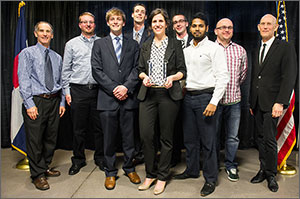
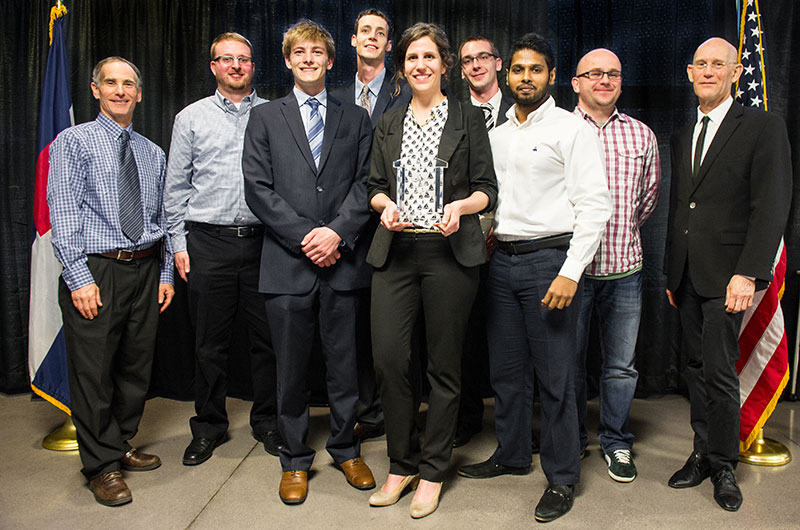
Photo of eight men and one woman, including the winning Montage Builders Northern Forest team.Enlarge image
The Montage Builders Northern Forest team from SUNY College of Environmental Science, Syracuse University, and Onondaga Community College also won a Grand Award at the Challenge Home Student Design Competition. Left to right: the Energy Department's Sam Rashkin; team members Brent Crump, Peter LiCongo, Andrew Kenneally, Michelle Tinner, David Wallace, Aamika Korale, and Jacek Bartczak; and Thomas Kenney of Home Innovation Research Labs.
Photo by Dennis Schroeder, NREL
A critical goal of the Challenge Home Student Design Competition is to facilitate the creation of a strong future workforce that can support the development of, and demand for, zero-energy-ready homes. To that end, students were provided with an opportunity to hear from industry thought leaders who presented their visions for the future of sustainable housing along with a series of technical presentations critical to advancing the students' knowledge of high-performance home design, engineering, and construction.
"This is the future of our industry," said Gene Myers, CEO of New Town Builders, a Denver-based builder of energy-efficient homes who served as a juror for the competition and also presented to the students. "It is important that we make this effort to develop a qualified workforce for the building industry. We need to nurture students who choose to engage in this topic, support the institutions that have made that possible, and encourage others to follow suit. A program such as this one is a great step in that direction."
The full attention and engaged participation of the students throughout the program indicated that their thirst for more knowledge continued even after having completed their designs and presentations.
"We may end up knowing more than our future employers do about green building design as a result of going through this process and the information we are receiving," said participant Martha Merzig, a graduate student in Integrated Design and Construction at Auburn University. "It's an exciting thing to be equipped with that knowledge at such an early stage in our careers, and I have high hopes for what we are going to be able to do with it going forward into the future."

NREL Provided a Perfect Setting
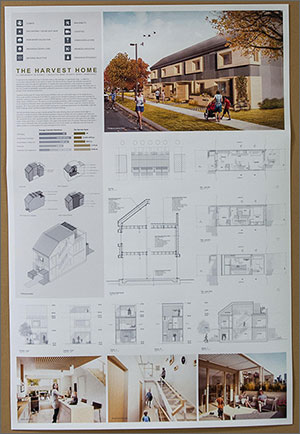
Photo of a poster showing a single-family attached townhome design. Enlarge image
The Urban Harvest team from Ryerson University in Toronto, Ontario, developed a high-performance single-family attached townhome design that would fit well in any urban environment.
Photo by Dennis Schroeder, NREL
The student teams had the opportunity to present their concepts for zero-energy-ready homes inside the award-winning LEED Platinum and net-zero-energy Research Support Facility on NREL's sustainable campus. And they were supported by the world-class staff from NREL's buildings research teams who have dedicated their careers to energy-efficient and zero-energy buildings. This synergy provided an ideal backdrop for the competition, one that provided inspiration and motivation to the students and staff alike.
"Our campus is a showcase for the right way to build buildings, and there's no other place where we could have held this competition and have the students be as engaged as they have been here," said Metzger. "They've gotten to see this type of design in action, and their interest is piqued even further by that opportunity. They are truly excited to have the chance to be here."
While developing and preparing their designs, the student teams regularly used research published by the laboratory as well as NREL-developed tools. This connection further demonstrated the synergistic relationship between the work of the students in this competition and the buildings research being done at NREL.
"We've got huge energy challenges in front of us, and it is a great opportunity to be able to engage directly with the next generation who will be tasked with helping us to innovate the future solutions to those challenges," said NREL Senior Engineer for Residential Buildings Dane Christensen. "Hosting this event gave us the chance to show off the work that we are doing here, work that we are very proud of, and it also gave us an opportunity to hear from the students and see the very talented work that they are doing. It was very exciting to be able to witness their passion, dedication, and skill firsthand."
Learn more about NREL's Buildings Research.
— David Glickson

Monday, May 12, 2014

NREL Announces Participants in National Executive Education Program

NREL News Release:

NREL Announces Participants in National Executive Education Program


Monday, May 12, 2014

The Energy Department's National Renewable Energy Laboratory (NREL) has selected 17 leaders to participate in its 2014 Executive Energy Leadership program (Energy Execs), which empowers executives to integrate clean energy solutions in their communities.

The five-month program offers executive decision-makers from throughout the U.S. an in-depth look at renewable energy and energy efficiency technologies. As part of the experience, participants receive briefings by NREL technology experts, research laboratory tours and visits to renewable energy installations.

"The continued transformation of our current energy system to one that is more sustainable will require informed decision-makers who are leading the way," NREL Director Dan Arvizu said. "We are pleased to welcome these business, community and government leaders so they can understand the implications of their energy decisions and demonstrate leadership for the long-term clean energy economy.

At the conclusion of the program, participants will present a viable clean energy project. Since its inception, more than 200 representatives of industry, government and non-profit organizations have completed the Energy Execs program, delivered through the Executive Energy Leadership Academy. For more information, visit http://www.nrel.gov/energyexecs/.

NREL is the U.S. Department of Energy's primary national laboratory for renewable energy and energy efficiency research and development. NREL is operated for DOE by The Alliance for Sustainable Energy, LLC.
Editors please note: A complete list of 2014's Energy Execs participants follows.

National Renewable Energy Laboratory
2014 Executive Energy Leadership Program Participants

Gary "Bernie" Bernfeld – City of Austin Electric Utility Commission
Drew Bolin – Colorado Public Utilities Commission
Meredith Brooks – FirmGreen, Inc.
John David Canney – Associated Landscape Contractors of Colorado
Sean Conboy – Vail Resorts
Elyse Hottel – City of Boulder
Ward Lenz – Advanced Energy
Nellis Kennedy-Howard – Sierra Club
Adam Knoff – Unico Properties, LLC
Zuhair Mased – University of California, Merced
Anthony Molinaro, Jr. – Allen & Shariff Engineering, LLC
Michael O'Malley – Xcel Energy
Deborah Ortega – Denver City Council
Laura Richardson – The Jordan Institute
Anturuan Stallworth – Atlantic Coast Energy Corporation
Penny Whitney – Rocky Mountain Technology Alliance
Christopher Worley – Colorado Energy Office

###

USDA Blog » Rural Electric Cooperatives: Leaders in Renewable Energy

America’s rural electric cooperatives provide electricity to more than 42 million people living and working in rural communities across the country. Co-ops, with support from USDA, have embraced renewable energy production. Today, they deepened that commitment by announcing new solar projects that will generate more than 150 megawatts of new solar capacity by 2020.
At an event in California, President Obama was joined by two West Coast industry leaders—Plumas-Sierra Rural Electric Cooperative (PSREC) based in Portola, California, and Okanogan County Electric Cooperative (OCEC), based in the state of Washington—to highlight industry efforts to expand renewable energy production.


USDA Blog » Rural Electric Cooperatives: Leaders in Renewable Energy

Sunday, May 11, 2014

Solar panels return to the W.H. - Alex Guillén - POLITICO.com

The solar panels are back on the White House roof.

Three decades after Ronald Reagan had Jimmy Carter’s solar panels tossed into the energy dustbin, the White House has finished putting sun-powered electricity back on top of the executive mansion in a small but symbolic gesture, according to the White House.


Read more: http://www.politico.com/story/2014/05/solar-panels-white-house-106516.html#ixzz31RROi9Hj


Solar panels return to the W.H. - Alex Guillén - POLITICO.com

Omega Selects GE's New 2.2-107 Brilliant Wind Turbine for 70-Megawatt Order in Brazil

GE Press Release:

Omega Selects GE's New 2.2-107 Brilliant Wind Turbine for 70-Megawatt Order in Brazil

  Share0 
 
LAS VEGAS---May 6, 2014---GE (NYSE: GE) today introduced the latest in its line of brilliant wind turbines with the 2.2-107 and announced an order of 32 turbines from Omega Energia in the Piaui region of Brazil. This is the first order for GE's 2.2-107 wind turbine, which was selected by Omega Energia in the A-5 Brazil energy auction on December 13, 2013.

The 2.2-107 machine is the latest in GE's line of brilliant wind turbines, which harness the power of theIndustrial Internet to analyze tens of thousands of data points every second, helping to manage wind's variability and provide smooth, predictable power. The turbine is an evolution of GE's 1.5-megawatt series of turbines and is well suited for Brazil's wind regime. As part of the contract, GE will provide the operations and maintenance on the 32 turbines for 10 years.

"The 2.2-107 wind turbine provides a 12 percent increase in capacity factor and a 33 percent increase in power output over GE's current offering while continuing to provide the reliability and efficiency of GE's wind turbines. We are thrilled to launch a new product again in Brazil," said Jean-Claude Robert, general manager of Latin America for GE's renewable energy business. "Today we have 1 gigawatt (GW) of wind projects installed in Brazil and 400 megawatts under construction. This new contract demonstrates that the industry recognizes our commitment to our customers and our outstanding execution capabilities in Brazil."

In 2013, 4.7 GW of wind were contracted in Brazil through the Brazil Energy Auction system, and GE secured contracts for more than 1 GW. GE also announced the installation of its 500th wind turbine in Brazil in September. These milestones complement the opening of GE's wind service centers andmanufacturing facilities to make 2013 a year of strong growth and expanded local presence for GE in Brazil.

GE has been in operation in Brazil since 1919 and today employs more than 8,500 people in the country. The company has operations throughout Brazil, including in Bahia, São Paulo, Minas Gerais and Rio de Janeiro. The local team uses GE's global expertise of engineers, field service technicians and logistics excellence to help provide the highest quality and strongest execution for its customers in Brazil.

About Omega

Omega is an independent investor, developer and operator of power assets in Brazil with the highest sustainability standards. The company operates power assets since 2010, has over 2,000 megawatts in hydro and wind developing projects and 11 contracted plants.

About GE

GE (NYSE: GE) works on things that matter. The best people and the best technologies taking on the toughest challenges. Finding solutions in energy, health and home, transportation and finance. Building, powering, moving and curing the world. Not just imagining. Doing. GE works. For more information, visit the company's website at www.ge.com.

About GE Power & Water

GE Power & Water provides customers with a broad array of power generation, energy delivery and water process technologies to solve their challenges locally. Power & Water works in all areas of the energy industry including renewable resources such as wind and solar; biogas and alternative fuels; and coal, oil, natural gas and nuclear energy. The business also develops advanced technologies to help solve the world's most complex challenges related to water availability and quality. Power & Water's six business units include Distributed Power, Nuclear Energy, Power Generation Products, Power Generation Services, Renewable Energy and Water & Process Technologies. Headquartered in Schenectady, N.Y., Power & Water is GE's largest industrial business.

Follow GE Power & Water and GE's renewables business on Twitter @GE_PowerWater and@GErenewables.

Tags

GE's Wind PowerUp* Technology Improving Output on More than 1,000 Units Worldwide

GE Press Release:

GE's Wind PowerUp* Technology Improving Output on More than 1,000 Units Worldwide

  Share0 
 
LAS VEGAS---May 6, 2014---Today, GE's (NYSE: GE) renewable energy business announces that itsWind PowerUp* platform has secured more than 1,000 units under contract to date. PowerUp, a GEPredictivity solution, is a customized software-enabled platform that allows wind farm operators to increase annual energy production (AEP) on their turbines by up to 5 percent, taking into account environmental conditions. A 5 percent increase in energy output translates to up to a 20 percent increase in profit per turbine.

"The industry's response to Wind PowerUp has been exciting to see over the past seven months," said Anne McEntee, president and CEO of GE's renewable energy business. "We have been working with our customers to develop customized solutions ideal for their fleet and working with them in new ways that helps them win."

PowerUp adjust performance dials, including speed, torque, pitch, aerodynamics and turbine controls with the goal of maximizing the power output of a wind farm. Today, GE introduced its GE Predictivity wind plant wake management software capabilities for wind turbines to mitigate wake loss at the farm or plant level. This capability is a part of GE's brilliant wind platform and will be incorporated into PowerUp in the coming year.

The more than 1,000 wind turbines with PowerUp translate to a potential 194 gigawatt hours of additional energy per year. Leading industry power producers such as E.ON and EDPR are some of the first to adopt the PowerUp platform and see improvements to the bottom line across their fleets.

GE's brilliant wind platform harnesses the power of the Industrial Internet to analyze tens of thousands of data points on a wind farm every second, driving higher power output and creating new revenue streams for customers. PowerUp is a Predictivity technology and is an ecomagination qualified product.

To view a video on PowerUp, click here.

About GE

GE (NYSE: GE) works on things that matter. The best people and the best technologies taking on the toughest challenges. Finding solutions in energy, health and home, transportation and finance. Building, powering, moving and curing the world. Not just imagining. Doing. GE works. For more information, visit the company's website at www.ge.com.

About GE Power & Water

GE Power & Water provides customers with a broad array of power generation, energy delivery and water process technologies to solve their challenges locally. Power & Water works in all areas of the energy industry including renewable resources such as wind and solar; biogas and alternative fuels; and coal, oil, natural gas and nuclear energy. The business also develops advanced technologies to help solve the world's most complex challenges related to water availability and quality. Power & Water's six business units include Distributed Power, Nuclear Energy, Power Generation Products, Power Generation Services, Renewable Energy and Water & Process Technologies. Headquartered in Schenectady, N.Y., Power & Water is GE's largest industrial business.

Follow GE Power & Water and GE's renewables business on Twitter @GE_PowerWater and@GErenewables.

*PowerUp is a service mark of the General Electric Company.

Tags