Monday, July 22, 2013

USDA Grant Funding Boosts Public Safety in an Indiana Town
USDA Blog Post:

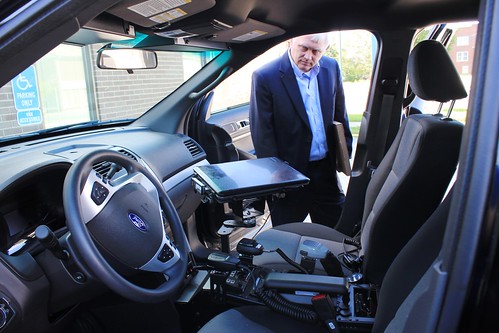
USDA Rural Development staff visited with Jasonville, Indiana town officials earlier this month during a ceremony celebrating the town’s purchase of a new flex fuel police vehicle.
Utilizing an Economic Impact Initiative (EII) Grant to fund 75 percent of the vehicle purchase price, Assistant Police Chief James E. Gadberry talked about how pleased the department was in working with USDA Rural Development.
He also noted three days after the vehicle arrived, it played an instrumental role during a high speed chase involving a suspected methamphetamine distributor. The vehicle performed perfectly during the pursuit and ultimate apprehension of the individual.
Rural Development Indiana State Director Phil Lehmkuhler said, “Rural Development appreciates the dangerous job done by those who serve as police officers. It is our hope that these funds will help to make their jobs safer and the citizens of Jasonville more secure.”
From left to right: State Director Philip Lehmkuhler, Clerk-Treasurer Jane Landry, Mayor Roy Terrell, Assistant Chief Gadberry, RD CP Specialist Craig McGowan, and RD Southern Indiana CP District Director Larry Adams.
EII grants are available to rural communities with a “not employed” rate of greater than 19-1/2 percent to help develop essential community facilities. One goal of the EII program is to provide funding for rural first responder agencies.
Since the beginning of the Obama Administration, the Communities Facilities program has provided more than $83 million in direct loans, guaranteed loans and grants that have enabled rural emergency responders to purchase more than 1,360 emergency vehicles, including about 210 ambulances, over 710 police cars and 440 fire trucks.
To find out more about how USDA Community Facilities programs can assist your rural town, click here.
Indiana USDA Rural Development State Director Philip Lehmkuhler inspects the equipment in Jasonville’s new police vehicle.
Friday, July 19, 2013
EPA Debuts Upgraded Energy Star Portfolio Manager Benchmarking Tool
FOR IMMEDIATE RELEASE
July 18, 2013
EPA Debuts Upgraded Energy Star Portfolio Manager Benchmarking Tool
WASHINGTON –– The U.S. Environmental Protection Agency (EPA) today announced the release of an upgrade to its popular online energy management and tracking tool, Energy Star Portfolio Manager. The upgraded tool can help businesses achieve the President’s call to make commercial buildings at least 20 percent more energy efficient by 2020. The new Energy Star Portfolio Manager delivers a more user-friendly interface, enhanced data sharing capabilities, better reporting, and for the first time, the ability to manage buildings across their lifecycle from design through occupancy.
Tens of thousands of organizations—including school districts, retail chains, hospital systems, and local governments—currently use Energy Star Portfolio Manager to measure the energy performance, water use, utility costs, and greenhouse gas emissions of more than 40 percent of the nation’s commercial building space.
“You can’t manage what you don’t measure,” said Janet McCabe, principal deputy assistant administrator for the Office of Air and Radiation. “The new ‘turbo-charged’ Portfolio Manager makes it easier than ever for building owners and managers to make strategic business decisions that are good for the environment and good for the bottom line. Consistent with President Obama’s Climate Action Plan, this tool helps businesses cut wasted energy, reduce harmful carbon pollution, and save money.”
The tool will continue to deliver the nearly 150 energy, greenhouse gas (GHG), and water performance metrics that owners and managers of commercial buildings use to make strategic management decisions. One of these metrics—the 1–100 Energy Star score, rates a building’s energy efficiency against similar buildings nationwide. A score of 50 represents median energy performance, whereas a score of 75 signifies that a building outperforms 75 percent of its peers. Buildings in the United States that score a 75 or higher, and have their data verified by a Professional Engineer or Registered Architect, are eligible to earn EPA’s Energy Star certification.
Energy Star certified buildings use, on average, 35 percent less energy and generate 35 percent fewer GHG emissions than typical buildings. Studies have shown that they have lower operating costs, increased asset value, and higher occupancy rates. Additionally, there are benefits to simply measuring and tracking a building’s energy performance in Portfolio Manager—a recent EPA study showed that buildings that benchmarked consistently over a three-year period logged an average energy use reduction of 2.4 percent each year. For commercial building portfolios with annual energy bills in the millions of dollars and that emit tens of thousands of metric tons of GHG emissions each year, these reductions can be substantial.
Products, homes and buildings that earn the Energy Star label prevent greenhouse gas emissions by meeting strict energy efficiency requirements set by the U.S. EPA. In 2012 alone, Americans, with the help of Energy Star, saved $24 billion on their utility bills and prevented greenhouse gas emissions equal to those of 50 million vehicles. From the first Energy Star qualified computer in 1992, the Energy Star label can now be found on products in more than 65 different categories, with more than 4.5 billion sold over the past 20 years. Over 1.4 million new homes and 20,000 facilities, including offices, schools, hospitals, and industrial plants, have earned the Energy Star.
More on Energy Star: http://www.energystar.gov
More on EPA’s Energy Star commercial and industrial program: http://www.energystar.gov/buildings
More on the benefits of benchmarking in Energy Star Portfolio Manager: http://www.energystar.gov/datatrends
R124
BetterWorldBooks.com
Thursday, July 18, 2013
Wednesday, July 17, 2013
Urban Transportation Systems Improve Energy Efficiency: IEA Report
This is an excerpt from EERE Network News, a weekly electronic newsletter.
July 17, 2013
Urban Transportation Systems Improve Energy Efficiency: IEA Report
Policies that improve the energy efficiency of urban transport systems could help save as much as $70 trillion in spending on vehicles, fuel, and transportation infrastructure between now and 2050, according to a new report from the International Energy Agency (IEA). Released on July 10, the report, A Tale of Renewed Cities, draws on examples from more than 30 cities across the globe to show how to improve transport efficiency through better urban planning and travel demand management. Extra benefits include lower greenhouse-gas emissions and higher quality of life.
The report offers three case studies to show how those cities have already improved their transport systems. For example, New York City shaved 11 minutes off travel times within a year of introducing express bus services, while at the same time attracting more passengers.
Among the three broad categories of policies recommended in the report are those that allow travel to be avoided, those that shift travel to more efficient modes, and those that improve the efficiency of vehicle and fuel technologies. The report notes that if fully implemented across the global transportation sector, the "avoid, shift and improve” approach could save up to $70 trillion in terms of lower spending on fuel, roadway infrastructure, and vehicles. See the IEA press release and the report website.
Climate Change: Effects on U.S. Energy
This is an excerpt from EERE Network News, a weekly electronic newsletter.
July 17, 2013
Climate Change: Effects on U.S. Energy
As President Obama said in his speech last month, climate change is happening—and the effects are already being felt across the country. Last year was the hottest year on record; the worst drought in generations covered more than half the country; record wildfires swept across western states; and an intensified Superstorm Sandy devastated communities on the East Coast.
The July 11 report U.S. Energy Sector Vulnerabilities to Climate Change and Extreme Weather examines current and potential future impacts of these climate trends on the U.S. energy sector. Researchers have identified several critical issues, including power-plant disruptions due to drought and the disruption of fuel supplies during severe storms. They’ve also pinpointed potential opportunities that would make our energy infrastructure more resilient to these risks. For the complete story, read the Energy Blog.
Subscribe to:
Posts (Atom)