Search This Blog

Showing posts with label sustainability. Show all posts

Tuesday, January 20, 2015

2013 Renewable Energy Data Book

January 20, 2015

From the National Renewable Energy Laboratory (NREL):


NREL's newly released 2013 Renewable Energy Data Book illustrates United States and global energy statistics, including renewable electricity generation, renewable energy development, clean energy investments, and technology-specific data and trends.http://www.nrel.gov/news/press/2015/15450.html

Thursday, January 15, 2015

BNL Newsroom | Solar Cell Polymers with Multiplied Electrical Output

New family of materials produces "twin" electrical charges on single molecules, potentially paving the way for easy manufacture of more efficient solar devices


BNL Newsroom | Solar Cell Polymers with Multiplied Electrical Output

Berkeley Lab Illuminates Price Premiums for U.S. Solar Home Sales - News Center

A multi-institutional research team of scientists led by the U.S. Department of Energy’s Lawrence Berkley Laboratory (Berkeley Lab), in partnership with Sandia National Laboratories, universities, and appraisers found that home buyers consistently have been willing to pay more for homes with host-owned solar photovoltaic (PV) energy systems —averaging about $4 per watt of PV installed—across various states, housing and PV markets, and home types. This equates to a premium of about $15,000 for a typical PV system. The team analyzed almost 22,000 sales of homes, almost 4,000 of which contained PV systems in eight states from 1999 to 2013—producing the most authoritative estimates to date of price premiums for U.S. homes with PV systems.


Berkeley Lab Illuminates Price Premiums for U.S. Solar Home Sales - News Center

Thursday, August 29, 2013

Hydrogen Fuel From Sunlight

Berkeley Lab Researchers at Joint Center for Artificial Photosynthesis Make Unique Semiconductor/Catalyst Construct

AUGUST 29, 2013
Lynn Yarris (510) 486-5375  lcyarris@lbl.gov
 21 


Feature
For more than two billion years, nature, through photosynthesis, has used the energy in sunlight to convert water and carbon dioxide into fuel (sugars) for green plants. (Photo by Roy Kaltschmidt)
In the search for clean, green sustainable energy sources to meet human needs for generations to come, perhaps no technology matches the ultimate potential of artificial photosynthesis. Bionic leaves that could produce energy-dense fuels from nothing more than sunlight, water and atmosphere-warming carbon dioxide, with no byproducts other than oxygen, represent an ideal alternative to fossil fuels but also pose numerous scientific challenges. A major step toward meeting at least one of these challenges has been achieved by researchers with the U.S. Department of Energy (DOE)’s Lawrence Berkeley National Laboratory (Berkeley Lab) working at the Joint Center for Artificial Photosynthesis (JCAP).
“We’ve developed a method by which molecular hydrogen-producing catalysts can be interfaced with a semiconductor that absorbs visible light,” says Gary Moore, a chemist with Berkeley Lab’s Physical Biosciences Division and principal investigator for JCAP. “Our experimental results indicate that the catalyst and the light-absorber are interfaced structurally as well as functionally.”
Moore is the corresponding author, along with Junko Yano and Ian  Sharp, who also hold joint appointments with Berkeley Lab and JCAP, of a paper describing this research in theJournal of the American Chemical Society (JACS). The article is titled
“Photofunctional Construct That Interfaces Molecular Cobalt-Based Catalysts for H2Production to a Visible-Light-Absorbing Semiconductor.” Co-authors are Alexandra Krawicz, Jinhui Yang and Eitan Anzenberg.
Earth receives more energy in one hour’s worth of sunlight than all of humanity uses in an entire year. Through the process of photosynthesis, green plants harness solar energy to split molecules of water into oxygen, hydrogen ions (protons) and free electrons. The oxygen is released as waste and the protons and electrons are used to convert carbon dioxide into the carbohydrate sugars that plants use for energy. Scientists aim to mimic the concept but improve upon the actual process.
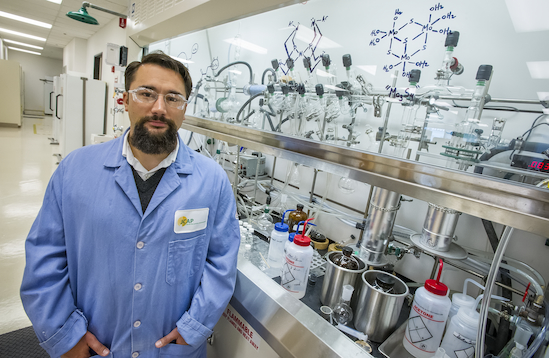
Gary Moore is a chemist with Berkeley Lab’s Physical Biosciences Division and principal investigator for the Joint Center for Artificial Photosynthesis. (Photo by Roy Kaltschmidt)
JCAP, which has a northern branch in Berkeley and a southern branch on the campus of the California Institute of Technology (Caltech), was established in 2010 by DOE as an Energy Innovation Hub. Operated as a partnership between Caltech and Berkeley Lab, JCAP is the largest research program in the United States dedicated to developing an artificial solar-fuel technology. While artificial photosynthesis can be used to generate electricity, fuels can be a more effective means of storing and transporting energy. The goal is an artificial photosynthesis system that’s at least 10 times more efficient than natural photosynthesis.
To this end, once photoanodes have used solar energy to split water molecules, JCAP scientists need high performance semiconductor photocathodes that can use solar energy to catalyze fuel production. In previous efforts to produce hydrogen fuel, catalysts have been immobilized on non-photoactive substrates. This approach requires the application of an external electrical potential to generate hydrogen. Moore and his colleagues have combined these steps into a single material.
“In coupling the absorption of visible light with the production of hydrogen in one material, we can generate a fuel simply by illuminating our photocathode,” Moore says. “No external electrochemical forward biasing is required.”
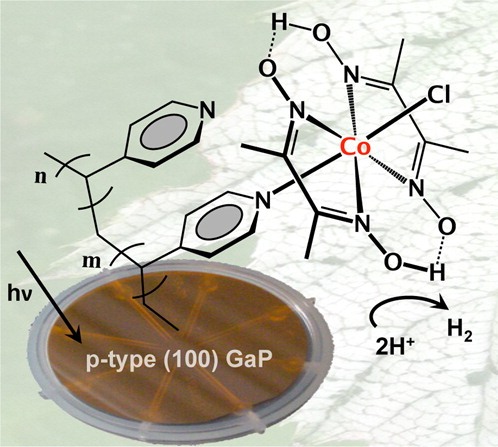
The new JCAP photocathode construct consists of the semiconductor gallium phosphide and a molecular cobalt-containing hydrogen production catalyst from the cobaloxime class of compounds. As an absorber of visible light, gallium phosphide can make use of a greater number of available solar photons than semiconductors that absorb ultraviolet light, which means it is capable of producing significantly higher photocurrents and rates of fuel production. However, gallium phosphide can be notoriously unstable during photoelectrochemical operations.
Gary Moore is a chemist with Berkeley Lab’s Physical Biosciences Division and principal investigator for the Joint Center for Artificial Photosynthesis. (Photo by Roy Kaltschmidt)
Grafting molecular cobalt-containing hydrogen production catalysts to a visible-light-absorbing semiconductor exploits the UV-induced immobilization chemistry of vinylpyridine to p-type (100) gallium phosphide (GaP).
Moore and his colleagues found that coating the surface of gallium phosphide with a film of the polymer vinylpyridine alleviates the instability problem, and if the vinylpyridine is then chemically treated with the cobaloxime catalyst, hydrogen production is significantly boosted.
“The modular aspect of our method allows independent modification of the light-absorber, linking material and catalyst, which means it can be adapted for use with other catalysts tethered over structured photocathodes as new materials and discoveries emerge,” Moore says. “This could allow us, for example, to replace the precious metal catalysts currently used in many solar-fuel generator prototypes with catalysts made from earth-abundant elements.”
Despite its promising electronic properties, gallium phosphide features a mid-sized optical band gap which ultimately limits the total fraction of solar photons available for absorption. Moore and his colleagues are now investigating semiconductors that cover a broader range of the solar spectrum, and catalysts that operate faster at lower electrical potentials. They also plan to investigate molecular catalysts for carbon dioxide reduction.
“We look forward to adapting our method to incorporate materials with improved properties for converting sunlight to fuel,” Moore says. “We believe our method provides researchers at JCAP and elsewhere with an important tool for developing integrated photocathode materials that can be used in future solar-fuel generators as well as other technologies capable of reducing net carbon dioxide emissions.”
This research was funded by the DOE Office of Science.
Additional Information
For more about JCAP go here
#  #  #
Lawrence Berkeley National Laboratory addresses the world’s most urgent scientific challenges by advancing sustainable energy, protecting human health, creating new materials, and revealing the origin and fate of the universe. Founded in 1931, Berkeley Lab’s scientific expertise has been recognized with 13 Nobel prizes. The University of California manages Berkeley Lab for the U.S. Department of Energy’s Office of Science. For more, visit www.lbl.gov.
DOE’s Office of Science is the single largest supporter of basic research in the physical sciences in the United States, and is working to address some of the most pressing challenges of our time. For more information, please visit the Office of Science website atscience.energy.gov/.

Wednesday, August 22, 2012

GE Capital Fleet Services Launches New Interactive Website Focused on Alternative Fuels and Sustainability

Press release:

22 August 2012
GE Capital Fleet Services Launches New Interactive Website Focused on Alternative Fuels and Sustainability
 

Eden Prairie, Minn. – August 22, 2012 – GE Capital Fleet Services today announced the launch of a new eco-focused website that provides access to the company’s depth of knowledge regarding alternative fuels and related sustainable products. The website can be accessed via this link:
The new website provides interactive tools that allow visitors to learn more about how GE Capital Fleet Services helps customers reduce costs, improve fleet performance and increase productivity via alternative fuel strategies. Highlights include:
  • A video presentation focusing on GE’s Vehicle Innovation Center, a state-of-the-art facility dedicated to the alternative fuel vehicle experience
  • An interactive Learning Center featuring an alternative fuel locator app and guides, resources and news for drivers, fleet managers and businesses
  • An overview of GE’s WattStation™ technology and associated smart grid products and services
  • Built-in accessibility to GE’s Intelligauge tool, an easy-to-use online app that calculates current and projected fuel costs and CO2 emissions
  • Educational videos demonstrating the benefits of alternative fuel vehicles and infrastructure solutions
“Our new, enhanced eco website presents users with an interactive and educational experience that shows how our green solutions can help optimize customers’ fleets,” said Deb Frodl, chief strategy officer for GE Capital Fleet Services and global alternative fuels leader for GE. “GE’s global depth of knowledge around alternative fuel vehicles allows us to tell the story of sustainability in fleet management from a unique perspective.”
“Our goal is to create a web experience that puts current and prospective customers in the driver’s seat of the total alternative fuel vehicle experience,” said Jadine Starmer, web product manager. “We continually strive to identify ways to help our customers preserve capital and look to greener solutions by use of the latest technologies and interactive tools.”
The launch of the interactive website follows the May 31st 2012 opening of GE’s world-class Vehicle Innovation Center at the company’s Fleet Services headquarters in Eden Prairie, Minnesota. The center provides current and prospective customers the ability to test drive and learn about the latest advancements and innovations for alternative fuel vehicles, via an on-site test track and education center.
About GE Capital, Fleet Services
GE Capital Fleet Services, based in Eden Prairie, Minn., is a global fleet management company with operations in the United States, Canada, Europe, Japan, Australia and New Zealand. Visit the website at gefleet.com or follow the company’s eco news and updates via Twitter (@GEFleetSvcs).
GE Capital offers consumers and businesses around the globe an array of financial products and services. For more information, visitwww.gecapital.com or follow company news via Twitter (@GECapital). GE (NYSE: GE) works on things that matter. The best people and the best technologies taking on the toughest challenges. Finding solutions in energy, health and home, transportation and finance. Building, powering, moving and curing the world. Not just imagining. Doing. GE works. For more information, visit the company's website at www.ge.com.
# # #

Monday, July 2, 2012

CA Technologies Extends Leadership of Energy and Sustainability Management Market with New CA ecoSoftware Capabilities


Press Releases

CA Technologies Extends Leadership of Energy and Sustainability Management Market with New CA ecoSoftware Capabilities

Latest Release of CA ecoGovernance Leverages Advanced Functionality, Flexible Configuration and Global Scalability
ISLANDIA, N.Y., July 2, 2012 – CA Technologies (NASDAQ: CA) today announced CA ecoGovernance 3.0, a key offering in the CA ecoSoftwaresuite that is designed to help customers with corporate energy and sustainability management.
CA ecoGovernance is designed to enable organizations to accelerate energy and sustainability business performance with automated data management, analysis and reporting. It features project planning and management, scenario planning, portfolio management and supply chain management capabilities that help enable corporate energy and sustainability transformation.
The new version provides a wide range of enhancements driven by the feedback of customers actively engaged in forward-thinking energy and sustainability best practices. These include:
• Real time key performance indicators (KPIs) that leverage automatic metrics management to monitor data streams for increased visibility, and better alignment of energy and resource performance with major business objectives.
• Enhanced analytics in multiple areas, including facility performance normalized to weather data, business travel analysis, and project and portfolio cost benefit analysis specialized for energy, carbon, water and waste reduction initiatives.
• Out-of-the-box survey templates for supply chain and building assessments to quickly gather and process data from external suppliers, or from staff who manage different facilities.
• Enhancements to the GRI reporting functionality, including role-based GRI program management.
• Enhanced support for EPA ENERGY STAR® integration – which has been available in CA ecoSoftware since 2010 – that includes new benchmark trending and site type efficiency analysis designed to help organizations get more from their ENERGY STAR® benchmarks.
• Mobile energy and sustainability interfaces for people on-the-go, which range from survey data capture for roaming field staff to interactive dashboards for executives’ mobile devices.
These enhanced features build on CA ecoGovernance’s existing capabilities such as out-of-the-box support for multiple languages, the agility to adapt to complex customer needs via a highly powerful configuration engine which enables mapping to existing processes, SaaS and on-premise delivery options, and its proven ability to integrate with other enterprise systems.
CA ecoGovernance 3.0 is complemented by CA ecoMeter  for real-time operational energy management and CA ecoDesktop for PC power management.  
Global Scalability and Flexibility Support Sustainability Initiatives
The CA ecoSoftware suite helps customers to more successfully address strategic concerns such as sustainability program execution, corporate energy management, ISO 50001, and the management of portfolios of key sustainability initiatives. By improving program management and addressing tactical needs such as operational reporting, voluntary disclosure, data management, measurement and verification, and the efficiency of physical assets, customers can be better positioned to achieve high-value business benefits. These benefits include improved operational performance, reduced spend on energy and other resources, better compliance, and enhanced brand perception among their customers and other stakeholders.
“Energy and sustainability are growing corporate concerns with increasing implications for bottom-line corporate performance,” said Terrence Clark, general manager, Energy and Sustainability Solutions, CA Technologies. “CA Technologies continues to work with many of the world’s leading companies to provide advanced software that uniquely supports excellence and innovation in these increasingly critical disciplines.”
Major corporations around the world use CA ecoSoftware and have found the solution’s ability to scale from the detailed asset level to the entire enterprise and the benefits of using software rather than manual approaches to be considerable.
“As a global sustainability leader, effective metrics and analytics are important in enabling our continued efforts towards greater sustainability,” said Alison Rowe, global executive director sustainability, Fujitsu Global Business Group. “We selected CA ecoSoftware to help us report in areas including energy, fuel and business travel and in the future, water and waste in our Australian operations. We benefited from the valuable assistance of the sustainability software experts at CA Technologies in applying this innovative software to meet the needs of our business, such as mandatory reporting to NGERS.”
“Sustainability is of great importance to us and therefore, reliable information about our performance in areas such as energy, carbon and water is very important too” said Linda Good, executive vice president and director of Corporate Services, BBVA Compass. “Prior to deploying CA ecoSoftware, this information was time consuming and complex to manage and analyze. We now have a centralized automated system which has made tasks such as analysis, verification and reporting for our sustainability program faster, more accurate, more effective and more efficient.”
“CA ecoSoftware delivers leading capabilities that can help organizations better manage energy and sustainability from the asset to the enterprise level,” said David Metcalfe, CEO, Verdantix. “CA Technologies has also demonstrated the capacity, skills, strategy and partnerships to deliver large and complex deployments successfully at major corporations.”
CA Technologies maintains a Customer Advisory Council for energy and sustainability comprised of executives and professionals drawn from around the world. The company also works with implementation and industry partners including Capgemini, ICF, Jones Lang LaSalle, Siemens and Wipro.
CA Technologies is an accredited Gold Carbon Calculation Partner of the Carbon Disclosure Project, an official ENERGY STAR Service and Product Provider Partner, and a certified GRI solutions provider.
For more information on CA ecoSoftware, visit:
About CA Technologies
CA Technologies (NASDAQ: CA) is an IT management software and solutions company with expertise across all IT environments – from mainframe and distributed, to virtual and cloud. CA Technologies manages and secures IT environments and enables customers to deliver more flexible IT services. CA Technologies innovative products and services provide the insight and control essential for IT organizations to power business agility. The majority of the Global Fortune 500 relies on CA Technologies to manage evolving IT ecosystems. For additional information, visit CA Technologies at www.ca.com.

Wednesday, May 9, 2012

LAKE NONA TO RIVAL LARGEST GLOBAL HEALTH AND SUSTAINABILITY COMMUNITIES

Press release:

09 May 2012
LAKE NONA TO RIVAL LARGEST GLOBAL HEALTH AND SUSTAINABILITY COMMUNITIES
 

Lake Nona and GE to develop innovative health and sustainability community

Orlando, Fla. – May 9, 2012 – (NYSE: GE) – Just east of Orlando’s international airport, the state-of-the-art community of Lake Nona is quickly developing with billions of dollars in new facilities, thousands of high-value jobs and modern neighborhoods.
The 7,000-acre master-planned Lake Nona community will provide healthy living and sustainability products for residents and businesses working with GE solutions.
"Our collaboration with GE brings a global perspective to Lake Nona that is helping us achieve a level of efficiency unmatched in the region,” said Lake Nona President Jim Zboril. “With the help of GE's emerging, innovative products, Lake Nona is quickly becoming a showplace for cutting-edge, sustainable design. GE’s products will play a key role in Lake Nona’s orientation for healthy living and sustainability, making a meaningful difference in energy use and health outcomes at Lake Nona.”
Energy Efficiency and Sustainability
Energy efficiency, sustainability and healthy living are top priorities at Lake Nona’s Laureate Park, a new 2,700-home neighborhood situated within walking distance to the fast-growing employment base of Lake Nona Medical City. With the help of GE, Lake Nona is integrating distinctive technologies and setting best-practice standards in the homebuilding industry within Laureate Park.
GE’s Homes Inspired by ecomagination program, coupled with the Masco Environments For Living Certified Green program, will provide reductions of at least 20 percent in energy, emissions and water usage in every Laureate Park home.
Among GE’s innovative products showcased at Laureate Park are its state-of-the-art Nucleus energy manager and the residential EV charging station, the WattStation™ Wall Mount. GE’s hybrid heat pump water heater, the GeoSpring™ Hybrid Water Heater, is also included in every home, saving households up to 62 percent annually on water heating costs. In addition Lake Nona’s use of energy-efficient GE LED roadway lighting, including decorative post top fixtures, will cut annual street lighting costs by up to 50 percent compared with metal halide lighting systems.
GE will make other energy-efficient products available at Lake Nona, including:
· GE ENERGY STAR® qualified Appliances (refrigeration, laundry, water heater)
· GE CFL Lighting
· GE Smart Thermostat
· GE Water Filtration
· GE Load Centers, Circuit Breakers and Surge Protectors
Healthier Living
In addition to GE’s ecomagination products, the Lake Nona collaboration also integrates GE lighting and healthcare technologies in hospitals, clinics and homes throughout Lake Nona.
Among the products slated for inclusion in Lake Nona residences are:
· GE’s Germicidal Lighting
· GE’s InBody system, offering in-depth body composition analysis
· GE’s microwave featuring a MyPlate button, which helps easily select foods from the new USDA guidelines for nutritious meal preparation
“Our relationship with GE exemplifies our vision of creating a collaborative environment that will inspire our residents,” said Thad Seymour, vice president of health and life sciences at Lake Nona. “The GE products will have a great impact on the health of our community.”
With more than $2 billion in active construction, millions of square feet of new educational, health and life science research facilities and thousands of new residences, Lake Nona has become a bright star during trying economic times.
“GE works to provide clean energy and affordable healthcare offerings,” said Luis Ramírez, CEO of GE Energy’s Industrial Solutions business. “Lake Nona is an opportunity to put those offerings and technology to work. We look forward to seeing this community grow.”
ABOUT GE GE works on things that matter. The best people and the best technologies taking on the toughest challenges. Finding solutions in energy, health and home, transportation and finance. Building, powering, moving and curing the world. Not just imagining. Doing. GE works. For more information, visit the company's website at www.ge.com.

ABOUT LAKE NONA

Lake Nona is a 7,000-acre master planned community within the city limits of Orlando that will be home to world-class education, medical and recreational facilities, a medical city, diverse workspaces, retail centers, entertainment choices and residential options for all types of people seeking the best the city has to offer with all the conveniences of living within a dynamic, vibrant community. Lake Nona is being developed by Lake Nona Property Holdings, owned by Tavistock Group, a private investment company with a broad portfolio of assets around the world.
For more information on Lake Nona, visit www.learnlakenona.com.
ABOUT TAVISTOCK GROUP
Tavistock Group is an international private investment company founded by Joe Lewis. The company provides creative capital structured for each investment opportunity and looks to deploy between $25 million to $1 billion behind established businesses, which benefit from its capital, flexibility, management expertise and global network of resources.
With investments in 175 companies across 15 countries, Tavistock Group’s investment portfolio includes: life sciences, sports teams and sporting events, manufacturing and distribution, oil, gas and energy, financial services, restaurants, commercial properties, private luxury residential properties, resort properties and master-planned real estate developments.
Generally, Tavistock Group invests for the long-term and focuses on improving all aspects of its investments, striving to generate strong returns and achieve excellence in every industry in which it competes.
For more information on Tavistock Group, visit www.tavistock.com.
###

Tuesday, May 8, 2012

Northrop Grumman Announces Significant Achievements in Environmental Sustainability, Diversity & Inclusion and Community Engagement


News Releases

Bookmark and Share

Northrop Grumman Announces Significant Achievements in Environmental Sustainability, Diversity & Inclusion and Community Engagement

Company Releases 2011 Corporate Responsibility Report

FALLS CHURCH, Va., May 8, 2012 (GLOBE NEWSWIRE) -- Northrop Grumman Corporation (NYSE:NOC) has released its 2011 Corporate Responsibility Report (CRR), a comprehensive publication that highlights the company's ongoing commitment to corporate responsibility, including environment sustainability, support for science, technology, engineering and mathematics (STEM) education, community service, corporate philanthropy and employee volunteerism, among other activities. It is the fifth year the company has published this report.
"At Northrop Grumman, responsibility is at the forefront of everything we do. It exists in the way we serve our customers, our employees, our shareholders, the communities where we live and operate, and our business partners," said Wes Bush, chairman, chief executive officer and president. "In all that we are doing to position our company for continued success, corporate responsibility is central–a key component of the value of performance we provide to all of our stakeholders."
The report also details several aspects of the company's corporate responsibility mission, including ethics leadership and governance; inclusion and diversity in the workplace; supply chain management; community partnerships; support for education; commitment to our troops and military families; and environmental, health and safety stewardship.
"Corporate responsibility has been a long-standing commitment and is very important for Northrop Grumman's business and operating strategies," said Sandra Evers-Manly, vice president of Corporate Responsibility. "As we continue to grow as a company, we remain focused on maintaining the highest of ethical standards, embracing diversity and becoming an ideal corporate citizen of the environment and of our communities. This report highlights the company's range of activities, and our continuing growth as a socially conscious enterprise."
Northrop Grumman's CRR is available online at: http://www.northropgrumman.com/corporate-responsibility/reports/index.html. Here are some key highlights:
Northrop Grumman's performance in environmental sustainability produced several important outcomes in 2011 
  • Northrop Grumman's score from the Carbon Disclosure Project has improved from 42 in 2009 to 80 (out of a top score of 100) in 2011. The company's greenhouse gas reduction performance has been ahead of plan and continues to be a primary objective of its sustainability strategy.
  • The company rose from #337 in 2009 to #51 in Newsweek magazine's 2011 comprehensive environmental ranking of the 500 largest American businesses. 
  • Computerworld magazine ranked Northrop Grumman #7 in its list of top 12 Green IT organizations in 2011, moving up from #11 in 2010.
For commitment to a diverse and inclusive workforce, and supply chain, the company has been recognized by several organizations
  • Ranked #37 among Top 50 Companies in Diversity by DiversityInc magazine.
  • Ranked #2 among Top 50 Employers by Minority Engineer magazine.
  • Ranked #3 in the Top 50 for positive working environment for members of minority groups by Minority Engineer.
  • Ranked Top 3 most admired companies for minority engineers by Black Engineer magazine.
  • Ranked Top 100 corporations for providing opportunities for Hispanics by Hispanic Network magazine.
  • Ranked #9 as best employer for graduating engineers by Black Collegiate magazine.
  • Ranked #7 Top 50 for "Multicultural Business Opportunities for 2011" by DiversityBusiness.com.
Northrop Grumman is a leading global security company providing innovative systems, products and solutions in aerospace, electronics, information systems and technical services to government and commercial customers worldwide. Please visit www.northropgrumman.com for more information.

Friday, April 27, 2012

SAP’s Sustainability Initiatives Lead to Industry Awards


SAP’s Sustainability Initiatives Lead to Industry Awards

SAP NEWSBYTE - SAP AG (NYSE: SAP) today released its quarterly sustainability update for the first quarter of 2012. Executing on its vision to making the world run better and improving people’s lives, SAP continues to innovate solutions for customers, improve its own operations and invest in society.
In March 2012, SAP released its 2011 sustainability report targeted at customers, partners, employees, shareholders and the public. Available at www.sapsustainabilityreport.com , the new report covers SAP’s innovations in the areas of software for energy management and sustainable operations, its own transformation into a more sustainable company and its social investment strategy. SAP recently won the 2012 PR News CSR Award for its 2010 Sustainability Report, as well as the JustMeans Social Innovation Awards for Best Integrated Report and Best Stakeholder Engagement.
In the first quarter of 2012, SAP’s sustainability efforts resulted in inclusion in the Global 100 Most Sustainable Companies (from #94 to #27) and the FTSE4Good Index. SAP was also named a winner of the inaugural 2012 Climate Leadership Awards, for which the U.S. Environmental Protection Agency (EPA) recognizes corporate, organizational and individual leadership in addressing climate change and reducing carbon pollution. The award recognizes SAP’s entire energy and carbon strategy – from its supply chain efforts to its internal operations – as well as the energy and sustainable operations software it delivers to customers worldwide.
As part of its commitment to long-term success, SAP publishes selected non-financial performance KPIs on a quarterly basis:
  • Part of SAP’s overall sustainability goals is fostering a diverse workforce, specifically increasing the number of women in management. At the end of the first quarter of 2012, the company employed 18.7 percent women in management, an increase of 0.8 percentage points compared to the end of March 2011. SAP has set a long-term target to increase the share of women in management to 25 percent by the year 2017. The company will continue to place a strong emphasis on recruitment, retention, promotion and mentoring of women throughout SAP.
  • SAP measures its performance in attracting and retaining talent to help ensure its long-term success. In the first quarter of 2012, the employee retention rate was 93 percent, unchanged compared to the first quarter of 2011.
  • SAP’s greenhouse gas (GHG) emissions for the first quarter totaled 145 kilotons, an increase of 22 percent compared to the first quarter of 2011. This can be attributed to a 45 percent increase in air travel, a seven percent increase in company car emissions and a seven percent increase in employees. Additionally, the number of company cars in the corporate car fleet increased by four percent. The emissions caused by facilities remained unchanged, even as the workforce grew. The company has put measures in place to improve its energy efficiency and carbon emissions after this quarter of increased emissions
“SAP continues to embark on a dual strategy to achieve its ambitious emissions targets of 480 kilotons by the end of the year,” said Peter Graf, chief sustainability officer, SAP. “On one side, SAP implements measures to become even more effective in our facilities, data centers, company car fleet and our purchase of more renewable energy. One the other side, we are stepping up our direct engagement with employees to promote more energy efficient behavior. It is because of these combined efforts that we stay committed to achieving our target of reducing emissions to year-2000 levels by 2020.”
For the complete quarterly update, including emissions data, visit www.sapsustainabilityreport.com. For more information, visit the SAP Newsroom. Follow SAP on Twitter at @sapnews. and@sustainableSAP.

Monday, March 19, 2012

Verizon Announces Aggressive Sustainability Goal

Verizon Announces Aggressive Sustainability Goal: Cutting Carbon Intensity in Half by 2020
Company Issues Its First Combined Annual and Corporate Responsibility Report; Outlines Strategy for Delivering Long-Term Shareholder Value by Addressing Social Issues Such as Health Care and Energy
News Release ShareThis
NEW YORK – March 19, 2012 –
Verizon announced today that it will cut its CO2 intensity in half by 2020, as part of the company's broad sustainability efforts.  Sustainability is a key aspect of the company's new strategy for delivering shareholder value.  The other aspects are developing marketplace solutions to address social issues like health care and energy, and aligning the company's philanthropic work with these issues to maximize community benefits.
"This is the era of big data," said Verizon Chairman and CEO Lowell McAdam. "Our business continues to grow at a rapid pace, but we're committed to innovating our way to growing responsibly by becoming more energy efficient, even as our business expands."  McAdam also took part in a "CEO Sit-Down" with Bloomberg TV correspondent Alix Steel today at the fifth annual Bloomberg New Energy Finance Summit.
Carbon intensity - the amount of energy needed to move data across Verizon's network - is a measurement of energy efficiency. It is improved by reducing the absolute amount of energy and by moving more data with the same unit of energy. Verizon is using its 2009 carbon intensity level as the benchmark for the company's 50 percent reduction by 2020.
To reinforce its commitment to its new shareholder-value strategy, the company today issued its first combined annual and corporate responsibility report, which is available at http://responsibility.verizon.com.
Fueling Social Innovation
Verizon believes that creating healthy, sustainable communities is the surest path to creating a healthy and sustainable business. 
"For Verizon, our most exciting growth opportunities occur where business and social interests intersect," McAdam said in a shareowners letter in the report. "As we look at how technology is transforming business and society, we see expanding opportunities ahead for us to use our unique network platforms to make a difference in the world. We believe we can become an even bigger force for good in the world - and, in doing so, extend our legacy of growth and shareowner value for many years to come."
By focusing on mobility, broadband and global connectivity, Verizon is breaking down old technology barriers and empowering businesses and communities.  Verizon's annual report describes the following initiatives:
Removing Barriers to Health Care

 
Neurologist Andy Southerland, M.D., participates in telemedicine encounter made possible by a Verizon Foundation grant to develop one of Virginia's first telehealth nursing curricula at the Department of Nursing at the University of Virginia-Wise. Telehealth is emerging as a way of providing patients in rural locations with access to specialty consultations.
Some 200,000 Americans die every year from treatable chronic disease, many because they lack ready access to medical care due to barriers of distance, time or availability of doctors and nurses. In one example of how Verizon is using 4G LTEtechnology to overcome these barriers, the company is working with health insurance provider WellPoint to change the model for delivering patient services via secure videoconferencing. WellPoint subscribers will soon be able to use their smartphones and tablets to consult with nurse managers for help in managing chronic conditions.
Through a grant from the Verizon Foundation, the University of Virginia launched its first telehealth nursing program to train medical personnel at the school's Wise County campus on the use of emerging telehealth technologies to improve health care access and services in rural regions of the state.
(NOTE: To view a video of just some of the ways that Verizon is transforming the way health care is delivered, visit: http://www.youtube.com/watch?v=7Ck6XX0qeNc.)


Making Education Accessible
Using technology to prepare students for success in the 21st century has long been a focus of the Verizon Foundation. Rapid deployment of 4G LTE mobile networks will be a game-changer in education, as it enables the adaptation of various technologies in the education setting. At St. Phillips Academy in Newark, N.J., for example, a VGo telepresence robot helps solve several classroom challenges including helping a homebound student undergoing medical treatments stay involved with the class.
And Verizon's award-winning educational website, Thinkfinity.org, will evolve into more than just one of the most popular Web resources for teachers. The foundation is working to develop an integrated solution that brings education to life on smartphones and tablets.
Verizon worked closely with Our Lady of Mt. Carmel School in Baltimore, MD, where teachers like Ryan Kloetzer use 4G LTE tablet computers to build excitement for learning science. Studies show that increasing student engagement with mobile learning devices such as tablets and smartphones brings improved academic achievement.Verizon provided St. Philip's Academy in Newark, NJ, with a VGo telepresence robot to solve a variety of classroom challenges, including helping a homebound student stay involved with his teachers and peers while recovering from medical treatments. The VGo robot was developed with support from the Verizon LTE Innovation Center.
For more information about how Verizon is helping to make communities stronger and more sustainable and building on a foundation for long-term growth, visit http://responsibility.verizon.com/. Information on the Verizon Foundation is available at www.verizonfoundation.org.
Verizon Communications Inc. (NYSE, Nasdaq: VZ), headquartered in New York, is a global leader in delivering broadband and other wireless and wireline communications services to consumer, business, government and wholesale customers.  Verizon Wireless operates America's most reliable wireless network, with nearly 108 million total connections nationwide.  Verizon also provides converged communications, information and entertainment services over America's most advanced fiber-optic network, and delivers integrated business solutions to customers in more than 150 countries, including all of the Fortune 500.  A Dow 30 company with $111 billion in 2011 revenues, Verizon employs a diverse workforce of nearly 194,000.  For more information, visit www.verizon.com.
####

Tuesday, February 28, 2012

Post from Dept. of Energy Blog

Taking a Tour of Wilmington's Energy-Efficient Spaces

February 28, 2012 - 11:30am


Roya Stanley (left) on a tour of the Snipes Academy of Arts and Design with the building's architect -- Thomas Hughes. Through interactive real-time energy data tools, Snipes students incorporate energy use data in their classroom projects and studies. | Photo Courtesy of the Cape Fear Green Building Alliance. Roya Stanley (left) on a tour of the Snipes Academy of Arts and Design with the building's architect -- Thomas Hughes. Through interactive real-time energy data tools, Snipes students incorporate energy use data in their classroom projects and studies. | Photo Courtesy of the Cape Fear Green Building Alliance.
I
n Wilmington, North Carolina, local institutions are leading the way in building efficiency and sustainability. From the WAVE Transit Forden Station to the Wilmington Convention Center to the city’s street sweeper complex, Wilmington is saving money by saving energy and supporting job growth in energy efficiency technologies. 


Last week, I experienced first-hand how Wilmington public buildings are leveraging energy efficiency and clean energy technologies to save money and reduce energy waste. I joined Representative Mike McIntyre, Mayor Bill Saffo and Joy Allen, executive director of the Cape Fear Green Building Alliance, on a tour of the city’s energy efficient buildings. 


At the Forden Station -- the first LEED Gold registered public building to break ground in the state of North Carolina -- on-site geothermal heating and cooling systems have helped reduce energy consumption by 45 percent. Snipes Academy of Arts and Design utilizes a water source heat pump system and outside air system for the school’s heating and cooling. Through interactive real-time energy data tools, Snipes students incorporate energy use data in their classroom projects and studies. 


Reducing energy waste in buildings is an important element for a sustainable energy future. In the United States, buildings consume about 40 percent of all U.S. energy, contributing a significant amount to overall energy costs. In Wilmington, the Cape Fear Green Building Alliance is helping train local energy auditors and building analysts to conduct energy efficiency upgrades and capture the savings. 


Nationally, through the Better Buildings Challenge, more than 60 companies, cities, universities, hospitals and other partners have committed to upgrading more than 1.6 billion square feet of building space across the country -- which will jobs, eliminate waste and help make our commercial and industrial buildings 20 percent more efficient by 2020. 


Check out more on the Better Buildings Challenge HERE.