The following is the introduction to the cover article of the new Renewable Energy from Waste magazine.
A Working Model
Greenwood Energy is producing market-friendly fuel pellets from waste in America's heartland.
Brian Taylor
April 23, 2012
Many alternative energy efforts get their starts with an application for a government grant or a proposal designed to tie into a specific tax advantage.
Greenwood Energy has applied for and received low-interest government-backed loans, but General Manager Ted Hansen says his company has created its business model specifically to “avoid reliance on unreliable government subsidies.”
New York-based Greenwood Energy is ramping up a facility in Green Bay, Wis., based on following that premise. It can handle 150,000 tons of inbound material while creating a fuel pellet that can compete with or supplement coal as boiler feedstock.
According to its website www.gwenergy.com, the fuel pellet production is a key part of one of the two main divisions of Greenwood Energy, the Fuels division. The other division focuses on “clean power generation [and] investing in and evaluating a number of projects across the biomass, fuel cell, hydro and biogas spaces.”
Having yielded positive early returns, Greenwood Energy’s project in Green Bay now signifies just a start to a wider plan to build several similar facilities in other parts of the country.
For more, click the link below:
http://www.rewmag.com/rew0412-fuel-pellets-from-waste.aspx
Showing posts with label waste. Show all posts
Showing posts with label waste. Show all posts
Saturday, May 19, 2012

Monday, May 7, 2012
GE Spotlights Wuhan Iron & Steel Success Story at AISTech 2012
News release:
07 May 2012
07 May 2012
GE Spotlights Wuhan Iron & Steel Success Story at AISTech 2012
- GE Showcases Wuhan Iron & Steel Waste-to-Value Solution That Has Saved $32 Million in Annual Savings
- GE Metals Solutions Features Solutions for Power Efficiency Improvements and Water Usage Reduction at Major Steel Conference
ATLANTA, GA.—May 7, 2012—Today at AISTech 2012—one of the largest conferences of the year for the iron and steel industry—GE (NYSE: GE) showcased the waste-to-value success story of China’s Wuhan Iron & Steel (Group) Company (WISCO). Wuhan’s challenge began shortly after the Chinese government passed stringent legislation to reduce the emissions of steel mill operations.
Collaborating with WISCO, GE was able to turn their challenge into a strategic opportunity by devising an advanced technology solution that captures waste gases from the blast furnace and converts them into usable energy. Sequestering and burning the gases reduces the emissions from the steel-making process, improves reliability and provides a zero-cost fuel source for generating the electricity necessary to operate the mill. In a rapidly growing region bursting with industrial opportunity, Wuhan’s goal is to produce more products while simultaneously lowering its power generation costs and reducing greenhouse gases. Thus far, the waste-to-value solution has been so successful that WISCO has saved $32 million in annual operational savings and reduced CO2 emissions by 2 million tons per year—equal to removing more than 391,000 cars off the road.
The World Steel Association reports that 1.3 billion tons of steel were produced in 2007, and production levels are expected to double by 2050 to meet the growing demand for steel around the world. Since energy constitutes a significant portion of the cost of steel production—from 20 to 40 percent in some countries—improvements in energy efficiency result in reduced production costs and in turn, improved competitiveness.
During this week’s AISTech steel conference at Atlanta’s Georgia World Congress Center, GE Metals Solutions is showcasing this waste-to-value and other solutions including:
- Power efficiency improvements to save more than 10 percent of facility costs.
- Water consumption solutions with 20 to 40 percent usage reduction and 25 to 40 percent in cost-out savings.
GE connects with steel producers everywhere to create viable solutions with the potential benefit to those steel mill customers looking to fulfill this staggering rise in demand.
Focusing on serving the metals industry, GE’s dedicated Metals Solutions organization is working with metals manufacturers to develop innovative solutions in the areas of power, water, automation and electrical distribution.
“The advances made in collaboration with Wuhan Iron & Steel (Group) Company serve as examples of our dedicated approach to the metals industry,” said Keiran Coulton, president of GE Global Industries and general manager of GE Metals Solutions. “We’re bringing the diverse GE product and service portfolio together, creating synergies specific to the metals industry and working with global manufacturers to take advantage of our vast research and development capabilities to help evolve the industry.”
GE Metals Solutions is a sponsor of AISTech 2012 and will spotlight the addition of Power Conversion—formerly known as Converteam—to the portfolio.
For more on the Wuhan Iron & Steel (Group) Company story, please visitwww.ge-spark.com/wuhan. Or, stop by the GE Metals Solutions booth at the Georgia World Congress Center (#1035).
About GE
GE (NYSE: GE) works on things that matter. The best people and the best technologies taking on the toughest challenges. Finding solutions in energy, health and home, transportation and finance. Building, powering, moving and curing the world. Not just imagining. Doing. GE works. For more information, visit the company's website at www.ge.com.
GE Energy works connecting people and ideas everywhere to create advanced technologies for powering a cleaner, more productive world. With more than 100,000 employees in over 100 countries, our diverse portfolio of product and service solutions and deep industry expertise help our customers solve their challenges locally. We serve the energy sector with technologies in such areas as natural gas, oil, coal and nuclear energy; wind, solar, biogas and water processing; energy management; and grid modernization. We also offer integrated solutions to serve energy- and water-intensive industries such as mining, metals, marine, petrochemical, food & beverage and unconventional fuels.
Follow GE Energy on Twitter @GE_Energy.
Tuesday, February 28, 2012
Post from Dept. of Energy Blog
Taking a Tour of Wilmington's Energy-Efficient Spaces
February 28, 2012 - 11:30am
 Roya Stanley (left) on a tour of the Snipes Academy of Arts and Design with the building's architect -- Thomas Hughes. Through interactive real-time energy data tools, Snipes students incorporate energy use data in their classroom projects and studies. | Photo Courtesy of the Cape Fear Green Building Alliance.
 I
n Wilmington, North Carolina, local institutions are leading the way in building efficiency and sustainability. From the WAVE Transit Forden Station to the Wilmington Convention Center to the city’s street sweeper complex, Wilmington is saving money by saving energy and supporting job growth in energy efficiency technologies.
Last week, I experienced first-hand how Wilmington public buildings are leveraging energy efficiency and clean energy technologies to save money and reduce energy waste. I joined Representative Mike McIntyre, Mayor Bill Saffo and Joy Allen, executive director of the Cape Fear Green Building Alliance, on a tour of the city’s energy efficient buildings.
At the Forden Station -- the first LEED Gold registered public building to break ground in the state of North Carolina -- on-site geothermal heating and cooling systems have helped reduce energy consumption by 45 percent. Snipes Academy of Arts and Design utilizes a water source heat pump system and outside air system for the school’s heating and cooling. Through interactive real-time energy data tools, Snipes students incorporate energy use data in their classroom projects and studies.
Reducing energy waste in buildings is an important element for a sustainable energy future. In the United States, buildings consume about 40 percent of all U.S. energy, contributing a significant amount to overall energy costs. In Wilmington, the Cape Fear Green Building Alliance is helping train local energy auditors and building analysts to conduct energy efficiency upgrades and capture the savings.
Nationally, through the Better Buildings Challenge, more than 60 companies, cities, universities, hospitals and other partners have committed to upgrading more than 1.6 billion square feet of building space across the country -- which will jobs, eliminate waste and help make our commercial and industrial buildings 20 percent more efficient by 2020.
Check out more on the Better Buildings Challenge HERE.
n Wilmington, North Carolina, local institutions are leading the way in building efficiency and sustainability. From the WAVE Transit Forden Station to the Wilmington Convention Center to the city’s street sweeper complex, Wilmington is saving money by saving energy and supporting job growth in energy efficiency technologies.
Last week, I experienced first-hand how Wilmington public buildings are leveraging energy efficiency and clean energy technologies to save money and reduce energy waste. I joined Representative Mike McIntyre, Mayor Bill Saffo and Joy Allen, executive director of the Cape Fear Green Building Alliance, on a tour of the city’s energy efficient buildings.
At the Forden Station -- the first LEED Gold registered public building to break ground in the state of North Carolina -- on-site geothermal heating and cooling systems have helped reduce energy consumption by 45 percent. Snipes Academy of Arts and Design utilizes a water source heat pump system and outside air system for the school’s heating and cooling. Through interactive real-time energy data tools, Snipes students incorporate energy use data in their classroom projects and studies.
Reducing energy waste in buildings is an important element for a sustainable energy future. In the United States, buildings consume about 40 percent of all U.S. energy, contributing a significant amount to overall energy costs. In Wilmington, the Cape Fear Green Building Alliance is helping train local energy auditors and building analysts to conduct energy efficiency upgrades and capture the savings.
Nationally, through the Better Buildings Challenge, more than 60 companies, cities, universities, hospitals and other partners have committed to upgrading more than 1.6 billion square feet of building space across the country -- which will jobs, eliminate waste and help make our commercial and industrial buildings 20 percent more efficient by 2020.
Check out more on the Better Buildings Challenge HERE.
Saturday, February 25, 2012
News Release from the DOE - Energy Efficiency Training Centers
President Highlights Smart Energy Training at U. of Miami
February 24, 2012
 President Barack Obama tours the University of Miami Industrial Assessment Center in Miami, Florida, Feb. 23, 2012. The IAC is where students learn how to become industrial energy-efficiency experts as they help small to mid-sized manufacturers reduce their energy costs. | Official White House Photo by Chuck Kennedy.
What have IACs accomplished to date?
- 15,000 energy assessments have helped save enough energy to power 5.5 million American homes.
- Participating manufacturers have saved more than $5.6 billion in energy costs.
- 3,000 students have graduated -- with more than 60 percent going on to careers in the energy industry.
During his visit to Florida, yesterday, President Obama highlighted the University of Miami's Industrial Assessment Center (IAC) as a smart and important piece of the administration's "all-of-the-above" approach to domestic energy sources.
In September of last year, the Energy Department gave 24 universities a total of $30M in grants to help train the next generation of industrial energy-efficiency experts. Each school will receive $200,000 to $300,000 per year for up to 5 years to train students on core energy management concepts. The teams conduct energy assessments in a broad range of manufacturing facilities, which prepare students to compete in today's economy while helping local companies and factories reduce energy waste, save money, and become more competitive.
As President Obama said yesterday, "We're taking a step that will make it easier for companies to save money by investing in energy solutions that have been proven here at the University of Miami -- new lighting systems; advanced heating and cooling systems that can lower a company's energy bills and make them more competitive."
Since the Industrial Assessment Center program began in 1976, university teams have conducted more than 15,000 energy assessments at U.S. manufacturing plants nationwide. To date, more than 3,000 students have graduated from the Industrial Assessment Center program, with more than 60 percent going on to careers in the energy industry. Critically, these assessments have helped save over 530 trillion BTUs of energy -- enough to meet the energy needs of 5.5 million American homes -- and have helped participating manufacturers save more than $5.6 billion in energy costs.
If you'd like to apply for an assessment, you can contact one of the 24 schools across the country that currently participate in the IAC Program.
In September of last year, the Energy Department gave 24 universities a total of $30M in grants to help train the next generation of industrial energy-efficiency experts. Each school will receive $200,000 to $300,000 per year for up to 5 years to train students on core energy management concepts. The teams conduct energy assessments in a broad range of manufacturing facilities, which prepare students to compete in today's economy while helping local companies and factories reduce energy waste, save money, and become more competitive.
As President Obama said yesterday, "We're taking a step that will make it easier for companies to save money by investing in energy solutions that have been proven here at the University of Miami -- new lighting systems; advanced heating and cooling systems that can lower a company's energy bills and make them more competitive."
Since the Industrial Assessment Center program began in 1976, university teams have conducted more than 15,000 energy assessments at U.S. manufacturing plants nationwide. To date, more than 3,000 students have graduated from the Industrial Assessment Center program, with more than 60 percent going on to careers in the energy industry. Critically, these assessments have helped save over 530 trillion BTUs of energy -- enough to meet the energy needs of 5.5 million American homes -- and have helped participating manufacturers save more than $5.6 billion in energy costs.
If you'd like to apply for an assessment, you can contact one of the 24 schools across the country that currently participate in the IAC Program.
Friday, February 24, 2012
News Release from GE - Landfill Gas
23 February 2012
GE Gas Engine Technology to Power China’s Largest Landfill Gas Project
- GE’s Jenbacher Gas Engines to Reduce Carbon Dioxide Emissions by More than 340,000 Tons per Year and Greenhouse Gas by Nearly 19 Million Cubic Meters Each Year
- Project Supports Chinese Government’s 12th Five-Year Plan to Invest More than RMB260 Billion in the Waste Treatment Industry by 2015
- GE Cements Leadership Position in China with Latest Alternative Power-to-Energy Project
SHANGHAI, CHINA—February 23, 2012
GE (NYSE: GE) today announced that its ecomagination-qualified Jenbacher gas engines will power China’s largest landfill gas (LFG) power generation project. The Laogang LFG project is owned by Laogang Renewable Energy Co., a joint venture formed by Veolia and Shanghai Environment Group, and supports the Chinese government’s 12th Five-Year Plan, during which China plans to invest more than RMB$260 billion in the waste treatment industry including waste-to-energy initiatives by 2015[1].
“Traditionally, landfill methane as a potent greenhouse gas has been released directly into the air,” said Chen Hongzhang, general manager, Laogang Renewable Energy Co. “By using GE’s gas engines fueled by LFG, we expect to save emissions by over 340,000 tons of carbon dioxide equivalent per year, significantly improving the local environment in Shanghai.”
Seven of GE’s ecomagination-qualified Jenbacher J420 gas engines, which will provide about 10 megawatts of electricity, will power the new Laogang LFG facility located in Shanghai. Each J420 engine combusts 2.7 million cubic meters (m3) of methane each year, providing an overall yearly reduction of greenhouse gas of around 18.9 million m³ for the seven gas engines. The Renewable Energy Company will sell any excess electricity generated to the grid. This project is an example of how GE’s portfolio of innovative distributed power solutions, ranging from 100 kilowatts (kW) to 100 megawatts (MW), gives businesses and communities around the world the ability to generate reliable and efficient power anywhere, whether on or off the grid.
GE’s Jenbacher landfill gas engines use the gas—consisting of methane, carbon dioxide (CO2) and nitrogen—created during the decomposition of organic substances in a landfill. Methane has a global warming factor 21 times greater than carbon dioxide, the most widely recognized greenhouse gas affecting climate change. With a calorific value of approximately 5 kWh/Nm³, landfill gas constitutes a high-value fuel for gas engines that can be effectively used for energy generation. One of GE’s Jenbacher J420 gas engines running on landfill gas can generate 1.4 MW electricity while saving the emissions of more than 49,000 metric tons of CO2-equivalent per year through methane destruction and displaced grid electricity production; this is equivalent to the annual CO2 emissions of more than 9,500 passenger cars on U.S. roads.
“This important project underscores our commitment to providing alternative energy solutions to help China meet its energy goals and cements our position as a leader in this segment,” said Rafael Santana, president and CEO—Gas Engines for GE Energy. “Our Jenbacher gas engines combine high efficiency and reliability with fuel flexibility to meet our customers’ needs with positive environmental impact. The seven Jenbacher J420 gas engines running on landfill gas are designed to generate almost 80 megawatt hours of electricity per year, which could power more than 46,000 Chinese households per year[2].”
The gas engines are scheduled to begin shipping in the second quarter of 2012 with commercial operation expected in December 2012.
This project is the latest in GE’s landfill gas solutions using Jenbacher gas engines. On October 31, 2011, GE announced that it had supplied a fourth J420 Jenbacher gas engine to Asja Brasil’s new 4.3-megawatt Belo Horizonte landfill-gas-to-energy (LFGTE) project in Brazil, helping to meet the country’s goals to increase the production of renewable and alternative energy.
On October 11, 2011, GE announced that it joined government officials and utility representatives at the Golden Triangle Regional Landfill in northeastern Mississippi in the United States to mark the commercial start up of the state’s first LFGTE project that will support the regional grid. Owned by the Golden Triangle Regional Solid Waste Management Authority (GTRSWMA), the LFGTE facility uses an ecomagination-qualified, GE J320 Jenbacher landfill gas engine to generate nearly 1 MW of renewable power sold through Tennessee Valley Authority’s renewable power initiative—enough to support about 700 average U.S. homes.
GE’s alternative gas-to-power portfolio includes its Jenbacher andWaukesha gas engines, which are specifically designed to provide the fuel flexibility needed to accommodate the use of alternative fuels such as landfill gas while offering high levels of electrical efficiency. GE’s Jenbacher landfill gas engines are part of the ecomagination portfolio for successfully demonstrating that converting landfill gas to electricity demonstrates both improved value and environmental performance. Ecomagination is GE’s commitment to invest in a future that creates innovative solutions to global environmental challenges.
Thursday, February 16, 2012
Tribal Clean Energy Projects Awarded $6.5 Million
News release from the U.S. Dept. of Energy:
Tribal Clean Energy Projects Awarded $6.5 Million from U.S. Energy Department
February 16, 2012 - 11:46am
WASHINGTON, D.C. – As part of the Obama Administration’s commitment to strengthening partnerships with Tribal Nations and supporting tribal energy development, U.S. Energy Secretary Steven Chu today announced that 19 clean energy projects to receive more than $6.5 million. These competitively selected projects will allow Native American Tribes to advance clean energy within their communities by assessing local energy resources, developing renewable energy projects and deploying clean energy technologies. These projects will help Tribal communities across the country save money and create new job and business opportunities.
“As President Obama highlighted in the State of the Union, the Administration is committed to building an American economy that lasts and leverages our nation’s clean energy resources,” said Secretary Chu. “The awards announced today will help Tribes across the country advance a sustainable energy future for their local communities, spur economic development, and advance innovative clean energy technologies.”
The Energy Department has taken a number of steps to strengthen its support for Tribal energy development and empower Tribal leaders to make informed decisions that promote community economic development. Over the past year, the Department has established the Indian Country Energy Infrastructure Working Group with Tribal leaders from across the country and launched programs to provide technical assistance and support to help Tribal communities, colleges and universities deploy energy projects and gain skills in energy development and financing.
Since 2002, the Energy Department’s Tribal Energy Program has provided $36 million to 159 tribal energy projects.
The projects selected for negotiation of award today fall under three project areas:
$3.6 Million for Feasibility Studies – Thirteen projects will receive $3.6 million to assess the technical and economic viability of developing renewable energy resources on tribal lands to generate utility-scale power or study the feasibility of installing renewable energy systems on buildings to reduce energy use by 30 percent.
$1.7 Million for Renewable Energy Development Projects – Four projects will receive $1.7 million for pre-construction development activities. Three are developing more than 250 megawatts of new renewable energy generation, and one, when implemented, would reduce the need for diesel fuel for heating by 80 percent – or 9,600 gallons annually.
$1.3 Million for Installation Projects – Two projects will receive $1.3 million to deploy renewable energy technologies to convert waste and other biomass to energy. Once installed, the projects will generate 5 megawatts of energy per hour using municipal solid waste and using cordwood for heating to save between 2,500 and 3,200 gallons of propane.
The tribal energy projects announced today were selected as a result of a DOE funding opportunity announcement issued last year. A summary of all 19 selected tribal energy projects is available HERE.
Under the authority of Title V of the Energy Policy Act of 2005, the DOE Office of Energy Efficiency and Renewable Energy’s Tribal Energy Program, in coordination with the Office of Indian Energy Policy and Programs, provides financial and technical assistance to Indian Tribes for the evaluation and development of their renewable energy resources, implementation of energy efficiency to reduce energy use, and provides education and training to help build the knowledge and skills essential for sustainable tribal energy projects.
The Energy Department has taken a number of steps to strengthen its support for Tribal energy development and empower Tribal leaders to make informed decisions that promote community economic development. Over the past year, the Department has established the Indian Country Energy Infrastructure Working Group with Tribal leaders from across the country and launched programs to provide technical assistance and support to help Tribal communities, colleges and universities deploy energy projects and gain skills in energy development and financing.
Since 2002, the Energy Department’s Tribal Energy Program has provided $36 million to 159 tribal energy projects.
The projects selected for negotiation of award today fall under three project areas:
$3.6 Million for Feasibility Studies – Thirteen projects will receive $3.6 million to assess the technical and economic viability of developing renewable energy resources on tribal lands to generate utility-scale power or study the feasibility of installing renewable energy systems on buildings to reduce energy use by 30 percent.
$1.7 Million for Renewable Energy Development Projects – Four projects will receive $1.7 million for pre-construction development activities. Three are developing more than 250 megawatts of new renewable energy generation, and one, when implemented, would reduce the need for diesel fuel for heating by 80 percent – or 9,600 gallons annually.
$1.3 Million for Installation Projects – Two projects will receive $1.3 million to deploy renewable energy technologies to convert waste and other biomass to energy. Once installed, the projects will generate 5 megawatts of energy per hour using municipal solid waste and using cordwood for heating to save between 2,500 and 3,200 gallons of propane.
The tribal energy projects announced today were selected as a result of a DOE funding opportunity announcement issued last year. A summary of all 19 selected tribal energy projects is available HERE.
Under the authority of Title V of the Energy Policy Act of 2005, the DOE Office of Energy Efficiency and Renewable Energy’s Tribal Energy Program, in coordination with the Office of Indian Energy Policy and Programs, provides financial and technical assistance to Indian Tribes for the evaluation and development of their renewable energy resources, implementation of energy efficiency to reduce energy use, and provides education and training to help build the knowledge and skills essential for sustainable tribal energy projects.
Thursday, February 9, 2012
Quebec's First Waste-to-Biofuels Facility
News release from Enerkem:
Enerkem and GreenField Ethanol Announce Quebec's First Waste-to-Biofuels Production Facility
VARENNES, Québec, February 6, 2012 – At a news conference in Varennes today, the
Government of Québec announced its plan to inject $27 million in Québec’s first
full-scale commercial cellulosic ethanol plant through the Ministry of Natural Resources
and Wildlife and Investissement Québec. This facility will be built and operated by a
joint venture partnership formed by Enerkem (www.enerkem.com), a waste-to-biofuels
and chemicals company, and GreenField Ethanol (www.greenfieldethanol.com), the
Canadian leader in alcohol production.
The future plant will be located in Varennes, Québec and will use Enerkem’s proprietary
technology to convert non-recyclable municipal solid waste into biofuels. With a
full-scale waste-to-biofuels facility under construction in Edmonton, Alberta, and another
one under development in Mississippi, the Varennes facility represents Enerkem’s third
full-scale commercial project.
"By producing liquid transportation fuel from non-recyclable waste, this facility opens the
door to the emergence of a new energy sector and will allow for local sustainable
management of our waste materials", declared Vincent Chornet, Enerkem President
and CEO. "Located on the site of Ethanol GreenField's current plant, this project will
represent one of the first integrations between an existing, first generation ethanol plant
and a new cellulosic ethanol plant."
"The construction of this innovative plant on our current site marks the beginning of our
transition to an integrated biorefinery in Varennes", said Jean Roberge, General
Manager, GreenField Ethanol Québec. "We are pleased to partner with Enerkem and
integrate their technology to build Québec’s first full-scale commercial cellulosic ethanol
plant. The use of waste materials, that is made possible with Enerkem's technology,
complements GreenField Ethanol R&D efforts with other types of biomass. "This waste-to-biofuels production facility will help reduce greenhouse emissions, fossil
fuel imports and landfilled volumes. The non-recyclable waste will come from
institutional, commercial and industrial sectors, and from construction and demolition
debris. The anticipated annual production capacity of this plant is approximately
38 million litres.
"In addition to presenting a solution to landfilling, today's announcement will enable
greenhouse gas emission reductions by about 110,000 metric tons of CO2 per year.
Cellulosic ethanol is a renewable fuel that will contribute to reducing our dependence on
petroleum products. By supporting this project, our government is concretely reinforcing
energy security for Québec. Today's announcement puts Québec in an advantageous
position in the search for alternatives to fossil fuel consumption", outlined Minister
Clément Gignac.
"Québec has resolved to reduce, by 2020, its greenhouse gas emissions to 20% below
1990 levels, as part of its 2006-2012 Climate Change Action Plan. We believe we can
be productive and create wealth and jobs, all while protecting our environment. The
construction of the cellulosic ethanol facility belonging to the joint venture formed by
Enerkem and GreenField Ethanol, is one step closer towards reducing our greenhouse
gas emissions. It is with solid and structured projects, such as the one presented today,
that Québec will reassert its leadership in a green and sustainable economy",
commented Minister Sam Hamad.
The $27 million contribution from the Government of Québec includes $18 million in
financial assistance from the Ministry of Natural Resources and Wildlife and a $9 million
loan from Investissement Québec.
Enerkem and GreenField Ethanol Announce Quebec's First Waste-to-Biofuels Production Facility
VARENNES, Québec, February 6, 2012 – At a news conference in Varennes today, the
Government of Québec announced its plan to inject $27 million in Québec’s first
full-scale commercial cellulosic ethanol plant through the Ministry of Natural Resources
and Wildlife and Investissement Québec. This facility will be built and operated by a
joint venture partnership formed by Enerkem (www.enerkem.com), a waste-to-biofuels
and chemicals company, and GreenField Ethanol (www.greenfieldethanol.com), the
Canadian leader in alcohol production.
The future plant will be located in Varennes, Québec and will use Enerkem’s proprietary
technology to convert non-recyclable municipal solid waste into biofuels. With a
full-scale waste-to-biofuels facility under construction in Edmonton, Alberta, and another
one under development in Mississippi, the Varennes facility represents Enerkem’s third
full-scale commercial project.
"By producing liquid transportation fuel from non-recyclable waste, this facility opens the
door to the emergence of a new energy sector and will allow for local sustainable
management of our waste materials", declared Vincent Chornet, Enerkem President
and CEO. "Located on the site of Ethanol GreenField's current plant, this project will
represent one of the first integrations between an existing, first generation ethanol plant
and a new cellulosic ethanol plant."
"The construction of this innovative plant on our current site marks the beginning of our
transition to an integrated biorefinery in Varennes", said Jean Roberge, General
Manager, GreenField Ethanol Québec. "We are pleased to partner with Enerkem and
integrate their technology to build Québec’s first full-scale commercial cellulosic ethanol
plant. The use of waste materials, that is made possible with Enerkem's technology,
complements GreenField Ethanol R&D efforts with other types of biomass. "This waste-to-biofuels production facility will help reduce greenhouse emissions, fossil
fuel imports and landfilled volumes. The non-recyclable waste will come from
institutional, commercial and industrial sectors, and from construction and demolition
debris. The anticipated annual production capacity of this plant is approximately
38 million litres.
"In addition to presenting a solution to landfilling, today's announcement will enable
greenhouse gas emission reductions by about 110,000 metric tons of CO2 per year.
Cellulosic ethanol is a renewable fuel that will contribute to reducing our dependence on
petroleum products. By supporting this project, our government is concretely reinforcing
energy security for Québec. Today's announcement puts Québec in an advantageous
position in the search for alternatives to fossil fuel consumption", outlined Minister
Clément Gignac.
"Québec has resolved to reduce, by 2020, its greenhouse gas emissions to 20% below
1990 levels, as part of its 2006-2012 Climate Change Action Plan. We believe we can
be productive and create wealth and jobs, all while protecting our environment. The
construction of the cellulosic ethanol facility belonging to the joint venture formed by
Enerkem and GreenField Ethanol, is one step closer towards reducing our greenhouse
gas emissions. It is with solid and structured projects, such as the one presented today,
that Québec will reassert its leadership in a green and sustainable economy",
commented Minister Sam Hamad.
The $27 million contribution from the Government of Québec includes $18 million in
financial assistance from the Ministry of Natural Resources and Wildlife and a $9 million
loan from Investissement Québec.
Thursday, February 2, 2012
WM Named EPA LMOP Industry Partner of the Year
Sometimes propaganda can have informational value. News release from Waste Management:
Waste Management Named EPA Landfill Methane Outreach Program Industry Partner of the Year
North America's largest landfill gas-to-energy owner and operator recognized for leadership in waste-based renewable energy development
Houston — January 18, 2012 — The U.S. Environmental Protection Agency’s Landfill Methane Outreach Program (LMOP) has named Waste Management, Inc. (NYSE: WM) its 2011 Industry Partner of the Year for leadership in developing waste-based renewable energy. Waste Management is the largest landfill gas-to-energy (LFGTE) developer and operator in North America and is continuing to expand its roster of energy facilities. This year’s awards were presented earlier today at the 15th Annual LMOP Partner and Project of the Year Awards Ceremony in Baltimore, MD.
To view a short video explaining how landfills can power homes, college campuses and more, visit the WM video- Landfill Power: Turning Gas into Energy.
In 2011, WM commissioned nine LFGTE facilities with a collective capacity of 29.5 MW, bringing the number of LFGTE facilities to 133 active projects in North America. In total, these facilities produced the equivalent of 617 MW of power – enough to power 473,000 homes, and offset the consumption of over 2.4 million tons of coal. Waste Management plans to commission four additional projects in the first quarter of 2012 and is working on at least eight additional projects through its dedicated in-house project development team, which works on both WM-owned sites and those owned by municipalities and industry partners.
“It is an honor to be recognized as a leading partner in this sector by the EPA, and a testament to the hard work of our team over the last several years,” said Paul Pabor, vice president of renewable energy at Waste Management. “Waste Management developed much of the technology still in use today, and continues to find new ways to capture resources in waste. We’re looking forward to continued innovation, creating electricity, generating renewable fuels and powering local businesses with the resources at our disposal.”
Waste Management was active in two projects that won 2010 Project of the Year. The first, the University of New Hampshire EcoLineTM project, brought gas from Waste Management’s Turnkey Landfill through a 12-mile pipe, supplying 85 percent of the campus’s heat and electricity needs. The second, at the Altamont Landfill Resource and Recovery Facility in Livermore, CA, consisted of a partnership with Linde North America. There, the companies produce up to 13,000 gallons of liquefied natural gas (LNG) from landfill gas every day to fuel hundreds of WM fleet vehicles. The Altamont project is the largest landfill gas-to-LNG project in the world.
Landfill gas, generated by the natural breakdown of organic materials in a landfill, contains large amounts of methane that can be collected to generate electricity, power local businesses or be turned into transportation fuel. A successful program can turn a modern landfill from a mere disposal site to a source of clean, renewable energy to power homes and fuel vehicles.
Waste Management is continually exploring new technologies and services to generate renewable energy from waste. LFGTE complements the company’s other waste services in the areas of recycling, landfill operations and waste-based energy technology. LFGTE projects also contribute to one of Waste Management’s sustainability goals, doubling energy generation by 2020 to power the equivalent of 2 million homes.
EPA’s LMOP has assisted with more than 500 LFG energy projects over the past 16 years. The United States currently has about 575 operational LFG energy projects which annually supply more than 14 billion kilowatt-hours of electricity and ~102 billion cubic feet of LFG to direct-use applications. There is still significant potential for expansion of the technology; LMOP has identified over 500 landfills that could provide an additional 1,155 MW of electrical power.
Waste Management Named EPA Landfill Methane Outreach Program Industry Partner of the Year
North America's largest landfill gas-to-energy owner and operator recognized for leadership in waste-based renewable energy development
Houston — January 18, 2012 — The U.S. Environmental Protection Agency’s Landfill Methane Outreach Program (LMOP) has named Waste Management, Inc. (NYSE: WM) its 2011 Industry Partner of the Year for leadership in developing waste-based renewable energy. Waste Management is the largest landfill gas-to-energy (LFGTE) developer and operator in North America and is continuing to expand its roster of energy facilities. This year’s awards were presented earlier today at the 15th Annual LMOP Partner and Project of the Year Awards Ceremony in Baltimore, MD.
To view a short video explaining how landfills can power homes, college campuses and more, visit the WM video- Landfill Power: Turning Gas into Energy.
In 2011, WM commissioned nine LFGTE facilities with a collective capacity of 29.5 MW, bringing the number of LFGTE facilities to 133 active projects in North America. In total, these facilities produced the equivalent of 617 MW of power – enough to power 473,000 homes, and offset the consumption of over 2.4 million tons of coal. Waste Management plans to commission four additional projects in the first quarter of 2012 and is working on at least eight additional projects through its dedicated in-house project development team, which works on both WM-owned sites and those owned by municipalities and industry partners.
“It is an honor to be recognized as a leading partner in this sector by the EPA, and a testament to the hard work of our team over the last several years,” said Paul Pabor, vice president of renewable energy at Waste Management. “Waste Management developed much of the technology still in use today, and continues to find new ways to capture resources in waste. We’re looking forward to continued innovation, creating electricity, generating renewable fuels and powering local businesses with the resources at our disposal.”
Waste Management was active in two projects that won 2010 Project of the Year. The first, the University of New Hampshire EcoLineTM project, brought gas from Waste Management’s Turnkey Landfill through a 12-mile pipe, supplying 85 percent of the campus’s heat and electricity needs. The second, at the Altamont Landfill Resource and Recovery Facility in Livermore, CA, consisted of a partnership with Linde North America. There, the companies produce up to 13,000 gallons of liquefied natural gas (LNG) from landfill gas every day to fuel hundreds of WM fleet vehicles. The Altamont project is the largest landfill gas-to-LNG project in the world.
Landfill gas, generated by the natural breakdown of organic materials in a landfill, contains large amounts of methane that can be collected to generate electricity, power local businesses or be turned into transportation fuel. A successful program can turn a modern landfill from a mere disposal site to a source of clean, renewable energy to power homes and fuel vehicles.
Waste Management is continually exploring new technologies and services to generate renewable energy from waste. LFGTE complements the company’s other waste services in the areas of recycling, landfill operations and waste-based energy technology. LFGTE projects also contribute to one of Waste Management’s sustainability goals, doubling energy generation by 2020 to power the equivalent of 2 million homes.
EPA’s LMOP has assisted with more than 500 LFG energy projects over the past 16 years. The United States currently has about 575 operational LFG energy projects which annually supply more than 14 billion kilowatt-hours of electricity and ~102 billion cubic feet of LFG to direct-use applications. There is still significant potential for expansion of the technology; LMOP has identified over 500 landfills that could provide an additional 1,155 MW of electrical power.
Wednesday, February 1, 2012
Be a Lean, Mean, Green Eating Machine
From the DOE Energy Savers blog:
 January 31, 2012 15:53
Like most Americans, I watched the State of the Union to hear President Obama outline his goals for the year ahead, to understand his energy outlook and plans, and of course, to see what Michelle would be wearing (a stunning royal blue, of course).
When listening to the President highlight his administration’s clean energy initiatives, I couldn’t help but remember the First Family's goals to reduce childhood obesity in America. By no surprise, the link between nationwide health improvement and energy efficiency efforts is strong. By reducing our demand for processed and imported foods, we can improve the health of generations to come, extend our overall lifespan and reduce the energy we waste on packaging.
In the First Lady's health program, she outlines goals of improving the quality of food in schools and making healthy foods more affordable and accessible for families. The message resonates with many of us who are steadfastly moving forward with our new year’s resolution to drop the pounds – and save some energy along the way.
If you were born in 1975 or later, you are probably well-versed on the topic of organic growing and eating. We’ve heard it a million times: Organic foods are foods that have not been produced using pesticides, chemicals or unnatural ingredients. So, what exactly is it about organic food that is green-friendly? Research has shown that foods grown by sustainable agricultural methods avoid unnecessary pollution and oil consumption caused by synthetic, petroleum-based fertilizers and pesticides.
In addition to the energy savings that comes from producing organic foods, growing them locally (perhaps in your own garden) saves the energy cost of shipping and importing. And while we're on the topic of growing in your backyard, it really is the least expensive option, as opposed to buying the sometimes overpriced organic produce in your grocery store.
Gardening websites suggest that many of your regular vegetables can be successfully grown in late winter/early spring, such as broccoli, beets, potatoes, radishes, collards, lettuce, peas and turnips. We've talked about composting several times – it's important to remember that your garden will benefit from the rich in nutrient soil you can obtain from composting.
While it isn't scientifically proven that organic food is more nutritious or can promote weight loss, there are thousands of testimonies online from people who have experienced firsthand that an organic diet can vastly improve health. From the reduction in pesticides and hormones to the fresher and “cleaner” taste of the foods, Americans have seen the difference in selecting organic for the foods they consume.
Looking ahead to rest of 2012, I hope we can all work alongside each other to improve our health and energy outlook and begin taking those baby steps to reach our goals – both as individuals and as a country.
Kristin Swineford supports DOE's Weatherization & Intergovernmental Program in Communications & Outreach.
Be a Lean, Mean, Green Eating Machine
January 31, 2012 15:53 Like most Americans, I watched the State of the Union to hear President Obama outline his goals for the year ahead, to understand his energy outlook and plans, and of course, to see what Michelle would be wearing (a stunning royal blue, of course).
When listening to the President highlight his administration’s clean energy initiatives, I couldn’t help but remember the First Family's goals to reduce childhood obesity in America. By no surprise, the link between nationwide health improvement and energy efficiency efforts is strong. By reducing our demand for processed and imported foods, we can improve the health of generations to come, extend our overall lifespan and reduce the energy we waste on packaging.
In the First Lady's health program, she outlines goals of improving the quality of food in schools and making healthy foods more affordable and accessible for families. The message resonates with many of us who are steadfastly moving forward with our new year’s resolution to drop the pounds – and save some energy along the way.
If you were born in 1975 or later, you are probably well-versed on the topic of organic growing and eating. We’ve heard it a million times: Organic foods are foods that have not been produced using pesticides, chemicals or unnatural ingredients. So, what exactly is it about organic food that is green-friendly? Research has shown that foods grown by sustainable agricultural methods avoid unnecessary pollution and oil consumption caused by synthetic, petroleum-based fertilizers and pesticides.
In addition to the energy savings that comes from producing organic foods, growing them locally (perhaps in your own garden) saves the energy cost of shipping and importing. And while we're on the topic of growing in your backyard, it really is the least expensive option, as opposed to buying the sometimes overpriced organic produce in your grocery store.
Gardening websites suggest that many of your regular vegetables can be successfully grown in late winter/early spring, such as broccoli, beets, potatoes, radishes, collards, lettuce, peas and turnips. We've talked about composting several times – it's important to remember that your garden will benefit from the rich in nutrient soil you can obtain from composting.
While it isn't scientifically proven that organic food is more nutritious or can promote weight loss, there are thousands of testimonies online from people who have experienced firsthand that an organic diet can vastly improve health. From the reduction in pesticides and hormones to the fresher and “cleaner” taste of the foods, Americans have seen the difference in selecting organic for the foods they consume.
Looking ahead to rest of 2012, I hope we can all work alongside each other to improve our health and energy outlook and begin taking those baby steps to reach our goals – both as individuals and as a country.
Kristin Swineford supports DOE's Weatherization & Intergovernmental Program in Communications & Outreach.
Saturday, January 28, 2012
Houston Joins Better Buildings Challenge
U.S. Dept. of Energy News Release:
City of Houston Joins Better Buildings Challenge, Partners with Energy Department to Reduce Energy Waste and Boost Efficiency
January 26, 2012
Washington, D.C. — Building on President Obama’s call in the State of the Union address earlier this week for a new era for American energy, U.S. Energy Secretary Steven Chu joined with Houston Mayor Annise Parker today to announce that Houston, Texas is joining the Better Buildings Challenge. Houston is the latest community to join the Challenge, a public-private partnership that seeks to improve energy efficiency 20 percent by 2020 in commercial, government, and school buildings across the country. As the newest Challenge community partner, the City of Houston is committing to improve energy efficiency across 30 million square feet of public and private buildings throughout the city.
“As President Obama made clear in this week’s State of the Union address, one of the easiest ways for businesses to save money and improve their competitiveness is to reduce energy waste in their buildings and factories,” said Secretary Chu. “Through the Better Buildings Challenge, the city of Houston is helping to boost manufacturing, create U.S. jobs, reduce pollution, and build an American economy that lasts.”
“I am committed to sustainability,” said Mayor Parker. “It’s not only helps our environment, it also saves taxpayer dollars. The city and its local corporate partners in the BBC have already taken numerous steps to make buildings and other facilities more energy efficient and more efficiencies will follow. We are leading by example.”
Through its participation in the Better Buildings Challenge, the City of Houston works with local partners to implement initiatives that reduce emissions, protect air quality and save taxpayers money. The city becomes the most recent community partner to join the Challenge since President Obama announced last month nearly $4 billion in combined federal and private sector funding for building energy upgrades over the next two years. To date, more than 60 companies, cities, universities, hospitals, and other partners throughout the U.S. have committed to upgrading more than 1.6 billion square feet of building space nationwide.
About the Better Buildings Challenge
The Better Buildings Challenge is a national leadership initiative that calls on corporate chief executive officers, university presidents and state and local leaders to make a significant commitment to energy efficiency. These leaders are recognized for the innovative work they are doing, the results they are achieving and the leadership role they provide for other organizations to follow. The goal of the Better Buildings Challenge is to create jobs, eliminate waste, and save money by making the nation’s commercial and industrial buildings 20 percent more efficient by 2020. The Challenge is managed by the U.S. Department of Energy.
“As President Obama made clear in this week’s State of the Union address, one of the easiest ways for businesses to save money and improve their competitiveness is to reduce energy waste in their buildings and factories,” said Secretary Chu. “Through the Better Buildings Challenge, the city of Houston is helping to boost manufacturing, create U.S. jobs, reduce pollution, and build an American economy that lasts.”
“I am committed to sustainability,” said Mayor Parker. “It’s not only helps our environment, it also saves taxpayer dollars. The city and its local corporate partners in the BBC have already taken numerous steps to make buildings and other facilities more energy efficient and more efficiencies will follow. We are leading by example.”
Through its participation in the Better Buildings Challenge, the City of Houston works with local partners to implement initiatives that reduce emissions, protect air quality and save taxpayers money. The city becomes the most recent community partner to join the Challenge since President Obama announced last month nearly $4 billion in combined federal and private sector funding for building energy upgrades over the next two years. To date, more than 60 companies, cities, universities, hospitals, and other partners throughout the U.S. have committed to upgrading more than 1.6 billion square feet of building space nationwide.
About the Better Buildings Challenge
The Better Buildings Challenge is a national leadership initiative that calls on corporate chief executive officers, university presidents and state and local leaders to make a significant commitment to energy efficiency. These leaders are recognized for the innovative work they are doing, the results they are achieving and the leadership role they provide for other organizations to follow. The goal of the Better Buildings Challenge is to create jobs, eliminate waste, and save money by making the nation’s commercial and industrial buildings 20 percent more efficient by 2020. The Challenge is managed by the U.S. Department of Energy.
Tuesday, January 17, 2012
Austin Using Green Innovation to Beat the Utility Blues
U.S. Dept of Energy blog post:
Austin Using Green Innovation to Beat the Utility Blues
January 17, 2012 - 1:03pm

An aerial view of the Hornsby Bend Biosolids Management Plant in Austin, Texas. | Photo courtesy of Austin Water.
Sewage treatment has always been a dirty business, dating back to the frontier days when "waste management" meant the guy who followed after the horses with a bucket and shovel.
However, thanks to modern technology, there are ways to turn some of the treatment processes into clean energy that can power public infrastructure facilities.
The Hornsby Bend Biosolids Management Plant in Austin, Texas, located on 1,200 acres of land along the Colorado River, is a national model for innovative approaches to improve the environment, such as reducing waste, producing compost, and protecting ecosystems.
Each year, thousands of tons of biosolids, the nutrient-rich organic materials resulting from the treatment of sewage sludge, are anaerobically digested and composted with Austin's yard trimmings into an EPA-certified soil conditioner called "Dillo Dirt" (as in armadillo). This popular product is sold to commercial vendors for sale and use in public landscaping projects across the city. Demand for "Dillo Dirt" often exceeds available supply.
During the 1980s, an initial effort to improve energy efficiency at the plant started when two 400 kW converted diesel generators were installed. The generators were fueled by a mixture of digester biogas from the site and diesel fuel. This worked fairly well, but after 20+ years the old generators are no longer serviceable or repairable, and in recent years the gas has had to be flared.
Austin decided to use $1.2 million of its Energy Efficiency and Conservation Block Grant from the American Recovery and Reinvestment Act to replace the old equipment with modern "biogas rated" generation equipment.
The new generator equipment will generate clean electricity by utilizing digester methane from the sludge treatment process without the use of fossil fuels. In short, the same anerobic digesting process used to create the Dillo Dirt will also make the biogas used to power the generators. The result will demonstrate distributed clean power generation, reduce the facility's operating costs, and offset on-peak operation of the plant, thereby contributing to Austin's effort to avoid building new conventional power generation plants.
The new equipment is on order and the city intends for the project to be fully operational by the middle of next year. This single generator should generate more energy than the entire Hornsby Bend facility uses, thereby offsetting the plant's total energy use and generating a credit to the water utility.
However, thanks to modern technology, there are ways to turn some of the treatment processes into clean energy that can power public infrastructure facilities.
The Hornsby Bend Biosolids Management Plant in Austin, Texas, located on 1,200 acres of land along the Colorado River, is a national model for innovative approaches to improve the environment, such as reducing waste, producing compost, and protecting ecosystems.
Each year, thousands of tons of biosolids, the nutrient-rich organic materials resulting from the treatment of sewage sludge, are anaerobically digested and composted with Austin's yard trimmings into an EPA-certified soil conditioner called "Dillo Dirt" (as in armadillo). This popular product is sold to commercial vendors for sale and use in public landscaping projects across the city. Demand for "Dillo Dirt" often exceeds available supply.
During the 1980s, an initial effort to improve energy efficiency at the plant started when two 400 kW converted diesel generators were installed. The generators were fueled by a mixture of digester biogas from the site and diesel fuel. This worked fairly well, but after 20+ years the old generators are no longer serviceable or repairable, and in recent years the gas has had to be flared.
Austin decided to use $1.2 million of its Energy Efficiency and Conservation Block Grant from the American Recovery and Reinvestment Act to replace the old equipment with modern "biogas rated" generation equipment.
The new generator equipment will generate clean electricity by utilizing digester methane from the sludge treatment process without the use of fossil fuels. In short, the same anerobic digesting process used to create the Dillo Dirt will also make the biogas used to power the generators. The result will demonstrate distributed clean power generation, reduce the facility's operating costs, and offset on-peak operation of the plant, thereby contributing to Austin's effort to avoid building new conventional power generation plants.
The new equipment is on order and the city intends for the project to be fully operational by the middle of next year. This single generator should generate more energy than the entire Hornsby Bend facility uses, thereby offsetting the plant's total energy use and generating a credit to the water utility.
Wednesday, January 11, 2012
NREL Helping Virgin Islands Cut Fuel Use
News release from the National Renewable Energy Laboratory. Keep in mind that a typical rate for electricity on the mainland United States is about 10 or 11 cents per kilowatt-hour.
 Enlarge image
The U.S. Virgin Islands are a great place to visit, but you wouldn't want to pay energy bills there.
The tiny U.S. territory in the Caribbean has just 110,000 residents, all the beach, surf, wind and sun you'd ever want, but energy prices that are four to five times higher than are paid in the continental United States.
Like many islands on earth, the USVI are almost 100 percent dependent on imported oil for electricity. Residents pay about 47 cents per kilowatt hour to light their homes and run their appliances. Imported oil is even used to desalinate the water because there is so little fresh water available other than what residences catch on their roof in the form of rain water.
But USVI Gov. John P. de Jongh Jr., working with the U.S. Department of Energy's National Renewable Energy Laboratory (NREL) and the U.S. Department of Interior, has vowed to transform energy use dramatically. In January, at his State of the Territory address, he announced the goal of reducing use of fossil fuels by 60 percent in the next 15 years.
That's huge, and a great challenge, and just possibly a blueprint for how to achieve those similar reductions on the mainland.
"What we're attempting to do is integrate every large portion of renewable energy into our system," said Karl Knight, the director of USVI's energy office, who also is a board member of the Virgin Islands Water and Power Authority. Think of it as a pilot for how to integrate renewables as a large proportion of the grid."
To get there, a half dozen different technologies need to be implemented, and energy efficiency will have to become a rallying cry.
 Enlarge image
That's where NREL's scientists and engineers are helping.
The United States, New Zealand, and Iceland are three of the leading actors in the international partnership, Energy Development in Island Nations (EDIN), and for the United States, its Virgin Islands territory was a natural fit.
"We wanted to help USVI particularly because the governor was very committed to transforming the energy infrastructure, as was the CEO of their utility," NREL's Adam Warren, who heads NREL's EDIN program, said.
NREL has helped USVI — its government, utilities and public and private groups — to map the renewable energy potential, and to determine how to get to a 60 percent reduction by 2025. Early on, NREL produced a major technological report on grid integration, transmission and distribution.
"We think 60 percent is very realistic," Knight said. "The government established that goal in collaboration with NREL and the Island Nations global partnership. They challenged Gov. deJongh to be aggressive in his goal-setting and he took them up on it. We established the aggressive goal because we spend so much on The only thing that people in the Virgin Islands talk about is the size of their electric bills."
The high rates have hurt low-income residents and have been a deterrent to economic investment, Knight said. "If the rate is going to be 40 cents a kilowatt hour or more, it shapes the type of business that's willing to locate in the Virgin Islands," he said. "Our total dependence on oil for power generation in an era of expensive crude oil is having a huge impact."
USVI burns 2.6 million barrels of oil each year to generate electricity and desalinate water.
The recipe to achieve a 60 percent reduction:
2 percent biomass
3 percent landfill gas
3 percent solar
6 percent wind
8 percent waste-to-energy
38 percent energy efficiency
NREL's Karen Petersen said the most cost-effective way to reduce fossil-fuel use — the low-hanging fruit, so to speak — is "to help the utility become more efficient in its operations." Simple measures such as turning off lights in buildings and lowering the air conditioning use in tourist hotels also will help immensely.
"We're working to create a whole cultural shift," Petersen said. "They're very conservative in their use of energy because of need, but it doesn't necessarily revolve around an environmental ethic."
Island residents "had a healthy dose of skepticism" when the plan for more solar, wind and biomass was proposed because past proposals haven't kept their promises, Knight said. "But we have tried to convince the community that we're not promising lightning in a bottle. This is a 15-year strategy," Knight said. "We're using tried and commercially proven technologies, gathering up the best practices and working in close consultation with energy experts such as the folks at NREL.
"This is not a developer selling some Star Trek technology that is going to save the day," Knight added. "It's is going to be a gradual build-up to what we believe is a successful achievement of our goals."
 Enlarge image
Dramatically changing how an island, a state or a nation gets its energy presents enormous challenges, not the least being a shaking of cultural norms.
"That's why we work with the entire community," said Warren. "In the past, they've seen systems go in by these fly-by-night developers that don't work the way they're supposed to.
"You need everyone on board — government, the private and public sectors to get something that big," Warren said. "We set up working groups to attack different areas — efficiency, renewables, transportation."
That's been key, Knight said. "We've been able to secure some good partnerships that have really put some effort into helping us achieve the goal. Through the assistance of NREL, we've established local working groups, both public sector and private sector and the participation of non-government organizations."
Some 80 percent of the USVI's economy is dependent on tourism. Tourist hotels use much more electricity, especially in the form of A/C, than does the average full-time resident. "If you're not using A/C, most of the load is going toward heating water or keeping the refrigerator cold," Warren said. In all, the household usage is about half of what it is in the United States — 450 kwh per month compared to 900 kwh.
Solar and wind energy are variable — they surge onto the grid when the sun is shining and the wind is blowing, but trickle or stop when the winds calm and the sun sets, or even when a thick cloud passes by.
Happily for the USVI, the highest electrical use is when the sun is shining — and all those tourists want the air conditioning cranked up.
Still, the variability means that distributed systems make more sense. So, USVI likely will have small solar arrays on dozens of rooftops, and just a few of the larger solar projects; likewise, wind energy is likely to be distributed widely, with a mix of small turbines and some larger turbine farms.
Combining wind and solar energy with electricity generated from closed landfills and waste gives a nice balance of variable sources and so-called dispatchable sources — the kind that utilities can ramp up and down to match demand.
Tackling how to load a high rate of renewables onto the grid will help the mainland United States, too. "We as a nation want to figure out the problems associated with a high-penetration of renewables," Warren said. "We hope we can show that first in the islands like USVI and Hawaii.
Island residents are leery of overloading the grid with too much renewable energy, but they're faced with the reality of 47 cents per kilowatt hour. They're facing serious tradeoffs, Warren said. "Do I pay my electricity bill or do I buy my medication?' is a real question that is forced on many."
"They're motivated to bring renewables on board and to conserve as much as possible because they need to," Petersen said. Businesses are closing daily because of the cost of electricity.
"We've sat down with the greatest experts in the nation out in Golden, Colo., and discussed our plans — and they've endorsed them fully. We can tell the most passionate members of our community that we've had conversations with NREL and, yes, they've endorsed the proposed projects."
"Our first and foremost goal is to assist other small island nations to curb their appetites for fossil-fuel-derived energy and to provide a model on the cost and investment return on the latest technologies."
"We're hoping there's a lesson to be learned here to benefit larger systems. Hopefully, we can be the test bed for the rest of the nation and the globe."
Learn more about what NREL is doing to move clean energy technologies into the marketplace.
— Bill Scanlon
Here are some of the ways NREL and the Island government plan to pare the 2.5 million barrels of oil that were used in 2010.
Another 100,000 barrels a year can be saved via capturing photons for electricity. NREL helped design a half-megawatt solar energy system on St. Thomas. "A half a megawatt is small from our standpoint, but is highly visible for the Virgin Islands," NREL's Adam Warren said.
Now, 27 different companies have submitted proposals hoping to be chosen to build a 10-megawatts or more of photovoltaic system by late 2013.
A crucial strategy is to switch from a distillation system to a reverse-osmosis system to desalinate the water.
"The southern shore has a good wind resource that would probably come in at about 10 cents per kilowatt hour, vs. the 47 cents they're paying now," NREL's Adam Warren said.
"We are very much engaged in a very rigorous public discourse on waste-to-energy," Karl Knight, the director of USVI's energy office, said. "People are concerned about emissions, as well as its impact on promoting recycling and waste reduction. But we believe using the best practices available those concerns about emissions can be addressed."
NREL Helping Virgin Islands Cut Fuel Use
January 11, 2012
 Enlarge image
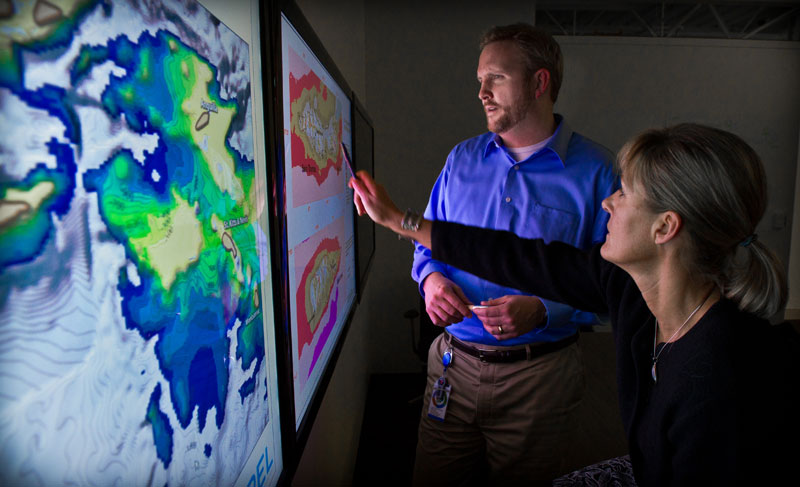
 NREL's Adam Warren, left, and Karen Petersen examine a map that shows the wind and sun resources of the U.S. Virgin Islands.
Credit: Dennis Schroeder
Credit: Dennis Schroeder
The tiny U.S. territory in the Caribbean has just 110,000 residents, all the beach, surf, wind and sun you'd ever want, but energy prices that are four to five times higher than are paid in the continental United States.
Like many islands on earth, the USVI are almost 100 percent dependent on imported oil for electricity. Residents pay about 47 cents per kilowatt hour to light their homes and run their appliances. Imported oil is even used to desalinate the water because there is so little fresh water available other than what residences catch on their roof in the form of rain water.
But USVI Gov. John P. de Jongh Jr., working with the U.S. Department of Energy's National Renewable Energy Laboratory (NREL) and the U.S. Department of Interior, has vowed to transform energy use dramatically. In January, at his State of the Territory address, he announced the goal of reducing use of fossil fuels by 60 percent in the next 15 years.
That's huge, and a great challenge, and just possibly a blueprint for how to achieve those similar reductions on the mainland.
"What we're attempting to do is integrate every large portion of renewable energy into our system," said Karl Knight, the director of USVI's energy office, who also is a board member of the Virgin Islands Water and Power Authority. Think of it as a pilot for how to integrate renewables as a large proportion of the grid."
To get there, a half dozen different technologies need to be implemented, and energy efficiency will have to become a rallying cry.
A Recipe for Energy Savings
 Enlarge image
 On a rooftop in St. Croix, U.S. Virgin Islands, an Energy Office intern inspects a solar collector.
Credit: Don Buchanan, USVI Energy Office
Credit: Don Buchanan, USVI Energy Office
The United States, New Zealand, and Iceland are three of the leading actors in the international partnership, Energy Development in Island Nations (EDIN), and for the United States, its Virgin Islands territory was a natural fit.
"We wanted to help USVI particularly because the governor was very committed to transforming the energy infrastructure, as was the CEO of their utility," NREL's Adam Warren, who heads NREL's EDIN program, said.
NREL has helped USVI — its government, utilities and public and private groups — to map the renewable energy potential, and to determine how to get to a 60 percent reduction by 2025. Early on, NREL produced a major technological report on grid integration, transmission and distribution.
"We think 60 percent is very realistic," Knight said. "The government established that goal in collaboration with NREL and the Island Nations global partnership. They challenged Gov. deJongh to be aggressive in his goal-setting and he took them up on it. We established the aggressive goal because we spend so much on The only thing that people in the Virgin Islands talk about is the size of their electric bills."
The high rates have hurt low-income residents and have been a deterrent to economic investment, Knight said. "If the rate is going to be 40 cents a kilowatt hour or more, it shapes the type of business that's willing to locate in the Virgin Islands," he said. "Our total dependence on oil for power generation in an era of expensive crude oil is having a huge impact."
USVI burns 2.6 million barrels of oil each year to generate electricity and desalinate water.
The recipe to achieve a 60 percent reduction:
2 percent biomass
3 percent landfill gas
3 percent solar
6 percent wind
8 percent waste-to-energy
38 percent energy efficiency
NREL's Karen Petersen said the most cost-effective way to reduce fossil-fuel use — the low-hanging fruit, so to speak — is "to help the utility become more efficient in its operations." Simple measures such as turning off lights in buildings and lowering the air conditioning use in tourist hotels also will help immensely.
"We're working to create a whole cultural shift," Petersen said. "They're very conservative in their use of energy because of need, but it doesn't necessarily revolve around an environmental ethic."
Island residents "had a healthy dose of skepticism" when the plan for more solar, wind and biomass was proposed because past proposals haven't kept their promises, Knight said. "But we have tried to convince the community that we're not promising lightning in a bottle. This is a 15-year strategy," Knight said. "We're using tried and commercially proven technologies, gathering up the best practices and working in close consultation with energy experts such as the folks at NREL.
"This is not a developer selling some Star Trek technology that is going to save the day," Knight added. "It's is going to be a gradual build-up to what we believe is a successful achievement of our goals."
Energy Transformation Isn't Easy
 Enlarge image
 The idyllic view of the coastline on St. Thomas, U.S. Virgin Islands, on Skyline Road near the capital Charlotte Amalie isn't spoiled by a 10-kilowatt photovoltaic system
Credit: Don Buchanan, USVI Energy Office
Credit: Don Buchanan, USVI Energy Office
"That's why we work with the entire community," said Warren. "In the past, they've seen systems go in by these fly-by-night developers that don't work the way they're supposed to.
"You need everyone on board — government, the private and public sectors to get something that big," Warren said. "We set up working groups to attack different areas — efficiency, renewables, transportation."
That's been key, Knight said. "We've been able to secure some good partnerships that have really put some effort into helping us achieve the goal. Through the assistance of NREL, we've established local working groups, both public sector and private sector and the participation of non-government organizations."
Some 80 percent of the USVI's economy is dependent on tourism. Tourist hotels use much more electricity, especially in the form of A/C, than does the average full-time resident. "If you're not using A/C, most of the load is going toward heating water or keeping the refrigerator cold," Warren said. In all, the household usage is about half of what it is in the United States — 450 kwh per month compared to 900 kwh.
Moving Renewables onto the Grid
One of the thorniest challenges is how to get so much renewable energy on the grid and still have it operate smoothly all hours of the day.
Solar and wind energy are variable — they surge onto the grid when the sun is shining and the wind is blowing, but trickle or stop when the winds calm and the sun sets, or even when a thick cloud passes by.
Happily for the USVI, the highest electrical use is when the sun is shining — and all those tourists want the air conditioning cranked up.
Still, the variability means that distributed systems make more sense. So, USVI likely will have small solar arrays on dozens of rooftops, and just a few of the larger solar projects; likewise, wind energy is likely to be distributed widely, with a mix of small turbines and some larger turbine farms.
Combining wind and solar energy with electricity generated from closed landfills and waste gives a nice balance of variable sources and so-called dispatchable sources — the kind that utilities can ramp up and down to match demand.
Tackling how to load a high rate of renewables onto the grid will help the mainland United States, too. "We as a nation want to figure out the problems associated with a high-penetration of renewables," Warren said. "We hope we can show that first in the islands like USVI and Hawaii.
Islanders Face Tough Choices
Virgin Islanders have heard horror stories about installed renewables that couldn't handle the load because the variability was too much, so part of NREL's job is to show how the proper steps with the right technology can make it a success.Island residents are leery of overloading the grid with too much renewable energy, but they're faced with the reality of 47 cents per kilowatt hour. They're facing serious tradeoffs, Warren said. "Do I pay my electricity bill or do I buy my medication?' is a real question that is forced on many."
"They're motivated to bring renewables on board and to conserve as much as possible because they need to," Petersen said. Businesses are closing daily because of the cost of electricity.
Optimism Grows from NREL/USVI Partnership
Knight is confident, and says NREL's participation has been crucial. "First, it has given the policy-makers the confidence that they're making the right decisions," Knight said. "To have a neutral party to discuss decisions with, to make sure that we are doing what is in the best interest of the population and the governor's goal, gives us and the policy makers credibility. We're able to say to the public, 'this isn't pie-in-the-sky.'"We've sat down with the greatest experts in the nation out in Golden, Colo., and discussed our plans — and they've endorsed them fully. We can tell the most passionate members of our community that we've had conversations with NREL and, yes, they've endorsed the proposed projects."
"Our first and foremost goal is to assist other small island nations to curb their appetites for fossil-fuel-derived energy and to provide a model on the cost and investment return on the latest technologies."
"We're hoping there's a lesson to be learned here to benefit larger systems. Hopefully, we can be the test bed for the rest of the nation and the globe."
Learn more about what NREL is doing to move clean energy technologies into the marketplace.
— Bill Scanlon
Virgin Islands Energy Reduction Plan
U.S. Virgin Islands Gov. John P. de Jongh, Jr., and other dignitaries and energy leaders traveled to the U.S. Department of Energy's National Renewable Energy Laboratory in February of 2010 to sign a memo of understanding that is the centerpiece of the plan to reduce consumption of fossil fuels on the islands by 60 percent.Here are some of the ways NREL and the Island government plan to pare the 2.5 million barrels of oil that were used in 2010.
Solar Energy: Photovoltaics and Solar Hot-Water Heating
Sixty-one thousand barrels can be saved if 40 percent of the USVI households take advantage of incentives to use the sun's energy to heat their hot water.Another 100,000 barrels a year can be saved via capturing photons for electricity. NREL helped design a half-megawatt solar energy system on St. Thomas. "A half a megawatt is small from our standpoint, but is highly visible for the Virgin Islands," NREL's Adam Warren said.
Now, 27 different companies have submitted proposals hoping to be chosen to build a 10-megawatts or more of photovoltaic system by late 2013.
Energy Efficiency
920,000 barrels of oil can be saved via better efficiency, including generation efficiency.A crucial strategy is to switch from a distillation system to a reverse-osmosis system to desalinate the water.
Wind Energy
178,000 barrels a year can be saved with 22.5 megawatts of wind energy. The plan is to deploy a mix of small and utility-scale wind turbines."The southern shore has a good wind resource that would probably come in at about 10 cents per kilowatt hour, vs. the 47 cents they're paying now," NREL's Adam Warren said.
Biomass, Landfill Gas and Waste-to-Energy
380,000 barrels can be saved each year by turning biomass into fuel, capturing and re-using the gas that forms below landfills, and turning waste into energy."We are very much engaged in a very rigorous public discourse on waste-to-energy," Karl Knight, the director of USVI's energy office, said. "People are concerned about emissions, as well as its impact on promoting recycling and waste reduction. But we believe using the best practices available those concerns about emissions can be addressed."
Subscribe to:
Posts (Atom)