Search This Blog

Showing posts with label microbe. Show all posts

Thursday, July 25, 2013

Microbial Who-Done-It For Biofuels


Shop Online at BestBuy.com.


New Technique Identifies Populations Within a Microbial Community Responsible for Biomass Deconstruction

JULY 25, 2013
Lynn Yarris (510) 486-5375  lcyarris@lbl.gov
 6 


News Release
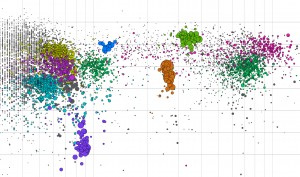
BlakeThe microbial world of biomass deconstruction became more clear with a JBEI/JGI/EMSL study of a thermophillic bacterial consortium adapted to switchgrass. This splatterplot is a visual representation of the consortium’s metagenome. (Image courtesy of Patrik D’haeseleer, JBEI)
The microbial world of biomass deconstruction became more clear with a JBEI/JGI/EMSL study of a thermophillic bacterial consortium adapted to switchgrass. This splatterplot is a visual representation of the consortium’s metagenome. (Image courtesy of Patrik D’haeseleer, JBEI)
One of the keys to commercialization of advanced biofuels is the development of cost-competitive ways to extract fermentable sugars from lignocellulosic biomass. The use of enzymes from thermophiles – microbes that thrive at extremely high temperatures and alkaline conditions – holds promise for achieving this. Finding the most effective of these microbial enzymes, however, has been a challenge. That challenge has now been met by a collaboration led by researchers with the U.S. Department of Energy (DOE)’s Joint BioEnergy Institute (JBEI).
Working with a compost-derived consortium of thermophillic bacterium adapted to grow on switchgrass, a leading potential fuel crop, and using a combination of metagenomic and metaproteomic technologies, the collaboration has identified individual microbial species whose enzymes were the most active in deconstructing the switchgrass biomass. Major institutes in addition to JBEI participating in this collaboration included DOE’s Joint Genome Institute (JGI), and EMSL, the Environmental Molecular Sciences Laboratory, a national scientific user facility at Pacific Northwest National Laboratory (PNNL).
“This marks the first time that the functional roles of individual microbial populations within a consortium have been linked with specific enzyme activities, in this case cellulase and hemicellulase,” says Steven Singer, director of JBEI’s microbial communities program. “Since these activities are broadly relevant to biofuel production, this is one of the first real-world applications being met by combining metagenomics and metaproteomics.”
Singer, who is also a research scientist with Lawrence Berkeley National Laboratory (Berkeley Lab)’s Earth Sciences Division, is the senior author of a paper describing this research in the journal PLOS One titled “Proteogenomic Analysis of a Thermophilic Bacterial Consortium Adapted to Deconstruct Switchgrass.” Co-authors are Patrik D’haeseleer, John Gladden, Martin Allgaier, Patrik Chain, Susannah Tringe, Stephanie Malfatti, Joshua Aldrich, Carrie Nicora, Errol Robinson, Ljiljana Paša-Tolić, Philip Hugenholtz and Blake Simmons.
Advanced biofuels – liquid transportation fuels synthesized from the sugars in cellulosic biomass – offer a clean, green and renewable alternative to gasoline, diesel and jet fuels. However, unlike the simple sugars in corn grain, the cellulose and hemicellulose in biomass are difficult to extract in part because they are embedded in a tough woody material called lignin. Thermophilic microbes are believed to be a rich source of cellulase and hemicellulase enzymes for lignocellulosic biomass deconstruction that are active at elevated temperatures and in the presence of pretreatment chemicals such as ionic liquids.
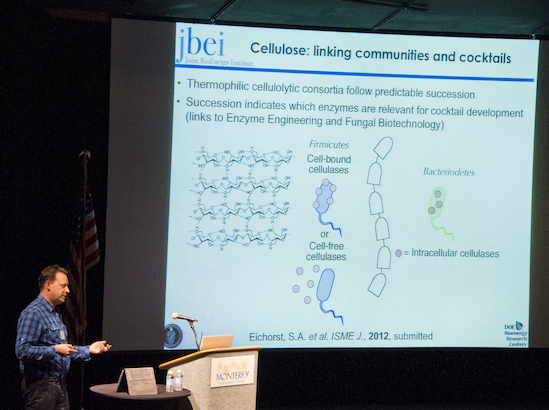
Steve Singer directs the Joint BioEnergy Insitute (JBEI)’s microbial communities program. (Photo by Roy Kaltschmidt, Berkeley Lab)
“Natural microbial communities that deconstruct biomass, such as those found in cow rumen or compost piles, are often too complex to decipher roles for individual microbial populations,” says Singer. “However, enrichment cultures established with defined substrates and at constant temperatures offer the possibility of simplifying these complex microbial communities and identifying functional roles for specific populations within the community.”
As part of their efforts to develop a cost-effective way to deconstruct lignocellulosic biomass into sugars for fuel, researchers in JBEI’s Deconstruction Division cultivated the switchgrass-feeding, compost-derived consortium of thermophiles.
“Using pretreated switchgrass at temperatures up to 80 degrees Celsius, we demonstrated that this consortium is an excellent source of enzymes for the development of enzymatic cocktails tailored to biorefinery processing conditions,” says Blake Simmons, a chemical engineer who heads JBEI’s Deconstruction Division and was a member of this research collaboration.
To identify the functional roles of community members within the switchgrass-feeding consortium, Singer, Simmons and their colleagues first used shotgun sequencing, a powerful metagenomics technique that enabled them to determine the metabolic potential of all the members of the consortium. They then used metaproteomic measurements to identify those enzymes, predicted by metagenomic analysis, that were actually produced by the microbial community.
“Doing metagenomics by shotgun sequencing is a bit like raiding a toy store and tossing hundreds of jigsaw puzzles onto a pile,” says Patrik D’haeseleer, a computational systems biologist who holds appointments with both JBEI and the Lawrence Livermore National Laboratory and is lead author of the PLOS One paper.
“Each individual puzzle piece may carry some useful information, but you only start to see the bigger picture once you reassemble the pieces,” D’haeseleer says. “Our collaborators at JGI used deep sequencing of millions of small pieces of DNA, and generated a partial assembly based on direct matches between the pieces. We developed a novel phylogenetic binning method to separate those partially assembled pieces into the major bacterial genomes in the consortium. This allowed us to then model the metabolic potential of all those members of the consortium.”
Analysis of metagenomic sequencing data identified the most abundant microbial populations in the consortium to be closely related strains of Thermus thermophilus andRhodothermus marinus. However, based on the assigned fractions of the switchgrass deconstruction proteome, the strains showing the most active role in switchgrass deconstruction were Gemmatimonadetes and Paenibacillus. By comparison, the more numerous Rhodothermus strain contributed fewer enzymes to biomass deconstruction
“By leveraging the unique capabilities of the JGI and EMSL with those at JBEI, we’re developing a more comprehensive functional understanding of how microbial consortia work to breakdown lignocellulose, and identifying the genes and enzymes that are responsible for this deconstruction,” Simmons says. “The list of genes and enzymes generated by this study has been placed into our expression pipeline and are being used to develop optimized cocktails that are capable of generating high sugar yields from pretreated lignocellulosic biomass.”
This research was supported by the DOE Office of Science.
# # #
JBEI is one of three Bioenergy Research Centers established by the DOE’s Office of Science in 2007. It is a scientific partnership led by Berkeley Lab and includes the Sandia National Laboratories, the University of California campuses of Berkeley and Davis, the Carnegie Institution for Science, and the Lawrence Livermore National Laboratory. DOE’s Bioenergy Research Centers support multidisciplinary, multi-institutional research teams pursuing the fundamental scientific breakthroughs needed to make production of cellulosic biofuels, or biofuels from nonfood plant fiber, cost-effective on a national scale.
DOE’s Office of Science is the single largest supporter of basic research in the physical sciences in the Unites States, and is working to address some of the most pressing challenges of our time.  For more information, please visit the Office of Science website atscience.energy.gov.
Additional Information
For more about the Joint BioEnergy Institute (JBEI) go here
For more about the Joint Genome Institute (JGI) go here
For more about EMSL, the Environmental Molecular Sciences Laboratory go here

Clean, Green High Performance Biofuels from Carbon Dioxide

AVG'S AWARD-WINNING PROTECTION!


JULY 24, 2013
Lynn Yarris (510) 486-5375  lcyarris@lbl.gov
 38 


Science Short
Jana Mueller was the lead author on a paper reporting that the bacterium Ralstonia eutropha has been engineered to produce diesel fuel from carbon dioxide. (Photo by Roy Kaltschmidt)
Could there come a time in which the carbon dioxide emitted from natural gas or coal-burning power plants that warms the atmosphere and exacerbates global climate change is harvested and used to produce clean, green and renewable liquid transportation fuels? A pathway to that possibility has been opened by a team of researchers with the U.S. Department of Energy (DOE)’s Joint BioEnergy Institute (JBEI) who have engineered a microbe now being used to produce biodegradable plastic into a strain that can produce a high-performance advanced biofuel.
“We’ve shown that the bacterium Ralstonia eutropha growing with carbon dioxide and hydrogen gas is able to generate significant quantities of diesel-range methyl ketones,” says Harry Beller, a JBEI microbiologist who led this research, which was funded through DOE’s Advanced Research Projects Agency-Energy (ARPA-E) program. “This holds the promise of making carbon-neutral biofuels using non-photosynthetic, carbon-dioxide fixing bacteria as a less resource-intensive alternative to making these biofuels from cellulosic biomass.”
Beller, who directs the Biofuels Pathways department for JBEI’s Fuels Synthesis Division, and also is a Senior Scientist with Berkeley Lab’s Earth Sciences Division, led a previous study in which genetic engineering was used to develop a strain of the bacteriumEscherichia coli (E. coli) that made methyl ketone compounds from the glucose in cellulosic biomass. Methyl ketones are naturally occurring aliphatic compounds now used in fragrances and flavorings. Beller and his JBEI colleagues have demonstrated that methyl ketones also have high diesel fuel ratings (cetane numbers), making them strong candidates as advanced biofuels.
“We’ve shown that, with the same set of genetic modifications, R. eutropha and E. coli can make comparable amounts of methyl ketones, but R. eutropha is making the ketones from carbon dioxide while E. coli is making them from glucose,” Beller says. “This shows that the methyl ketone pathway that we’ve designed is versatile and able to function well in bacterial hosts with substantially different metabolic lifestyles.”
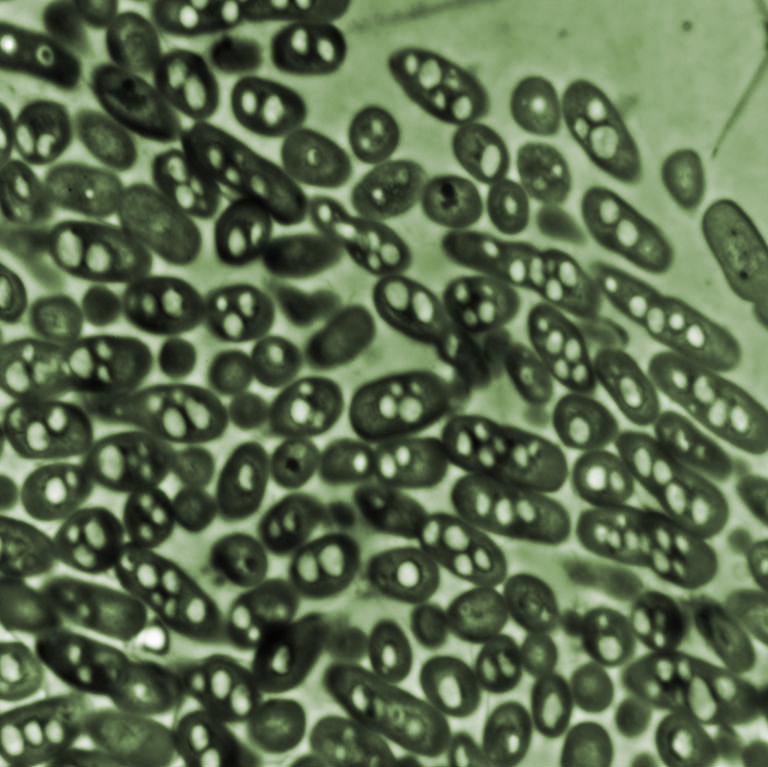
Micrograph shows Ralstonia eutropha bacteria in culture. (Image courtesy of Christopher Brigham, MIT)
Current strategies for producing advanced biofuels that could replace gasoline, diesel or jet fuels in today’s engines and infrastructures are based on extracting fermentable sugars stored in the cellulosic biomass of green plants. Those sugars represent chemical energy that was converted from solar energy via photosynthesis and provide the carbon atoms needed to make fuels. R. eutropha is a common soil bacterium that can naturally use hydrogen rather than sunlight as an energy source for converting carbon dioxide into various organic compounds. However, native strains of R. eutropha do not produce detectable levels of methyl ketones and generate very low levels of the fatty acids that are precursors to methyl ketones.
“Since our engineered strains of R. eutropha can use fixed carbon dioxide to make methyl ketones, its biofuels don’t require many of the steps needed to convert cellulosic biomass into fuels, such as growing and harvesting the biofuel crop, digesting the lignocellulosic biomass, and enzymatically saccharifying the digested biomass to produce fermentable  sugars,” Beller says. “The resources needed for these steps could therefore be eliminated if R. eutropha were used to make biofuels directly from carbon dioxide.”
Beller is the corresponding author of a paper in the journal AEM that describes this research titled “Engineering of Ralstonia eutropha H16 for Autotrophic and Heterotrophic Production of Methyl Ketones.” Co-authors are Jana Müller, Daniel MacEachran, Helcio Burd, Noppadon Sathitsuksanoh, Changhao Bi, Yi-Chun Yeh, Taek Soon Lee, Nathan Hillson, Swapnil Chhabra and Steven Singer.
For more about the Joint BioEnergy Institute (JBEI) go here

Sunday, January 22, 2012

Clearing a Potential Roadblock to Bisabolane

From the Lawrence Berkeley National Laboratory:


Clearing a Potential Roadblock to Bisabolane
Joint BioEnergy Institute Researchers Identify Key Enzyme Structure
January 09, 2012
Lynn Yarris (510) 486-5375  lcyarris@lbl.gov


JBEI researchers determined the structure of the AgBIS enzyme and found it to consist of three helical domains, the first three-domain structure ever found in a synthase of sesquiterpenes. This discovery holds importance for advanced biofuels and other applications.

The recent discovery that bisabolane, a member of the terpene class of chemical compounds used in fragrances and flavorings, holds high promise as a biosynthetic alternative to D2 diesel fuel has generated keen interest in the green energy community and the trucking industry. Now a second team of researchers with the U.S Department of Energy (DOE)’s Joint BioEnergy Institute (JBEI) has determined the three-dimensional crystal structure of a protein that is key to boosting the microbial-based production of bisabolane as an advanced biofuel.

The JBEI research team, led by bioengineers Paul Adams and Jay Keasling, solved the protein crystal structure of an enzyme in the Grand fir (Abies grandis) that synthesizes bisabolene, the immediate terpene precursor to bisabolane. The performance of this enzyme – the Abies grandis α-bisabolene synthase (AgBIS) – when engineered into microbes, has resulted in a bottleneck that hampers the conversion by the microbes of simple sugars into bisabolene.

“Our high resolution structure of AgBIS should make it possible to design changes in the enzyme that will enable microbes to make bisabolene faster,” says Adams, a leading authority on x-ray crystallography. “It should also enable us to engineer out inhibition effects that slow throughput, and perhaps also  engineer the enzyme to produce other kinds of fuels similar to bisabolane.”

Adams, who heads JBEI’s Technologies Division, is the corresponding author of a paper describing this work in the Cell Press journal Structure. The paper is titled “Structure of a Three-Domain Sesquiterpene Synthase: A Prospective Target for Advanced Biofuels Production.” Co-authoring it with Adams and Keasling were Ryan McAndrew, Pamela Peralta-Yahya, Andy DeGiovanni, Jose Pereira and Masood Hadi.

JBEI is one of three DOE Bioenergy Research Centers established by DOE’s Office of Science to advance the technology for the commercial production of advanced biofuels. It is a multi-institutional partnership led by the Lawrence Berkeley National Laboratory (Berkeley Lab) and headquartered in Emeryville, CA.


This past fall, JBEI researchers identified bisabolane as a potential new advanced biofuel that could replace D2 diesel, today’s standard fuel for diesel engines, with a clean, green, renewable alternative that’s produced in the United States. Using the tools of synthetic biology, the researchers engineered strains of bacteria and yeast to produce bisabolene from simple sugars, which was then hydrogenated into bisabolane. While showing much promise, the yields of bisabolene have to be improved for microbial-based production of bisabolane fuel to be commercially viable.

“The inefficient terpene synthase enzyme is one of the bottlenecks in the metabolic pathway used by the engineered microbes,” says Peralta-Yahya, a lead member of the earlier JBEI team as well as the current team. “Knowing the AgBIS crystal structure will guide us in engineering it for improved catalytic efficiency and stability, which should bring our bisabolene yields closer to economic competitiveness.”

Peralta-Yahya and her colleagues determined that the AgBIS enzyme consists of three helical domains, the first three-domain structure ever found in a synthase of sesquiterpenes – terpene compounds that contain 15 carbon atoms. The discovery of this unique structure holds importance on several fronts, as co-lead author of the Structure paper McAndrew explains.

“That we found the structure of AgBIS to be more similar to diterpene (20 carbon terpene compounds) synthases not only provides us with insight into the function of these less well characterized enzymes, it also provides us with clues to the evolutionary heritage as the archetypal three-domain terpenoid synthases became two-domain sesquiterpene synthases in plants. Furthering our knowledge of the structures and functions of terpenoid synthases may prove to have abundant practical applications aside from advanced biofuels because these enzymes produce a wide variety of specialized chemicals.”

Solving the three-dimensional crystal structure of AgBIS was made possible by the protein crystallography capabilities of Berkeley Lab’s Advanced Light Source (ALS), a DOE Office of Science national user facility for synchrotron radiation, and the first of the world’s third generation light sources. For this work, the JBEI team used three of the five protein crystallography beamlines operated by the Berkeley Center for Structural Biology (BCSB) – beamlines 8.2.1, 8.2.2, and 5.0.3.

“We needed to use multiple beamlines because we collected data on several crystals – the protein by itself, and the protein with different inhibitors/cofactors,” says Adams, who headed the  BCSB from 2004 to 2011. “Also, the approach we used to solve the AgBIS structure required high flux tunable x-rays such as those provided at 8.2.1 and 8.2.2, which are superbend beamlines.”

This research was supported by the DOE Office of Science.
# # #