Search This Blog

Saturday, July 27, 2013

Packed House in Tucson, Arizona for Energy Round Table Listening Session with Rural Utilities Administrator


BetterWorldBooks.com


USDA Blog Post:

Sorry Mr. Wolfe. As it turns out, you actually CAN go home again…and John Padalino recently did.
Padalino is the Administrator for the USDA Rural Utilities Service (RUS), a branch of USDA Rural Development. Born in south Tucson, Padalino grew up along the border where his father was a customs agent. Recently he was back in Tucson to facilitate a Rural Development Energy Round Table.
The round table was filled to capacity with participants that represented small businesses, solar companies, utilities, community action groups, tribes, contractors, and local governments.
The lively dialogue revolved around USDA’s renewable energy programs. Padalino began with a thumbnail of the various program areas—Renewable Energy for America Program (REAP), bioenergy, broadband/telecom, electric, and water. Participants gave input on how the programs are working for them…and were able to ask specific questions about projects and programs.
“This is when government works the best,” said Padalino, “when officials can have an open dialogue on how the programs are actually fitting the needs of users.”
Following the dialogue, Padalino and Arizona State Director Alan Stephens drove to Benson, Arizona, where Padalino was the keynote speaker at the Arizona Electric Power Cooperative (AEPCO) Generation and Transmission Conference.
While in Benson, Padalino received an email saying that President Barack Obama had just officially made him the administrator of RUS. He had been serving as acting administrator. The email encouraged him to get sworn in to the position at the earliest convenience.
Following the AEPCO conference Padalino and Stephens toured the USDA funded Tin Town wastewater project site with Bisbee Public Works Director Tom Klimek.
Arrangements were made to have the Bisbee City Clerk swear-in Padalino the following morning.  In Council Chambers the next morning City Clerk Gloria Gonzalez conducted the official swearing in.
“Being appointed by the President of the United States and then being sworn in to such a senior position is a memorable event under any circumstances,” said Stephens. “It was made even more so that this Arizona native could do so in the Bisbee City Council Chambers.”
Following the swearing in, Padalino and Stephens visited the Copper Queen Hospital in Bisbee where USDA had made a $7 million direct Community Facilities loan to remodel and expand the facility. They toured the new state-of-the-art emergency room.
Before heading back to Tucson for his flight back to D.C., Padalino and Stephens toured the Center for Academic Success and the Sunnyside Fire District’s new fire station in Douglas. Both projects were funded by USDA.

Friday, July 26, 2013

Wood-Boring Gribbles Intrigue Researchers


NREL News Release:

Wood-Boring Gribbles Intrigue Researchers

July 24, 2013
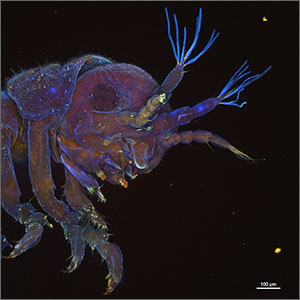
This is a light-enhanced close-up of a tiny crustacean's head and torso, with what looks like fluorescent-blue antennae. Three of its legs are showing.Enlarge image
A gribble is a tiny wood borer that produces its own enzyme that can devastate wood efficiently. Researchers hope that by studying gribbles they can learn ways to improve the process of turning biomass into liquid fuels.
Courtesy Laura Michie, University of Portsmouth, United Kingdom
Tiny wood borers known colloquially as gribbles make their own enzymes and use them to eat through docks in harbor towns, earning enmity from fishermen all around the world.
Now, researchers from the Energy Department's National Renewable Energy Laboratory (NREL) and elsewhere are exploring whether that curse can be turned into a blessing for the biofuels industry.
The trouble with gribbles — that they can break down biomass into sugars even in harsh environments — might become the great thing about gribbles, as the industry searches for enzymes that can thrive in salt-rich, high-solids settings.
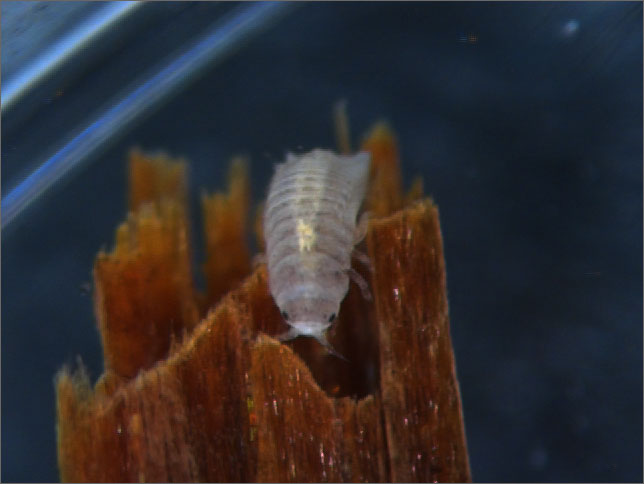
Gribbles (scientific name: Limnoria quadripunctata) are 1 to 3 millimeters long and have an organ called the hepatopancreas that extends almost the entire length of their bodies. This organ is where gribbles make their own enzymes. In other words, they don't rely, as termites, cows, and humans do, on the organisms that find their way into their stomachs to aid in digesting the food they eat.
The gribble enzymes also hold promise of tolerating salts better than other enzymes, likely due to the fact they evolved in a marine environment. These unique properties could teach biomass researchers how to make better enzymes that operate in a high-solids industrial environment, breaking biomass down more effectively into sugars, which can then be converted into ethanol or a renewable fuel to replace gasoline, diesel, or jet fuel.
And that could make the conversion of biomass to fuel both quicker and cheaper, say biofuels researchers from NREL, the University of Kentucky, and the Universities of York and Portsmouth in the United Kingdom. These scientists collaborated on a recent paper describing the crystal structure of a key enzyme produced by the gribble. The report was recently published in the Proceedings of the National Academy of Sciences of the United States of America. Britain's Biotechnology and Biological Science Research Council (the BBSRC) is funding the work by U.K. researchers. The Energy Department is funding the work by U.S. researchers.

Biofuels Industry Needs Super-Tough Enzymes
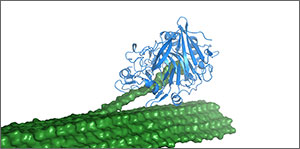
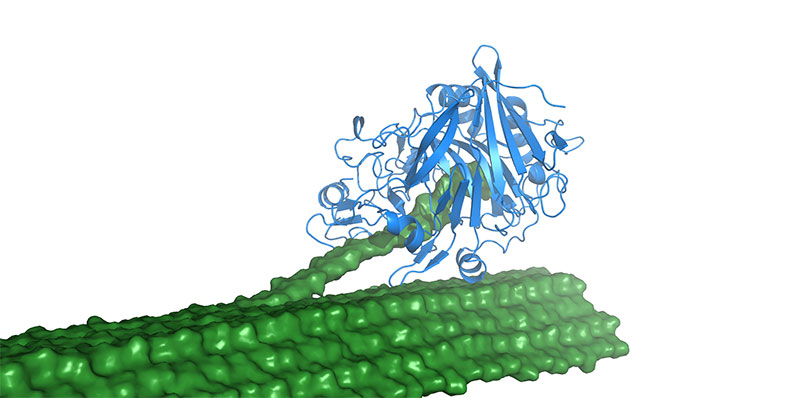
This is an illustration of an enzyme breaking down a molecule.Enlarge image
An illustration of the gribble's Cel7b enzyme at molecular scale.
Courtesy of John McGeehan, University of Portsmouth
The biofuels industry needs tough, efficient enzymes that are tolerant of harsh industrial conditions. NREL Senior Scientist Gregg Beckham, one of the authors of the paper, said gribbles are marine creatures, so the enzymes in the gribbles' guts would seem to naturally thrive in high-salt environments.
Enzymes are typically harvested from fungi because fungi are responsible for most of the biomass degradation in nature. Gribbles live in inner-tidal zones, mango groves, rainforests, harbors, and coves, devouring wood where they find it.
The little wood borers drew extra attention from biomass researchers after scientists from the Universities of York and Portsmouth in 2010 published the exciting news that the gribble produces an enzyme from an important family of cellulases (specifically Family 7 cellulases), that are usually found in fungi.
The gribble, in fact, has three Family 7 enzymes, the workhorses of industrial enzyme cocktails. One of them, dubbed Cel7B, is the subject of the latest paper describing its crystal structure.
"There are striking differences between the gribble enzyme and those derived from the fungi," Beckham said. "We have some suggestions that those differences may teach us a few new tricks in engineering enzymes for enhanced performance in an industrial setting."

Enzyme Thrives in Super Salty Water

The researchers' tests of Cel7B found that it remained active at more than six times the salt concentration of the sea. It even became slightly more effective in its ability to degrade biomass as salt concentration increased, Beckham noted.
"For biomass conversion, industry wants to push up to very high solids, with very little water around. The gribble enzyme has evolved in a harsh, high-solids environment in the gribble gut, so it could very well thrive."
That's important to the bottom line because "the less water you have in the process, the smaller your reactor can be," Beckham said. The smaller the reactor, the more concentrated the sugar product is, and the more money can be saved in a biofuels production plant.
The authors of the scientific paper proposed that the enzyme can teach important things about engineering industrial enzymes for biomass conversion. The Cel7B enzyme may provide clues as to how to design particular features of enzymes for greater stability in industrial settings.

Learning How it Adapts
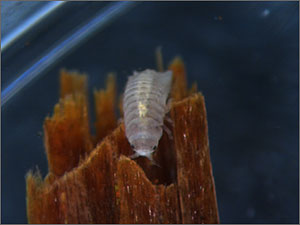
This photo shows a gribble, looking here like roly-poly bug, on a tree branch.Enlarge image
Gribbles live in inner-tidal zones, mango groves, rainforests, harbors and coves, devouring wood where they find it.
Courtesy Katrin Besser and Clare Steele-King, University of York.
The work leading to the paper gave the scientists a better understanding of how the organism adapts and survives — and that will be very useful as research on the gribble continues.
The U.K. researchers used X-ray diffraction to solve the structure of the gribble enzyme and biochemical techniques to understand its activity. NREL researchers applied high performance computing to simulate the structure solved by X-ray diffraction to get a dynamic picture of the enzyme.
The National Bioenergy Center and NREL's Biosciences Center were a natural fit for the project because among their most important missions is to design new and better enzymes.
Characterizing the gribble enzyme is crucial to understanding it. The knowledge acquired could help in the design of a better enzyme for degrading biomass, leading to a product that could better compete with petroleum.
Combining structural biology with molecular dynamics made it possible to characterize the enzyme at the molecular level, the researchers said. "They work really beautifully together because structural biology gives you a static picture, and molecular dynamics simulations can give you a dynamic picture," Beckham said.
Going forward, the researchers will use high performance computing to compare the gribble enzymes to similar enzymes from fungi. "We will be able to use what we learn to make better predictions about enzyme activity, whether the enzyme can be used directly in biomass conversion or can be modified to be more like fungal enzymes while retaining useful characteristics, such as the ability for some high-solids tolerance," Beckham said.
Learn more about the National Bioenergy Center and NREL's Biosciences Center.
— Bill Scanlon

NC Anaerobic Digester Receives Funding - REW - Renewable Energy from Waste

NC Anaerobic Digester Receives Funding - REW - Renewable Energy from Waste

Thursday, July 25, 2013

BMW vs. Tesla: The race heats up with the i3 - Jul. 25, 2013

BMW vs. Tesla: The race heats up with the i3 - Jul. 25, 2013

Microbial Who-Done-It For Biofuels


Shop Online at BestBuy.com.


New Technique Identifies Populations Within a Microbial Community Responsible for Biomass Deconstruction

JULY 25, 2013
Lynn Yarris (510) 486-5375  lcyarris@lbl.gov
 6 


News Release
BlakeThe microbial world of biomass deconstruction became more clear with a JBEI/JGI/EMSL study of a thermophillic bacterial consortium adapted to switchgrass. This splatterplot is a visual representation of the consortium’s metagenome. (Image courtesy of Patrik D’haeseleer, JBEI)
The microbial world of biomass deconstruction became more clear with a JBEI/JGI/EMSL study of a thermophillic bacterial consortium adapted to switchgrass. This splatterplot is a visual representation of the consortium’s metagenome. (Image courtesy of Patrik D’haeseleer, JBEI)
One of the keys to commercialization of advanced biofuels is the development of cost-competitive ways to extract fermentable sugars from lignocellulosic biomass. The use of enzymes from thermophiles – microbes that thrive at extremely high temperatures and alkaline conditions – holds promise for achieving this. Finding the most effective of these microbial enzymes, however, has been a challenge. That challenge has now been met by a collaboration led by researchers with the U.S. Department of Energy (DOE)’s Joint BioEnergy Institute (JBEI).
Working with a compost-derived consortium of thermophillic bacterium adapted to grow on switchgrass, a leading potential fuel crop, and using a combination of metagenomic and metaproteomic technologies, the collaboration has identified individual microbial species whose enzymes were the most active in deconstructing the switchgrass biomass. Major institutes in addition to JBEI participating in this collaboration included DOE’s Joint Genome Institute (JGI), and EMSL, the Environmental Molecular Sciences Laboratory, a national scientific user facility at Pacific Northwest National Laboratory (PNNL).
“This marks the first time that the functional roles of individual microbial populations within a consortium have been linked with specific enzyme activities, in this case cellulase and hemicellulase,” says Steven Singer, director of JBEI’s microbial communities program. “Since these activities are broadly relevant to biofuel production, this is one of the first real-world applications being met by combining metagenomics and metaproteomics.”
Singer, who is also a research scientist with Lawrence Berkeley National Laboratory (Berkeley Lab)’s Earth Sciences Division, is the senior author of a paper describing this research in the journal PLOS One titled “Proteogenomic Analysis of a Thermophilic Bacterial Consortium Adapted to Deconstruct Switchgrass.” Co-authors are Patrik D’haeseleer, John Gladden, Martin Allgaier, Patrik Chain, Susannah Tringe, Stephanie Malfatti, Joshua Aldrich, Carrie Nicora, Errol Robinson, Ljiljana PaÅ¡a-Tolić, Philip Hugenholtz and Blake Simmons.
Advanced biofuels – liquid transportation fuels synthesized from the sugars in cellulosic biomass – offer a clean, green and renewable alternative to gasoline, diesel and jet fuels. However, unlike the simple sugars in corn grain, the cellulose and hemicellulose in biomass are difficult to extract in part because they are embedded in a tough woody material called lignin. Thermophilic microbes are believed to be a rich source of cellulase and hemicellulase enzymes for lignocellulosic biomass deconstruction that are active at elevated temperatures and in the presence of pretreatment chemicals such as ionic liquids.
Steve Singer directs the Joint BioEnergy Insitute (JBEI)’s microbial communities program. (Photo by Roy Kaltschmidt, Berkeley Lab)
“Natural microbial communities that deconstruct biomass, such as those found in cow rumen or compost piles, are often too complex to decipher roles for individual microbial populations,” says Singer. “However, enrichment cultures established with defined substrates and at constant temperatures offer the possibility of simplifying these complex microbial communities and identifying functional roles for specific populations within the community.”
As part of their efforts to develop a cost-effective way to deconstruct lignocellulosic biomass into sugars for fuel, researchers in JBEI’s Deconstruction Division cultivated the switchgrass-feeding, compost-derived consortium of thermophiles.
“Using pretreated switchgrass at temperatures up to 80 degrees Celsius, we demonstrated that this consortium is an excellent source of enzymes for the development of enzymatic cocktails tailored to biorefinery processing conditions,” says Blake Simmons, a chemical engineer who heads JBEI’s Deconstruction Division and was a member of this research collaboration.
To identify the functional roles of community members within the switchgrass-feeding consortium, Singer, Simmons and their colleagues first used shotgun sequencing, a powerful metagenomics technique that enabled them to determine the metabolic potential of all the members of the consortium. They then used metaproteomic measurements to identify those enzymes, predicted by metagenomic analysis, that were actually produced by the microbial community.
“Doing metagenomics by shotgun sequencing is a bit like raiding a toy store and tossing hundreds of jigsaw puzzles onto a pile,” says Patrik D’haeseleer, a computational systems biologist who holds appointments with both JBEI and the Lawrence Livermore National Laboratory and is lead author of the PLOS One paper.
“Each individual puzzle piece may carry some useful information, but you only start to see the bigger picture once you reassemble the pieces,” D’haeseleer says. “Our collaborators at JGI used deep sequencing of millions of small pieces of DNA, and generated a partial assembly based on direct matches between the pieces. We developed a novel phylogenetic binning method to separate those partially assembled pieces into the major bacterial genomes in the consortium. This allowed us to then model the metabolic potential of all those members of the consortium.”
Analysis of metagenomic sequencing data identified the most abundant microbial populations in the consortium to be closely related strains of Thermus thermophilus andRhodothermus marinus. However, based on the assigned fractions of the switchgrass deconstruction proteome, the strains showing the most active role in switchgrass deconstruction were Gemmatimonadetes and Paenibacillus. By comparison, the more numerous Rhodothermus strain contributed fewer enzymes to biomass deconstruction
“By leveraging the unique capabilities of the JGI and EMSL with those at JBEI, we’re developing a more comprehensive functional understanding of how microbial consortia work to breakdown lignocellulose, and identifying the genes and enzymes that are responsible for this deconstruction,” Simmons says. “The list of genes and enzymes generated by this study has been placed into our expression pipeline and are being used to develop optimized cocktails that are capable of generating high sugar yields from pretreated lignocellulosic biomass.”
This research was supported by the DOE Office of Science.
# # #
JBEI is one of three Bioenergy Research Centers established by the DOE’s Office of Science in 2007. It is a scientific partnership led by Berkeley Lab and includes the Sandia National Laboratories, the University of California campuses of Berkeley and Davis, the Carnegie Institution for Science, and the Lawrence Livermore National Laboratory. DOE’s Bioenergy Research Centers support multidisciplinary, multi-institutional research teams pursuing the fundamental scientific breakthroughs needed to make production of cellulosic biofuels, or biofuels from nonfood plant fiber, cost-effective on a national scale.
DOE’s Office of Science is the single largest supporter of basic research in the physical sciences in the Unites States, and is working to address some of the most pressing challenges of our time.  For more information, please visit the Office of Science website atscience.energy.gov.
Additional Information
For more about the Joint BioEnergy Institute (JBEI) go here
For more about the Joint Genome Institute (JGI) go here
For more about EMSL, the Environmental Molecular Sciences Laboratory go here

Clean, Green High Performance Biofuels from Carbon Dioxide

AVG'S AWARD-WINNING PROTECTION!


JULY 24, 2013
Lynn Yarris (510) 486-5375  lcyarris@lbl.gov
 38 


Science Short
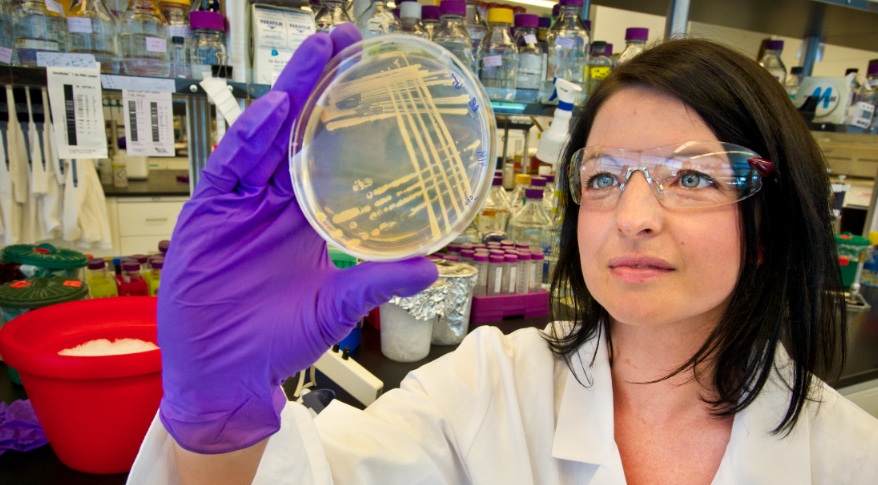
Jana Mueller was the lead author on a paper reporting that the bacterium Ralstonia eutropha has been engineered to produce diesel fuel from carbon dioxide. (Photo by Roy Kaltschmidt)
Could there come a time in which the carbon dioxide emitted from natural gas or coal-burning power plants that warms the atmosphere and exacerbates global climate change is harvested and used to produce clean, green and renewable liquid transportation fuels? A pathway to that possibility has been opened by a team of researchers with the U.S. Department of Energy (DOE)’s Joint BioEnergy Institute (JBEI) who have engineered a microbe now being used to produce biodegradable plastic into a strain that can produce a high-performance advanced biofuel.
“We’ve shown that the bacterium Ralstonia eutropha growing with carbon dioxide and hydrogen gas is able to generate significant quantities of diesel-range methyl ketones,” says Harry Beller, a JBEI microbiologist who led this research, which was funded through DOE’s Advanced Research Projects Agency-Energy (ARPA-E) program. “This holds the promise of making carbon-neutral biofuels using non-photosynthetic, carbon-dioxide fixing bacteria as a less resource-intensive alternative to making these biofuels from cellulosic biomass.”
Beller, who directs the Biofuels Pathways department for JBEI’s Fuels Synthesis Division, and also is a Senior Scientist with Berkeley Lab’s Earth Sciences Division, led a previous study in which genetic engineering was used to develop a strain of the bacteriumEscherichia coli (E. coli) that made methyl ketone compounds from the glucose in cellulosic biomass. Methyl ketones are naturally occurring aliphatic compounds now used in fragrances and flavorings. Beller and his JBEI colleagues have demonstrated that methyl ketones also have high diesel fuel ratings (cetane numbers), making them strong candidates as advanced biofuels.
“We’ve shown that, with the same set of genetic modifications, R. eutropha and E. coli can make comparable amounts of methyl ketones, but R. eutropha is making the ketones from carbon dioxide while E. coli is making them from glucose,” Beller says. “This shows that the methyl ketone pathway that we’ve designed is versatile and able to function well in bacterial hosts with substantially different metabolic lifestyles.”
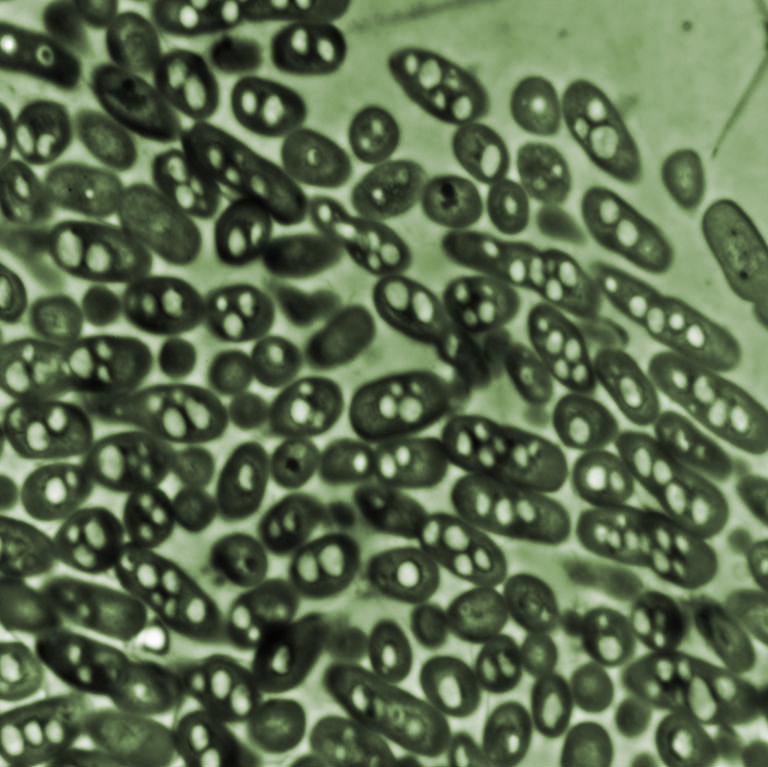
Micrograph shows Ralstonia eutropha bacteria in culture. (Image courtesy of Christopher Brigham, MIT)
Current strategies for producing advanced biofuels that could replace gasoline, diesel or jet fuels in today’s engines and infrastructures are based on extracting fermentable sugars stored in the cellulosic biomass of green plants. Those sugars represent chemical energy that was converted from solar energy via photosynthesis and provide the carbon atoms needed to make fuels. R. eutropha is a common soil bacterium that can naturally use hydrogen rather than sunlight as an energy source for converting carbon dioxide into various organic compounds. However, native strains of R. eutropha do not produce detectable levels of methyl ketones and generate very low levels of the fatty acids that are precursors to methyl ketones.
“Since our engineered strains of R. eutropha can use fixed carbon dioxide to make methyl ketones, its biofuels don’t require many of the steps needed to convert cellulosic biomass into fuels, such as growing and harvesting the biofuel crop, digesting the lignocellulosic biomass, and enzymatically saccharifying the digested biomass to produce fermentable  sugars,” Beller says. “The resources needed for these steps could therefore be eliminated if R. eutropha were used to make biofuels directly from carbon dioxide.”
Beller is the corresponding author of a paper in the journal AEM that describes this research titled “Engineering of Ralstonia eutropha H16 for Autotrophic and Heterotrophic Production of Methyl Ketones.” Co-authors are Jana Müller, Daniel MacEachran, Helcio Burd, Noppadon Sathitsuksanoh, Changhao Bi, Yi-Chun Yeh, Taek Soon Lee, Nathan Hillson, Swapnil Chhabra and Steven Singer.
For more about the Joint BioEnergy Institute (JBEI) go here

Wednesday, July 24, 2013

Energy Department, EU Partner on EV and Smart Grid Coordination


BetterWorldBooks.com


This is an excerpt from EERE Network News, a weekly electronic newsletter.

July 24, 2013

Energy Department, EU Partner on EV and Smart Grid Coordination

Electric vehicles (EV) seem to be everywhere these days. As Secretary Moniz highlighted on July 19, plug-in hybrid sales doubled in the first six months of 2013 compared to the same period in 2012—and sales are only expected to grow as the next generation of cars and grid systems demonstrate even greater cost saving for consumers.
That is why the Energy Department launched a new center recently that will work to ensure that vehicles, charging stations, communications and networking systems work in unison with the electric grid. The Electric Vehicle-Smart Grid Interoperability Center, located at Argonne National Laboratory just outside of Chicago, will work to harmonize emerging EV and smart grid technologies.
Why is this important? The emergence of EVs brings new economic opportunities for local utilities. Large-scale capital investment by companies for the deployment of EVs, chargers and the smart grid will depend on the ability of consumers to conveniently, safely and securely charge—anywhere, anytime. This will require close linkages between the automotive and utility industries as new demand for electricity brings the need for new investments in power generation and grid systems. For the complete story, see the Energy Blog.