North Carolina company's Maverick Oasis BG gas-to-liquid methanol plant converts biogas from a range of waste products.
Maverick Synfuels to market biogas-to-methanol pla - Renewable Energy From Waste
Sunday, March 8, 2015

Two Executives Indicted for Scheming to Defraud Chicago and Other Governments of Grant Funds Intended to Establish Charging Stations for Electric Vehicles
FBI Chicago Division Press Release:
Two Executives Indicted for Scheming to Defraud Chicago and Other Governments of Grant Funds Intended to Establish Charging Stations for Electric Vehicles
Two Executives Indicted for Scheming to Defraud Chicago and Other Governments of Grant Funds Intended to Establish Charging Stations for Electric Vehicles
| U.S. Attorney’s OfficeMarch 04, 2015 |
CHICAGO—Owners of a green tech startup company that installed and maintained charging stations for plug-in electric vehicles were indicted yesterday for allegedly engaging in a scheme to fraudulently obtain federal and state grant funds, from the City of Chicago, the State of Pennsylvania Department of Environmental Protection, and two California entities: the Bay Area Air Quality Management District, and the Association of Bay Area Governments.
Defendants Mariana Gerzanych, 36, and Timothy Mason, 58, both of California, were coowners of 350Green LLC of Los Angeles, California, which purported to install and maintain charging stations for plug in electric vehicles. Between 2010 and 2012, 350Green obtained over $2.9 million in grants from the City of Chicago, the Pennsylvania Department of Environmental Protection, the Association of Bay Area Governments, and the Bay Area Air Quality Management District, to install and maintain public electric vehicle charging stations.
Gerzanych and Mason were each charged with five counts of wire fraud in an indictment returned by a federal grand jury yesterday and announced today. They will appear before U.S. District Court for arraignment at a later date. According to the indictment, between August 2010 and September 2012, as principals of 350Green, Mason and Gerzanych applied for and received over $2.9 million in grants from the City of Chicago, the Pennsylvania Department of Environmental Protection, the Association of Bay Area Governments, and the Bay Area Air Quality Management District. The grant funds were intended to support installation and operation of charging stations for electric vehicles. In particular, the indictment alleges that, in order to obtain grant funds, Mason and Gerzanych falsely claimed that a company called Actium Power had supplied Level 3 DC fast chargers to 350Green and that 350Green had paid Actium Power for those chargers, when in fact Actium Power did not supply the chargers, and the actual manufacturer of the chargers was never paid. Further, the indictment alleges that, in order to obtain the grant funds, 350Green submitted claims to the City of Chicago falsely representing that subcontractors and vendors had been paid when in fact, they had not.
As a result of Mason and Gerzanych’s false claims, the City of Chicago and the State of Pennsylvania Department of Environmental Protection paid 350Green. In order to cover up the scheme, the indictment further alleges that Mason and Gerzanych made false statements to 350Green’s governmental partners regarding 350Green’s financial status and reasons for 350Green’s financial difficulties.
Each count of the indictment carries a maximum penalty of 20 years in prison and a $250,000 fine. If convicted, the Court must impose a reasonable sentence under federal statutes and the advisory United States Sentencing Guidelines. The indictment also seeks forfeiture of approximately $1.9 million.
“These grant funds were intended to help communities live in a more eco-friendly way. The Department of Justice will not tolerate fraud at the expense of such an important mission,” said Zachary T. Fardon, United States Attorney for the Northern District of Illinois.
“There will always be those who see innovation as just another mark for fraud and deception, so we are gratified by the continuing collaboration with our federal partners in stopping old school exploitation of new programs directed at tomorrow’s challenges,” said Inspector General Joseph Ferguson.
The charges were announced by Zachary T. Fardon, United States Attorney for the Northern District of Illinois; Robert J. Holley, Special Agent-in-Charge of the Chicago Office of the Federal Bureau of Investigation; Joseph Ferguson, Inspector General for the City of Chicago; and John R. Hartman, Deputy Inspector General for Investigations of the U.S. Department of Energy Office of Inspector General. Also participating in the investigation was the Harrisburg, Pennsylvania Office of the Federal Bureau of Investigation.
The government is being represented by Assistant United States Attorney Maureen E. Merin.
The public is reminded that an indictment contains only charges and is not evidence of guilt. The defendants are presumed innocent and are entitled to a fair trial at which the government has the burden of proving guilt beyond a reasonable doubt.
This content has been reproduced from its original source.
Thursday, March 5, 2015
Topaz Solar Farm, California
From NASA's Earth Observatory:

Topaz Solar Farm, California
The new 550 megawatt facility in California produces enough electricity to power 180,000 homes. Read more at http://
#eartheveryday
Topaz Solar Farm, California
The new 550 megawatt facility in California produces enough electricity to power 180,000 homes. Read more at http://
#eartheveryday
Tuesday, March 3, 2015
Save Energy with USDA Rural Development
From USDA:
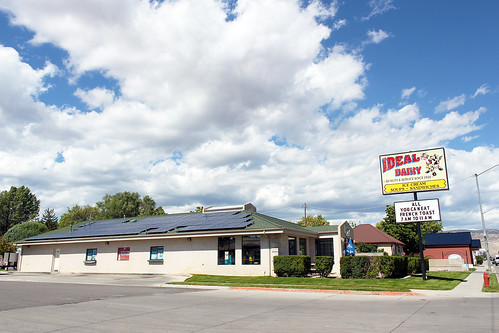
The recently installed solar panels on the roof of Ideal Dairy in Richfield, Utah save them around $400 per month in utility costs on average.
Last month, Secretary Vilsack announced the opening of the new application cycle for our Rural Energy for America Program (REAP). In addition to the announcement, RBS conducted a national REAP stakeholder forum which discussed program changes and provided examples of successful projects from previous years.
For example, Ideal Dairy restaurant of Richfield, Utah used a REAP grant to leverage a loan from Zions Bank and install an array of solar panels on the roof of its retail location. The addition has saved an average of $400 a month in electricity expenditures for owners Kristi and Gary Sorenson. A larger scale solar project in Guayanila, Puerto Rico allowed a major employer – Master Paints and Chemicals Corporation – to completely offset its $180,000 annual energy expenses and give it independence from fossil fuel-based energy.
Solar panels are just one example of what can be done with REAP. The 2014 Farm Bill provided funding for the Rural Energy for America Program (REAP), for energy efficiency improvements for agricultural producers and rural small businesses. These can include new, high efficiency heating and cooling equipment, efficient windows and insulation, and even wind turbine or hydroelectric projects.
I’ve just returned from speaking with the Independent Community Bankers of America at their annual convention. We discussed options for leveraging REAP and other Rural Business programs – and it’s through partnerships with our rural bankers that we’re able to leverage Federal funding and improve access to capital in our rural communities. That amplifies the effect and reach of our Rural Energy for America Program guarantees and grants.
I encourage folks interested in the program to check out our Rural Energy for America Program information sheet to learn more. We’re also going to be holding informational webinars – we’re calling them ‘REAP Round-ups’. These webinars will hold valuable information for folks considering applying for funding, as well as allow participants to ask questions. We held our first REAP Round-up to discuss energy efficiency improvements on February 18. For those who didn’t attend, we recorded it for you to go back and watch at your convenience. We have two more coming, with a discussion on renewable energy systems on March 11, and a session on energy project financing with loan guarantees on April 2. We’ll record those as well just in case you miss them – and you’ll be able to find the recorded versions at the same link.
USDA Rural Development is leading the way in providing financial support for rural small business owners who are improving their energy efficiency and developing renewable energy resources.
Monday, March 2, 2015
NREL Refines Method to Convert Lignin to Nylon Precursor
From NREL:
NREL Refines Method to Convert Lignin to Nylon Precursor
Recent Findings Published in Energy & Environmental Science
Thursday, February 26, 2015
A new study from the Energy Department's National Renewable Energy Laboratory (NREL) demonstrates the conversion of lignin-derived compounds to adipic acid, an important industrial dicarboxylic acid produced for its use as a precursor to nylon, plasticizers, lubricants, polyesters, and other popular products and chemicals.
The demonstration is an important step toward the goal of garnering more uses from lignin, which could be crucial for the economic success of the biofuels industry. It also shows that adipic acid can be produced from a renewable resource, which might have important ramifications for mitigating greenhouse gases.
Published in Energy & Environmental Science, the research in "Adipic acid production from lignin" demonstrates how lignin-derived compounds can first be converted to muconic acid via a biological process. Muconic acid can then be separated from the biological culture and catalytically converted into adipic acid. A patent application has been filed on this research, and the NREL Technology Transfer Office will be working with researchers to identify potential licensees of the technology.
The potential impact of this study is revealed by a quick review of the production numbers of adipic acid. Approximately 2.5 million tons of adipic acid are produced each year, mainly as a precursor for the production of nylon, and this global demand is expected to increase by up to 3.5% annually. Nylon is one of the most abundant materials in the world, used in everything from carpet and ropes to clothing and toothbrushes. With more than 4 million metric tons of nylon manufactured annually around the world, capitalizing on the production of adipic acid from lignin-derived aromatic molecules could one day have a significant impact on the bottom line of lignocellulosic biorefineries.
"The current industrial pathway to produce adipic acid involves oxidation of cyclohexanol and cyclohexanone with nitric acid, which is a harsh process that produces nitrous oxide that must be cleaned up," said Gregg Beckham, senior engineer at NREL and a co-author of the study. "The development of a new process toward converting renewable lignin feedstocks to adipic acid could potentially provide positive economic benefits and greenhouse gas offsets, but, certainly, major technology improvements must still be made."
Lignin is one of the most abundant organic materials on Earth (second only to cellulose), and it potentially offers a vast, renewable source for the sustainable production of fuels, chemicals, and materials. Valorization of lignin has been shown by techno-economic analysis conducted at NREL to be essential to the development and success of the biofuels industry. However, because it is inherently difficult to remove from biomass, lignin is currently underutilized in fuel and chemical production.
"While our research is still in the concept stage, this gets us one step closer to improving the technology to expand the slate of molecules that can be viably produced from lignin," Beckham said. "As more lignocellulosic biorefineries come on line, large quantities of lignin will be generated, and valorization of these waste streams could eventually play a key role for the economic viability and environmental sustainability of biorefineries."
The work reported in Energy & Environmental Science was funded by the Energy Department's Bioenergy Technologies Office.
NREL is the U.S. Department of Energy's primary national laboratory for renewable energy and energy efficiency research and development. NREL is operated for the Energy Department by The Alliance for Sustainable Energy, LLC.
###
NREL: News Feature - NREL Science Crucial to Success of New Biofuels Plants
The Energy Department's National Renewable Energy Laboratory (NREL) played crucial roles in the technology that has led companies DuPont, POET, and Abengoa to open commercial-scale facilities to turn biomass into clean transportation fuels.
Combined, the three facilities are a huge step toward meeting the Department's goals of producing clean energy from the non-food parts of plants, creating good American jobs, mitigating greenhouse gases, and boosting America's energy security.
NREL: News Feature - NREL Science Crucial to Success of New Biofuels Plants
Sunday, March 1, 2015
N P awarded Global Cemfuels alternative fuel suppl - Renewable Energy From Waste
Company plans to deliver waste-derived fuels to several new European countries this year.
N P awarded Global Cemfuels alternative fuel suppl - Renewable Energy From Waste
N P awarded Global Cemfuels alternative fuel suppl - Renewable Energy From Waste
Subscribe to:
Posts (Atom)