From the U.S. Department of Energy Office of Energy Efficiency and Renewable Energy:
This #hospital, dedicated to taking care of Northern California’s military #veterans, improved its #energy efficiency in large part due to an Energy Department program. For #TBT, we go back to 1997 when our Federal Energy Management Program (FEMP) awarded the first in a series of six regional “Super Energy Savings Performance Contracts (ESPCs)” to help government agencies improve their energy efficiency and reduce taxpayer costs. The San Francisco VA Medical Center (pictured) was among the first federal facilities to award an ESPC to an energy service company using our contract. ESPCs enable federal agencies to fund building upgrades such as heating, cooling, lighting, and building automation systems without up-front costs. Recently, we announced a new solicitation that will spur more energy efficiency and renewable energy improvements at federal government facilities across the #US. Learn more: http://go.usa.gov/3grPJ.
Search This Blog
Showing posts with label renewable energy. Show all posts
Thursday, April 2, 2015
Thursday, March 5, 2015
Topaz Solar Farm, California
From NASA's Earth Observatory:
Topaz Solar Farm, California
The new 550 megawatt facility in California produces enough electricity to power 180,000 homes. Read more at http:// earthobservatory.nasa.gov/ IOTD/ view.php?id=85403&src=fb
#eartheveryday
Topaz Solar Farm, California
The new 550 megawatt facility in California produces enough electricity to power 180,000 homes. Read more at http://
#eartheveryday
Monday, January 12, 2015
Investing in the Future of Maine's Great Outdoors with Renewable Energy
From USDA:
Posted by Virginia Manuel, Maine State Director, USDA Rural Development, on January 12, 2015 at 10:30 AM

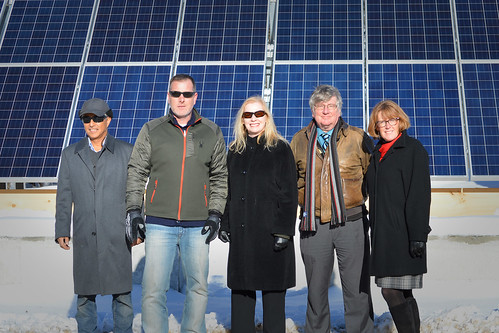
Standing in front of the solar array at Mt. Abram, Maine’s first solar-powered ski area are Solar Market Owner Naoto Inoue; Mt. Abram Owner Matthew Hancock; USDA Rural Development State Director Virginia Manuel; Senator Angus King's representative, Ben Tucker; and Senator Susan Collins' representative, Carlene Tremblay.
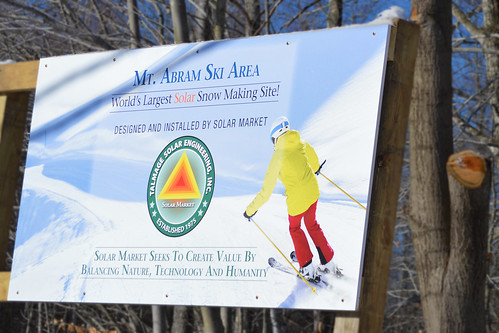
Recently I had the privilege of joining Matthew Hancock and his team at Mt. Abram, a unique, sustainable ski area located in the mountains of Western Maine. An immense 803 panel solar photovoltaic system greeted gatherers as they drove in, the result of a Renewable Energy for America Program (REAP) Grant awarded by Maine USDA Rural Development. The system in Greenwood is the second largest solar project in the country for a ski area, the first ever in Maine, and as a sign next to the solar panels boasts, it is also the “World’s Largest Snow Making Site.”
This important project was made possible in part by a USDA Rural Development Rural Energy for America Program Grant, which provided $235,000 of the $940,000 total project cost. Matt’s business will benefit significantly, with 70 percent of operations at the ski area operating on solar generated power, while skiers and nature enthusiasts will appreciate its green, carbon emission-reducing features, making Mt. Abram truly “Maine’s Sustainable Mountain Playground.” In addition to its solar features, Mt. Abram heats the lodge with wood pellets and was the second ski area in North America to install electric vehicle chargers.
Mt. Abram expects to draw 40,000 skiers to its mountain this winter season, with many from out of state coming to take advantage of our snowy winters! These ski enthusiasts will patronize the local restaurants, shops, and lodging facilities in the rural communities surrounding the ski area and helps to support 125 vital jobs at Mt. Abram.

Mt. Abram is the world’s largest solar snow making site.
In addition to supporting USDA’s America’s Great Outdoors initiative, this project joins a long line of renewable energy firsts here in Maine that have been supported by USDA Rural Development. Other landmark renewable energy projects include Maine’s first net-zero solar greenhouse, Cozy Acres, in North Yarmouth; Maine’s first net-zero solar affordable housing complex, Brookside Village senior housing, in Farmington; and Maine’s first affordable solar wharf, Potts Harbor Lobster Company wharf, in Harpswell.
We have a responsibility for good stewardship of our outdoor spaces, and going forward, USDA Rural Development’s renewable energy programs will continue to help preserve the pristine beauty of Maine’s natural resources!

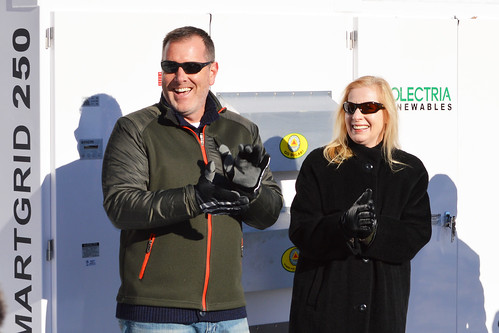
Matt Hancock and Virginia Manuel celebrate after throwing a switch and officially commissioning the solar panels.
Friday, September 13, 2013
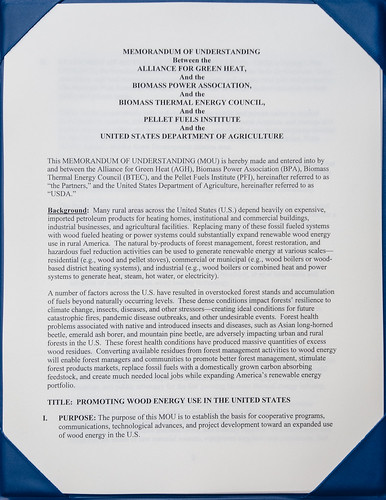
Funds Promote Development of Rural Wood to Energy Projects
USDA Blog Post:
Posted by Patrick Holmes, Special Assistant, Natural Resources and Environment, on September 13, 2013 at 1:00 PM

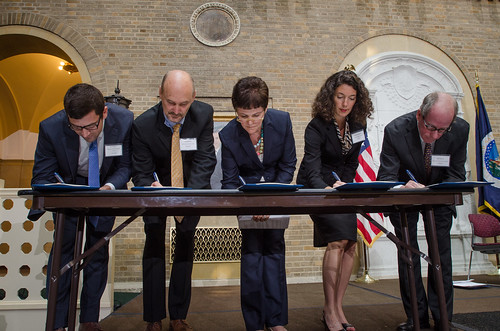
U.S. Department of Agriculture (USDA) Bioenergy Memorandum of Understanding is signed by wood energy partners (left - right) Biomass Thermal Energy Council, Executive Director Joseph Seymour; Alliance for Green Heat, President John Ackerly; USDA Deputy Agriculture Secretary Krysta Harden; Pellet Fuels Institute Executive, Director Jennifer Hedrick; Biomass Power Association, President and CEO Bob Cleaves, at the USDA Headquarters in Washington, D.C. on September 11, 2013. USDA Photo by Lance Cheung.
Earlier this week, USDA, U.S. Forest Service and partners took a major step to improve forest management, create rural jobs, prevent wildfires, and expand promising renewable energy opportunities.
Deputy Secretary Krysta Harden joined leaders from the Alliance for Green Heat, the Biomass Power Association, the Biomass Thermal Energy Council, and the Pellet Fuels Institute here in Washington for the announcement of a new partnership agreement. Acting as master of ceremonies for the signing event was Acting USDA Rural Development Under Secretary Doug O’Brien. Through the Rural Energy for America program and other programs, Rural Development has been a leader in promoting deployment of wood-to-energy projects.
This agreement focuses on promoting wood energy nationwide to reduce fire risk, bolster rural economic development, improve air quality and help meet the Obama Administration’s “All of the Above” renewable energy and energy efficiency goals. The organizations support the use of wood energy across the scale of users – from residential users, to commercial and institutional facilities, to industrial production of heat and/or electricity to drive businesses and feed the electrical grid.
For more than a decade, USDA has supported wood energy as part of a forest restoration economy. Since 2009 USDA has invested over $956 million (nearly $1 billion) through grants, loans, and loan guarantees to support over 200 wood energy projects across the country.
Led by the Forest Service, this work helps to restore the health of forests and watersheds, provide rural areas with cost-effective energy alternatives, and create new income and employment opportunities in sectors ranging from engineering and construction, to manufacturing and forestry. It also provides an economical alternative to fuel oil heating in areas where natural gas supplies are limited. USDA’s Rural Development mission area and the Farm Services Agency also support wood energy through a variety of grants, loans, and loan guarantees. All told, USDA agencies contributed over $500 million last year to support wood energy.
The Deputy Secretary also announced the award of over $1 million dollars in grants to develop wood energy teams with Alaska, California, Idaho, Minnesota and New Hampshire. These cooperative agreements signal that successful wood energy projects and forest restoration efforts demand partnership at all levels as well as the sustained commitment of many and diverse forest users. The federal funds will leverage $1.8 million in non-federal investments.
Grant recipients are:
Idaho Governor’s Office of Energy Resources, Boise
The Watershed Research & Training Center, Hayfork, Calif.
Minnesota Department of Natural Resources, Saint Paul
North Country Resource Conservation & Development Council, Gilford, N.H.
The Alaska Energy Authority, Anchorage
For more information on the cooperative agreement program, visit http://na.fs.fed.us/werc/wood-energy/. For more information on USDA’s renewable energy programs click here.

U.S. Department of Agriculture (USDA) Deputy Secretary Krysta Harden hosts the signing of the USDA Bioenergy Memorandum of Understanding and was joined by leaders for the announcement of the new partnership agreement at the USDA Headquarters in Washington, D.C. on September 11, 2013. USDA Photo by Lance Cheung.
Labels:
Alaska,
bioenergy,
California,
Doug O'Brien,
energy efficiency,
forestry,
FS,
FSA,
Idaho,
jobs,
Minnesota,
MOU,
New Hampshire,
RD,
REAP,
renewable energy,
Washington DC,
watersheds,
wildfires,
Wood to Energy
Tuesday, July 2, 2013
USDA Blog » Acting Under Secretary Discusses USDA’s Role in Building Support for Aviation Biofuels
Labels:
bioeconomy,
biofuels,
Chicago,
Climate Change,
conservation,
Department of Energy,
Department of the Navy,
DOE,
Doug O'Brien,
Economic Growth,
energy,
FAA,
RD,
renewable energy,
rural communities,
Rural Development
Sunday, December 18, 2011
(Archived Article) Portugal Gives Itself a Clean-Energy Makeover
The contents of this post were gleaned from a New York Times article with the above title. The original article was published August 9, 2010.
Five years ago, the leaders of Portugal decided to harness the country’s wind, hydropower, sunlight, and ocean waves.
Nearly 45% of the electricity in Portugal’s grid will come from renewable sources this year, up from 17% just five years ago.
Land-based wind power has expanded sevenfold in that time. And Portugal expects in 2011 to become the first country to inaugurate a national network of charging stations for electric cars.
Portugal has little fossil fuel of its own.
Portugal participates in the European Union’s version of cap and trade.
Portuguese households have long paid about twice what Americans pay for electricity.
To force Portugal’s energy transition, the prime minister’s government restructured and privatized former state energy utilities to create a grid better suited to renewable power sources. To lure private companies into Portugal’s new market, the government gave them contracts locking in a stable price for 15 years.
Portugal has large untapped resources of wind and river power, the two most cost-effective renewable sources.
While the government estimates that the total investment in revamping Portugal’s energy structure will be about 16.3 billion euros, that cost is borne by the private companies that operate the grid and the renewable plants and is reflected in consumers’ electricity rates. The companies’ payback comes from the 15 years of guaranteed wholesale electricity rates promised by the government. Once the new infrastructure is completed, it is expected that the system will cost about 1.7 billion euros a year less to run than if formerly did, primarily by avoiding natural gas imports.
To ensure a stable power base when the forces of nature shut down, the system needs to maintain a base of fossil fuel that can be fired up at will.
Portugal began upgrading its grid of transmission lines a decade ago. Accommodating a greater share of renewable power cost an additional 480 million euros, an expense folded into electricity rates.
Environmental and conservation groups are concerned about the effects of so many new wind turbines and dams on wildlife and habitat.
Renewable energy has not created many green jobs.
Saturday, December 17, 2011
(Archived Article) Wind Turbine Projects Run Into Resistance
This post summarizes an interesting New York Times article with the above title that was published on or about September 9, 2010. (When I download an article from my Kindle to my computer, the date recorded is the date of the download, not the date of publication.)
Although this article did not contain many of the numbers that I am so fond of, it still highlighted a problem that does not receive much discussion. People interested in the proper siting of wind turbines should take note.
BARSTOW, Calif. — The United States military has found a new menace hiding here in the vast emptiness of the Mojave Desert in California: wind turbines.
Moving turbine blades can be indistinguishable from airplanes on many radar systems, and they can even cause blackout zones in which planes disappear from radar entirely.
Clusters of wind turbines, which can reach as high as 400 feet, look very similar to storm activity on weather radar, making it harder for air traffic controllers to give accurate weather information to pilots.
Although the military says no serious incidents have yet occurred because of the interference, the wind turbines pose an unacceptable risk to training, testing and national security in certain regions, Dr. Dorothy Robyn, deputy under secretary of defense, recently told a House Armed Services subcommittee.
Because of its concerns, the Defense Department has emerged as a formidable opponent of wind projects in direct conflict with another branch of the federal government, the Energy Department, which is spending billions of dollars on wind projects as part of President Obama’s broader effort to promote renewable energy.
Eliminating turbine clutter on radar is complicated. Part of the challenge is that many radar systems in use in the United States date back to the 1950s and have outdated processing capabilities — in some cases, less than those of a modern laptop computer.
While there are technology fixes to ease interference on these aging systems, it can be tricky to filter out just the turbines.
On radar, “a wind turbine can look like a 747 on final approach,” said Peter Drake, technical director at Raytheon, a major provider of radar systems. “We don’t want to have the software eliminate a real 747.”
The Energy Department says the problem should be solvable through new technologies.
Labels:
aircraft,
airplanes,
defense,
energy,
interference,
military,
national security,
radar,
renewable energy,
storm,
turbine,
weather,
wind farm,
wind power,
wind projects,
wind turbine,
wind turbines
Subscribe to:
Posts (Atom)