Search This Blog

Showing posts with label wave. Show all posts

Tuesday, September 4, 2012

Project Aims to Harness Wave Energy Off the Oregon Coast


The following is an excerpt from an article in 


The New York Times
Tuesday, September 04, 2012

Project Aims to Harness Wave Energy Off the Oregon Coast

By KIRK JOHNSON

PORTLAND, Ore. — About 15 years ago, this environmentally conscious state with a fir tree on its license plates began pushing the idea of making renewable energy from the ocean waves that bob and swell on the Pacific horizon. But then one of the first test-buoy generators, launched with great fanfare, promptly sank. It was not a good start.

But time and technology turned the page, and now the first commercially licensed grid-connected wave-energy device in the nation, designed by a New Jersey company, Ocean Power Technologies, is in its final weeks of testing before a planned launch in October. The federal permit for up to 10 generators came last month, enough, the company says, to power about 1,000 homes. When engineers are satisfied that everything is ready, a barge will carry the 260-ton pioneer to its anchoring spot about two and a half miles offshore near the city of Reedsport, on the central coast.

“All eyes are on the O.P.T. buoy,” said Jason Busch, the executive director of the Oregon Wave Energy Trust, a nonprofit state-financed group that has spent $10 million in the last six years on scientific wave-energy research and grants, including more than $430,000 to Ocean Power Technologies alone. Making lots of electricity on the buoy and getting it to shore to turn on lights would be great, Mr. Busch said. Riding out the storm-tossed seas through winter? Priceless. “It has to survive,” he said.

Adding to the breath-holding nature of the moment, energy experts and state officials said, is that Oregon is also in the final stages of a long-term coastal mapping and planning project that is aiming to produce, by late this year or early next, a blueprint for where wave energy could be encouraged or discouraged based on potential conflicts with fishing, crabbing and other marine uses.

The project’s leader, Paul Klarin, said wave technology is so new, compared to, say, wind energy, that the designs are like a curiosity shop — all over the place in creative thinking about how to get the energy contained in a wave into a wire in a way that is cost-effective and efficient.

“Some are on the seabed on the ocean floor, some are in the water column, some are sitting on the surface, some project up from the surface into the atmosphere, like wind — many different sizes, many different forms, many different footprints,” said Mr. Klarin, the marine program coordinator at the Oregon Department of Land Conservation and Development. “There’s no one-size-fits-all kind of plan.”

Energy development groups around the world are closely watching what happens here, because success or failure with the first United States commercial license could affect the flow of private investment by bigger companies that have mostly stayed on the shore while smaller entrepreneurs struggled in the surf. Ocean Power Technologies also will be seeking money to build more generators.

For more, visit www.nytimes.com.

Wednesday, July 11, 2012

Ocean Power Technologies and Lockheed Martin to Develop Wave-Energy Project in Australia

Press release:


Ocean Power Technologies and Lockheed Martin to Develop Wave-Energy Project in Australia

PENNINGTON, N.J. and BALTIMORE, July 11, 2012 – Ocean Power Technologies, Inc. (Nasdaq: OPTT), a leading wave energy technology company, and Lockheed Martin (NYSE:LMT) have entered into a teaming agreement with the goal of developing a 19 megawatt wave-energy project in Victoria, Australia. This is one of the largest wave-energy projects announced to date, and leverages a grant from the Commonwealth of Australia.
For the project, Lockheed Martin will assist with the design of Ocean Power Technologies’ (OPT) PowerBuoy® technology, lead the production and system integration of the wave-energy converters and support overall program management.  Lockheed Martin and OPT have been collaborating since 2004, first on the development of an Advanced Deployable System for the U.S. Navy and most recently to design and launch utility-scale wave energy converters off the coast of Reedsport, Oregon.
“Lockheed Martin is applying its expertise to commercialize promising, emerging alternative energy technologies,” said Dan Heller, vice president of new ventures for Lockheed Martin’s Mission Systems & Sensors business. “We see great potential in harnessing the vast power of the ocean. By working with OPT and Australian industry on this project, we will advance wave energy in Australia and globally.”
According to the World Energy Council, wave energy has the potential to produce around 2,000 terawatt hours of electricity a year, or enough power to meet 10 percent of the world’s current energy needs.  In Australia, which has very attractive wave resources, this percentage could be significantly higher.
Charles F. Dunleavy, Chief Executive Officer of OPT, said, “Lockheed Martin’s commitment to alternative energy and its engineering, production, and systems integration expertise will provide momentum to our Australia initiatives, where both companies see great potential for large-scale wave energy generation. We also appreciate the Commonwealth government’s continued support of this project, which we expect to create a significant number of local jobs as we develop and maintain operations over the life of the power station.”
Funding for the project, which is to be located off the coast of Portland, Victoria, also includes a previously announced grant of A$66.5 million ($65.3 million USD) from the Commonwealth of Australia’s Department of Resources, Energy and Tourism. A Funding Deed sets out the terms of the grant, including the requirement to obtain significant additional project financing.  
The project is to be developed by a special purpose Australian company, Victorian Wave Partners Pty Ltd, currently owned by Ocean Power Technologies (Australasia) Pty Ltd.  The partners are assessing financing opportunities for the project and pursuing power purchase agreements with local industry and utilities. 

About Lockheed Martin:
Headquartered in Bethesda, Md., Lockheed Martin is a global security and aerospace company that employs about 123,000 people worldwide and is principally engaged in the research, design, development, manufacture, integration and sustainment of advanced technology systems, products and services. The Corporation's net sales for 2011 were $46.5 billion. 
About Ocean Power Technologies:
Ocean Power Technologies, Inc. (Nasdaq: OPTT) is a pioneer in wave-energy technology that harnesses ocean wave resources to generate reliable and clean and environmentally-beneficial electricity. OPT has a strong track record in the advancement of wave energy and participates in an estimated $150 billion annual power generation equipment market. OPT’s proprietary PowerBuoy® system is based on modular, ocean-going buoys that capture and convert predictable wave energy into clean electricity. The Company is widely recognized as a leading developer of on-grid and autonomous wave-energy generation systems, benefiting from 15 years of in-ocean experience. OPT is headquartered in Pennington, New Jersey, USA with an office in Warwick, UK.

Sunday, January 29, 2012

Tapping into Wave and Tidal Ocean Power

U.S. Dept. of Energy blog post:

Tapping into Wave and Tidal Ocean Power: 15% Water Power by 2030

January 27, 2012


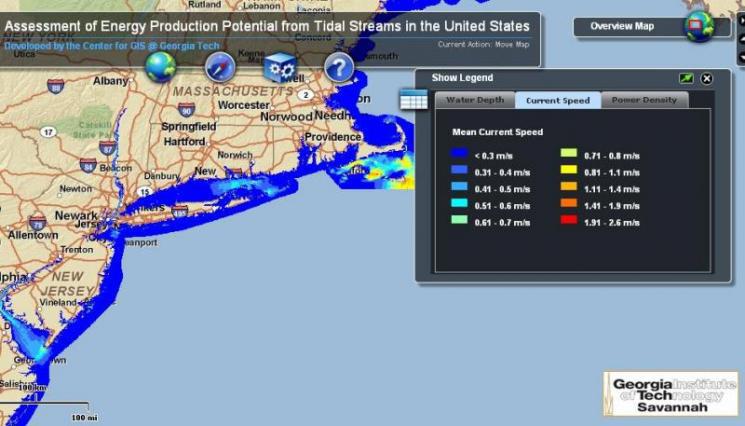
A map generated by Georgia Tech's tidal energy resource database shows mean current speed of tidal streams. The East Coast, as shown above, has strong tides that could be tapped to produce energy.  | Photo courtesy of Georgia Institute of Technology A map generated by Georgia Tech's tidal energy resource database shows mean current speed of tidal streams. The East Coast, as shown above, has strong tides that could be tapped to produce energy. | Photo courtesy of Georgia Institute of Technology
In the most rigorous analyses undertaken to date, two recently released resource assessments show that waves and tidal currents off the nation's coasts contain enough energy to provide a significant portion our nation’s total annual electricity usage.

The United States uses about 4,000 terawatt hours (TWh) of electricity per year. The reports find that the nation’s waves and tides could potentially produce up to 1,420 TWh annually, or 15 percent of America’s electricity. Although these resources won’t be used in their entirety, they represent a major opportunity for America to harness homegrown, clean power and create jobs.

The West Coast, including Alaska and Hawaii, has especially high potential for wave energy development while significant opportunities also exist along the East Coast, which have strong tides that could be tapped to produce energy.  

The assessments—Mapping and Assessment of the United States Ocean Wave Energy Resource and Assessment of Energy Production Potential from Tidal Streams in the United States—reflect the size and magnitude of waves and tides in the ocean and serve as a foundation for an ongoing effort to map out the best locations for extraction of ocean energy.  

The Energy Department’s National Renewable Energy Laboratory incorporated the data from the wave resource assessment into its U.S. Renewable Resource atlas, where viewers can pan, zoom, and filter through graphically displayed data layers.  In the future, 30 years of wave and weather data will be incorporated into the database to inform technological requirements and risks associated with wave energy development projects.

Georgia Tech‘s previously announced tidal streams database displays online maps that allow the public, policy makers, and water power developers to easily explore potential marine and hydrokinetic power-producing regions in the United States. 

For more information about other water power resource assessments,  visit the Energy Department’s Water Power Program website.

Sunday, December 18, 2011

(Archived Article) Portugal Gives Itself a Clean-Energy Makeover

The contents of this post were gleaned from a New York Times article with the above title.  The original article was published August 9, 2010.


Five years ago, the leaders of Portugal decided to harness the country’s wind, hydropower, sunlight, and ocean waves.

Nearly 45% of the electricity in Portugal’s grid will come from renewable sources this year, up from 17% just five years ago.

Land-based wind power has expanded sevenfold in that time.  And Portugal expects in 2011 to become the first country to inaugurate a national network of charging stations for electric cars.

Portugal has little fossil fuel of its own.

Portugal participates in the European Union’s version of cap and trade.

Portuguese households have long paid about twice what Americans pay for electricity.

To force Portugal’s energy transition, the prime minister’s government restructured and privatized former state energy utilities to create a grid better suited to renewable power sources.  To lure private companies into Portugal’s new market, the government gave them contracts locking in a stable price for 15 years.
Portugal has large untapped resources of wind and river power, the two most cost-effective renewable sources.

While the government estimates that the total investment in revamping Portugal’s energy structure will be about 16.3 billion euros, that cost is borne by the private companies that operate the grid and the renewable plants and is reflected in consumers’ electricity rates.  The companies’ payback comes from the 15 years of guaranteed wholesale electricity rates promised by the government.  Once the new infrastructure is completed, it is expected that the system will cost about 1.7 billion euros a year less to run than if formerly did, primarily by avoiding natural gas imports.

To ensure a stable power base when the forces of nature shut down, the system needs to maintain a base of fossil fuel that can be fired up at will.

Portugal began upgrading its grid of transmission lines a decade ago.  Accommodating a greater share of renewable power cost an additional 480 million euros, an expense folded into electricity rates.

Environmental and conservation groups are concerned about the effects of so many new wind turbines and dams on wildlife and habitat.

Renewable energy has not created many green jobs.