Search This Blog

Showing posts with label development. Show all posts

Wednesday, April 25, 2012

IBM and Bauman Moscow State Technical University Open Smarter Cities Development and Education Center in Russia


IBM and Bauman Moscow State Technical University Open Smarter Cities Development and Education Center in Russia

Collaboration will create new opportunities for students and support the development of Russian Cities
ARMONK, N.Y. and MOSCOW - 25 Apr 2012: IBM (NYSE: IBM) and Bauman Moscow State Technical University (BMSTU) today announced the opening of a Smarter Cities Development and Education Center in Russia – the first of its kind in the region.
Located on the university's Moscow campus, the center will be home to a unique educational program giving students the chance to explore and apply IBM's latest technologies and solutions to improve the management of urban infrastructure and support the development of smarter cities. Aligned with the Russian government's priorities for the modernization and technological development of urban centers across the country, the center will support the development of IT skills crucial to Russia's innovation agenda.
"The launch of the new Smarter Cities Development and Education Center at BMSTU is a significant milestone for IBM in the Russian market and shows the maturity of the Smarter Cities vision," said Kirill Korniliev, Country General Manager of IBM in Russia and the Commonwealth of Independent States. "Skills are crucial for the development of smarter cities and by establishing this new facility we will open up new opportunities for young professionals and spur innovation in the field."
Students will be given the chance to explore how advanced technologies such as analytics software and mobile collaboration tools can help to integrate city systems such as water, traffic and public safety. A key component of the center will be IBM's Intelligent Operations Center (IOC) for Smarter Cities, which is designed to help cities of all sizes integrate city systems and apply intelligence to their operations through one central point of command. Some of the center's first development projects will look at how IBM's IOC solution can be integrated with data from  Russia's Global Navigation Satellite System, which already spans some 33 cities in Russia, to enable officials to better monitor and respond to city incidents.
"Creating this center gives rise to a new professional direction for our graduates," says Anatoly Alexandrov, Rector of Bauman Moscow State Technical University.  "This collaboration with IBM provides our graduates with skills that we believe will be in significant demand as Russia seeks to create Smarter Cities and increase its global economic competitiveness."
In the past two years, IBM has opened Smarter Cities centers in Dublin, Ireland in collaboration with Ireland's Industrial Development Agency and the University of Guadalajara in Mexico. The new center in Moscow is part of IBM's ongoing global effort to help students and city leaders develop expertise and apply innovative technologies to create smart solutions to tackle issues that have high social and economic impact for cities around the world.
About IBM
For more information about IBM Smarter Cities please visit: http://www.ibm.com/smartercities.
About Bauman Moscow State Technical University (BMSTU)
For more information about BMSTU please visit: http://www.bmstu.ru/english/.

Friday, March 30, 2012

Obama Administration and Great Lakes States Announce Agreement to Spur Development of Offshore Wind Projects

Obama Administration and Great Lakes States Announce Agreement to Spur Development of Offshore Wind Projects

March 30, 2012 - 12:00pm

Washington, D.C. – As part of President Obama’s all of the above approach to energy, the Obama Administration today joined with the governors of Illinois, Michigan, Minnesota, New York and Pennsylvania to announce the signing of a Memorandum of Understanding (MOU) that will streamline the efficient and responsible development of offshore wind resources in the Great Lakes.  This effort underscores the President’s commitment to American made energy, increasing energy independence, and creating jobs.

“President Obama is focused on leveraging American energy sources, including increased oil and gas production, the safe development of nuclear power, as well as renewable energy from sources like wind and solar, which is on track to double in the President’s first term,” said Nancy Sutley, Chair of the White House Council on Environmental Quality.  “This agreement among Federal agencies and Great Lakes states is a smart, practical way to encourage the development of homegrown energy that will create jobs, power homes, and help increase our nation’s energy security.”

 “As the President has made clear, an American economy that lasts is one built on American energy, designed and produced by American workers,” said Deputy Energy Secretary Daniel Poneman.  “This effort will allow us to tap into our abundant offshore resources, enhancing our energy security through an all-of-the-above strategy that develops every available source of American energy.”

The MOU will enhance collaboration between Federal and State agencies to speed review of proposed offshore wind projects.  Specifically, Federal and State agencies will develop an action plan that sets priorities and recommends steps for achieving efficient and responsible evaluation of proposed offshore wind power projects in the Great Lakes region.

Unlocking the Great Lakes’ offshore wind energy resources could yield tremendous economic and environmental benefits throughout the region, and has the potential to produce more than 700 gigawatts of energy from offshore wind, about one fifth of the total offshore wind potential in the U.S.  The development of even a small portion of the area’s offshore wind potential could create tens of thousands of clean energy jobs and generate revenue for local businesses.  These efforts are in line with the steps the Administration has taken to increase domestic energy production, including increased production of our nation’s oil and natural gas resources – with domestic oil production higher than any time in the last eight years and natural gas at an all-time high.  The Administration is also supporting the construction of the first nuclear power plant in 30 years, and today’s announcement builds on the extensive effort by the Administration to increase energy from renewable sources like wind and solar, which will double by the end of the President’s first term.

The National Renewable Energy Laboratory estimates that each gigawatt of offshore wind installed could produce enough electricity to power 300,000 homes.  The efforts made possible by today’s agreement will also bolster existing investments in offshore wind technologies by promoting a consistent and predictable regulatory environment that inspires innovation and helps to bring clean energy solutions to market.
“In Illinois, we believe investing in clean energy projects and the development of wind resources helps promote economic development and create jobs, while reducing our dependence on foreign energy sources,” Illinois Governor Pat Quinn said.  “We are extremely pleased to collaborate with the U.S. DOE and our fellow Great Lakes states to harness the clean, natural power of our offshore wind.”

“Minnesota has been a leader in developing wind energy for nearly two decades.  We now have more than 2.7 thousand megawatts of wind projects online, and we rank fifth among the states for the most installed wind capacity,” said Minnesota Governor Mark Dayton.  “We look forward to sharing our expertise with other states and federal agencies, to learning from them, and to collaborating on the further development of offshore wind resources.”

“The Great Lakes have the potential to provide clean energy from offshore wind and related green jobs in upstate New York,” said New York Governor Andrew Cuomo.  “This MOU offers a responsible mechanism for enhanced and efficient collaboration among federal, state and local interests in evaluating processes and proposals for development of this resource.”

“This agreement will enable states to work together to ensure that any proposed off-shore wind projects are reviewed in a consistent manner, and that the various state and federal agencies involved collaborate and coordinate their reviews,” said Pennsylvania Governor Tom Corbett.

To safely and responsibly develop offshore wind resources, Federal and State agencies – which share jurisdiction in the Great Lakes – must fully evaluate the potential social, environmental, safety and security impacts of projects.  The agreement signed today will enhance collaboration between Federal and State agencies to speed review of proposed offshore wind projects and accelerate the development of clean, American energy from offshore wind energy resources in the Great Lakes region.  Under the MOU, Federal and State agencies will develop an action plan that sets priorities and recommends steps for achieving efficient and responsible evaluation of proposed offshore wind power projects in the Great Lakes region.

The following participants have signed the MOU:

State of Illinois
State of Michigan
State of Minnesota
State of New York
Commonwealth of Pennsylvania
White House Council on Environmental Quality
U.S. Department of Energy
U.S. Department of Defense
U.S. Department of the Army
Advisory Council on Historic Preservation
U.S. Coast Guard
U.S. Environmental Protection Agency
U.S. Fish and Wildlife Service
Federal Aviation Administration
National Oceanic and Atmospheric Administration
A fact sheet can be found HERE, and the MOU can be read in full HERE.

Thursday, March 29, 2012

The Legend Grows – South Dakota Seed Company Saves Big Bucks with Biomass

As the team at Legend Seeds of De Smet, South Dakota, gears up for spring and the 2012 growing season, they do so from a newly-constructed, state-of-the-art facility, located just east of their former space on Highway 14.  The new office, seed lab and expanded warehouse space were designed to better accommodate the additional full-time office staff needed to support the stretching trade area and growing field staff for the Legend organization. Thanks to a USDA program, the building is also energy efficient.
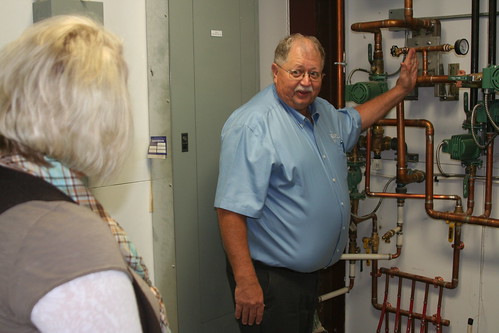
USDA Business & Cooperative Program Director Dana Kleinsasser(left), Area Specialist Darlene Bresson, and Legend Seeds President Glen Davis check out the biomass boiler system, which saves 60 percent of the cost of heating the seed company building, compared to the previous system.
The former office space that was purchased in 1992 had been remodeled and updated over the years but Legend owner, Glen Davis, recognized that the increasing demand for productivity would be best met if he augmented the workspace and workflow for his talented team.  In addition to a fresh contemporary look and serviceable layout, the new space boasts an impressive, highly-efficient heating and cooling system powered by a 250,000 BTU biomass boiler.
Using the biomass boiler accomplished two goals – to reduce energy usage and to reduce the amount of carry-over corn that was going to the local landfill.  Typically, renewable energy, such as the biomass boiler, carry large up-front installation costs.  But with the assistance of the Rural Energy for America program (REAP) from USDA Rural Development, Legend Seeds received a grant for 25 percent of the boiler cost.  With the boiler, Legend’s energy bill is projected to be reduced by nearly 60 percent, and the cost to dispose of waste corn will decline also – a win-win situation.
“The funding provided by REAP has been not only a help in construction of the new office’s heating system but also the advice and support has been valuable in completing the entire project,” said Glen Davis, president of Legend Seeds.
Seed company President Glen Davis explains to Business & Cooperative Program Director Dana Kleinsasser how the USDA-funded boiler heats the facility, saving 60 percent of the cost of energy.
USDA is currently accepting applications for Rural Energy for America funding, but the deadline for some applications is rapidly approaching.  To find out more, call your State Rural Development office or click here.  To read more about how REAP has been used to reduce energy costs across America, click here.

Cisco Reinforces Commitment to Russian Sustainable Development and Innovation

Cisco Reinforces Commitment to Russian Sustainable Development and Innovation

Thursday, March 22, 2012

Deputy Under Secretary Cheryl Cook Announces Obama Administration Accomplishments Supporting Renewable Energy

David Fink, owner of Heidel Hollow Farm, described the farm’s energy savings from the 896 panel solar array funded by USDA Rural Development to USDA officials and others gathered at his farm.
The sun shone brightly on the 896 panel solar array at Heidel Hollow Farm in Germansville, Penn., as USDA Rural Development Deputy Under Secretary Cheryl L. Cook, other USDA officials and guests celebrated the farm’s successful renewable energy project and the announcement of a new USDA Renewable Energy and Energy Efficiency Report. Heidel Hollow Farm, a family-owned, 1,600 acre hay farm, was awarded two USDA  Rural Energy for America Program (REAP) grants in 2010. The grants were used toward a solar energy project that provides approximately 252,800 KW of electricity used in the hay compressing operation of the farm and an energy efficiency project that replaced one diesel engine with five electric motors, saving over 8,000 gallons of diesel fuel each year.  The compactor increases the density of baled hay by 2 1/2 times for more efficient shipping to overseas customers.
According to Deputy Under Secretary Cook, “Rural Development’s REAP grants to Heidel Hollow Farm are excellent examples of funding that contributes to making farm operations more energy efficient and economical. This funding for renewable energy projects helps rebuild and revitalize rural America.”   The Renewable Energy and Energy Efficiency report, released by Secretary Vilsack, highlights the ways in which USDA’s REAP program contributes to U.S. energy independence. Heidel Hollow Farm is one of 79 renewable energy projects funded in Pennsylvania since 2009. In total, Rural Development invested over $5.6 million in Pennsylvania energy projects.  Click here to find out how REAP is making a difference and saving energy in Pennsylvania.
USDA Rural Development Deputy Under Secretary Cheryl  L. Cook, Esq.  lifts one of the 35 lb. compressed hay bales currently being produced at Heidel Hollow Farm in Germansville for overseas shipment.  Energy used to compress the bales comes from solar power.
USDA Rural Development Deputy Under Secretary Cheryl L. Cook, Esq. lifts one of the 35 lb. compressed hay bales currently being produced at Heidel Hollow Farm in Germansville for overseas shipment. Energy used to compress the bales comes from solar power.
The deadline for some 2012 Energy applications is approaching. To find out more, contact your local USDA Rural Development office or click here.

New Funding for Biomass Research and Development

Obama Administration Announces New Funding for Biomass Research and Development Initiative

March 22, 2012 - 1:12pm

COLUMBUS, Ohio  – Today, as President Obama went to Ohio State University to discuss the Administration’s all-out, all-of-the-above strategy for American energy, the White House announced up to $35 million over three years to support research and development in advanced biofuels, bioenergy and high-value biobased products. The projects funded through the Biomass Research and Development Initiative (BRDI) – a joint program through the U.S. Department of Agriculture (USDA) and the U.S. Energy Department (DOE) – will help develop economically and environmentally sustainable sources of renewable biomass and increase the availability of renewable fuels and biobased products that can help replace the need for gasoline and diesel in vehicles and diversify our energy portfolio. Today’s announcement to invest in advanced biofuels supports President Obama’s blueprint for an economy fueled by homegrown, alternative energy sources designed and produced by American workers.  These investments will help cut America’s oil imports, develop clean alternative energy technologies, and protect American families and businesses from the ups and downs of the global oil market. 

“USDA’s partnership with the Department of Energy aims to improve our country’s energy security and provide sustainable jobs in communities across the country,” said Agriculture Secretary Tom Vilsack. “This funding represents the kind of innovation we need to build American-made, homegrown biofuels and biobased products that will help to break our dependence on foreign oil and move our nation toward a clean energy economy.”

“President Obama called for an all-of-the-above strategy that develops every available source of American energy and advances technologies that will help reduce our dependence on foreign oil and save money for American consumers,” said Secretary Chu. “Investing in next-generation biofuels helps boost the competitiveness of the U.S. biofuels industry, supports economic development in rural communities, and creates skilled jobs for American workers.”

For fiscal year 2012, applicants seeking BRDI funding must propose projects that integrate science and engineering research in the following three technical areas that are critical to the broader success of alternative biofuels production:

·         Feedstock Development
Funding will support research, development and demonstration activities for improving biomass feedstocks and their supply, including the harvest, transport, preprocessing, and storage necessary to produce biofuels and biobased products.
·         Biofuels and Biobased Products Development
Research, development and demonstration activities will support cost-effective technologies to increase the use of cellulosic biomass in the production of biofuels and biobased products. Funding will also support the development of a wide range of technologies to produce various biobased products, including animal feeds and chemicals that can potentially increase the economic viability of large-scale fuel production in a biorefinery.
·         Biofuels Development Analysis
Projects will develop analytical tools to better evaluate the effects of expanded biofuel production on the environment and to assess the potential of using federal land resources to sustainably increase feedstock production for biofuels and biobased products.

Integrating multiple technical areas in each project will encourage collaborative problem-solving approaches, enable grantees to identify and address knowledge gaps, and facilitate the formation of research consortia.
Subject to annual appropriations, USDA and DOE plan to contribute up to $35 million over three years for this year’s BRDI solicitation. This funding is expected to support five to seven projects over three to four years. A description of the solicitation, eligibility requirements, and application instructions is available at https://www.fedconnect.net/ and http://www.grants.gov/ under Reference Number DE-FOA-0000657. Applications are due April 23, 2012, and must be submitted electronically. It is anticipated that applicants who submit completed applications will be notified of the results by June 15, 2012.

In addition to the funding announced today by USDA and DOE, the Obama Administration is taking a number of aggressive steps to support the growth of robust renewable energy and biobased markets in the U.S.

For example, in August 2011, the President announced that USDA, DOE and the Navy are investing up to $510 million during the next three years in partnership with the private sector to produce advanced drop-in aviation and marine biofuels to power military and commercial transportation. The initiative supports the President’s Blueprint for A Secure Energy Future, the Administration’s framework for reducing America’s dependence on foreign oil.

On Feb. 21, President Obama issued a Presidential Memorandum directing the federal government to take decisive steps to dramatically increase the purchase of biobased products over the next two years. Biobased products include items like paints, soaps and detergents and are developed from farm-grown plants, rather than chemicals or petroleum bases. The biobased products sector marries the two most important economic engines for rural America: agriculture and manufacturing. To support these efforts, USDA created the BioPreferred program to promote the increased purchase and use of biobased products. Last year, USDA released the USDA Certified Biobased Product label to assure consumers that a product or package contains a verified amount of renewable biological ingredients.

Grants awards and national program leadership for the BRDI program will be administered by USDA’s National Institute of Food and Agriculture (NIFA) and DOE’s Office of Energy Efficiency and Renewable Energy.

Through federal funding and leadership for research, education and extension programs, NIFA focuses on investing in science and solving critical issues impacting people’s daily lives and the nation’s future. More information is available at: www.nifa.usda.gov.

The Energy Department's Office of Energy Efficiency and Renewable Energy (EERE) accelerates development and facilitates deployment of energy efficiency and renewable energy technologies and market-based solutions that strengthen U.S. energy security, environmental quality, and economic vitality. Learn more about EERE’s work with industry, academia and national laboratory partners on a balanced portfolio of research in biomass feedstocks and conversion technologies.

Wednesday, March 21, 2012

Hundreds Learn About Biodigester Energy Options at a Wisconsin Seminar

Hundreds Learn About Biodigester Energy Options at a Wisconsin Seminar


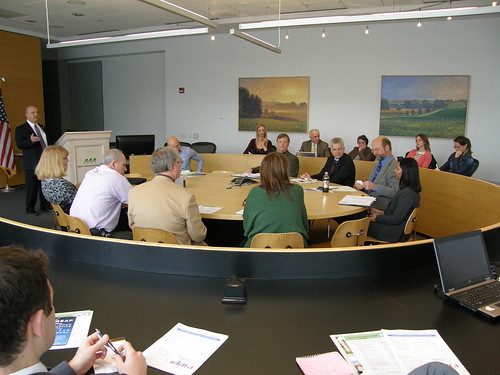
Hundreds of people, over the web or in person, learned about the financing and technology ofanaerobic digester systems, the subject of a pair of webinars recently hosted at the University of Wisconsin-Madison.  A broad spectrum of individuals participated including academics, farmers, and representatives of the environmental community.
The webinars, addressing two critical issues in renewable energy production specifically anaerobic digesters, were part of the Renewable Energy Education Field Days Program. The program is a series of courses targeted to landowners, community leaders, and dairy farmers that focuses on the multiple issues involved in renewable energy production—from feedstock production and refinery conversion technologies to handling, storage, legal and financial issues. The programs provide information useful in deciding whether to implement renewable energy technology in their operation.
The first webinarFinancing a Anaerobic Digester System, showcased dairy farmers and community leaders who shared their first-hand experiences in financing, installing, and maintaining digester systems. Commercial and private lenders also spoke of their experiences in financing digester operations. Topics included return on investment, private funding, government/private partnership funding options, cost of construction, potential revenue generation streams, avoided environmental costs, tax incentives and cost of operation, including management and labor costs.
Technical Aspects of Anaerobic Digester Systems was the title of the second webinar. This session examined digester technologies–psychrophilic (covered lagoon), mesophilic (plug flow and completely mixed), and thermophilic (completely mixed).  Farmer/operators discussed why they selected a specific technology for their operation, as well as their operational and management experiences with those technologies.
The webinars were organized in collaboration with Farm Foundation, USDA Rural Development, USDA Office of Energy Policy and New Uses, the U.S. Environmental Protection Agency,Innovation Center for U.S. Dairy and the Wisconsin Bioenergy Initiative of the University of Wisconsin.
The webinars originated from the Pyle Center at the University of Wisconsin, Madison.
For more information about USDA’s energy programs, click here.

Wednesday, March 14, 2012

USDA Blog Post

Rural New Mexico Businesses Saving Energy and Going Green!


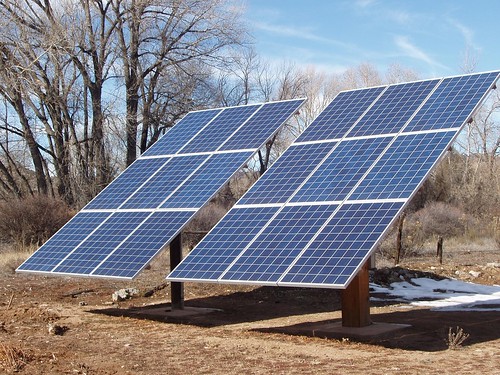
This eighteen solar panel array is generating more than enough electricity to offset the cost of energy it takes to run the Los Ebanistas, Inc. contracting firm’s woodshop and offices in Dixon, NM on an everyday basis.  The extra energy that is generated is then routed back into the electric grid allowing Los Ebanistas to make a profit on the additional energy.
This eighteen solar panel array is generating more than enough electricity to offset the cost of energy it takes to run the Los Ebanistas, Inc. contracting firm’s woodshop and offices in Dixon, NM on an everyday basis. The extra energy that is generated is then routed back into the electric grid allowing Los Ebanistas to make a profit on the additional energy.
It’s 8:20 AM and Jo Ann Shelby, the manager of Compass Components, in Deming, New Mexico is beginning her day by going over her latest work production and business expense reports.  She finds the cost of electricity to light the 90,000 square foot assembly plant is down 50 percent.
At the exact same time across the state in Dixon, New Mexico, Mark Johnson the owner of Los Ebanistas, Incorporated construction firm is in his office and hears the sound of a table saw ripping a piece of oak.  He knows even though he’s using the same amount of electricity as he did last year, he’s actually making money.
What do these two businesses have in common?  The answer is simple.  They both invested in energy efficient and renewable energy systems with the help of the federal government.
Both businesses applied for and received financial help to offset the cost of installing these new energy systems through the Rural Energy for America Program (REAP) administered by USDA Rural Development.  The REAP program was created to help  agricultural producers and small rural businesses take advantage of installing alternative energy systems to help them be more competitive in their business dealings and at the same time help America become more energy independent.
This program can offset the cost of installing energy efficiency or an alternative energy system with a 25 percent grant.  REAP can be used to pay for the installation of energy efficient air conditioners, heaters and lighting systems. It can also be used to pay for the installation of bioenergy, flexible fuel pumps, small and large wind and solar; geothermal-electric generation and direct use; hydropower, hydrogen, and anaerobic digester systems.
The main assembly plant building at Compass Components, Inc. in Deming, New Mexico is now equipped with a new more efficient lighting system.  By replacing the old fluorescent light system the company is now saving 50 percent on its lighting bill.
The main assembly plant building at Compass Components, Inc. in Deming, New Mexico is now equipped with a new more efficient lighting system. By replacing the old fluorescent light system the company is now saving 50 percent on its lighting bill.
Using the REAP program Compass Components Incorporated (CCI) installed a new lighting system at the Deming assembly plant.  CCI received a grant to offset the cost of installing the new energy efficient lighting system. The system replaces 630 fluorescent tube lights with 48 energy-efficient T-8 Hi-Bay lights. Since installing the new lighting system CCI has seen enough savings in its electric bill to recoup its investment in a few years.
Los Ebanistas, Inc. received a grant to help pay for the cost of the installation of an 18 panel solar power system. The new system provides enough electricity to power the Los Ebanistas offices and woodworking shop where they manufacture custom cabinets and furniture. By making the investment to install the solar power array, Los Ebanistas has become more energy efficient and more profitable at the same time because it sells the extra power its solar array produces to the Jemez Mountains Electric Cooperative.
USDA is currently accepting applications for funding through the REAP program.  To find out more, call your local USDA Rural Development State Office.

Monday, March 5, 2012

Applicants Sought for New Funding

(MARCH 5, 2012) USDA SEEKS APPLICATIONS FOR ECONOMIC DEVELOPMENT FUNDING TO CREATE JOBS IN RURAL AREAS
WASHINGTON, DC, Mar 05, 2012 -- Agriculture Secretary Tom Vilsack announced today that USDA is seeking applications for loans and grants to help rural businesses create jobs and spur economic development. The funding is being provided under the Rural Economic Development Loan and Grant (REDLG) program.
“Boosting access to capital sparks job creation and revitalizes the rural economy,” said Vilsack. “USDA works in partnership with cooperatives and utilities across America, and we intend to utilize this program to leverage federal and private investments to put rural residents to work.” 
Eligible recipients are USDA rural utilities program borrowers. Those recipients pass the funds to local organizations. The funding is leveraged to create projects that retain or create jobs and upgrade public infrastructure. The maximum amount of funding for any one project is $1 million for loans and $300,000 for grants.
Organizations use REDLG funds to create jobs and improve services. For example, the Utilities District of Western Indiana received a REDLG loan and grant in 2011 to construct an elevated water storage tank and supply lines. The project will serve a technology park and two communities, creating nearly 400 jobs.
USDA plans to award up to $79 million in loan and $10 million in grants through the program. The deadline for submitting applications is the last business day of each month through September 30th of 2012. Applications must be submitted to the Rural Development state office where the project will be located. A list of these offices is available on the USDA Rural Development web site,http://www.rurdev.usda.gov/StateOfficeAddresses.html, or on page 12792 of the March 2 Federal Register,http://www.gpo.gov/fdsys/pkg/FR-2012-03-02/pdf/2012-5043.pdf.
Since taking office, President Obama’s Administration has taken historic steps to improve the lives of rural Americans, put people back to work and build thriving economies in rural communities. From proposing the American Jobs Act to establishing the first-ever White House Rural Council – chaired by Agriculture Secretary Tom Vilsack – the President wants the federal government to be the best possible partner for rural businesses and entrepreneurs and for people who want to live, work and raise their families in rural communities.
USDA, through its Rural Development mission area, administers and manages housing, business and community infrastructure and facility programs through a national network of state and local offices. Rural Development has an active portfolio of more than $165 billion in affordable loans and loan guarantees. These programs are designed to improve the economic stability of rural communities, businesses, residents, farmers and ranchers and improve the quality of life in rural America.
#

Monday, February 27, 2012

Energy Innovation Summit

Business, Government and Tech Leaders Give the Full Perspective

February 24, 2012 

Secretary of Energy Steven Chu speaking at the 2011 ARPA-E Energy Innovation Summit. | Energy Department file photo. Secretary of Energy Steven Chu speaking at the 2011 ARPA-E Energy Innovation Summit. | Energy Department file photo.
When the third annual ARPA-E Energy Innovation Summit convenes in Washington, DC, next week, key innovators from across the country and around the world will meet to share ideas for solving our greatest energy challenges.

While recent ARPA-E award winners and finalists will be on display at the Technology Showcase, the keynote speakers will offer a personal perspective on innovation in the energy sector.

One of the highlights of the conference will be a "fireside chat" between Bill Gates, chairman of Microsoft Corporation, and Secretary of Energy Steven Chu. Under Gates' leadership, Microsoft has led the computer industry with investments in research and development each year. Check Energy.gov after the Summit for a video of the conversation that you can watch, share, and offer your perspective on.

Former President Bill Clinton will deliver remarks on Wednesday. As the 42nd President of the United States, President Clinton oversaw the longest period of peacetime economic expansion in U.S. history and the creation of more than 22 million jobs. 

We'll also hear from Dr. Arun Majumdar, Director of ARPA-E, and Dr. Susan Hockfield, President of the Massachusetts Institute of Technology (MIT) and co-chair of the President's Advanced Manufacturing Partnership.
From the private sector, we will be joined by Ursula M. Burns, Chairman and CEO of the Xerox Corporation; Frederick W. Smith, Chairman, President and CEO of the FedEx Corporation; and Lee Scott, chairman of BDT Capital and former CEO of Walmart. Each of these individuals has been an innovative leader in their field and will offer their own perspectives on what it takes for innovators and entrepreneurs to succeed in the clean energy economy.

The Summit will also highlight the winning startup companies that competed in DOE’s “America’s Next Top Energy Innovator Challenge," which leverages cutting-edge technologies from the Energy Department’s national laboratories to support new startup companies across the country. The Secretary will present the winners with awards on Monday during the luncheon, and you can learn more about their innovations at their booth in the Technology Showcase.

You can find more information on the ARPA-E Energy Innovation Summit and the full program for the three-day conference here. 

Thursday, February 16, 2012

Tribal Clean Energy Projects Awarded $6.5 Million

News release from the U.S. Dept. of Energy:


Tribal Clean Energy Projects Awarded $6.5 Million from U.S. Energy Department

February 16, 2012 - 11:46am

WASHINGTON, D.C. – As part of the Obama Administration’s commitment to strengthening partnerships with Tribal Nations and supporting tribal energy development, U.S. Energy Secretary Steven Chu today announced that 19 clean energy projects to receive more than $6.5 million. These competitively selected projects will allow Native American Tribes to advance clean energy within their communities by assessing local energy resources, developing renewable energy projects and deploying clean energy technologies. These projects will help Tribal communities across the country save money and create new job and business opportunities.

“As President Obama highlighted in the State of the Union, the Administration is committed to building an American economy that lasts and leverages our nation’s clean energy resources,” said Secretary Chu. “The awards announced today will help Tribes across the country advance a sustainable energy future for their local communities, spur economic development, and advance innovative clean energy technologies.”

The Energy Department has taken a number of steps to strengthen its support for Tribal energy development and empower Tribal leaders to make informed decisions that promote community economic development. Over the past year, the Department has established the Indian Country Energy Infrastructure Working Group with Tribal leaders from across the country and launched programs to provide technical assistance and support to help Tribal communities, colleges and universities deploy energy projects and gain skills in energy development and financing.

Since 2002, the Energy Department’s Tribal Energy Program has provided $36 million to 159 tribal energy projects.

The projects selected for negotiation of award today fall under three project areas:

$3.6 Million for Feasibility Studies – Thirteen projects will receive $3.6 million to assess the technical and economic viability of developing renewable energy resources on tribal lands to generate utility-scale power or study the feasibility of installing renewable energy systems on buildings to reduce energy use by 30 percent.

$1.7 Million for Renewable Energy Development Projects – Four projects will receive $1.7 million for pre-construction development activities.  Three are developing more than 250 megawatts of new renewable energy generation, and one, when implemented, would reduce the need for diesel fuel for heating by 80 percent – or 9,600 gallons annually.

$1.3 Million for Installation Projects – Two projects will receive $1.3 million to deploy renewable energy technologies to convert waste and other biomass to energy.  Once installed, the projects will generate 5 megawatts of energy per hour using municipal solid waste and using cordwood for heating to save between 2,500 and 3,200 gallons of propane.

The tribal energy projects announced today were selected as a result of a DOE funding opportunity announcement issued last year. A summary of all 19 selected tribal energy projects is available HERE.
Under the authority of Title V of the Energy Policy Act of 2005, the DOE Office of Energy Efficiency and Renewable Energy’s Tribal Energy Program, in coordination with the Office of Indian Energy Policy and Programs, provides financial and technical assistance to Indian Tribes for the evaluation and development of their renewable energy resources, implementation of energy efficiency to reduce energy use, and provides education and training to help build the knowledge and skills essential for sustainable tribal energy projects.

Thursday, February 9, 2012

Burns & McDonnell Dedicates New Smart Grid Laboratory

News release from Burns & McDonnell:


Burns & McDonnell dedicates new Smart Grid Laboratory

FOR IMMEDIATE RELEASE: January 27, 2012
KANSAS CITY, Mo. — Burns & McDonnell has significantly expanded and upgraded its Smart Grid Laboratory as a result of a move into a new larger testing and development facility equipped with more than $1 million in state-of-the-art diagnostics and testing equipment. The new facility was formally dedicated during a Jan. 27 open house for employee-owners and clients. The new testing facility is now open and available for the exclusive use of Burns & McDonnell clients.

Located in a 600-square-foot space within the Burns & McDonnell World Headquarters, the lab incorporates the technologies clients are using to modernize the power grid. These include:
  • IEC 61850 - GOOSE, MMS, and Sampled Values messaging for both control and process bus implementations
  • DNP 3.0
  • Protective relaying over packet networks
  • Network technologies including SONET, Ethernet, IP, and MPLS
  • Fiber and wireless communications technologies
  • Substation automation logic controllers
  • SCADA Remote Terminals
  • Data Concentrators
  • Fault Recorders
  • Metering equipment measuring power quality and harmonics
  • GPS and IEEE 1588 time synchronization.
The laboratory is intended to demonstrate how advanced information technologies can be integrated with power delivery equipment as the industry moves toward highly automated, "self-healing" distribution systems. The lab allows Burns & McDonnell engineers to work with clients to configure and test solutions during design and installation, therefore improving project success and speed of deployment.

The Burns & McDonnell Smart Grid Laboratory was first built in 2007 as testing facility for select clients who were interested in demonstrating interoperability of software, two-way communications equipment and other automation equipment in preparation for deployments of Smart Grid projects. In addition to the latest technologies and devices, the lab is capable of simulating two complete substations and varying power conditions. It has the equipment many utilities have been deploying, enabling testing of interoperability between multiple vendors and vintages of equipment.

Equipment and systems in the lab can test advanced substation and distribution feeder automation using IEC 61850 and DNP 3.0 testing applications between multiple vendors and relay types. It can also stage demonstrations of high speed tripping using GOOSE messaging, HMI interoperability, substation visualization and automation systems. Communications with deployment of Ethernet, IP, and MPLS technology can focus on a converged networking platform for security, automation and protection.

Another issue facing Smart Grid deployment is interoperability of legacy and advanced equipment. By demonstrating how legacy and advanced equipment can be integrated together in a unified design, investments in IED relaying incorporating the latest technologies can be justified. The lab has successfully demonstrated solutions such as tying IEC-61850 to the power line carrier and integrating advanced protection and control systems with legacy equipment using RS-232 and DNP interfaces.

Additionally, security tests can be implemented through firewalls and gateway devices with card access and physical security sharing a converged network. These tests have been helpful in showing how to integrate security into substation design.

Monday, February 6, 2012

Meeting with USDA Officials to Discuss Renewable Energy Opportunities

Earlier this week, I had the opportunity to facilitate a meeting with many rural energy stakeholders that USDA Rural Development works closely with here in Iowa.
Joining me in the discussion were representatives from the Environmental Law and Policy Center, Iowa Farm Bureau Federation, MidAmerican Energy, USDA Farm Service Agency, Community Vitality Center at Iowa State University, the Iowa Economic Development Authority, the Iowa Department of Natural Resources and many more.
Also in attendance were representatives from Senator Tom Harkin’s and Congressman Leonard Boswell’s offices.  Senator Harkin helped draft the original Energy Title in the 2002 Farm Bill.
During the conversation it was very clear that USDA Rural Development’s energy programs are making significant impacts on rural communities throughout Iowa.  The business owners and farmers benefitting from this assistance are decreasing their energy footprint, converting renewable resources into cleaner energy, and creating and saving jobs.
Since 2002, USDA Rural Development has awarded $130 million in guaranteed loans and grants to help more than 700 small businesses and producers in Iowa reduce energy costs by making energy-efficiency improvements, as well as installing renewable energy systems such as wind turbines, geothermal and solar.
I was excited to hear from LaVon Griffieon, owner of Griffieon Farms and a past recipient of the agency’s Rural Energy for America Program (REAP). LaVon had tremendous praise for the program, as well as how helpful Rural Development staff was throughout the entire application and awarding process. Griffieon Farms’ fresh meat direct-market business is now using 34 percent less energy thanks to three new commercial freezers purchased with assistance from REAP.
Iowa Rural Development State Director Bill Menner (Standing, Left) addresses participants in a renewable energy meeting in Des Moines.
Mark Edelman with Iowa State University’s Community Vitality Center, and Jennifer Reutzel with the Iowa Department of Natural Resources (DNR), both talked about the importance of energy audits for small businesses in rural America.  This year REAP dollars are helping fund a pollution prevention program sponsored by the Iowa DNR that helps companies reduce water use and save energy, among other things.
Also during the meeting Andy Olsen with Environmental Law and Policy Center emphasized the important role solar technologies and small wind projects could play with producers and businesses looking to save energy costs.
USDA is currently accepting application for REAP funding.  For more information please visitwww.rurdev.usda.gov or click here.