Search This Blog

Showing posts with label resources. Show all posts

Thursday, February 16, 2012

Tribal Clean Energy Projects Awarded $6.5 Million

News release from the U.S. Dept. of Energy:


Tribal Clean Energy Projects Awarded $6.5 Million from U.S. Energy Department

February 16, 2012 - 11:46am

WASHINGTON, D.C. – As part of the Obama Administration’s commitment to strengthening partnerships with Tribal Nations and supporting tribal energy development, U.S. Energy Secretary Steven Chu today announced that 19 clean energy projects to receive more than $6.5 million. These competitively selected projects will allow Native American Tribes to advance clean energy within their communities by assessing local energy resources, developing renewable energy projects and deploying clean energy technologies. These projects will help Tribal communities across the country save money and create new job and business opportunities.

“As President Obama highlighted in the State of the Union, the Administration is committed to building an American economy that lasts and leverages our nation’s clean energy resources,” said Secretary Chu. “The awards announced today will help Tribes across the country advance a sustainable energy future for their local communities, spur economic development, and advance innovative clean energy technologies.”

The Energy Department has taken a number of steps to strengthen its support for Tribal energy development and empower Tribal leaders to make informed decisions that promote community economic development. Over the past year, the Department has established the Indian Country Energy Infrastructure Working Group with Tribal leaders from across the country and launched programs to provide technical assistance and support to help Tribal communities, colleges and universities deploy energy projects and gain skills in energy development and financing.

Since 2002, the Energy Department’s Tribal Energy Program has provided $36 million to 159 tribal energy projects.

The projects selected for negotiation of award today fall under three project areas:

$3.6 Million for Feasibility Studies – Thirteen projects will receive $3.6 million to assess the technical and economic viability of developing renewable energy resources on tribal lands to generate utility-scale power or study the feasibility of installing renewable energy systems on buildings to reduce energy use by 30 percent.

$1.7 Million for Renewable Energy Development Projects – Four projects will receive $1.7 million for pre-construction development activities.  Three are developing more than 250 megawatts of new renewable energy generation, and one, when implemented, would reduce the need for diesel fuel for heating by 80 percent – or 9,600 gallons annually.

$1.3 Million for Installation Projects – Two projects will receive $1.3 million to deploy renewable energy technologies to convert waste and other biomass to energy.  Once installed, the projects will generate 5 megawatts of energy per hour using municipal solid waste and using cordwood for heating to save between 2,500 and 3,200 gallons of propane.

The tribal energy projects announced today were selected as a result of a DOE funding opportunity announcement issued last year. A summary of all 19 selected tribal energy projects is available HERE.
Under the authority of Title V of the Energy Policy Act of 2005, the DOE Office of Energy Efficiency and Renewable Energy’s Tribal Energy Program, in coordination with the Office of Indian Energy Policy and Programs, provides financial and technical assistance to Indian Tribes for the evaluation and development of their renewable energy resources, implementation of energy efficiency to reduce energy use, and provides education and training to help build the knowledge and skills essential for sustainable tribal energy projects.

Monday, February 6, 2012

Turbines Off NYC East River

Post from the blog of the U.S. Dept. of Energy:


Turbines Off NYC East River Will Create Enough Energy to Power 9,500 Homes

February 6, 2012 

Free Flow System turbine being installed in East River, New York, NY (Dec 2006). | Image Credit: Kris Unger/Verdant Power, Inc. Free Flow System turbine being installed in East River, New York, NY (Dec 2006). | Image Credit: Kris Unger/Verdant Power, Inc.
As part of the Roosevelt Island Tidal Energy project, 30 turbines are being installed along the strait that connects the Long Island Sound with the Atlantic Ocean in the New York Harbor. The project, led by Verdant Power, Inc., is the first ever commercially licensed tidal energy project in the United States.

The turbines are scheduled to be fully installed by 2015 and will use the flow of the river and tides to generate 1,050 kilowatts of electricity -- enough to power 9,500 New York homes.

The turbines will also collect important data about environmental impacts on fish and river sediment and provide jobs to a team of technicians who will maintain and monitor the equipment.

The Energy Department helps advance water power technologies by funding research to determine the size of the water resource and by developing innovative technologies to unleash its energy potential. The Department began providing Verdant Power with funding in 2008 to improve the turbines’ blade design. Verdant had been successfully developing and testing turbine prototypes in the East River since 2002, but those turbine rotors were not durable enough to be scaled up for commercialization. With the Department’s assistance, Verdant designed and tested new blades, which are stronger and more reliable -- allowing them to capture more energy from faster currents at greater depths and at a lower cost.

This technological improvement represents progress for the entire tidal energy industry.

Department funding for innovative water power technologies is helping the United States to take advantage of its vast water power resources to generate clean energy and to bolster the renewable energy economy. As advanced marine and hydrokinetic technologies are responsibly deployed and new hydropower opportunities are seized, water resources could deliver 15 percent of our nation’s electricity supply by 2030. Visit the Office of Energy Efficiency and Renewable Energy’s Water Power Program to learn more about how marine and hydrokinetic technologies are generating renewable, environmentally responsible, and cost-effective electricity from water resources.

Monday, January 23, 2012

DOE Reports Show Potential for Wave & Tidal Energy Production

Progress Alert from the U.S. Department of Energy:


DOE Reports Show Major Potential for Wave and Tidal Energy Production Near U.S. Coasts

January 18, 2012

The U.S. Department of Energy (DOE) today released two nationwide resource assessments showing that waves and tidal currents off the nation's coasts could contribute significantly to the United States' total annual electricity production, further diversify the nation's energy portfolio, and provide clean, renewable energy to coastal cities and communities. These new wave and tidal resource assessments, combined with ongoing analyses of the technologies and other resource assessments, show that water power, including conventional hydropower and wave, tidal, and other water power resources, can potentially provide 15% of our nation's electricity by 2030. Today's reports represent the most rigorous analysis undertaken to date to accurately define the magnitude and location of America's ocean energy resources. The information in these resource assessments can help to further develop the country's significant ocean energy resources, create new industries and new jobs in America, and secure U.S. leadership in an emerging global market.

The United States uses about 4,000 terawatt hours (TWh) of electricity per year. DOE estimates that the maximum theoretical electric generation that could be produced from waves and tidal currents is approximately 1,420 TWh per year, approximately one-third of the nation's total annual electricity usage. Although not all of the resource potential identified in these assessments can realistically be developed, the results still represent major opportunities for new water power development in the United States, highlighting specific opportunities to expand on the 6% of the nation's electricity already generated from renewable hydropower resources.

The two reports—"Mapping and Assessment of the United States Ocean Wave Energy ResourcePDF" and "Assessment of Energy Production Potential from Tidal Streams in the United StatesPDF"—calculate the maximum kinetic energy available from waves and tides off U.S. coasts that could be used for future energy production, and which represent largely untapped opportunities for renewable energy development in the United States.

The West Coast, including Alaska and Hawaii, has especially high potential for wave energy development, while significant opportunities for wave energy also exist along the East Coast. Additionally, parts of both the West and East Coasts have strong tides that could be tapped to produce energy.

Earlier this year, DOE announced the availability of its national tidal resource database, which maps the maximum theoretically available energy in the nation's tidal streams. This database contributed to the "Assessment of Energy Production Potential from Tidal Streams in the United StatesPDF" report, prepared by Georgia Tech.

The wave energy assessment report, titled "Mapping and Assessment of the United States Ocean Wave Energy ResourcePDF," was prepared by the Electric Power Research Institute (EPRI), with support and data validation from researchers at Virginia Tech and DOE's National Renewable Energy Laboratory (NREL). The report describes the methods used to produce geospatial data and to map the average annual and monthly significant wave height, wave energy period, mean direction, and wave power density in the coastal United States. NREL incorporated the data into a new marine and hydrokinetic energy section in their U.S. Renewable Resource atlas.

In addition to the wave and tidal resource assessments released today, DOE plans to release additional resource assessments for ocean current, ocean thermal gradients, and new hydropower resources in 2012. To support the development of technologies that can tap into these vast water power resources, DOE's Water Power Program is undertaking a detailed technical and economic assessment of a wide range of water power technologies in order to more accurately predict the opportunities and costs of developing and deploying these innovative technologies. The Program is currently sponsoring over 40 demonstration projects that will advance the commercial readiness of these systems, provide first-of-a-kind, in-water performance data that will validate cost-of-energy predictions, and identify pathways for large cost reductions.

These resource assessments, techno-economic assessments, and technology demonstration projects are critical elements of DOE's strategy to capture the very real opportunities associated with water power development, and to further define the path to supplying 15% of the nation's electricity through water power technologies.

DOE's Office of Energy Efficiency and Renewable Energy invests in clean energy technologies that strengthen the economy, protect the environment, and reduce dependence on foreign oil. DOE's Water Power Program is paving the way for industry and government to make sound investment and policy decisions about the deployment of renewable water power technologies by quantifying the nation's theoretically available water power resources.

Wednesday, January 11, 2012

NREL Helping Virgin Islands Cut Fuel Use

News release from the National Renewable Energy Laboratory.  Keep in mind that a typical rate for electricity on the mainland United States is about 10 or 11 cents per kilowatt-hour.

NREL Helping Virgin Islands Cut Fuel Use

January 11, 2012

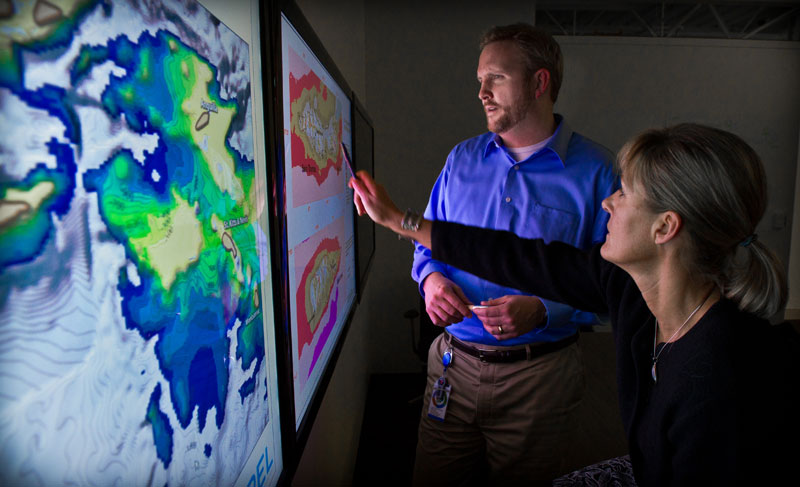
In this photo, a man and a woman are looking at a huge colorful wall map that shows sun resources in yellows and oranges, wind resources in blues. Enlarge image
NREL's Adam Warren, left, and Karen Petersen examine a map that shows the wind and sun resources of the U.S. Virgin Islands.
Credit: Dennis Schroeder

The U.S. Virgin Islands are a great place to visit, but you wouldn't want to pay energy bills there.

The tiny U.S. territory in the Caribbean has just 110,000 residents, all the beach, surf, wind and sun you'd ever want, but energy prices that are four to five times higher than are paid in the continental United States.

Like many islands on earth, the USVI are almost 100 percent dependent on imported oil for electricity.  Residents pay about 47 cents per kilowatt hour to light their homes and run their appliances. Imported oil is even used to desalinate the water because there is so little fresh water available other than what residences catch on their roof in the form of rain water.

But USVI Gov. John P. de Jongh Jr., working with the U.S. Department of Energy's National Renewable Energy Laboratory (NREL) and the U.S. Department of Interior, has vowed to transform energy use dramatically.  In January, at his State of the Territory address, he announced the goal of reducing use of fossil fuels by 60 percent in the next 15 years.

That's huge, and a great challenge, and just possibly a blueprint for how to achieve those similar reductions on the mainland.

"What we're attempting to do is integrate every large portion of renewable energy into our system," said Karl Knight, the director of USVI's energy office, who also is a board member of the Virgin Islands Water and Power Authority.  Think of it as a pilot for how to integrate renewables as a large proportion of the grid."

To get there, a half dozen different technologies need to be implemented, and energy efficiency will have to become a rallying cry.

A Recipe for Energy Savings

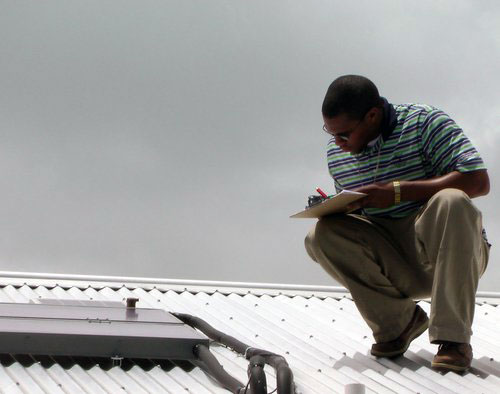
This photo shows a young man on an aluminum rooftop crouching as he looks at a solar collector and writes some data on a clipboard. Enlarge image
On a rooftop in St. Croix, U.S. Virgin Islands, an Energy Office intern inspects a solar collector.
Credit: Don Buchanan, USVI Energy Office

That's where NREL's scientists and engineers are helping.

The United States, New Zealand, and Iceland are three of the leading actors in the international partnership, Energy Development in Island Nations (EDIN), and for the United States, its Virgin Islands territory was a natural fit.

"We wanted to help USVI particularly because the governor was very committed to transforming the energy infrastructure, as was the CEO of their utility," NREL's Adam Warren, who heads NREL's EDIN program, said.

NREL has helped USVI — its government, utilities and public and private groups — to map the renewable energy potential, and to determine how to get to a 60 percent reduction by 2025. Early on, NREL produced a major technological report on grid integration, transmission and distribution.

"We think 60 percent is very realistic," Knight said. "The government established that goal in collaboration with NREL and the Island Nations global partnership. They challenged Gov. deJongh to be aggressive in his goal-setting and he took them up on it. We established the aggressive goal because we spend so much on  The only thing that people in the Virgin Islands talk about is the size of their electric bills."

The high rates have hurt low-income residents and have been a deterrent to economic investment, Knight said. "If the rate is going to be 40 cents a kilowatt hour or more, it shapes the type of business that's willing to locate in the Virgin Islands," he said. "Our total dependence on oil for power generation in an era of expensive crude oil is having a huge impact."

USVI burns 2.6 million barrels of oil each year to generate electricity and desalinate water.

The recipe to achieve a 60 percent reduction:
2 percent biomass
3 percent landfill gas
3 percent solar
6 percent wind
8 percent waste-to-energy

38 percent energy efficiency

NREL's Karen Petersen said the most cost-effective way to reduce fossil-fuel use — the low-hanging fruit, so to speak — is "to help the utility become more efficient in its operations." Simple measures such as turning off lights in buildings and lowering the air conditioning use in tourist hotels also will help immensely.

"We're working to create a whole cultural shift," Petersen said. "They're very conservative in their use of energy because of need, but it doesn't necessarily revolve around an environmental ethic."

Island residents "had a healthy dose of skepticism" when the plan for more solar, wind and biomass was proposed because past proposals haven't kept their promises, Knight said. "But we have tried to convince the community that we're not promising lightning in a bottle. This is a 15-year strategy," Knight said. "We're using tried and commercially proven technologies, gathering up the best practices and working in close consultation with energy experts such as the folks at NREL.

"This is not a developer selling some Star Trek technology that is going to save the day," Knight added. "It's is going to be a gradual build-up to what we believe is a successful achievement of our goals."

Energy Transformation Isn't Easy

In this photo, a long rectangular chain of solar panels sits in the foreground, surrounded by lush green vegetation. In the background is the Caribbean Sea dotted with large rocks. Enlarge image
The idyllic view of the coastline on St. Thomas, U.S. Virgin Islands, on Skyline Road near the capital Charlotte Amalie isn't spoiled by a 10-kilowatt photovoltaic system
Credit: Don Buchanan, USVI Energy Office

Dramatically changing how an island, a state or a nation gets its energy presents enormous challenges, not the least being a shaking of cultural norms.

"That's why we work with the entire community," said Warren. "In the past, they've seen systems go in by these fly-by-night developers that don't work the way they're supposed to.

"You need everyone on board — government, the private and public sectors to get something that big," Warren said. "We set up working groups to attack different areas — efficiency, renewables, transportation."

That's been key, Knight said. "We've been able to secure some good partnerships that have really put some effort into helping us achieve the goal.  Through the assistance of NREL, we've established local working groups, both public sector and private sector and the participation of non-government organizations."

Some 80 percent of the USVI's economy is dependent on tourism. Tourist hotels use much more electricity, especially in the form of A/C, than does the average full-time resident. "If you're not using A/C, most of the load is going toward heating water or keeping the refrigerator cold," Warren said. In all, the household usage is about half of what it is in the United States — 450 kwh per month compared to 900 kwh.

Moving Renewables onto the Grid


One of the thorniest challenges is how to get so much renewable energy on the grid and still have it operate smoothly all hours of the day.


Solar and wind energy are variable — they surge onto the grid when the sun is shining and the wind is blowing, but trickle or stop when the winds calm and the sun sets, or even when a thick cloud passes by.

Happily for the USVI, the highest electrical use is when the sun is shining — and all those tourists want the air conditioning cranked up.

Still, the variability means that distributed systems make more sense. So, USVI likely will have small solar arrays on dozens of rooftops, and just a few of the larger solar projects; likewise, wind energy is likely to be distributed widely, with a mix of small turbines and some larger turbine farms.

Combining wind and solar energy with electricity generated from closed landfills and waste gives a nice balance of variable sources and so-called dispatchable sources — the kind that utilities can ramp up and down to match demand.

Tackling how to load a high rate of renewables onto the grid will help the mainland United States, too. "We as a nation want to figure out the problems associated with a high-penetration of renewables," Warren said. "We hope we can show that first in the islands like USVI and Hawaii.

Islanders Face Tough Choices

Virgin Islanders have heard horror stories about installed renewables that couldn't handle the load because the variability was too much, so part of NREL's job is to show how the proper steps with the right technology can make it a success.

Island residents are leery of overloading the grid with too much renewable energy, but they're faced with the reality of 47 cents per kilowatt hour. They're facing serious tradeoffs, Warren said. "Do I pay my electricity bill or do I buy my medication?' is a real question that is forced on many."

"They're motivated to bring renewables on board and to conserve as much as possible because they need to," Petersen said. Businesses are closing daily because of the cost of electricity.

Optimism Grows from NREL/USVI Partnership

Knight is confident, and says NREL's participation has been crucial. "First, it has given the policy-makers the confidence that they're making the right decisions," Knight said. "To have a neutral party to discuss decisions with, to make sure that we are doing what is in the best interest of the population and the governor's goal, gives us and the policy makers credibility. We're able to say to the public, 'this isn't pie-in-the-sky.'

"We've sat down with the greatest experts in the nation out in Golden, Colo., and discussed our plans — and they've endorsed them fully. We can tell the most passionate members of our community that we've had conversations with NREL and, yes, they've endorsed the proposed projects."

"Our first and foremost goal is to assist other small island nations to curb their appetites for fossil-fuel-derived energy and to provide a model on the cost and investment return on the latest technologies."

"We're hoping there's a lesson to be learned here to benefit larger systems. Hopefully, we can be the test bed for the rest of the nation and the globe."

Learn more about what NREL is doing to move clean energy technologies into the marketplace.
— Bill Scanlon


Virgin Islands Energy Reduction Plan

U.S. Virgin Islands Gov. John P. de Jongh, Jr., and other dignitaries and energy leaders traveled to the U.S. Department of Energy's National Renewable Energy Laboratory in February of 2010 to sign a memo of understanding that is the centerpiece of the plan to reduce consumption of fossil fuels on the islands by 60 percent.

Here are some of the ways NREL and the Island government plan to pare the 2.5 million barrels of oil that were used in 2010.

Solar Energy: Photovoltaics and Solar Hot-Water Heating

Sixty-one thousand barrels can be saved if 40 percent of the USVI households take advantage of incentives to use the sun's energy to heat their hot water.

Another 100,000 barrels a year can be saved via capturing photons for electricity. NREL helped design a half-megawatt solar energy system on St. Thomas. "A half a megawatt is small from our standpoint, but is highly visible for the Virgin Islands," NREL's Adam Warren said.

Now, 27 different companies have submitted proposals hoping to be chosen to build a 10-megawatts or more of photovoltaic system by late 2013.

Energy Efficiency

920,000 barrels of oil can be saved via better efficiency, including generation efficiency.

A crucial strategy is to switch from a distillation system to a reverse-osmosis system to desalinate the water.

Wind Energy

178,000 barrels a year can be saved with 22.5 megawatts of wind energy. The plan is to deploy a mix of small and utility-scale wind turbines.

"The southern shore has a good wind resource that would probably come in at about 10 cents per kilowatt hour, vs. the 47 cents they're paying now," NREL's Adam Warren said.

Biomass, Landfill Gas and Waste-to-Energy

380,000 barrels can be saved each year by turning biomass into fuel, capturing and re-using the gas that forms below landfills, and turning waste into energy.

"We are very much engaged in a very rigorous public discourse on waste-to-energy," Karl Knight, the director of USVI's energy office, said.  "People are concerned about emissions, as well as its impact on promoting recycling and waste reduction. But we believe using the best practices available those concerns about emissions can be addressed."

Monday, January 9, 2012

Electronic Atlas Maps U.S. Renewable Energy Resources

News Release from the National Renewable Energy Laboratory:


Electronic Atlas Maps U.S. Renewable Energy Resources


Friday, January 06, 2012


A new geospatial application developed by the U.S. Department of Energy's National Renewable Energy Laboratory (NREL) allows users to easily and accurately map potential renewable energy resources in the United States.

The interactive tool, RE Atlas, is free to use and available online at http://maps.nrel.gov/re_atlas.
"Ease of use and breadth of data make RE Atlas an excellent tool for policymakers, planners, energy developers, and others who need to better understand the renewable resources available in the United States," said Dan Getman, whose team in NREL's Strategic Energy Analysis Center developed the tool. "RE Atlas is an important addition to NREL's suite of geospatial tools, because it brings together so many renewable energy datasets in one easy-to-use tool."

RE Atlas is designed to facilitate energy policy development, investment, and education by making high quality data accessible and easy to understand. The tool creates dynamic maps of renewable resources, including biomass, geothermal, hydropower, solar, and wind. RE Atlas can display resources individually or in a composite fashion.

NREL is the U.S. Department of Energy's primary national laboratory for renewable energy and energy efficiency research and development. NREL is operated for DOE by the Alliance for Sustainable Energy, LLC.

Monday, December 19, 2011

Integrating Variable Wind Energy into the Grid


A few years ago, I overheard some local utility employees discussing wind power at a conference.  They were agreeing that if not for the Government mandates and subsidies, their utilities would not touch wind power.  The problem was pretty much the variability of production.


The post below was taken from one of the U.S. Department of Energy's blogs.  I wanted to post this announcement on my blog quickly so I have not had a chance to review this report, yet.  It sounds like they may have found some ways to address the variability issues.  Hopefully, so.


New Report: Integrating Variable Wind Energy into the Grid

December 19, 2011 
The Energy Department and Alstom Grid announce the availability of a new report on integrating wind energy into the electrical grid. | Image source: The Strategies and Decision Support Systems for Integrating Variable Energy Resources in Control Centers for Reliable Grid Operations Report. The Energy Department and Alstom Grid announce the availability of a new report on integrating wind energy into the electrical grid. | Image source: The Strategies and Decision Support Systems for Integrating Variable Energy Resources in Control Centers for Reliable Grid Operations Report.
Wind doesn’t always blow consistently and sometimes doesn’t blow at all, but wind energy is not unreliable – just ask grid operators.

In a new report, Strategies and Decision Support Systems for Integrating Variable Energy Resources in Control Centers for Reliable Grid Operations, they offer their first-hand perspectives on how variable energy sources, including wind energy, actually impact grid operations.

Grid operators are the individuals who ensure that you receive electricity reliably and at an economical price. They balance electricity supply and demand 24 hours a day, 7 days a week, 365 days a year. You can think of them as the air traffic controllers for the power system, constantly monitoring and directing activities on the grid to keep the lights on in your home.

The study, a first-of-its-kind review, finds that the ability to forecast variable energy output is vital to successfully integrating variable energy into the electrical grid. The study also finds that decision support tools are also essential to helping grid operators incorporate wind forecasts and obtain optimal power flow in their grids. The study describes several decision support tools that are currently used by grid operators. However, existing decision support tools in the United States need to evolve further as more domestic variable energy enters the electrical grid.

Despite these challenges, the grid operators interviewed have a positive outlook for integrating variable energy and are eager to share and apply best practices with other operators.

The Energy Department funded two organizations, Areva Federal Services and Alstom Grid, through the American Recovery and Reinvestment Act. As part of this study, Areva and Alstom interviewed 33 grid operators in 18 countries who, together, are responsible for integrating 72 percent of the wind energy world-wide into their grids. Alstom presented some of their findings in a webinar in October 2011.

Over the past two decades, there has been a large increase in the production of wind energy across the world, growing from roughly 2 gigawatts in 1990 to almost 200 gigawatts in 2010. That’s enough wind energy to serve about 50 million U.S. homes. The final report and executive summary provides even more insights direct from grid operators about the challenges, solutions, and successes of integrating variable wind energy into the grid.