Search This Blog

Showing posts with label NREL. Show all posts

Thursday, September 29, 2016

NREL Report Shows U.S. Solar Photovoltaic Costs Continuing to Fall in 2016

From NREL:


NREL Report Shows U.S. Solar Photovoltaic Costs Continuing to Fall in 2016

SEPTEMBER 28, 2016
Graph of Solar PV costs from Q4 2009 to Q1 2016
NREL U.S. PV system cost benchmarks, from the fourth quarter of 2009 to the first quarter of 2016
The modeled costs to install solar photovoltaic (PV) systems continued to decline in the first quarter of 2016 in the U.S. residential, commercial, and utility-scale sectors, according to updated benchmarks from the Energy Department's National Renewable Energy Laboratory (NREL). Driving the cost reductions were lower module and inverter prices, increased competition, lower installer and developer overheads, improved labor productivity, and optimized system configurations.
"The continuing total cost decline of solar PV systems demonstrates the sustained economic competitiveness of solar PV for the industry across all three sectors," said NREL Senior Analyst and Project Lead Ran Fu.
The modeled costs for the first quarter of 2016 were down from the fourth quarter of 2015 by 6 percent, 4 percent, and 20 percent in the residential, commercial, and utility-scale sectors, respectively. The costs fell to $2.93 per watt of direct current for residential systems, $2.13 per watt of direct current for residential systems, and $1.42 per watt of direct current (Wdc) for residential systems for fixed-tilt utility-scale systems, and $1.49 Wdc for one-axis-tracking utility-scale systems.
"Such accurate cost benchmarks are critical for tracking the progress of PV systems toward cost-reduction goals. Because our cost model categorizes hardware and non-hardware costs with a high degree of resolution, the results can also be used to identify specific cost-reduction investment opportunities and assess regional levelized costs of energy," Fu said.
The new results also highlight the importance of non-hardware, or "soft," costs. As the pace of cost reductions for modules and inverters has slowed in recent years, the proportion from soft costs-such as labor, overhead, and permitting costs-has grown. In the first quarter of 2016, soft costs accounted for 58 percent of residential system costs, 49 percent of commercial system costs, and 34 percent of utility-scale system costs.
NREL uses a "bottom-up" modeling method to construct total capital costs by quantifying the typical cost of each individual system and project-development component, largely through dialogues and interviews with solar industry collaborators. The results represent total installed system costs from the perspective of the PV project developer or installer, including net profit in the cost of the hardware. The benchmarks are national averages weighted by state installed PV capacities.
NREL has produced the annual benchmarks since 2009. The full technical report (U.S. Solar Photovoltaic System Cost Benchmark Q1 2016)as well as a presentation about the new results and a data file are available online:
This ongoing work is supported by the Energy Department's Office of Energy Efficiency and Renewable Energy (EERE) through its SunShot Initiative. SunShot is a collaborative national effort that aggressively drives innovation to make solar energy fully cost-competitive with traditional energy sources before the end of the decade. This research is part of NREL's broader clean energy manufacturing analysis activities, which yield insights that can support Energy Department and industry decisions about research and development targets, investment strategies, and policy evaluation.
NREL is the U.S. Department of Energy's primary national laboratory for renewable energy and energy efficiency research and development. NREL is operated for the Energy Department by The Alliance for Sustainable Energy, LLC.
###

Thursday, March 22, 2012

From the National Renewable Energy Laboratory

NREL Thinks Big at Wind Technology Center

Credit: Dennis Schroeder
Further technology improvements will be critical to the future of wind energy. Research at NREL is leading the way. Full story

Wednesday, February 15, 2012

Return to the Archives

There isn't much Renewable Energy or Energy Efficiency news today, so I thought I would go back to the Archives to find something of interest.  Below is a DOE article from September 2007 with some interesting links.

Hope you enjoy.


Renewable Energy, Bioproduct Inventions Win Seven R&D 100 Awards

September 26, 2007

Researchers at DOE national laboratories and facilities contributed to 31 out of the 100 technology advancements that are being honored this year with R&D 100 Awards. As a top harbinger of innovative research and development, R&D Magazine has been recognizing the top 100 inventions of the year for the past 45 years. This year's awards include 18 that are related to energy efficiency and renewable energy, of which 7 are related to renewable energy. (The energy efficiency winners are covered in a separate article.) See the awards announcements on Beam/X-Ray Devices (PDF 99 KBPDF), Energy (PDF 150 KBPDF), Materials & Metals (PDF 243 KBPDF), and Thermal technologies (PDF 105 KBPDF) in R&D Magazine. Download Adobe Reader.

Among renewable energy technologies, DOE's National Renewable Energy Laboratory (NREL) and Spectrolab, a Boeing subsidiary, earned an award for building the first solar cell to surpass 40% conversion efficiency. That is, the solar cell is able to convert more than 40% of the sunlight hitting it into electricity. Other solar cell technologies include an improved transparent conductor made out of carbon nanotubes. Transparent conductors often form the top layer of thin-film solar cells and related devices, such as flat panel displays. A German company also won for inventing a small high-vacuum pump used in solar cell manufacturing that consumes one-third less power than earlier pumps. See the NREL press release.

Thanks in part to support from DOE's Inventions & Innovations program, Phenotype Screening Corporation won an award for a non-invasive system to image and characterize plant roots, a technology that could be important for biomass crop development. In addition, DOE's Lawrence Berkeley National Laboratory (LBNL) helped to develop a gas turbine that can run on biogas, hydrogen, and other fuels; UTC Power worked with a hot springs resort in Alaska to develop a device that generates power from low-temperature geothermal resources; and Battelle Memorial Institute invented a biobased polyol, a chemical that could replace up to 3 billion pounds of petroleum-based polyols that are used each year in the United States to produce foams, coatings, and adhesives. Other biobased polyols have been developed recently, but the Battelle invention is reactive enough to form polyurethane foams. The chemical is also generated from glycerine, a byproduct of the biodiesel industry. See the press releases from LBNL, UTC Power, and Battelle.

Tuesday, February 14, 2012

Thermal Storage Gets More Solar on the Grid

From the National Renewable Energy Laboratory (NREL):


Thermal Storage Gets More Solar on the Grid

February 14, 2012

This photo taken at dusk shows gleaming rows of mirrors in front of darkening desert mountains. Enlarge image
Abengoa is erecting more than 3,200 mirrored parabolic troughs at its Solana plant near Gila Bend, Ariz. When at full operation, the CSP plant will serve more than 70,000 homes.
Credit: Dennis Schroeder

It's 4:45 on a sweltering August afternoon, and the rooftop solar panels are starting to lose juice. The sun's lower angles and that huge cottonwood tree are interfering with the efficient photon-to-electricity transfer.
What is an environmentally conscious — but air-conditioning-loving — homeowner to do?

Peak demand for electricity in the United States typically hits between 4 p.m. and 8 p.m., which doesn't quite line up with the sun's schedule. It's fortunate that the sun is high in the sky during many of the hours when the air conditioning is in demand. But in summer, people tend to need air conditioning during the dinner hour and beyond, when kitchen appliances are whirring, lights are on, and TVs are blaring.

To the rescue comes concentrating solar power (CSP), a technology being tested and deployed by utilities in America's deserts and southern Spain.

New analysis at the U.S. Department of Energy's (DOE) National Renewable Energy Laboratory (NREL) has found that CSP, with its greater grid flexibility and ability to store energy for as long as 15 hours, can enhance total solar power generation and actually give photovoltaic (PV) systems a greater presence on the grid.

PV panels convert photons from the sun directly into electrons for electricity — and are grabbing real estate on rooftops across the Americas, Europe, and Asia.

CSP technologies use mirrors to reflect and concentrate sunlight onto receivers that collect the sun's heat. This thermal energy can then be used to drive a steam turbine that produces electricity for utilities.

Thermal Storage Can Even Out the Bumps

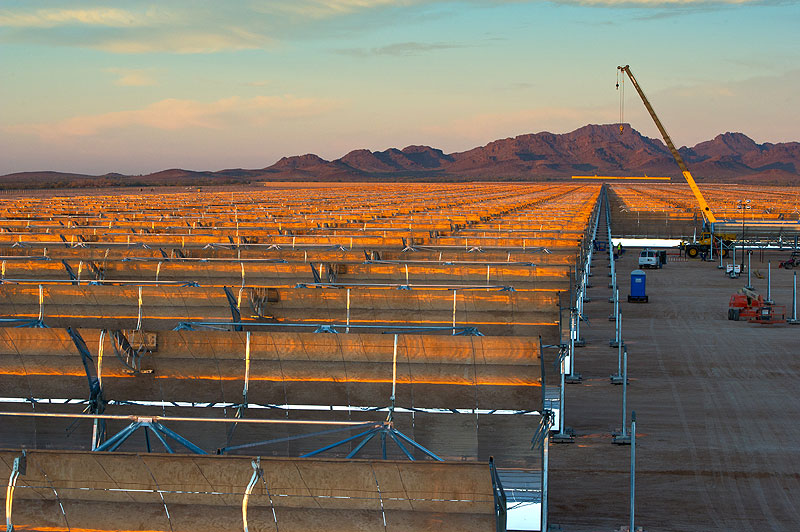
In this photo, mirrors in the foreground gleam orange from the sun, while mountains dominate the background. Enlarge image
Crews work around the clock installing mirrored parabolic trough collectors — built on site — that will cover 3 square miles at Abengoa's Solana Plant. When finished, the plant will generate 280 megawatts of clean, sustainable power.
Credit: Dennis Schroeder

Like Edison and Tesla or Dempsey and Tunney, the two major solar energy technologies never meant to play nice. Each had its niche — and its dreams of market share.

But that's changing, said NREL analyst Paul Denholm, co-author with Mark Mehos of the study "Enabling Greater Penetration of Solar Power via Use of CSP with Thermal Energy StoragePDF."

Think of power from PV as a roller coaster of highs and lows, and power from CSP, via thermal energy storage, as a gently rolling train.

PV panels and wind turbines contribute electricity to the grid, but without the ability to store that power, they cannot supply the grid after the sun sets, or after the wind dies. Even passing clouds can cause drops in the amount of solar energy that gets on the grid.

Large fossil-fueled and nuclear power plants can't be quickly stopped or started to accommodate variable energy sources such as solar and wind energy.

CSP can even out these ebbs and flows because it can store power and ramp up output when the amount of direct wind or solar power drops.

Grid Flexibility is the Key

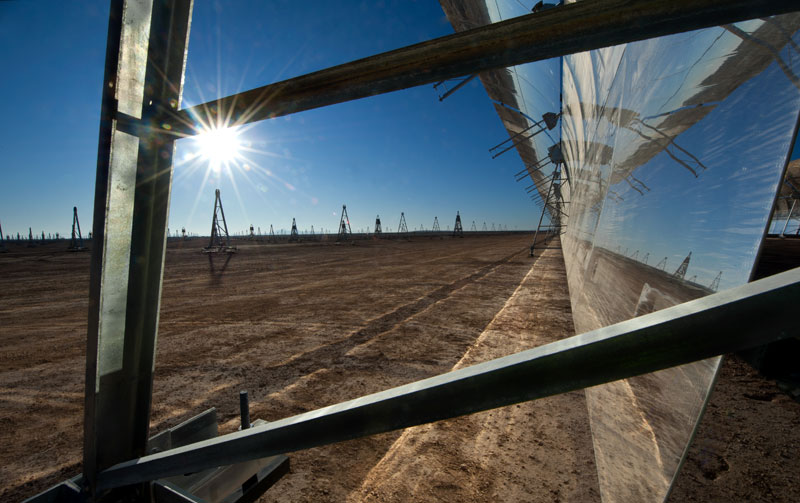
This photo is a close-up of one mirror and its supporting beams, with the sun gleaming above one of the cross beams. In the background are other structures on the Solana Plant and the mountains further back. Enlarge image
Light is reflected in a 25-foot-wide, 500-foot-long, and 10-foot-high parabolic trough collector at Abengoa's Solana Plant.
Credit: Dennis Schroeder

"It all gets down to grid flexibility," Denholm said. "What sets of grid technologies do you deploy to make the grid respond faster and over a greater range to the input of variable energy such as solar and wind?

"If you can't respond quickly, you end up potentially throwing away wind and solar energy.

"We know that the more wind and solar you add to the grid, the harder it is to balance the grid and maintain reliability."

A CSP plant works by heating a heat transfer fluid that is used to boil water to make steam. But because of thermal inertia, by the time that fluid gets through the system's pipes to the power plant, perhaps 10 or 15 minutes have passed.

When a cloud passes over a PV panel, the drop in energy production is immediate. But because of the 10 or 15 minutes of thermal inertia, a cloud passing over a CSP tower doesn't cause this immediate drop. Nor is there the immediate surge when sunlight returns.

"The change is more gradual," Denholm said. "That's one reason CSP can bring a greater quality to the grid."

Still, the greater potential for CSP — and for CSP helping PV to expand its role on the grid — is its capacity to store the energy it captures from the sun for several hours, making it a source of reliable energy after the sun sets.

"CSP can fill in that gap in the evening when there's peak demand for electricity," Denholm said. "Together, the solar resource can provide all that peak demand. And together they can reduce or eliminate the need to build new power plants for those peak periods."

Molten Salts a Low-Cost Solution

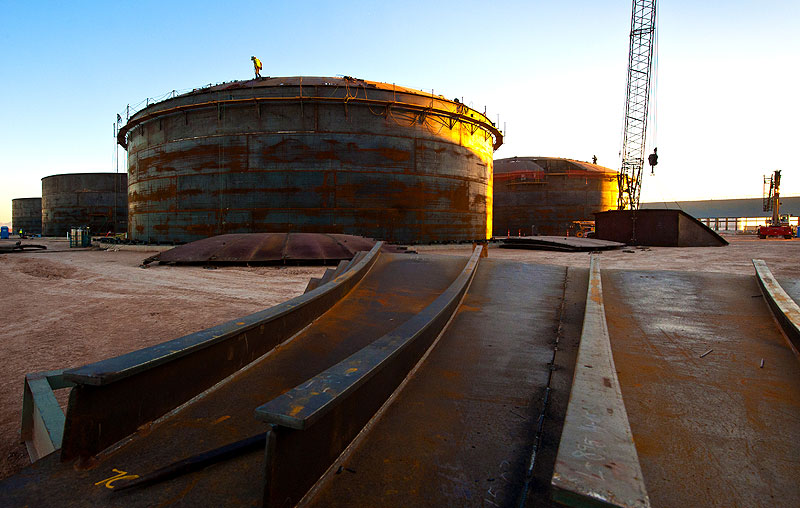
This photo shows a squat, cylindrical tank dwarfing the men working on its roof, with a crane and another tank in the background, and steel construction beams in the foreground. Enlarge image
The tanks that hold the molten salts at Abengoa's Solana Plant are enormous. The salts can keep the solar-heated fluids very hot for several hours, so they can be transferred to turbines to produce electricity even when the sun isn't shining.
Credit: Dennis Schroeder

Thermal energy storage at CSP plants "is low-cost because it's not exotic," Denholm said. "It's some large tanks with some media to store energy before you use it to boil the water." The best medium for storage available today is molten salt, NREL's Greg Glatzmaier said.

Molten salts are abundant and not very costly. They behave themselves, neither decomposing nor volatizing at the high temperature needed in a CSP plant — about 565 degrees Celsius (°C).

At a typical molten-salt CSP plant, the salts are stored in two tanks, one much hotter than the other.
In the case of a power tower CSP plant, in which the mirrors focus the sun's rays on one receiver atop a tower, the lower-temperature tank is at about 293°C, while the higher-temperature tank is at 565°C, Glatzmaier said.

The salt is pumped from the "cold" tank to the power tower, where it collects the solar energy that's focused on the receiver, raising its average temperature. The salts then descend into the "hot" tank, where they can maintain this very hot temperature for several days, though typically they are used within hours.

The salt in the hot tank is then sent to a heat exchanger that generates the steam needed to turn the turbines at a power plant. The turbines generate electricity that goes to homes and businesses.

As they exit the steam generator, the salts cool, and by the time they return to the cold tank, they measure at about 293°C.

When the sun is shining, the CSP plant can take the salts out of the cold tank, heat them up at the tower's receiver, and then dump them into the hot tank for storage, Glatzmaier said. "If you come to the end of the day and the hot tank is pretty full, you can keep generating electricity by withdrawing the salts from the hot tank to generate steam."

It's a continual balancing act. If all the salt is in the cold tank, no stored energy is available. If it's all in the hot tank, there's plenty of energy stored for later use, but nothing to replenish the system.

Molten salts tend to freeze at about 200°C, so as long as the two tanks range between 293°C and 565°C, the salts are in no danger of reverting to a solid state. At room temperature, the salts look like powdery white table salt. At the higher temperatures in a CSP plant, the salts look like water.

The molten salts used for storage are a mix of sodium nitrate and potassium nitrate. Sodium nitrate is mined from dry lake beds in Chile, in surroundings similar to the Utah salt flats. Potassium nitrate also occurs in nature and is mined in Chile, Ethiopia, and elsewhere.

Plants with Storage in Spain, Nevada, Arizona, California

Abengoa Solar is building a 250-megawatt CSP plant near Gila Bend, Ariz., that will cover 1,900 acres and use 900,000 mirrors to direct sunlight to heat a working fluid inside its tubes. The plant's six hours of thermal storage mean it can deliver electricity after the sun sets to approximately 70,000 homes.

The 19.9-megawatt power tower run by Gemasolar near Granada in southern Spain is configured to store enough energy during the summer to provide solar-generated electricity 24 hours a day, Glatzmaier said. In the winter, when there's less sunshine, electricity comes from more conventional sources a few hours each day. The system aims to power 25,000 homes and reduce carbon dioxide emissions by more than 30,000 tons a year.

SolarReserve is building the 110-megawatt Crescent Dunes Solar Energy Project near Tonopah, Nev., which will use molten salt to store the sun's energy as heat for several hours. It will include more than 17,000 mirrors to focus the sun's light on a tower 640 feet high.

BrightSource is building an even larger CSP project in the Mojave Desert near Needles, Calif., that will have storage for just a couple of hours a day — but this will be enough to serve more than 140,000 homes during peak hours. Company executives say the plant will reduce carbon dioxide emissions by more than 400,000 tons per year.

PV/CSP Symbiosis Makes Economic Sense

The cost of PV has been plummeting, and it has a cost advantage over CSP. But CSP has the advantage of storage, and so teamed with PV can improve the benefits and bottom lines of both technologies. Storage does raise the price of a CSP plant, but "if you're running your turbine more hours in a day, you're amortizing your turbine cost over more generation time, and there's a real cost benefit there," Glatzmaier said. The bottom line: when storage is added to a CSP plant, it increases the value of its electricity — both its energy value and its capacity value.

Solar plants also can store energy in batteries, but at least for now, that approach is quite expensive. Other thermal storage technologies being investigated by researchers include phase-change or thermal-chemical storage.


Denholm and Mehos caution that the preliminary analysis in their study will require more advanced grid simulations to verify the actual ability of CSP to help wind and PV gain a larger presence on the grid. An important next step, they say, would be more complete simulations using utility-grade software. That will answer questions on the realistic performance of the generation fleet, transmission constraints, and actual CSP operations.

Learn more about NREL's solar energy research and analysis.
— Bill Scanlon


Monday, February 13, 2012

NREL Seeks Leaders


National Renewable Energy Laboratory (NREL) - Innovation for Our Energy Future
News Release

NREL Seeks Leaders for National Executive Academy

Monday, February 13, 2012

Applications are currently being accepted for the U.S. Department of Energy's National Renewable Energy Laboratory's (NREL) 2012 Executive Energy Leadership Academy (Energy Execs). Energy Execs is a leadership program focused on educating business, community, and government leaders about clean energy solutions through energy efficiency and renewable energy technologies.
The two Energy Execs learning opportunities are the Leadership Program and the Leadership Institute. Both programs are designed to provide executive decision-makers with information and tools to guide their organizations and communities in energy-related planning.
"NREL plays an important role in engaging a cross-section of industry and community leaders in transforming our energy systems," NREL Director Dan Arvizu said. "It's a critical time in the United States and globally to accelerate understanding about the opportunities and challenges of market-viable energy solutions for secure, clean electricity, and fuel."
Representatives from 120 industry, government, and non-profit organizations have completed the program since 2007. Participants are selected from a national pool of candidates.
Apply online for the 2012Leadership ProgramandLeadership Instituteor via fax or mail. The application deadline is March 30, 2012.
NREL is the U.S. Department of Energy's primary national laboratory for renewable energy and energy efficiency research and development. NREL is operated for DOE by the Alliance for Sustainable Energy, LLC.
###
Visit NREL online at www.nrel.gov

NREL is a national laboratory of the U.S. Department of Energy, Office of Energy Efficiency and Renewable Energy, operated by the Alliance for Sustainable Energy, LLC. NRELU.S. Department of EnergyOffice of Energy Efficiency and Renewable EnergyOffice of Energy Efficiency and Renewable EnergyAlliance for Sustainable Energy, LLC

Thursday, February 9, 2012

Over $12 Million to Spur Solar Energy Innovation

News release from the Department of Energy:


Energy Department Announces Over $12 Million to Spur Solar Energy Innovation

February 8, 2012 - 1:53pm

WASHINGTON, D.C. -- As part of the Obama Administration’s blueprint for an American economy built to last, today U.S. Energy Secretary Steven Chu announced over $12 million to speed solar energy innovation from the lab to the marketplace through the Energy Department’s SunShot Incubator program. The funding will accelerate American innovation in solar energy and manufacturing by supporting advancements in hardware, reductions in soft costs, and the development of pilot manufacturing and production projects.

“Investments in American energy and manufacturing are critical building blocks for an American economy built to last,” said Secretary Chu. “The SunShot Incubator program fosters the innovative small businesses that will rapidly bring technological advances to market and pioneer a new era in American energy.”

The SunShot Incubator program helps launch new startups and business units within existing companies to accelerate the innovative solar technology development. Since 2007, DOE has invested $60 million through the Incubator in promising technologies as they are brought from the lab to the marketplace. These investments have catalyzed $1.6 billion in private sector support. The federal investment in these projects has been leveraged at a rate of more than 26-to-1.

The funding opportunity announced today builds on the SunShot Incubator program’s history of successful partnerships. Nearly forty companies have participated in the Incubator, including Colorado-based PrimeStar. In 2007, DOE’s National Renewable Energy Laboratory and PrimeStar Solar announced a cooperative R&D agreement to transition NREL’s cadmium telluride solar technology to commercial production. PrimeStar also received a $3 million Incubator award that year to commercialize its highly-efficient, low-cost photovoltaic solar panels based on the technology pioneered by NREL. Today, PrimeStar is owned by GE, which has announced a $600 million investment in the company and the construction of a large-scale manufacturing plant in Colorado that will employ more than 350 American workers to produce state-of-the-art solar panels. Through the Department’s SunShot Incubator program, these types of investments help early-stage companies overcome barriers to bring innovative solar technologies to market faster.

Today’s SunShot Incubator funding will support innovations in the development of hardware and non-hardware approaches from the proof-of-concept stage to prototype demonstration, including advances in photovoltaics, concentrating solar power and power electronics, as well as streamlined permitting, inspection and financing approaches, and to shorten the timeline for awardees to transition innovative prototypes produced at lab-scale into pilot and eventually full-scale manufacturing, production, or deployment. Each of the investments will require significant cost-share commitments from the awardees.

Applications are due on April 9, 2012. For more information and application requirements for the Funding Opportunity Announcement, please visit the Funding Opportunity Exchange website.

Launched in February 2011, DOE’s SunShot Initiative funds competitive research to make solar energy systems faster, easier, and cheaper for America’s homeowners, businesses and utilities to generate clean, renewable energy. The collaborative national effort aims to make solar energy cost competitive with other forms of energy by the end of the decade. Achieving this goal will drive widespread adoption of solar energy technologies, fortify the U.S. leadership in the global clean energy race, spur new industries, and create jobs across the nation. For more information, visit the SunShot Initiative website.

DOE's Office of Energy Efficiency and Renewable Energy accelerates development and facilitates deployment of energy efficiency and renewable technologies and market-based solutions that strengthen U.S. energy security, environmental quality, and economic vitality.

Wednesday, February 8, 2012

Linear Fresnel Technology

News release from NREL:


Linear Fresnel Technology added to System Advisor Model's Capabilities

Now utilities can get detailed information on siting, performance and finances

Wednesday, February 08, 2012


 A promising Concentrating Solar Power (CSP) technology that uses a stationary receiver tube and an array of mirrors mounted near the ground can now be accessed within the System Advisor Model (SAM), which predicts annual energy production, hourly performance and return on investment.

The U.S. Department of Energy's National Renewable Energy Laboratory (NREL) teamed with the Electric Power Research Institute (EPRI) of Palo Alto, Calif., to develop a new direct-steam-generation (DSG) linear Fresnel model in SAM.

CSP technologies use mirrors to reflect the sun toward a receiver that absorbs heat and transfers it to a working fluid. The hot liquid boils water to produce steam which drives a turbine, producing electricity. CSP is a utility-scale technology that is ideally suited for sunny climates such as the American southwest, arid sections of Spain, the Middle East, and North Africa.

The linear Fresnel technology uses an array of low-profile rotating mirrors that reflect sunlight to a fixed receiver. The mirrors and receivers are arranged in series, and each collector loop may be a kilometer or more in length. The low-profile reflector architecture enables high concentrated flows while reducing wind loads and structural cost.

"The first linear Fresnel design modeled in SAM is a direct-steam system", said NREL's Mike Wagner, who co-wrote the software program. Soon, a linear Fresnel system that uses high-temperature molten salt for storage will be added to the SAM repertoire.

"One of the drivers for starting with the direct-steam model is that it operates at temperatures that integrate well with existing coal-fired power plants," said Wagner, a mechanical engineer who is the project leader for power-tower research and development at NREL. "Utilities are very interested in how this technology performs compared to other CSP technologies."

NREL and Sandia National Laboratories developed SAM – originally called the Solar Advisor Model – and made it available to the public for the first time in 2008. SAM uses information on weather, system design, geography, cost and many other variables so utilities and their potential financiers can know in detail the best places to site the technologies, the amount of energy they produce, and the likely return on investment. The quasi-steady-state model in SAM allows users to investigate energy and fluid flows, operating temperatures, and pressure drops.

The new linear Fresnel tool in SAM is designed to provide useful information, including full performance and financial results in seconds per simulation, for utilities, policy-makers, and researchers on the linear Fresnel. The model was developed with involvement from the linear Fresnel industry to ensure realistic and useful output that applies to current and future technology solutions.

The new linear Fresnel model is available in the current SAM release at sam.nrel.gov/content/downloads.
The Electric Power Research Institute, Inc. (EPRI, www.epri.com) is an independent, nonprofit, organization which conducts research and development to help address challenges in electricity, including reliability, efficiency, health, safety and the environment, for the benefit of the public.

NREL is the U.S. Department of Energy's primary national laboratory for renewable energy and energy efficiency research and development. NREL is operated for DOE by the Alliance for Sustainable Energy, LLC.
###

Monday, January 30, 2012

NREL's REDB Connects Smart Grid Research

NREL's REDB Connects Smart Grid Research

January 27, 2012

Photo of a man walking past a rack of electricity switchers. Enlarge image
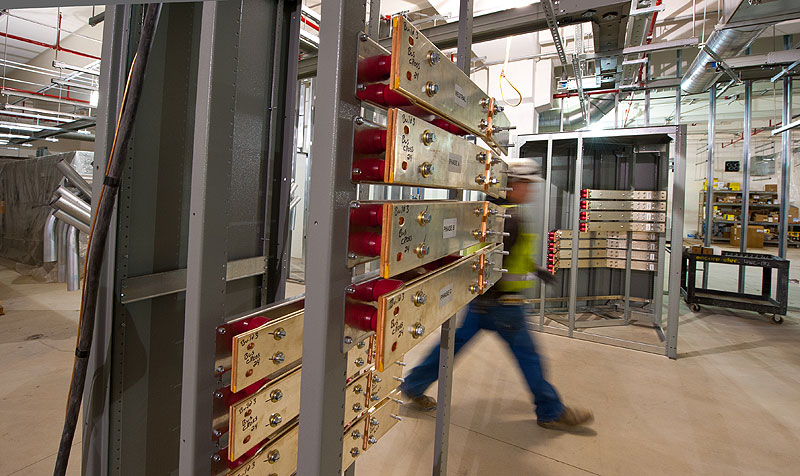
An electrical contractor walks between two racetrack switchboards, which are being installed in the REDB room of the Energy Systems Integration Facility (ESIF) at NREL. These switchboards are capable of 1,600 amps and are part of the 1 megawatt testing capabilities at ESIF.
Credit: Dennis Schroeder

Plug-n-play has become so integrated into daily life that most computer users don't give a second thought to hooking up a camera or smart phone to a laptop or tablet. Now, take the same concept and apply it to the nation's complex electrical systems when it comes to "plugging in" renewables or smart grid technologies.
To make that a reality, the U.S. Department of Energy's (DOE) National Renewable Energy Laboratory (NREL) is building electrically interconnected laboratories as part of its Energy Systems Integration Facility (ESIF) where research partners can literally plug in and test new energy technologies on real and simulated power systems before hooking them up to the grid.

This plug-n-play adaptability is possible because of the Research Electrical Distri­bution Bus (REDB) at ESIF, which will function as a power integra­tion circuit capable of connecting multiple sources of energy, interconnecting laboratories and experiments. All of this will allow NREL and its partners to test and simulate what happens when components, such as solar inverters, are connected to the grid.

"Each lab in ESIF has its own niche with different kinds of equipment and functionality fostering research on all aspects of energy integration," NREL Electrical Engineer Greg Martin said. "There is nowhere else where you can bring in a piece of equipment, connect it up, and be testing in a matter of days — along with the type of data acquisition we can provide."

Think Big

 Illustration showing the location and layout of REDB. Enlarge image
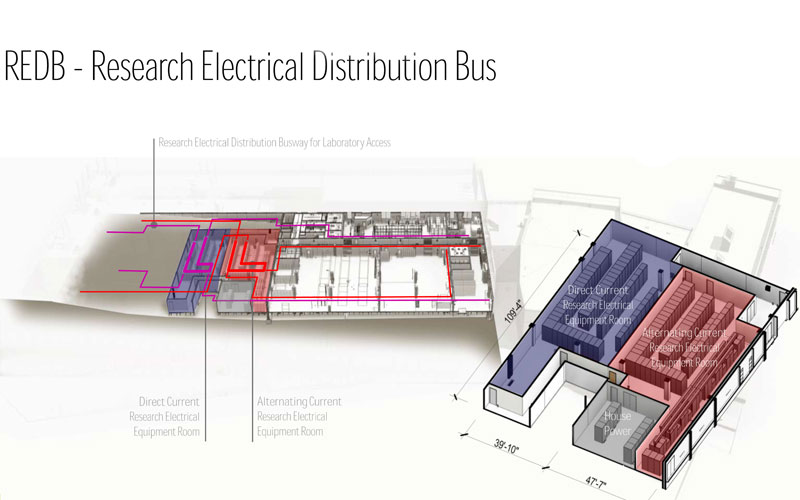
The Research Electrical Distri¬bution Bus (REDB) is the electrical back bone interconnecting many of the laboratories at ESIF. This state-of-the-art facility will enable NREL and industry to work together to develop and evaluate their individual technologies on a controlled integrated energy system platform.
Credit: Rendering courtesy of SmithGroupJJR

Made up of four ring buses — two for AC current and two for DC current — the REDB will be the backbone for all of NREL's energy systems integration testing.

"You can think of the ESIF equipped with the REDB as a place where you can bring your equipment and with our real time simulation tools, we can make your equipment think that is connected electrically to another piece of equipment, a utility distribution feeder, or even the grid," Acting Group Manager for Distributed Energy Systems Integration Bill Kramer said.

The scale of the laboratories in the ESIF and the size of the equipment to be tested are hard to visualize, but according to Kramer, a real test scenario for the REDB could include the following.

A research partner delivers an experimental device to ESIF on a flatbed truck. The truck enters the ESIF through large overhead doors that lead into the high bay area of the Power Systems Integration Laboratory where a bridge crane lifts the experiment, which contains a battery in a 40 foot container, off the truck and places it in the lab. The battery is connected to DC power with a programmable switch that is connected to the REDB. Running parallel with the REDB is a Supervisory Control and Data Acquisition (SCADA) system. SCADA enables the researchers safely to turn power on and off, and track the data flowing during the experiment. At this point, using the SCADA and REBD systems, researchers can interconnect that large battery with another laboratory, or to a transformer connected to a solar array in the Outdoor Testing Facility. The battery can be charged and discharged thanks to the ESIF's power hardware in the loop.

SCADA Brings Testing into View

A key element to the testing power systems and components at ESIF is the SCADA, which will serve as the computer control system for the REDB. In addition to controlling the REDB safely, the SCADA also provides high resolution data output. The SCADA will support a large visualization screen in the control room allowing researchers and partners to watch the experiment in real-time.

In a control room, researchers can see the electrical bus, close switches, and checkout grid simulators. Research partners will be able to control the systems on portions of the REBD checked out specifically to them. The data from the experiment is streamed to secure servers, so if a utility is working with the lab that information can remain with the researcher and their partner. It's easily compartmentalized so that an experiment has its own power system and data.

Safety is key at NREL and the SCADA will constantly run safety checks to make sure that no equipment is damaged or pushed beyond its safety limits.

ESIF is Not Just for Renewables, or NREL

Photo of a large laboratory under construction. Enlarge image
The 5,300 square foot Smart Power Laboratory in ESIF is connected to the REDB. Like most labs in ESIF, the Smart Power Laboratory will be highly configurable and can test anything from home automation technology to advanced inverters.
Credit: Dennis Schroeder

"The ESIF labs are reconfigurable so that as technologies advance, we can change with them," Kramer said.
"The design of ESIF in and of itself is an integrated system. ESIF bridges the gap between electrical, thermal, and fuels disciplines."

The nation's utility infrastructure currently is driven by fossil fuels. An objective for ESIF is to make it so industry can use and modify existing pieces of equipment to work with new technologies such as solar and wind.

"We are here to help utilities and companies that want to design new equipment that will increase the penetration of renewables into the energy grid," Kramer said. "However, we won't work just with renewables at the ESIF. We could also test natural gas field generators. This type of testing will also help us move forward because if you don't take into consideration the overall system and only work on a component at a time, you will never come up with the optimal solution."

"At the end of the day, we want to provide a platform to allow other laboratories, government, industry, utilities, to all develop technologies for the future energy marketplace," Martin added. "It is important for everyone to be able to do testing before putting something out in the field and discovering that it didn't work they way they thought. Instead they can bring their equipment to the ESIF, hook it up and it is going to think it is part of the power system."

ESIF also is working to make virtual connections to other laboratories across the country in an effort to share expertise. "If you have a lab, and want to have a virtual connection into the ESIF with your equipment being tested in your lab, you will still be able to make use of ESIF and all of the equipment that is in it," Kramer said.

"We have this amazing capability that no one has ever had before," Martin said. "If you have an idea for novel system, bring it in and we'll test it, or we'll partner with you on some other types of research."
This state-of-the-art facility is scheduled for completion by the end of the year. It will enable NREL and industry to work together to develop and evaluate their individual technolo­gies on a controlled integrated energy system platform. Test­ing at the ESIF is intended to facilitate widespread adoption of renewable energy and smart grid technologies and help reduce risks associated with early market penetration.


NREL & Gamesa to Collaborate on R&D Project

National Renewable Energy Laboratory (NREL) - Innovation for Our Energy Future
News Release

NREL, Gamesa to Collaborate on R&D Project

Venture serves to help develop next generation of wind turbines

Friday, January 27, 2012


Golden, Colo., Jan. 27, 2012 – The U.S. Department of Energy's National Renewable Energy Laboratory (NREL) and Gamesa Technology Corp., Inc. will study and test a variety of components and systems that will guide development of the next generation of wind turbines designed specifically for the U.S. marketplace.
The public-private partnership expects to focus on innovations that will enhance the capabilities and performance of advanced wind systems in tapping the vast potential of this renewable energy resource and ultimately bring the nation closer to 20 percent wind energy by 2030.
NREL and Gamesa will collaborate on work in three key areas: developing new wind turbine components and rotors for the U.S. market; researching and testing the performance of new control strategies; and devising models that will help advance the development of offshore wind in U.S. coastal waters.
"We are pleased to have Gamesa working with NREL as an R&D partner," Dana Christensen, NREL's Deputy Laboratory Director for Science and Technology, said. "These types of collaborations demonstrate a commitment to crucial technology development and the public-private partnerships necessary to ensure the continued momentum of the wind power industry. Our role with the Department of Energy is to help reduce technical risks and thereby help accelerate next generation technology into the marketplace. NREL is proud to be at the forefront of this important work."
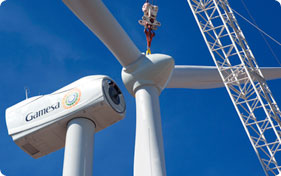
Gamesa, already has installed and commissioned a G97 Class IIIA 2.0 MW test wind turbine at NREL's National Wind Technology Center near Boulder, Colo. NREL's wind technology center is the most extensive wind-turbine testing facility in the nation. 
"Wind energy is going to continue to play a key role in creating a stronger and more sustainable American economy," said Dr. Miguel Angel Gonzalez-Posada, Vice President of Technology for Gamesa North America. "This partnership is an exciting venture that showcases Gamesa's commitment to enhanced clean energy development, as well as our drive to deliver reliable, efficient and cost-effective wind turbine technologies to the U.S. marketplace."
Since being introduced last year, Gamesa's G9X-2.0 MW turbine platform has gained recognition for its advanced blade design, updated nacelle, enhanced control systems and other features that increase energy output substantially. The G97 Class IIIA 2.0 MW model, which will serve as the test platform with NREL, is designed specifically for low-wind sites, a segment from which Gamesa expects more than half of all future on-shore demand.
Using Gamesa's turbine platform as a laboratory, researchers will study the behavior of systems and how new designs, products or equipment can affect performance.
Full project testing on the entire slate of programs is set to begin this month. The core provisions of the public-private partnership run through 2013, with options for two additional years of collaboration.
NREL is the U.S. Department of Energy's primary national laboratory for renewable energy and energy efficiency research and development. NREL is operated for DOE by The Alliance for Sustainable Energy, LLC.
 
###
 
Visit NREL online at www.nrel.gov


NREL is a national laboratory of the U.S. Department of Energy, Office of Energy Efficiency and Renewable Energy, operated by the Alliance for Sustainable Energy, LLC. NRELU.S. Department of EnergyOffice of Energy Efficiency and Renewable EnergyOffice of Energy Efficiency and Renewable EnergyAlliance for Sustainable Energy, LLC

Saturday, January 21, 2012

Lease Option Increases Rooftop Solar's Appeal, Study Says

From the U.S. Dept. of Energy's National Renewable Energy Laboratory (NREL):

National Renewable Energy Laboratory (NREL) - Innovation for Our Energy Future
News Release

Lease Option Increases Rooftop Solar’s Appeal, Study Says

Low Down Payment, Immediate Savings, Lure a New, Less Affluent Demographic


Friday, January 20, 2012


Rooftop solar panels are attracting a new demographic of customers who are choosing to lease rather than buy, and enjoying the low upfront costs and immediate savings.
The new third-party-lease business model lets homeowners save money the very first month, rather than breaking even a decade later after an initial investment of $10,000 or $20,000.

Analysts with the U.S. Department of Energy's National Renewable Energy Laboratory (NREL) found that the solar lease models are surging in southern California. And they're being adopted in less affluent neighborhoods that had few customer-owned systems.
The NREL study, "The Transformation of Southern California's Residential Photovoltaics Market through Third-Party Ownership," is in the current edition of the journal Energy Policy.

The study indicated an attraction for third-party leasing in neighborhoods with less affluence than those most likely to go for the customer-owned option.
It found a positive correlation between customers outright buying solar energy systems and customers living in neighborhoods where the average household income was $150,000 or more.

But with third-party-leased photovoltaic (PV) panels, that positive correlation appeared in neighborhoods where the average household income was just $100,000 or more.
If what's true in southern California proves true for the nation, it means that rooftop solar power could prove tempting for an additional 13 million Americans who live in households that earn between $100,000 and $150,000 per year.

"What is so interesting about the southern California data is that the strong decrease in PV prices – from lower retail costs and stronger federal incentives – didn't pick up a new demographic. But the new business model – leasing – did pick up a new customer demographic," NREL's Easan Drury, the lead author of the report, said.

Repackaging the value of photovoltaics as a simple savings on the monthly bill is an attractive alternative to the pitch that it will pay for itself in a decade, he said. "If someone comes up to you and says you can make money next month and forever, that totally changes how people see the value of solar."

Among Drury's other findings:
  • Third-party leasing usually eliminates the need for home-equity-style financing and, thus, the need for significant equity in the home. Without the hurdle of financing, more people can adopt solar, Drury said. 
  • Along with the lower income threshold, Drury found a surge in solar leasing in neighborhoods with younger families.
  • In the Los Angeles and Orange county markets, customer-owned PV was five times more prevalent than third-party owned in 2009. In 2010, the ratio had dropped to 2 to 1. And for the first quarter of 2011, the ratio was almost even.
Homeowners can put as little as $3,000 down and see an immediate drop in their electricity costs,  albeit that first year the drop may be just a couple dollars a month.
The real benefits come over the next two decades, when the $40 or $50 per month they're paying to lease the solar panels stays constant, while, presumably, the cost of electricity goes up. Third-party companies are touting potential customer savings of $10,000 to $15,000 over two decades.

NREL is the Department of Energy's primary national laboratory for renewable energy and energy efficiency research and development. NREL is operated for DOE by The Alliance for Sustainable Energy, LLC.
###

Wednesday, January 11, 2012

NREL Helping Virgin Islands Cut Fuel Use

News release from the National Renewable Energy Laboratory.  Keep in mind that a typical rate for electricity on the mainland United States is about 10 or 11 cents per kilowatt-hour.

NREL Helping Virgin Islands Cut Fuel Use

January 11, 2012
In this photo, a man and a woman are looking at a huge colorful wall map that shows sun resources in yellows and oranges, wind resources in blues. Enlarge image
NREL's Adam Warren, left, and Karen Petersen examine a map that shows the wind and sun resources of the U.S. Virgin Islands.
Credit: Dennis Schroeder

The U.S. Virgin Islands are a great place to visit, but you wouldn't want to pay energy bills there.

The tiny U.S. territory in the Caribbean has just 110,000 residents, all the beach, surf, wind and sun you'd ever want, but energy prices that are four to five times higher than are paid in the continental United States.

Like many islands on earth, the USVI are almost 100 percent dependent on imported oil for electricity.  Residents pay about 47 cents per kilowatt hour to light their homes and run their appliances. Imported oil is even used to desalinate the water because there is so little fresh water available other than what residences catch on their roof in the form of rain water.

But USVI Gov. John P. de Jongh Jr., working with the U.S. Department of Energy's National Renewable Energy Laboratory (NREL) and the U.S. Department of Interior, has vowed to transform energy use dramatically.  In January, at his State of the Territory address, he announced the goal of reducing use of fossil fuels by 60 percent in the next 15 years.

That's huge, and a great challenge, and just possibly a blueprint for how to achieve those similar reductions on the mainland.

"What we're attempting to do is integrate every large portion of renewable energy into our system," said Karl Knight, the director of USVI's energy office, who also is a board member of the Virgin Islands Water and Power Authority.  Think of it as a pilot for how to integrate renewables as a large proportion of the grid."

To get there, a half dozen different technologies need to be implemented, and energy efficiency will have to become a rallying cry.

A Recipe for Energy Savings
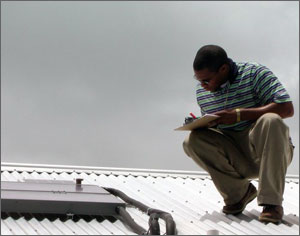
This photo shows a young man on an aluminum rooftop crouching as he looks at a solar collector and writes some data on a clipboard. Enlarge image
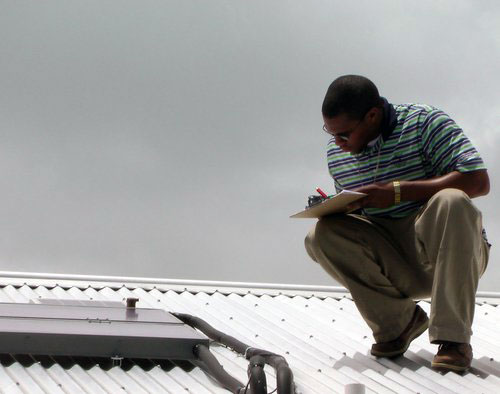
On a rooftop in St. Croix, U.S. Virgin Islands, an Energy Office intern inspects a solar collector.
Credit: Don Buchanan, USVI Energy Office

That's where NREL's scientists and engineers are helping.

The United States, New Zealand, and Iceland are three of the leading actors in the international partnership, Energy Development in Island Nations (EDIN), and for the United States, its Virgin Islands territory was a natural fit.

"We wanted to help USVI particularly because the governor was very committed to transforming the energy infrastructure, as was the CEO of their utility," NREL's Adam Warren, who heads NREL's EDIN program, said.

NREL has helped USVI — its government, utilities and public and private groups — to map the renewable energy potential, and to determine how to get to a 60 percent reduction by 2025. Early on, NREL produced a major technological report on grid integration, transmission and distribution.

"We think 60 percent is very realistic," Knight said. "The government established that goal in collaboration with NREL and the Island Nations global partnership. They challenged Gov. deJongh to be aggressive in his goal-setting and he took them up on it. We established the aggressive goal because we spend so much on  The only thing that people in the Virgin Islands talk about is the size of their electric bills."

The high rates have hurt low-income residents and have been a deterrent to economic investment, Knight said. "If the rate is going to be 40 cents a kilowatt hour or more, it shapes the type of business that's willing to locate in the Virgin Islands," he said. "Our total dependence on oil for power generation in an era of expensive crude oil is having a huge impact."

USVI burns 2.6 million barrels of oil each year to generate electricity and desalinate water.

The recipe to achieve a 60 percent reduction:
2 percent biomass
3 percent landfill gas
3 percent solar
6 percent wind
8 percent waste-to-energy

38 percent energy efficiency

NREL's Karen Petersen said the most cost-effective way to reduce fossil-fuel use — the low-hanging fruit, so to speak — is "to help the utility become more efficient in its operations." Simple measures such as turning off lights in buildings and lowering the air conditioning use in tourist hotels also will help immensely.

"We're working to create a whole cultural shift," Petersen said. "They're very conservative in their use of energy because of need, but it doesn't necessarily revolve around an environmental ethic."

Island residents "had a healthy dose of skepticism" when the plan for more solar, wind and biomass was proposed because past proposals haven't kept their promises, Knight said. "But we have tried to convince the community that we're not promising lightning in a bottle. This is a 15-year strategy," Knight said. "We're using tried and commercially proven technologies, gathering up the best practices and working in close consultation with energy experts such as the folks at NREL.

"This is not a developer selling some Star Trek technology that is going to save the day," Knight added. "It's is going to be a gradual build-up to what we believe is a successful achievement of our goals."

Energy Transformation Isn't Easy
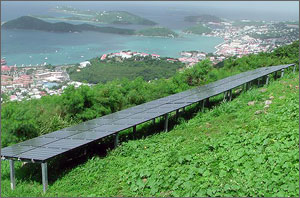
In this photo, a long rectangular chain of solar panels sits in the foreground, surrounded by lush green vegetation. In the background is the Caribbean Sea dotted with large rocks. Enlarge image
The idyllic view of the coastline on St. Thomas, U.S. Virgin Islands, on Skyline Road near the capital Charlotte Amalie isn't spoiled by a 10-kilowatt photovoltaic system
Credit: Don Buchanan, USVI Energy Office

Dramatically changing how an island, a state or a nation gets its energy presents enormous challenges, not the least being a shaking of cultural norms.

"That's why we work with the entire community," said Warren. "In the past, they've seen systems go in by these fly-by-night developers that don't work the way they're supposed to.

"You need everyone on board — government, the private and public sectors to get something that big," Warren said. "We set up working groups to attack different areas — efficiency, renewables, transportation."
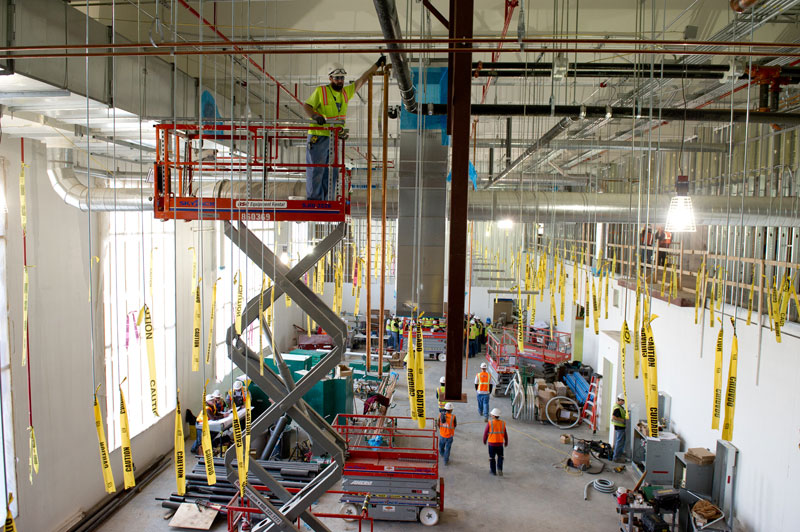
That's been key, Knight said. "We've been able to secure some good partnerships that have really put some effort into helping us achieve the goal.  Through the assistance of NREL, we've established local working groups, both public sector and private sector and the participation of non-government organizations."
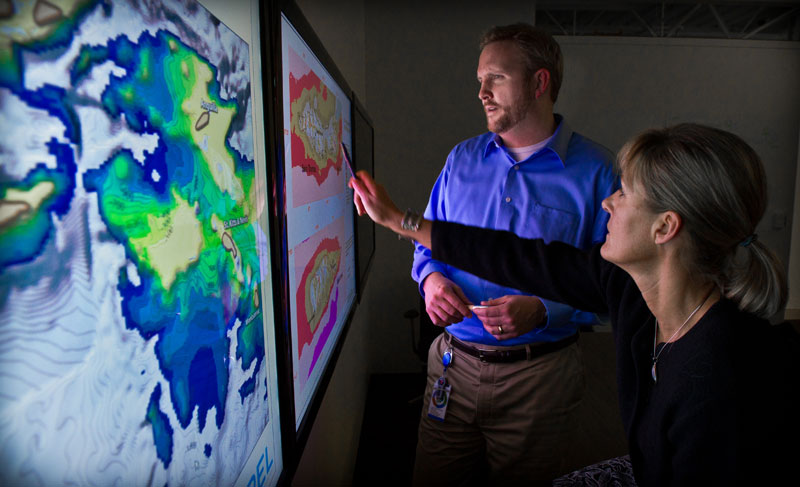
Some 80 percent of the USVI's economy is dependent on tourism. Tourist hotels use much more electricity, especially in the form of A/C, than does the average full-time resident. "If you're not using A/C, most of the load is going toward heating water or keeping the refrigerator cold," Warren said. In all, the household usage is about half of what it is in the United States — 450 kwh per month compared to 900 kwh.

Moving Renewables onto the Grid


One of the thorniest challenges is how to get so much renewable energy on the grid and still have it operate smoothly all hours of the day.


Solar and wind energy are variable — they surge onto the grid when the sun is shining and the wind is blowing, but trickle or stop when the winds calm and the sun sets, or even when a thick cloud passes by.

Happily for the USVI, the highest electrical use is when the sun is shining — and all those tourists want the air conditioning cranked up.

Still, the variability means that distributed systems make more sense. So, USVI likely will have small solar arrays on dozens of rooftops, and just a few of the larger solar projects; likewise, wind energy is likely to be distributed widely, with a mix of small turbines and some larger turbine farms.

Combining wind and solar energy with electricity generated from closed landfills and waste gives a nice balance of variable sources and so-called dispatchable sources — the kind that utilities can ramp up and down to match demand.

Tackling how to load a high rate of renewables onto the grid will help the mainland United States, too. "We as a nation want to figure out the problems associated with a high-penetration of renewables," Warren said. "We hope we can show that first in the islands like USVI and Hawaii.

Islanders Face Tough Choices

Virgin Islanders have heard horror stories about installed renewables that couldn't handle the load because the variability was too much, so part of NREL's job is to show how the proper steps with the right technology can make it a success.

Island residents are leery of overloading the grid with too much renewable energy, but they're faced with the reality of 47 cents per kilowatt hour. They're facing serious tradeoffs, Warren said. "Do I pay my electricity bill or do I buy my medication?' is a real question that is forced on many."

"They're motivated to bring renewables on board and to conserve as much as possible because they need to," Petersen said. Businesses are closing daily because of the cost of electricity.

Optimism Grows from NREL/USVI Partnership

Knight is confident, and says NREL's participation has been crucial. "First, it has given the policy-makers the confidence that they're making the right decisions," Knight said. "To have a neutral party to discuss decisions with, to make sure that we are doing what is in the best interest of the population and the governor's goal, gives us and the policy makers credibility. We're able to say to the public, 'this isn't pie-in-the-sky.'

"We've sat down with the greatest experts in the nation out in Golden, Colo., and discussed our plans — and they've endorsed them fully. We can tell the most passionate members of our community that we've had conversations with NREL and, yes, they've endorsed the proposed projects."

"Our first and foremost goal is to assist other small island nations to curb their appetites for fossil-fuel-derived energy and to provide a model on the cost and investment return on the latest technologies."

"We're hoping there's a lesson to be learned here to benefit larger systems. Hopefully, we can be the test bed for the rest of the nation and the globe."

Learn more about what NREL is doing to move clean energy technologies into the marketplace.
— Bill Scanlon


Virgin Islands Energy Reduction Plan

U.S. Virgin Islands Gov. John P. de Jongh, Jr., and other dignitaries and energy leaders traveled to the U.S. Department of Energy's National Renewable Energy Laboratory in February of 2010 to sign a memo of understanding that is the centerpiece of the plan to reduce consumption of fossil fuels on the islands by 60 percent.

Here are some of the ways NREL and the Island government plan to pare the 2.5 million barrels of oil that were used in 2010.

Solar Energy: Photovoltaics and Solar Hot-Water Heating

Sixty-one thousand barrels can be saved if 40 percent of the USVI households take advantage of incentives to use the sun's energy to heat their hot water.

Another 100,000 barrels a year can be saved via capturing photons for electricity. NREL helped design a half-megawatt solar energy system on St. Thomas. "A half a megawatt is small from our standpoint, but is highly visible for the Virgin Islands," NREL's Adam Warren said.

Now, 27 different companies have submitted proposals hoping to be chosen to build a 10-megawatts or more of photovoltaic system by late 2013.

Energy Efficiency

920,000 barrels of oil can be saved via better efficiency, including generation efficiency.

A crucial strategy is to switch from a distillation system to a reverse-osmosis system to desalinate the water.

Wind Energy

178,000 barrels a year can be saved with 22.5 megawatts of wind energy. The plan is to deploy a mix of small and utility-scale wind turbines.

"The southern shore has a good wind resource that would probably come in at about 10 cents per kilowatt hour, vs. the 47 cents they're paying now," NREL's Adam Warren said.

Biomass, Landfill Gas and Waste-to-Energy

380,000 barrels can be saved each year by turning biomass into fuel, capturing and re-using the gas that forms below landfills, and turning waste into energy.

"We are very much engaged in a very rigorous public discourse on waste-to-energy," Karl Knight, the director of USVI's energy office, said.  "People are concerned about emissions, as well as its impact on promoting recycling and waste reduction. But we believe using the best practices available those concerns about emissions can be addressed."