Search This Blog

Showing posts with label photovoltaic. Show all posts

Monday, June 11, 2012

GE and Fraunhofer Join Forces to Predict Lifetime of Power Electronics in Photovoltaic Plants

Press release:

11 June 2012
GE and Fraunhofer Join Forces to Predict Lifetime of Power Electronics in Photovoltaic Plants
 

  • GE to Collaborate on the CoMoLeFo Project on Future-Oriented Monitoring Method for Solar Inverters
  • The New Technology Allows a Clearer Forecast of the Remaining Life of IGBTs in Operation

BERLIN—June 11, 2012—Solar power will play a key role in tomorrow’s energy mix in Germany. In order for the sector to grow and to ensure a good return on investment, the reliability of photovoltaic (PV) power plants is critical. Further development of PV power electronics will help improve overall plant reliability.

Constant load fluctuations burden the power electronics of solar inverters in PV plants. This increases the risk of sudden plant failure. Up to now it was almost impossible to safely predict the service life of expensive power semiconductors. GE (NYSE: GE) today announced that together with Fraunhofer Institute for Reliability and Microintegration IZM, a method to forecast the remaining life time of power electronics is being developed. The first prototype of this measurement system will be presented in Berlin in September 2012.

The achievements so far of the still ongoing joint CoMoLeFo project (Condition Monitoring für Leistungselektronik in der Fotovoltaik or Condition Monitoring for Power Electronics in Photovoltaics) are identification and detection of relevant aging mechanisms of Insulated Gate Bipolar Transistor (IGBT) power modules. IGBTs are switch elements designed for high-power levels and constitute the central component of modern inverters. Mathematical algorithms and measuring data are now able to make precise assessments concerning the condition of semiconductors during operation. This enables a forecast of the remaining life time of an IGBT and therefore conditions based maintenance. Reliability is improved and hence, the operating time can be increased significantly while expenses caused by unscheduled downtimes and consequences thereof are reduced.

"The results we have seen so far during the project enhance our knowledge of failure mechanisms and are particularly valuable both when it comes to refining simulation models and to designing new power electronics systems," notes Dr. Ing. Andreas Middendorf, head of the CoMoLeFo project at Fraunhofer Institute for Reliability and Microintegration IZM.

CoMoLeFo is based on two complementary processes: One process indirectly determines the chip temperature by measuring relevant electrical parameters of the IGBT during operation. In order to evaluate the resulting load exposure to the system, the temperature data is applied to a physics of failure model. The other process monitors the parameter shift due to aging. In this way, the remaining life time of the IGBTs can be determined by a software based remote diagnostic system. The information can be forwarded to the customer and the service company.

"CoMoLeFo will enable condition monitoring of the system. This will be accompanied by improved availability of our inverters. We will be able to offer our customers more targeted service thanks to the forecasts. This will help saving time and reducing costs for our customers," notes Dr. Georg Möhlenkamp, senior leader, product management for GE Energy’s Power Conversion business.

In addition to GE Energy and Fraunhofer Institute for Reliability and Microintegration IZM, the other companies involved in the project sponsored by TSB Berlin with RDF funds include imc Meßsysteme GmbH and Elbau Elektronik Bauelemente GmbH.

Please visit GE at the Intersolar Europe 2012 show being held June 13-15 in Munich, Germany, in hall C4, stand 476.

About Fraunhofer Institute
Fraunhofer is Europe’s largest application-oriented research organization. The research efforts are geared entirely to people’s needs: health, security, communication, energy and the environment. As a result, the work undertaken by researchers and developers has a significant impact on people’s lives. The Fraunhofer Institute for Reliability and Microintegration IZM covers the entire spectrum of technologies and services necessary for developing reliable electronics and integrating new technology into applications.

About GE
GE (NYSE: GE) works on things that matter. The best people and the best technologies taking on the toughest challenges. Finding solutions in energy, health and home, transportation and finance. Building, powering, moving and curing the world. Not just imagining. Doing. GE works. For more information, visit the company's website at www.ge.com.

GE Energy works connecting people and ideas everywhere to create advanced technologies for powering a cleaner, more productive world. With more than 100,000 employees in over 100 countries, our diverse portfolio of product and service solutions and deep industry expertise help our customers solve their challenges locally. We serve the energy sector with technologies in such areas as natural gas, oil, coal and nuclear energy; wind, solar, biogas and water processing; energy management; and grid modernization. We also offer integrated solutions to serve energy- and water-intensive industries such as mining, metals, marine, petrochemical, food & beverage and unconventional fuels.

Follow GE Energy on Twitter @GE_Energy.

Wednesday, May 16, 2012

Honeywell Launches Third-Generation Film To Protect Solar Panels


Press Releases
  Back to Index
5/16/2012 
Honeywell Launches Third-Generation Film To Protect Solar Panels 
 
PowerShield® 3W is more durable than competitive films, allowing solar panels to reliably supply power even in the harshest environments
MORRIS TOWNSHIP, N.J., May 16, 2012 – Honeywell (NYSE: HON) announced today that it has introduced its third-generation laminate film designed to protect solar power panels from harsh environments while helping them maintain power output over their 25-year lifespans.

The product, PowerShield® 3W, is a cost-effective backsheet for photovoltaic panels that helps protect the electrical circuits in solar panel modules, preventing moisture from entering the module and keeping electrical charges within the module. These features help the module retain maximum power output while maintaining electrical safety.

PowerShield 3W is a laminate that is bound by a proprietary adhesive specifically designed for photovoltaic applications. The adhesive helps make the laminate the most durable backsheet available from Honeywell to date.

“We are committed to developing solutions that increase the performance and overall lifetime of solar panels. Honeywell’s latest innovative backsheet, PowerShield 3W, provides solar panel manufacturers with cost-effective and reliable protection for their modules,” said Jerry Buchanan, global business manager for Honeywell’s photovoltaic backing systems business. “This backsheet has been proven to perform in some of the most rigorous conditions.”

PowerShield 3W is available now, and leading module manufacturers are already including it in module designs.

Independent photovoltaic-industry laboratory tests show that PowerShield 3W can withstand more than 3,000 hours of accelerating aging exposure at 85°C (185°F) and 85 percent relative humidity without losing structural integrity.

The backsheet’s superior adhesive offers excellent resistance to discoloration due to aging, which helps solar modules retain their appearance and reflectivity. Like all PowerShield backsheets, PowerShield 3W offers high resistance to environmental degradation from sunlight, heat, cold and humidity; strong resistance to acids, bases, solvents, salts and other chemicals; and resistance to excessive moisture infiltration within a module.

The technology behind PowerShield 3W is based on Honeywell’s more than 30 years of experience as the world’s leading manufacturer of high-barrier films for food packaging, industrial and healthcare applications, including packaging that protects drugs sold by the world’s leading pharmaceutical companies.

Honeywell has an active and global research and development program for photovoltaic backsheets, with laboratories in Morris Township, New Jersey, and Shanghai, China.

The Honeywell PowerShield supply chain provides module makers with a single point of contact for every component of their backsheet, helping ensure a reliable supply and quality.  

Honeywell also offers printable dopants and chemicals for the manufacture of solar cells, the SOLARC™ anti-reflective coating for solar panels, and solar panel installation sales and services.

For more information on Honeywell’s PowerShield backing systems, visitwww.honeywellpowershield.com.

Honeywell Performance Materials and Technologies is a global leader in developing and manufacturing advanced materials and process technologies. These materials and technologies are used by people every day in a wide range of industries and applications, from petroleum refining to environmentally friendlier refrigerants to bullet-resistant vests. Our advanced materials are critical in the manufacture of products ranging from nylon to computer chips to pharmaceutical packaging. Process technologies developed by our UOP business form the foundation for most of the world’s refiners, efficiently producing gasoline, diesel, jet fuel and petrochemicals. UOP is now pioneering technology to produce real fuels from renewable energy sources.

Honeywell (www.honeywell.com) is a Fortune 100 diversified technology and manufacturing leader, serving customers worldwide with aerospace products and services; control technologies for buildings, homes and industry; turbochargers; and specialty materials. Based in Morris Township, N.J., Honeywell’s shares are traded on the New York, London, and Chicago Stock Exchanges.  For more news and information on Honeywell, please visitwww.honeywellnow.com.

Tuesday, March 20, 2012

Wells Fargo Announces Environmental Financing in 2011

News Release
Wells Fargo Announces Record $2.8 Billion in Environmental Financing in 2011 
Company surpasses $11.7 billion since 2005; releases 2011 Environmental Finance Report
SAN FRANCISCO — March 20, 2012
Wells Fargo & Company (NYSE: WFC) today announced a record $2.8 billion in loan commitments and tax equity financing in 2011 to businesses and projects with a direct positive impact on the environment. That brings Wells Fargo’s total environmental financing and investments to $11.7 billion since 2005, when the company first announced a dedicated environmental financing commitment.
In its latest Environmental Finance Report, released today, the company announced that since 2005 it has extended more than $3.8 billion in debt and equity commitments to U.S. - based renewable energy projects, nearly $2.1 billion to customers who develop or support environmentally beneficial products and services, and over $5.8 billion in construction and term financing for buildings that have received or are designed to receive LEED® certification. Today’s announcement of $11.7 billion in loans and investments represents total capital made available to environmental markets by business units across the company.
“Exciting recent developments in renewable energy, green building, and other environmental markets are providing a strong base to stimulate global economic growth and facilitate the flow of important financial support for a variety of green enterprises,” said Barry Neal, head ofWells Fargo Environmental Finance. “As our investments and lending activity demonstrate, Wells Fargo has long recognized this opportunity and the need to support our customers, who are leading the way in creating a better, more sustainable future.”
In 2011, Wells Fargo provided the following in loans and investments to environmental markets:
·         Approximately $450 million in tax equity deployed to solar photovoltaic projects, doubling total investment in the sector to more than $9oo million
·         Approximately $200 million in wind project tax equity investments, increasing total wind investment to date to more than $1.6 billion
·         Over $1.5 billion in loans to LEED®-certified commercial buildings and community development projects
·         More than $150 million in loans to commercial banking and community banking cleantech customers
In addition to increasing its financial commitments, Wells Fargo continues to expand new product offerings, such as renewable energy construction financing and cleantech insurance brokerage, while building upon its core traditional banking services for companies in these sectors. The company’s multiple cleantech-focused groups and regional teams work together to support green enterprises as they fuel the development of a cleaner economy.
Wells Fargo’s services for environmental customers are provided by a variety of business groups around the world, including: 
·         Wells Fargo Environmental Finance § National Cleantech Group
·         Community Lending Investment § Public Finance and Sustainable Public Infrastructure
·         Real Estate Banking and Real Estate Capital Markets
·         Wells Fargo Securities Renewable Energy Group
·         Wells Fargo Equipment Finance and Commercial Asset Leasing and Financing
·         Wells Fargo Insurance Services
About Wells Fargo
Wells Fargo & Company (NYSE: WFC) is a nationwide, diversified, community-based financial services company with $1.3 trillion in assets. Founded in 1852 and headquartered in San Francisco, Wells Fargo provides banking, insurance, investments, mortgage, and consumer and commercial finance through more than 9,000 stores, 12,000 ATMs, the Internet (wellsfargo.com), and other distribution channels across North America and internationally. With more than 270,000 team members, Wells Fargo serves one in three households in America. Wells Fargo & Company was ranked No. 23 on Fortune’s 2011 rankings of America’s largest corporations. Wells Fargo’s vision is to satisfy all our customers’ financial needs and help them succeed financially.

Saturday, February 25, 2012

Post from Dept. of Energy Blog

Transphorm Takes Energy Efficiency to a New Level

February 24, 2012 

Transphorm's gallium nitride semiconductors could be used to make operating photovoltaic panels, like these on the roof of the Research Support Facility, motor drives and transistors more energy efficient. | Photo courtesy of National Renewable Energy Laboratory. Transphorm's gallium nitride semiconductors could be used to make operating photovoltaic panels, like these on the roof of the Research Support Facility, motor drives and transistors more energy efficient. | Photo courtesy of National Renewable Energy Laboratory.

When electricity travels from your home’s power outlet through a cord and into a device, part of the charge is lost along the way.

To say it’s lost means the conductive materials in the device resist the flow of electricity, so even though the computer, air conditioner or toaster still turns on, not all the power that left the outlet makes the journey to its destination. The place it still shows up is on residential and commercial energy bills nationwide to the tune of $40 billion annually, or 10 percent of energy consumed in the United States.

Transphorm, a startup developing technology partially funded by ARPA-E, focuses on improving the ease at which electricity moves through transistors, an electrical component that controls the electrical energy that flows around an electrical circuit. Most transistors are made of silicon, which lose more energy at high speeds and voltage levels, but are also cost effective. Transphorm’s transistors are developed from a new material, which decreases the electricity lost by 90 percent.

Gallium nitride (GaN) semiconductors could be used to make cost-effective, high-performance power converters for electric motor drives and components of solar panels and electric vehicles. As electricity moves through this material, there’s less ‘drag,’ so even though the material is more expensive to produce than silicon, the costs are recouped in saved energy costs.

Such materials, when used in electric motors for machinery or other devices with electric motors, reduce American demand for energy and, in part, ensure our national energy security.

The project is one of 14 that comprise ARPA-E’s Agile Delivery of Electrical Power Technology (ADEPT) program. Transphorm was initially awarded $2.95 million from ARPA-E’s first round of funding in 2010. Since then, the organization has raised $63 million in capital to continue moving electric components to a sustainable and energy efficient energy distribution.  

To learn more about Transphorm technology and other innovative companies that are changing the way we produce and use energy, join us at the 2012 ARPA-E Energy Innovation Summit  held February 27-29 at Washington DC’s National Harbor.

Tuesday, February 14, 2012

Thermal Storage Gets More Solar on the Grid

From the National Renewable Energy Laboratory (NREL):


Thermal Storage Gets More Solar on the Grid

February 14, 2012

This photo taken at dusk shows gleaming rows of mirrors in front of darkening desert mountains. Enlarge image
Abengoa is erecting more than 3,200 mirrored parabolic troughs at its Solana plant near Gila Bend, Ariz. When at full operation, the CSP plant will serve more than 70,000 homes.
Credit: Dennis Schroeder

It's 4:45 on a sweltering August afternoon, and the rooftop solar panels are starting to lose juice. The sun's lower angles and that huge cottonwood tree are interfering with the efficient photon-to-electricity transfer.
What is an environmentally conscious — but air-conditioning-loving — homeowner to do?

Peak demand for electricity in the United States typically hits between 4 p.m. and 8 p.m., which doesn't quite line up with the sun's schedule. It's fortunate that the sun is high in the sky during many of the hours when the air conditioning is in demand. But in summer, people tend to need air conditioning during the dinner hour and beyond, when kitchen appliances are whirring, lights are on, and TVs are blaring.

To the rescue comes concentrating solar power (CSP), a technology being tested and deployed by utilities in America's deserts and southern Spain.

New analysis at the U.S. Department of Energy's (DOE) National Renewable Energy Laboratory (NREL) has found that CSP, with its greater grid flexibility and ability to store energy for as long as 15 hours, can enhance total solar power generation and actually give photovoltaic (PV) systems a greater presence on the grid.

PV panels convert photons from the sun directly into electrons for electricity — and are grabbing real estate on rooftops across the Americas, Europe, and Asia.

CSP technologies use mirrors to reflect and concentrate sunlight onto receivers that collect the sun's heat. This thermal energy can then be used to drive a steam turbine that produces electricity for utilities.

Thermal Storage Can Even Out the Bumps

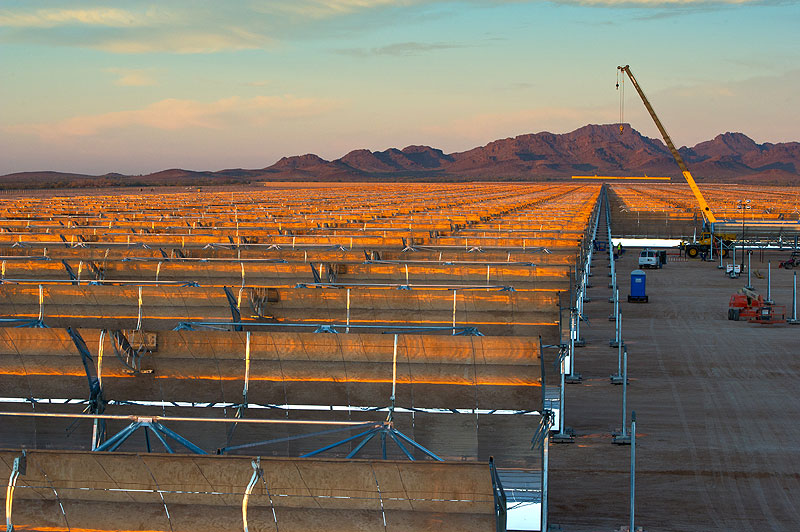
In this photo, mirrors in the foreground gleam orange from the sun, while mountains dominate the background. Enlarge image
Crews work around the clock installing mirrored parabolic trough collectors — built on site — that will cover 3 square miles at Abengoa's Solana Plant. When finished, the plant will generate 280 megawatts of clean, sustainable power.
Credit: Dennis Schroeder

Like Edison and Tesla or Dempsey and Tunney, the two major solar energy technologies never meant to play nice. Each had its niche — and its dreams of market share.

But that's changing, said NREL analyst Paul Denholm, co-author with Mark Mehos of the study "Enabling Greater Penetration of Solar Power via Use of CSP with Thermal Energy StoragePDF."

Think of power from PV as a roller coaster of highs and lows, and power from CSP, via thermal energy storage, as a gently rolling train.

PV panels and wind turbines contribute electricity to the grid, but without the ability to store that power, they cannot supply the grid after the sun sets, or after the wind dies. Even passing clouds can cause drops in the amount of solar energy that gets on the grid.

Large fossil-fueled and nuclear power plants can't be quickly stopped or started to accommodate variable energy sources such as solar and wind energy.

CSP can even out these ebbs and flows because it can store power and ramp up output when the amount of direct wind or solar power drops.

Grid Flexibility is the Key

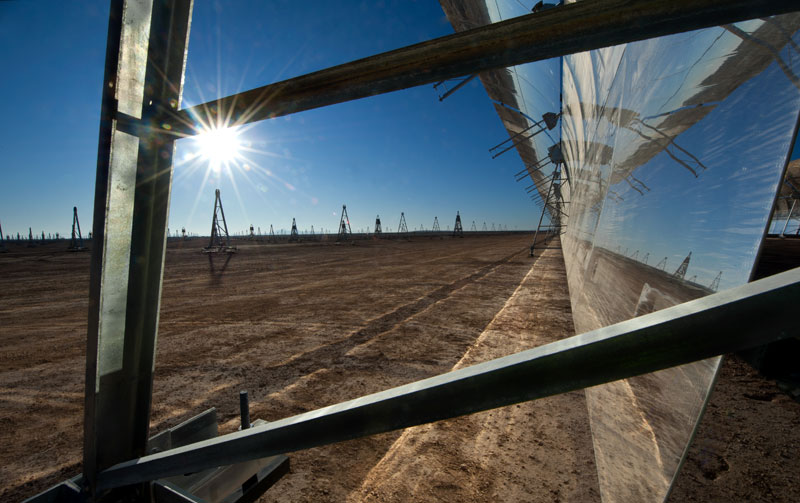
This photo is a close-up of one mirror and its supporting beams, with the sun gleaming above one of the cross beams. In the background are other structures on the Solana Plant and the mountains further back. Enlarge image
Light is reflected in a 25-foot-wide, 500-foot-long, and 10-foot-high parabolic trough collector at Abengoa's Solana Plant.
Credit: Dennis Schroeder

"It all gets down to grid flexibility," Denholm said. "What sets of grid technologies do you deploy to make the grid respond faster and over a greater range to the input of variable energy such as solar and wind?

"If you can't respond quickly, you end up potentially throwing away wind and solar energy.

"We know that the more wind and solar you add to the grid, the harder it is to balance the grid and maintain reliability."

A CSP plant works by heating a heat transfer fluid that is used to boil water to make steam. But because of thermal inertia, by the time that fluid gets through the system's pipes to the power plant, perhaps 10 or 15 minutes have passed.

When a cloud passes over a PV panel, the drop in energy production is immediate. But because of the 10 or 15 minutes of thermal inertia, a cloud passing over a CSP tower doesn't cause this immediate drop. Nor is there the immediate surge when sunlight returns.

"The change is more gradual," Denholm said. "That's one reason CSP can bring a greater quality to the grid."

Still, the greater potential for CSP — and for CSP helping PV to expand its role on the grid — is its capacity to store the energy it captures from the sun for several hours, making it a source of reliable energy after the sun sets.

"CSP can fill in that gap in the evening when there's peak demand for electricity," Denholm said. "Together, the solar resource can provide all that peak demand. And together they can reduce or eliminate the need to build new power plants for those peak periods."

Molten Salts a Low-Cost Solution

This photo shows a squat, cylindrical tank dwarfing the men working on its roof, with a crane and another tank in the background, and steel construction beams in the foreground. Enlarge image
The tanks that hold the molten salts at Abengoa's Solana Plant are enormous. The salts can keep the solar-heated fluids very hot for several hours, so they can be transferred to turbines to produce electricity even when the sun isn't shining.
Credit: Dennis Schroeder

Thermal energy storage at CSP plants "is low-cost because it's not exotic," Denholm said. "It's some large tanks with some media to store energy before you use it to boil the water." The best medium for storage available today is molten salt, NREL's Greg Glatzmaier said.

Molten salts are abundant and not very costly. They behave themselves, neither decomposing nor volatizing at the high temperature needed in a CSP plant — about 565 degrees Celsius (°C).

At a typical molten-salt CSP plant, the salts are stored in two tanks, one much hotter than the other.
In the case of a power tower CSP plant, in which the mirrors focus the sun's rays on one receiver atop a tower, the lower-temperature tank is at about 293°C, while the higher-temperature tank is at 565°C, Glatzmaier said.

The salt is pumped from the "cold" tank to the power tower, where it collects the solar energy that's focused on the receiver, raising its average temperature. The salts then descend into the "hot" tank, where they can maintain this very hot temperature for several days, though typically they are used within hours.

The salt in the hot tank is then sent to a heat exchanger that generates the steam needed to turn the turbines at a power plant. The turbines generate electricity that goes to homes and businesses.

As they exit the steam generator, the salts cool, and by the time they return to the cold tank, they measure at about 293°C.

When the sun is shining, the CSP plant can take the salts out of the cold tank, heat them up at the tower's receiver, and then dump them into the hot tank for storage, Glatzmaier said. "If you come to the end of the day and the hot tank is pretty full, you can keep generating electricity by withdrawing the salts from the hot tank to generate steam."

It's a continual balancing act. If all the salt is in the cold tank, no stored energy is available. If it's all in the hot tank, there's plenty of energy stored for later use, but nothing to replenish the system.

Molten salts tend to freeze at about 200°C, so as long as the two tanks range between 293°C and 565°C, the salts are in no danger of reverting to a solid state. At room temperature, the salts look like powdery white table salt. At the higher temperatures in a CSP plant, the salts look like water.

The molten salts used for storage are a mix of sodium nitrate and potassium nitrate. Sodium nitrate is mined from dry lake beds in Chile, in surroundings similar to the Utah salt flats. Potassium nitrate also occurs in nature and is mined in Chile, Ethiopia, and elsewhere.

Plants with Storage in Spain, Nevada, Arizona, California

Abengoa Solar is building a 250-megawatt CSP plant near Gila Bend, Ariz., that will cover 1,900 acres and use 900,000 mirrors to direct sunlight to heat a working fluid inside its tubes. The plant's six hours of thermal storage mean it can deliver electricity after the sun sets to approximately 70,000 homes.

The 19.9-megawatt power tower run by Gemasolar near Granada in southern Spain is configured to store enough energy during the summer to provide solar-generated electricity 24 hours a day, Glatzmaier said. In the winter, when there's less sunshine, electricity comes from more conventional sources a few hours each day. The system aims to power 25,000 homes and reduce carbon dioxide emissions by more than 30,000 tons a year.

SolarReserve is building the 110-megawatt Crescent Dunes Solar Energy Project near Tonopah, Nev., which will use molten salt to store the sun's energy as heat for several hours. It will include more than 17,000 mirrors to focus the sun's light on a tower 640 feet high.

BrightSource is building an even larger CSP project in the Mojave Desert near Needles, Calif., that will have storage for just a couple of hours a day — but this will be enough to serve more than 140,000 homes during peak hours. Company executives say the plant will reduce carbon dioxide emissions by more than 400,000 tons per year.

PV/CSP Symbiosis Makes Economic Sense

The cost of PV has been plummeting, and it has a cost advantage over CSP. But CSP has the advantage of storage, and so teamed with PV can improve the benefits and bottom lines of both technologies. Storage does raise the price of a CSP plant, but "if you're running your turbine more hours in a day, you're amortizing your turbine cost over more generation time, and there's a real cost benefit there," Glatzmaier said. The bottom line: when storage is added to a CSP plant, it increases the value of its electricity — both its energy value and its capacity value.

Solar plants also can store energy in batteries, but at least for now, that approach is quite expensive. Other thermal storage technologies being investigated by researchers include phase-change or thermal-chemical storage.


Denholm and Mehos caution that the preliminary analysis in their study will require more advanced grid simulations to verify the actual ability of CSP to help wind and PV gain a larger presence on the grid. An important next step, they say, would be more complete simulations using utility-grade software. That will answer questions on the realistic performance of the generation fleet, transmission constraints, and actual CSP operations.

Learn more about NREL's solar energy research and analysis.
— Bill Scanlon


Saturday, January 21, 2012

Lease Option Increases Rooftop Solar's Appeal, Study Says

From the U.S. Dept. of Energy's National Renewable Energy Laboratory (NREL):

National Renewable Energy Laboratory (NREL) - Innovation for Our Energy Future
News Release

Lease Option Increases Rooftop Solar’s Appeal, Study Says

Low Down Payment, Immediate Savings, Lure a New, Less Affluent Demographic


Friday, January 20, 2012


Rooftop solar panels are attracting a new demographic of customers who are choosing to lease rather than buy, and enjoying the low upfront costs and immediate savings.
The new third-party-lease business model lets homeowners save money the very first month, rather than breaking even a decade later after an initial investment of $10,000 or $20,000.

Analysts with the U.S. Department of Energy's National Renewable Energy Laboratory (NREL) found that the solar lease models are surging in southern California. And they're being adopted in less affluent neighborhoods that had few customer-owned systems.
The NREL study, "The Transformation of Southern California's Residential Photovoltaics Market through Third-Party Ownership," is in the current edition of the journal Energy Policy.

The study indicated an attraction for third-party leasing in neighborhoods with less affluence than those most likely to go for the customer-owned option.
It found a positive correlation between customers outright buying solar energy systems and customers living in neighborhoods where the average household income was $150,000 or more.

But with third-party-leased photovoltaic (PV) panels, that positive correlation appeared in neighborhoods where the average household income was just $100,000 or more.
If what's true in southern California proves true for the nation, it means that rooftop solar power could prove tempting for an additional 13 million Americans who live in households that earn between $100,000 and $150,000 per year.

"What is so interesting about the southern California data is that the strong decrease in PV prices – from lower retail costs and stronger federal incentives – didn't pick up a new demographic. But the new business model – leasing – did pick up a new customer demographic," NREL's Easan Drury, the lead author of the report, said.

Repackaging the value of photovoltaics as a simple savings on the monthly bill is an attractive alternative to the pitch that it will pay for itself in a decade, he said. "If someone comes up to you and says you can make money next month and forever, that totally changes how people see the value of solar."

Among Drury's other findings:
  • Third-party leasing usually eliminates the need for home-equity-style financing and, thus, the need for significant equity in the home. Without the hurdle of financing, more people can adopt solar, Drury said. 
  • Along with the lower income threshold, Drury found a surge in solar leasing in neighborhoods with younger families.
  • In the Los Angeles and Orange county markets, customer-owned PV was five times more prevalent than third-party owned in 2009. In 2010, the ratio had dropped to 2 to 1. And for the first quarter of 2011, the ratio was almost even.
Homeowners can put as little as $3,000 down and see an immediate drop in their electricity costs,  albeit that first year the drop may be just a couple dollars a month.
The real benefits come over the next two decades, when the $40 or $50 per month they're paying to lease the solar panels stays constant, while, presumably, the cost of electricity goes up. Third-party companies are touting potential customer savings of $10,000 to $15,000 over two decades.

NREL is the Department of Energy's primary national laboratory for renewable energy and energy efficiency research and development. NREL is operated for DOE by The Alliance for Sustainable Energy, LLC.
###

Tuesday, December 27, 2011

Library Patrons in New York Check-Out Renewable Energy

The following was gleaned from a December 27 blog post on the U.S. Department of Energy's web site.


Library Patrons in New York Check-Out Renewable Energy
December 27, 2011


The public library in Esopus, New York, used Recovery Act funds to install two photovoltaic arrays expected to generate 31,200 kWh of electricity annually -- approximately 30 percent of the library’s electricity use and a savings of nearly $4,000 in energy costs each year. | Photo courtesy of New York State Energy Research and Development Authority (NYSERDA).

Communications Liaison, State Energy Program

In a hamlet on the Hudson River in upstate New York, two newly installed photovoltaic arrays at the local library are generating electricity, interest in renewable energy, and community pride.

Recognizing its role as an educator and community leader, the Esopus Library used a $96,790 award from the Recovery Act to install the 22.5kW roof-mounted and 5.5kW ground-mounted photovoltaic systems.

The new solar system is expected to generate approximately 31,200 kWh of electricity annually -- approximately 30 percent of the library’s electricity use and a savings of $4,000 in energy costs each year.
The ninety-six 230-watt Sharp® photovoltaic panels, made in Memphis, Tennessee, along with the PVPowered™ 30 kW inverter and rooftop DPW Solar Mounting System were installed by a crew of eight electricians over a period of three days.

After completing the 22.5kW roof system, the city still had funds to spare. In turn, the library worked with NYSERDA to modify the project contract and spend the remaining money to add the 5.5kW ground system. The unexpected second array will deliver approximately 120 percent of the electricity that the grant was based on, while still staying within the original cost.