Showing posts with label storage. Show all posts
Showing posts with label storage. Show all posts
Thursday, March 26, 2015

Thursday, August 2, 2012
ARPA-E Announces $43 Million for Transformational Energy Storage Projects to Advance Electric Vehicle and Grid Technologies
Press release from the U.S. Dept. of Energy:
ARPA-E Announces $43 Million for Transformational Energy Storage Projects to Advance Electric Vehicle and Grid Technologies
August 2, 2012 - 10:34am
News Media Contact
WASHINGTON – The Department of Energy today announced that 19 transformative
new projects will receive a total of $43 million in funding from the
Department’s Advanced Research Projects Agency-Energy (ARPA-E) to leverage the
nation’s brightest scientists, engineers and entrepreneurs to develop
breakthrough energy storage technologies and support promising small businesses.
These projects are supported through two new ARPA-E programs -- Advanced
Management and Protection of Energy Storage Devices (AMPED) and Small Business
Innovation Research (SBIR) – and will focus on innovations in battery management
and storage to advance electric vehicle technologies, help improve the
efficiency and reliability of the electrical grid and provide important energy
security benefits to America’s armed forces.
“This latest round of ARPA-E projects seek to address the remaining challenges in energy storage technologies, which could revolutionize the way Americans store and use energy in electric vehicles, the grid and beyond, while also potentially improving the access to energy for the U.S. military at forward operating bases in remote areas,” said Secretary of Energy Steven Chu. “These cutting-edge projects could transform our energy infrastructure, dramatically reduce our reliance on imported oil and increase American energy security.”
Twelve research projects are receiving $30 million in funding under the AMPED program, which aims to develop advanced sensing and control technologies that could dramatically improve and provide new innovations in safety, performance, and lifetime for grid-scale and vehicle batteries. Unlike other Department of Energy efforts to push the frontiers of battery chemistry, AMPED is focused on maximizing the potential of existing battery chemistries. These innovations will help reduce costs and improve the performance of next generation storage technologies, which could be applied in both plug-in electric and hybrid-electric vehicles. For example, Battelle Memorial Institute in Columbus, Ohio, will develop an optical sensor to monitor the internal environment of a lithium-ion battery in real-time.
ARPA-E is also announcing a total of $13 million for seven projects to enterprising small businesses to pursue cutting-edge energy storage developments for stationary power and electric vehicles. These projects will develop new innovative battery chemistries and battery designs, continuing ARPA-E’s funding for storage technologies. These awards are part of the larger Department-wide Small Business Innovative Research (SBIR)/Small Business Technology Transfer (STTR) program. For example, Energy Storage Systems, Inc., in Portland, Oregon, will construct a flow battery for grid scale storage using an advanced cell design and electrolyte materials composed of low cost iron. The flow battery will have a target storage cost of less than $100/kWh, which could enable deployment of renewable energy technologies throughout the grid.
Information on all of the new AMPED and SBIR projects announced today is available HERE.
ARPA-E’s Principal Deputy Director Eric Toone announced the selected projects at the Information Technology and Innovation Foundation’s event, the “New Age of Discovery: Government’s Role in Transformative Innovation,” in Washington, DC, where he spoke alongside former ARPA-E Director Arun Majumdar.
ARPA-E was launched in 2009 to seek out transformational, breakthrough technologies that are too risky for private-sector investment but have the potential to translate science into quantum leaps in energy technology, form the foundation for entirely new industries, and have large commercial impacts. Prior to today’s announcement, ARPA-E has attracted over 5,000 applications from research teams, which have resulted in approximately 180 groundbreaking projects worth nearly $500 million. More information on the program is available at www.arpa-e.energy.gov.
“This latest round of ARPA-E projects seek to address the remaining challenges in energy storage technologies, which could revolutionize the way Americans store and use energy in electric vehicles, the grid and beyond, while also potentially improving the access to energy for the U.S. military at forward operating bases in remote areas,” said Secretary of Energy Steven Chu. “These cutting-edge projects could transform our energy infrastructure, dramatically reduce our reliance on imported oil and increase American energy security.”
Twelve research projects are receiving $30 million in funding under the AMPED program, which aims to develop advanced sensing and control technologies that could dramatically improve and provide new innovations in safety, performance, and lifetime for grid-scale and vehicle batteries. Unlike other Department of Energy efforts to push the frontiers of battery chemistry, AMPED is focused on maximizing the potential of existing battery chemistries. These innovations will help reduce costs and improve the performance of next generation storage technologies, which could be applied in both plug-in electric and hybrid-electric vehicles. For example, Battelle Memorial Institute in Columbus, Ohio, will develop an optical sensor to monitor the internal environment of a lithium-ion battery in real-time.
ARPA-E is also announcing a total of $13 million for seven projects to enterprising small businesses to pursue cutting-edge energy storage developments for stationary power and electric vehicles. These projects will develop new innovative battery chemistries and battery designs, continuing ARPA-E’s funding for storage technologies. These awards are part of the larger Department-wide Small Business Innovative Research (SBIR)/Small Business Technology Transfer (STTR) program. For example, Energy Storage Systems, Inc., in Portland, Oregon, will construct a flow battery for grid scale storage using an advanced cell design and electrolyte materials composed of low cost iron. The flow battery will have a target storage cost of less than $100/kWh, which could enable deployment of renewable energy technologies throughout the grid.
Information on all of the new AMPED and SBIR projects announced today is available HERE.
ARPA-E’s Principal Deputy Director Eric Toone announced the selected projects at the Information Technology and Innovation Foundation’s event, the “New Age of Discovery: Government’s Role in Transformative Innovation,” in Washington, DC, where he spoke alongside former ARPA-E Director Arun Majumdar.
ARPA-E was launched in 2009 to seek out transformational, breakthrough technologies that are too risky for private-sector investment but have the potential to translate science into quantum leaps in energy technology, form the foundation for entirely new industries, and have large commercial impacts. Prior to today’s announcement, ARPA-E has attracted over 5,000 applications from research teams, which have resulted in approximately 180 groundbreaking projects worth nearly $500 million. More information on the program is available at www.arpa-e.energy.gov.
Tuesday, March 20, 2012
New Catalyst for Safe, Reversible Hydrogen Storage
New Catalyst for Safe, Reversible Hydrogen Storage
Room-temperature reaction takes place in water; can switch from hydrogen storage to release by changing pH
March 18, 2012
 Etsuko Fujita, Jonathan Hull, and James Muckerman
UPTON, NY — Scientists at the U.S. Department of Energy’s (DOE) Brookhaven National Laboratory and collaborators have developed a new catalyst that reversibly converts hydrogen gas and carbon dioxide to a liquid under very mild conditions. The work — described in a paper published online March 18, 2012, in Nature Chemistry — could lead to efficient ways to safely store and transport hydrogen for use as an alternative fuel.
Hydrogen is seen as an attractive fuel because it can efficiently be converted to energy without producing toxic products or greenhouse gases. However, the storage and transportation of hydrogen remain more problematic than for liquid hydrocarbon fuels. The new work builds on earlier efforts to combine hydrogen with carbon dioxide to produce a liquid formic acid solution that can be transported using the same kind of infrastructure used to transport gasoline and oil.
“This is not the first catalyst capable of carrying out this reaction, but it is the first to work at room temperature, in an aqueous (water) solution, under atmospheric pressure — and that is capable of running the reaction in forward or reverse directions depending on the acidity of the solution,” said Brookhaven chemist Etsuko Fujita, who oversaw Brookhaven’s contributions to this research.
“When the release of hydrogen is desired for use in fuel cells or other applications, one can simply flip the ‘pH switch’ on the catalyst to run the reaction in reverse,” said Brookhaven chemist James Muckerman, a co-author on the study. He noted that the liquid formic acid might also be used directly in a formic-acid fuel cell.
Collaborator Yuichiro Himeda of the National Institute of Advanced Industrial Science and Technology (AIST) of Japan had been making substantial progress toward the goal of developing this type of catalyst for a number of years. He used iridium metal complexes containing aromatic diimine ligands (groups of atoms bound to the metal) with pendent, peripheral hydroxyl (OH) groups that can serve as acidic sites that release protons to become pendent bases.
Himeda recently entered into collaboration — via the U.S.-Japan Collaboration on Clean Energy Technology program — with Fujita, Muckerman, and Jonathan Hull (a Goldhaber Fellow working on Fujita’s team). The Brookhaven group carried out coordinated experimental and theoretical studies to understand the sequence of chemical steps by which these catalysts converted H2and CO2 into formic acid. Their goal was to design new catalysts with improved performance.
The Brookhaven team’s key idea came from Nature: “We were inspired by the way hydrogen bonds and bases relay protons in the active sites of some enzymes,” Hull said.
 This diagram shows the new catalyst in its protonated and deprotonated states as it reversibly converts hydrogen and CO2 gas to and from liquid formate or formic acid at ambient temperature and pressure. The gases can thereby be stored and transported as a liquid, and used later in carbon-neutral energy applications, simply by adjusting the pH. This diagram shows the new catalyst in its protonated and deprotonated states as it reversibly converts hydrogen and CO2 gas to and from liquid formate or formic acid at ambient temperature and pressure. The gases can thereby be stored and transported as a liquid, and used later in carbon-neutral energy applications, simply by adjusting the pH. |
“Good catalysts efficiently move protons and electrons around, taking them from some molecules and placing them onto others to produce the desired product,” he explained. “Nature has many ways of doing this. Under the right conditions, the hydroxyl groups on the diimine ligand of the catalyst help hydrogen react with carbon dioxide, which is difficult to do. We thought we could improve the reactivity by placing the pendent bases near the metal centers, rather than in peripheral positions.”
Once the Brookhaven team understood how Himeda’s catalysts worked, Hull realized that a novel ligand that had been synthesized by collaborators Brian Hashiguchi and Roy Periana of The Scripps Research Institute for an entirely different purpose would possibly be ideal for accomplishing this goal. The Brookhaven group designed a new iridium metal catalyst incorporating this new ligand.
Collaborator David Szalda of Baruch College (City University of New York) determined the atomic level crystal structure of the new catalyst to “see” how the arrangement of its atoms might explain its function.
Tests of the new catalyst revealed superior catalytic performance for storing and releasing H2 under very mild reaction conditions. For the reaction combining CO2 with H2, the scientists observed high turnovers at room temperature and ambient pressure; for the catalytic decomposition of formic acid to release hydrogen, the catalytic rate was faster than any previous report.
“We were able to convert a 1:1 mixture of H2 and CO2 to formate (the deprotonated form of formic acid) at room temperature, successfully regenerate H2, and then repeat the cycle. It’s a design principle we are very fortunate to have found,” said Hull.
The regenerated high-pressure gas mixture (hydrogen and carbon dioxide) is quite pure; importantly, no carbon monoxide (CO) — an impurity that can ‘poison’ fuel cells and thus reduce their lifetime — was detected. Therefore, this method of storing and regenerating hydrogen might have a use in hydrogen fuel cells.
Further efforts to optimize the hydrogen storage process are ongoing using several catalysts with the same design principle.
“This is a wonderful example of how fundamental research can lead to the understanding and control of factors that contribute to the solution of technologically important problems,” Muckerman concluded.
This research was funded by the DOE Office of Science, a Goldhaber Distinguished Fellowship, and by the Japanese Ministry of Economy, Trade, and Industry.
DOE’s Office of Science is the single largest supporter of basic research in the physical sciences in the United States, and is working to address some of the most pressing challenges of our time. For more information, please visit science.energy.gov.
Related Links
Tuesday, February 14, 2012
Thermal Storage Gets More Solar on the Grid
From the National Renewable Energy Laboratory (NREL):
 Enlarge image
It's 4:45 on a sweltering August afternoon, and the rooftop solar panels are starting to lose juice. The sun's lower angles and that huge cottonwood tree are interfering with the efficient photon-to-electricity transfer.
What is an environmentally conscious — but air-conditioning-loving — homeowner to do?
Peak demand for electricity in the United States typically hits between 4 p.m. and 8 p.m., which doesn't quite line up with the sun's schedule. It's fortunate that the sun is high in the sky during many of the hours when the air conditioning is in demand. But in summer, people tend to need air conditioning during the dinner hour and beyond, when kitchen appliances are whirring, lights are on, and TVs are blaring.
To the rescue comes concentrating solar power (CSP), a technology being tested and deployed by utilities in America's deserts and southern Spain.
New analysis at the U.S. Department of Energy's (DOE) National Renewable Energy Laboratory (NREL) has found that CSP, with its greater grid flexibility and ability to store energy for as long as 15 hours, can enhance total solar power generation and actually give photovoltaic (PV) systems a greater presence on the grid.
PV panels convert photons from the sun directly into electrons for electricity — and are grabbing real estate on rooftops across the Americas, Europe, and Asia.
CSP technologies use mirrors to reflect and concentrate sunlight onto receivers that collect the sun's heat. This thermal energy can then be used to drive a steam turbine that produces electricity for utilities.
 Enlarge image
Like Edison and Tesla or Dempsey and Tunney, the two major solar energy technologies never meant to play nice. Each had its niche — and its dreams of market share.
But that's changing, said NREL analyst Paul Denholm, co-author with Mark Mehos of the study "Enabling Greater Penetration of Solar Power via Use of CSP with Thermal Energy Storage ."
."
Think of power from PV as a roller coaster of highs and lows, and power from CSP, via thermal energy storage, as a gently rolling train.
PV panels and wind turbines contribute electricity to the grid, but without the ability to store that power, they cannot supply the grid after the sun sets, or after the wind dies. Even passing clouds can cause drops in the amount of solar energy that gets on the grid.
Large fossil-fueled and nuclear power plants can't be quickly stopped or started to accommodate variable energy sources such as solar and wind energy.
CSP can even out these ebbs and flows because it can store power and ramp up output when the amount of direct wind or solar power drops.
 Enlarge image
"It all gets down to grid flexibility," Denholm said. "What sets of grid technologies do you deploy to make the grid respond faster and over a greater range to the input of variable energy such as solar and wind?
"If you can't respond quickly, you end up potentially throwing away wind and solar energy.
"We know that the more wind and solar you add to the grid, the harder it is to balance the grid and maintain reliability."
A CSP plant works by heating a heat transfer fluid that is used to boil water to make steam. But because of thermal inertia, by the time that fluid gets through the system's pipes to the power plant, perhaps 10 or 15 minutes have passed.
When a cloud passes over a PV panel, the drop in energy production is immediate. But because of the 10 or 15 minutes of thermal inertia, a cloud passing over a CSP tower doesn't cause this immediate drop. Nor is there the immediate surge when sunlight returns.
"The change is more gradual," Denholm said. "That's one reason CSP can bring a greater quality to the grid."
Still, the greater potential for CSP — and for CSP helping PV to expand its role on the grid — is its capacity to store the energy it captures from the sun for several hours, making it a source of reliable energy after the sun sets.
"CSP can fill in that gap in the evening when there's peak demand for electricity," Denholm said. "Together, the solar resource can provide all that peak demand. And together they can reduce or eliminate the need to build new power plants for those peak periods."
 Enlarge image
Thermal energy storage at CSP plants "is low-cost because it's not exotic," Denholm said. "It's some large tanks with some media to store energy before you use it to boil the water." The best medium for storage available today is molten salt, NREL's Greg Glatzmaier said.
Molten salts are abundant and not very costly. They behave themselves, neither decomposing nor volatizing at the high temperature needed in a CSP plant — about 565 degrees Celsius (°C).
At a typical molten-salt CSP plant, the salts are stored in two tanks, one much hotter than the other.
In the case of a power tower CSP plant, in which the mirrors focus the sun's rays on one receiver atop a tower, the lower-temperature tank is at about 293°C, while the higher-temperature tank is at 565°C, Glatzmaier said.
The salt is pumped from the "cold" tank to the power tower, where it collects the solar energy that's focused on the receiver, raising its average temperature. The salts then descend into the "hot" tank, where they can maintain this very hot temperature for several days, though typically they are used within hours.
The salt in the hot tank is then sent to a heat exchanger that generates the steam needed to turn the turbines at a power plant. The turbines generate electricity that goes to homes and businesses.
As they exit the steam generator, the salts cool, and by the time they return to the cold tank, they measure at about 293°C.
When the sun is shining, the CSP plant can take the salts out of the cold tank, heat them up at the tower's receiver, and then dump them into the hot tank for storage, Glatzmaier said. "If you come to the end of the day and the hot tank is pretty full, you can keep generating electricity by withdrawing the salts from the hot tank to generate steam."
It's a continual balancing act. If all the salt is in the cold tank, no stored energy is available. If it's all in the hot tank, there's plenty of energy stored for later use, but nothing to replenish the system.
Molten salts tend to freeze at about 200°C, so as long as the two tanks range between 293°C and 565°C, the salts are in no danger of reverting to a solid state. At room temperature, the salts look like powdery white table salt. At the higher temperatures in a CSP plant, the salts look like water.
The molten salts used for storage are a mix of sodium nitrate and potassium nitrate. Sodium nitrate is mined from dry lake beds in Chile, in surroundings similar to the Utah salt flats. Potassium nitrate also occurs in nature and is mined in Chile, Ethiopia, and elsewhere.
The 19.9-megawatt power tower run by Gemasolar near Granada in southern Spain is configured to store enough energy during the summer to provide solar-generated electricity 24 hours a day, Glatzmaier said. In the winter, when there's less sunshine, electricity comes from more conventional sources a few hours each day. The system aims to power 25,000 homes and reduce carbon dioxide emissions by more than 30,000 tons a year.
SolarReserve is building the 110-megawatt Crescent Dunes Solar Energy Project near Tonopah, Nev., which will use molten salt to store the sun's energy as heat for several hours. It will include more than 17,000 mirrors to focus the sun's light on a tower 640 feet high.
BrightSource is building an even larger CSP project in the Mojave Desert near Needles, Calif., that will have storage for just a couple of hours a day — but this will be enough to serve more than 140,000 homes during peak hours. Company executives say the plant will reduce carbon dioxide emissions by more than 400,000 tons per year.
Solar plants also can store energy in batteries, but at least for now, that approach is quite expensive. Other thermal storage technologies being investigated by researchers include phase-change or thermal-chemical storage.
Denholm and Mehos caution that the preliminary analysis in their study will require more advanced grid simulations to verify the actual ability of CSP to help wind and PV gain a larger presence on the grid. An important next step, they say, would be more complete simulations using utility-grade software. That will answer questions on the realistic performance of the generation fleet, transmission constraints, and actual CSP operations.
Learn more about NREL's solar energy research and analysis.
— Bill Scanlon
Thermal Storage Gets More Solar on the Grid
February 14, 2012
 Enlarge image
 Abengoa is erecting more than 3,200 mirrored parabolic troughs at its Solana plant near Gila Bend, Ariz. When at full operation, the CSP plant will serve more than 70,000 homes.
Credit: Dennis Schroeder
Credit: Dennis Schroeder
It's 4:45 on a sweltering August afternoon, and the rooftop solar panels are starting to lose juice. The sun's lower angles and that huge cottonwood tree are interfering with the efficient photon-to-electricity transfer.
What is an environmentally conscious — but air-conditioning-loving — homeowner to do?
Peak demand for electricity in the United States typically hits between 4 p.m. and 8 p.m., which doesn't quite line up with the sun's schedule. It's fortunate that the sun is high in the sky during many of the hours when the air conditioning is in demand. But in summer, people tend to need air conditioning during the dinner hour and beyond, when kitchen appliances are whirring, lights are on, and TVs are blaring.
To the rescue comes concentrating solar power (CSP), a technology being tested and deployed by utilities in America's deserts and southern Spain.
New analysis at the U.S. Department of Energy's (DOE) National Renewable Energy Laboratory (NREL) has found that CSP, with its greater grid flexibility and ability to store energy for as long as 15 hours, can enhance total solar power generation and actually give photovoltaic (PV) systems a greater presence on the grid.
PV panels convert photons from the sun directly into electrons for electricity — and are grabbing real estate on rooftops across the Americas, Europe, and Asia.
CSP technologies use mirrors to reflect and concentrate sunlight onto receivers that collect the sun's heat. This thermal energy can then be used to drive a steam turbine that produces electricity for utilities.
Thermal Storage Can Even Out the Bumps
 Enlarge image
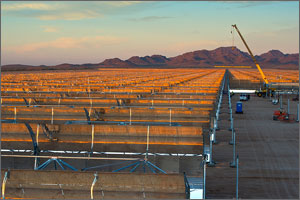
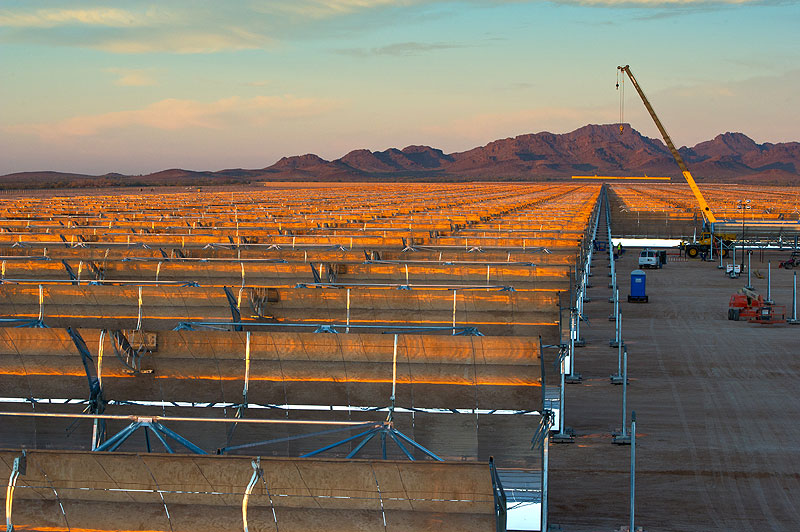
 Crews work around the clock installing mirrored parabolic trough collectors — built on site — that will cover 3 square miles at Abengoa's Solana Plant. When finished, the plant will generate 280 megawatts of clean, sustainable power.
Credit: Dennis Schroeder
Credit: Dennis Schroeder
Like Edison and Tesla or Dempsey and Tunney, the two major solar energy technologies never meant to play nice. Each had its niche — and its dreams of market share.
But that's changing, said NREL analyst Paul Denholm, co-author with Mark Mehos of the study "Enabling Greater Penetration of Solar Power via Use of CSP with Thermal Energy Storage
."Think of power from PV as a roller coaster of highs and lows, and power from CSP, via thermal energy storage, as a gently rolling train.
PV panels and wind turbines contribute electricity to the grid, but without the ability to store that power, they cannot supply the grid after the sun sets, or after the wind dies. Even passing clouds can cause drops in the amount of solar energy that gets on the grid.
Large fossil-fueled and nuclear power plants can't be quickly stopped or started to accommodate variable energy sources such as solar and wind energy.
CSP can even out these ebbs and flows because it can store power and ramp up output when the amount of direct wind or solar power drops.
Grid Flexibility is the Key
 Enlarge image
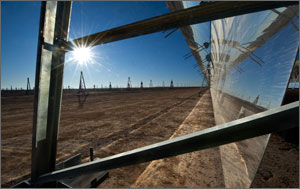
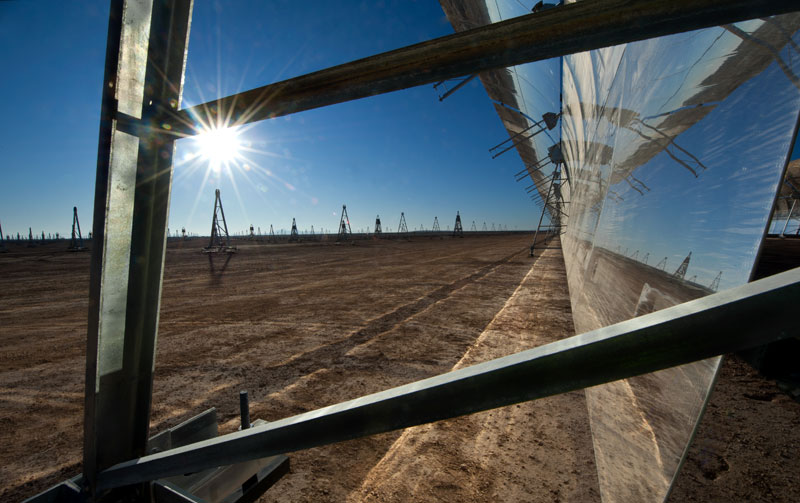
 Light is reflected in a 25-foot-wide, 500-foot-long, and 10-foot-high parabolic trough collector at Abengoa's Solana Plant.
Credit: Dennis Schroeder
Credit: Dennis Schroeder
"It all gets down to grid flexibility," Denholm said. "What sets of grid technologies do you deploy to make the grid respond faster and over a greater range to the input of variable energy such as solar and wind?
"If you can't respond quickly, you end up potentially throwing away wind and solar energy.
"We know that the more wind and solar you add to the grid, the harder it is to balance the grid and maintain reliability."
A CSP plant works by heating a heat transfer fluid that is used to boil water to make steam. But because of thermal inertia, by the time that fluid gets through the system's pipes to the power plant, perhaps 10 or 15 minutes have passed.
When a cloud passes over a PV panel, the drop in energy production is immediate. But because of the 10 or 15 minutes of thermal inertia, a cloud passing over a CSP tower doesn't cause this immediate drop. Nor is there the immediate surge when sunlight returns.
"The change is more gradual," Denholm said. "That's one reason CSP can bring a greater quality to the grid."
Still, the greater potential for CSP — and for CSP helping PV to expand its role on the grid — is its capacity to store the energy it captures from the sun for several hours, making it a source of reliable energy after the sun sets.
"CSP can fill in that gap in the evening when there's peak demand for electricity," Denholm said. "Together, the solar resource can provide all that peak demand. And together they can reduce or eliminate the need to build new power plants for those peak periods."
Molten Salts a Low-Cost Solution
 Enlarge image
 The tanks that hold the molten salts at Abengoa's Solana Plant are enormous. The salts can keep the solar-heated fluids very hot for several hours, so they can be transferred to turbines to produce electricity even when the sun isn't shining.
Credit: Dennis Schroeder
Credit: Dennis Schroeder
Thermal energy storage at CSP plants "is low-cost because it's not exotic," Denholm said. "It's some large tanks with some media to store energy before you use it to boil the water." The best medium for storage available today is molten salt, NREL's Greg Glatzmaier said.
Molten salts are abundant and not very costly. They behave themselves, neither decomposing nor volatizing at the high temperature needed in a CSP plant — about 565 degrees Celsius (°C).
At a typical molten-salt CSP plant, the salts are stored in two tanks, one much hotter than the other.
In the case of a power tower CSP plant, in which the mirrors focus the sun's rays on one receiver atop a tower, the lower-temperature tank is at about 293°C, while the higher-temperature tank is at 565°C, Glatzmaier said.
The salt is pumped from the "cold" tank to the power tower, where it collects the solar energy that's focused on the receiver, raising its average temperature. The salts then descend into the "hot" tank, where they can maintain this very hot temperature for several days, though typically they are used within hours.
The salt in the hot tank is then sent to a heat exchanger that generates the steam needed to turn the turbines at a power plant. The turbines generate electricity that goes to homes and businesses.
As they exit the steam generator, the salts cool, and by the time they return to the cold tank, they measure at about 293°C.
When the sun is shining, the CSP plant can take the salts out of the cold tank, heat them up at the tower's receiver, and then dump them into the hot tank for storage, Glatzmaier said. "If you come to the end of the day and the hot tank is pretty full, you can keep generating electricity by withdrawing the salts from the hot tank to generate steam."
It's a continual balancing act. If all the salt is in the cold tank, no stored energy is available. If it's all in the hot tank, there's plenty of energy stored for later use, but nothing to replenish the system.
Molten salts tend to freeze at about 200°C, so as long as the two tanks range between 293°C and 565°C, the salts are in no danger of reverting to a solid state. At room temperature, the salts look like powdery white table salt. At the higher temperatures in a CSP plant, the salts look like water.
The molten salts used for storage are a mix of sodium nitrate and potassium nitrate. Sodium nitrate is mined from dry lake beds in Chile, in surroundings similar to the Utah salt flats. Potassium nitrate also occurs in nature and is mined in Chile, Ethiopia, and elsewhere.
Plants with Storage in Spain, Nevada, Arizona, California
Abengoa Solar is building a 250-megawatt CSP plant near Gila Bend, Ariz., that will cover 1,900 acres and use 900,000 mirrors to direct sunlight to heat a working fluid inside its tubes. The plant's six hours of thermal storage mean it can deliver electricity after the sun sets to approximately 70,000 homes.The 19.9-megawatt power tower run by Gemasolar near Granada in southern Spain is configured to store enough energy during the summer to provide solar-generated electricity 24 hours a day, Glatzmaier said. In the winter, when there's less sunshine, electricity comes from more conventional sources a few hours each day. The system aims to power 25,000 homes and reduce carbon dioxide emissions by more than 30,000 tons a year.
SolarReserve is building the 110-megawatt Crescent Dunes Solar Energy Project near Tonopah, Nev., which will use molten salt to store the sun's energy as heat for several hours. It will include more than 17,000 mirrors to focus the sun's light on a tower 640 feet high.
BrightSource is building an even larger CSP project in the Mojave Desert near Needles, Calif., that will have storage for just a couple of hours a day — but this will be enough to serve more than 140,000 homes during peak hours. Company executives say the plant will reduce carbon dioxide emissions by more than 400,000 tons per year.
PV/CSP Symbiosis Makes Economic Sense
The cost of PV has been plummeting, and it has a cost advantage over CSP. But CSP has the advantage of storage, and so teamed with PV can improve the benefits and bottom lines of both technologies. Storage does raise the price of a CSP plant, but "if you're running your turbine more hours in a day, you're amortizing your turbine cost over more generation time, and there's a real cost benefit there," Glatzmaier said. The bottom line: when storage is added to a CSP plant, it increases the value of its electricity — both its energy value and its capacity value.Solar plants also can store energy in batteries, but at least for now, that approach is quite expensive. Other thermal storage technologies being investigated by researchers include phase-change or thermal-chemical storage.
Denholm and Mehos caution that the preliminary analysis in their study will require more advanced grid simulations to verify the actual ability of CSP to help wind and PV gain a larger presence on the grid. An important next step, they say, would be more complete simulations using utility-grade software. That will answer questions on the realistic performance of the generation fleet, transmission constraints, and actual CSP operations.
Learn more about NREL's solar energy research and analysis.
— Bill Scanlon
Tuesday, February 7, 2012
Energy Innovation Hubs
News release from the U.S. Dept. of Energy:
Energy Department to Launch New Energy Innovation Hub Focused on Advanced Batteries and Energy Storage
February 7, 2012
Washington, D.C. – U.S. Secretary of Energy Steven Chu announced today plans to launch a new Energy Innovation Hub for advanced research on batteries and energy storage with an investment of up to $120 million over five years. The hub, which will be funded at up to $20 million in fiscal year 2012, will focus on accelerating research and development of electrochemical energy storage for transportation and the electric grid. The interdisciplinary research and development through the new Energy Innovation Hub will help advance cutting-edge energy storage and battery technologies that can be used to improve the reliability and the efficiency of the electrical grid, to better integrate clean, renewable energy technologies as part of the electrical system, and for use in electric and hybrid vehicles that will reduce the nation’s dependence on foreign oil.
“As part of the Obama Administration’s investments in science and innovation, this Energy Innovation Hub will bring together scientists, engineers, and industry to develop fresh concepts and new approaches that will ensure America is at the leading-edge of the growing global market for battery technology,” said Secretary Chu. “With the advances from this research and development effort, we will be able to design and produce batteries here in America that last longer, go farther, and cost less than today’s technologies.”
Energy Innovation Hubs are designed to bring together teams of scientists and engineers across intellectual disciplines to rapidly accelerate scientific discoveries and shorten the path from laboratory innovation to technological development and commercial deployment of critical energy technologies. The hubs are part of the Obama Administration’s broad-based clean energy research strategy aimed at harnessing American innovation to achieve needed breakthroughs in important energy technologies to grow the clean energy economy and generate new clean energy jobs.
The goal of the Batteries and Energy Storage Hub will be to deliver research leading to revolutionary new technologies. While advancing the current understanding and underlying science around energy storage, the role of the new hub will be to develop radically new scientific approaches, including the exploration of new materials, devices, systems and novel approaches for transportation and utility-scale storage. The hub should foster new energy storage designs and develop working, scalable prototype devices that demonstrate radically new approaches for electrochemical storage, overcoming current manufacturing limitations through innovation to reduce complexity and cost. The ultimate goal will be to surpass the current technical limits for electrochemical energy storage and reduce the risk level enough for industry to further develop the innovations discovered by the hub and deploy these new technologies into the marketplace.
Letters of Intent to apply are due on March 1, 2012 with full applications due on May 31, 2012.
Universities, national laboratories, nonprofit organizations, and private firms are eligible to compete and are encouraged to form partnerships when submitting their proposals. The award selection is expected this summer. The full Funding Opportunity Announcement (FOA) is available HERE.
This will be the fourth such hub established by the Department since 2010. Other hubs include the Joint Center for Artificial Photosynthesis, which focuses on advanced research to develop fuels directly from sunlight; the Consortium for Advanced Simulation of Light Water Reactors, which is seeking to improve nuclear reactors through sophisticated computer-based modeling and simulation; and the Greater Philadelphia Innovation Cluster for Energy-Efficient Buildings, which is working to achieve major breakthroughs in energy efficient building design. Information on the existing hubs can be found on the Energy Innovation Hubs website: http://energy.gov/hubs.
Energy Innovation Hubs are designed to bring together teams of scientists and engineers across intellectual disciplines to rapidly accelerate scientific discoveries and shorten the path from laboratory innovation to technological development and commercial deployment of critical energy technologies. The hubs are part of the Obama Administration’s broad-based clean energy research strategy aimed at harnessing American innovation to achieve needed breakthroughs in important energy technologies to grow the clean energy economy and generate new clean energy jobs.
The goal of the Batteries and Energy Storage Hub will be to deliver research leading to revolutionary new technologies. While advancing the current understanding and underlying science around energy storage, the role of the new hub will be to develop radically new scientific approaches, including the exploration of new materials, devices, systems and novel approaches for transportation and utility-scale storage. The hub should foster new energy storage designs and develop working, scalable prototype devices that demonstrate radically new approaches for electrochemical storage, overcoming current manufacturing limitations through innovation to reduce complexity and cost. The ultimate goal will be to surpass the current technical limits for electrochemical energy storage and reduce the risk level enough for industry to further develop the innovations discovered by the hub and deploy these new technologies into the marketplace.
Letters of Intent to apply are due on March 1, 2012 with full applications due on May 31, 2012.
Universities, national laboratories, nonprofit organizations, and private firms are eligible to compete and are encouraged to form partnerships when submitting their proposals. The award selection is expected this summer. The full Funding Opportunity Announcement (FOA) is available HERE.
This will be the fourth such hub established by the Department since 2010. Other hubs include the Joint Center for Artificial Photosynthesis, which focuses on advanced research to develop fuels directly from sunlight; the Consortium for Advanced Simulation of Light Water Reactors, which is seeking to improve nuclear reactors through sophisticated computer-based modeling and simulation; and the Greater Philadelphia Innovation Cluster for Energy-Efficient Buildings, which is working to achieve major breakthroughs in energy efficient building design. Information on the existing hubs can be found on the Energy Innovation Hubs website: http://energy.gov/hubs.
Tuesday, January 3, 2012
Building Storehouses for the Sun's Energy, for Use After Dark
The following was gleaned from a January 3 New York Times article with the above title.
Building Storehouses for the Sun’s Energy, for Use After Dark
The solar power industry must overcome a major stumbling block: finding a way to store it for use when the sun isn’t shining.
Solar thermal power makes electricity by using the sun’s heat to boil water. The water can be used to heat salt that stores the energy until later, when the sun is no longer shining.
The U.S. Energy Department recently gave a $737 million loan guarantee to a solar thermal company for a plant that will generate 110 megawatts at peak and store enough heat to run for eight to 10 hours when the sun is not shining.
The U.S. Energy Department recently gave a $737 million loan guarantee to a solar thermal company for a plant that will generate 110 megawatts at peak and store enough heat to run for eight to 10 hours when the sun is not shining.
One advantage of adding storage capacity has to do with the equipment that makes electricity being the most expensive part of a solar thermal system. If it is connected to storage technology, it can run almost twice as many hours as a plant without storage. That means the unit cost of electricity drops.
Another has to do with the arcane economics of electricity. A utility must assure a supply of electricity in two forms: energy and capacity. The difference has never meant much to most consumers, who directly pay only for energy, as measured in kilowatt-hours.
But capacity, the dependable ability to produce power, is becoming more important as renewable energy forms a larger and larger part of the grid.
Wind and sun provide a lot of energy but not much capacity. Today, backup capacity for wind and solar power comes in the form of expensive gas-fired generators, which sit idle most of the year but operate when the wind stops blowing or the sun stops shining.
Storage could cut costs by 4 cents a kilowatt-hour, Mr. Denholm calculates — a considerable benefit for a commodity that retails for an average of 11 cents. A big part of the savings is not having to build the gas-fired generators for backup.
Subscribe to:
Posts (Atom)