Search This Blog

Showing posts with label transportation. Show all posts

Saturday, April 12, 2014

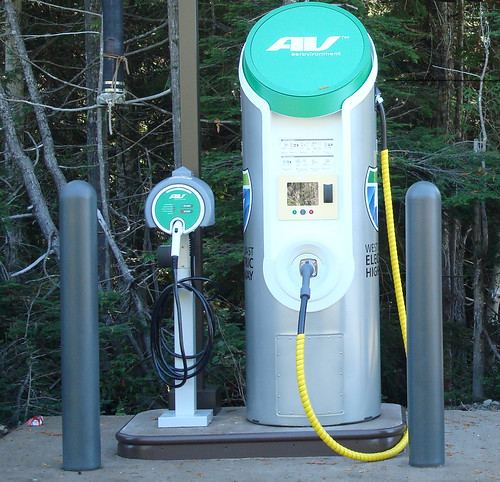
Ready, Set, Charge! Mt. Hood National Forest Welcomes First Electric Vehicle Charging Station

USDA Blog Post:

Mt. Hood National Forest is home to the nation’s first electric vehicle fast charger installed on land managed by the U.S. Forest Service and on a ski resort. (Courtesy Oregon Department of Transportation)
Oregon, home to the nation’s first border-to-border electric highway, continues its emergence as the ultimate travel destination for electric vehicle (EV) drivers. The Forest Service, the Oregon Department of Transportation and their partners recently unveiled America’s first EV fast-charger installed on U.S. Forest Service land and at a ski resort.
By using the growing West Coast Electric Highway fast-charger network, EV drivers can now travel up Mt. Hood’s rugged slopes, looming large at 11,250 feet and located just over an hour from Portland, Ore. The charging station, at Mt. Hood Skibowl West, completes Oregon’s Mt. Hood-Columbia River Gorge Electric Byway.
“It’s a natural fit to support infrastructure that promotes clean energy near forest recreation sites,” said Bill Westbrook of the Forest Service’s Zigzag Ranger District.
Partners in this accomplishment include Travel Oregon, the U.S. Department of TransportationU.S. Senator Jeff Merkley, the U.S. Forest Service, AeroVironment, Portland General Electric and the Oregon Office of the Governor.
“The opening of the Mt. Hood fast-charger marks a major milestone in Oregon’s efforts to support electric vehicle travel across the state, including to wild and scenic places and recreation destinations,” said Oregon Gov. John Kitzhaber. “This not only helps minimize our environmental impact, it also creates an economic boost for small businesses located along Oregon Electric Byways.”
Ashley Horvat, Oregon’s electric vehicle officer, said Oregonians aren’t content to relegate electric vehicles to just city driving.
“We see the potential to use EVs for long distance travel, helping us preserve Oregon’s landscapes for future generations to travel Oregon forever,” she said.
One of the keys to success in supporting and growing electric vehicle adoption is reducing range anxiety, or concern about how far an electric vehicle can go before it needs re-charging.

Friday, August 24, 2012

GE Unveils the First Tier 4 Heavy-Haul Locomotive

Press release:

24 August 2012
GE Unveils the First Tier 4 Heavy-Haul Locomotive
 

· Cleanest, smartest and most fuel-efficient diesel-electric Evolution® Series Locomotive for heavy-haul freight will meet EPA Tier 4 emission requirements
· Breakthrough diesel engine technology to reduce key emissions by more than 70 percent
· Enables freight railroads to save more than $1.5 billion in infrastructure and operating costs
· Locomotives designed and developed in partnership with GE’s U.S. rail customers, and manufactured domestically
· Investment of $600 million over eight years to hone cutting-edge technology

ERIE, Pa.--24 August 2012-- GE Transportation (NYSE: GE) today unveiled the prototype for its next Evolution® Series Locomotive that will decrease constituent emissions by more than 70 percent and save railroad customers more than $1.5 billion in infrastructure and operational costs1. GE expects that the locomotive will be the first in the industry to meet the U.S. Environmental Protection Agency’s (EPA) stringent “Tier 4” emission standards, which call for the single-largest emission reduction in the tiered program’s timeline. The new locomotive will meet this standard with technological advancements versus costly alternatives, which require special exhaust additives and infrastructure investments.
This new locomotive is part of GE’s ecomagination-qualified Evolution SeriesLocomotive family – the best-selling global locomotive platform. Today, more than 5,000 Evolution Series Locomotives operate in the U.S. and globally, allowing railroads to move one ton of freight more than 480 miles on a single gallon of fuel. This new engine technology is the result of an initial six-year, $400 million investment, followed by a two-year, $200 million investment to hone the research, design and engineering to meet Tier 4 standards.
Lorenzo Simonelli, President and CEO of GE Transportation said, “GE Transportation continues to challenge what is possible and reshape the future of the rail industry in the United States. Thanks to the tireless efforts of our employees and the collaboration with our customers, we are the first in the industry to offer a solution that meets the next phase of the EPA’s emissions standards. Our technology is good for our customers and better for the environment.”
Tom Corbett, Governor of Pennsylvania said, "This is another example of the innovation and ingenuity of the Erie workforce and GE. My administration firmly believes we can be successful in business while also safeguarding our environment and this advancement does exactly that. Congratulations to the GE Transportation team on this milestone achievement."
The EPA has introduced “Tier 4” industry standards that require reduction of locomotive emissions to curb the potential environmental effects typically associated with these emissions. Effective in 2015, the EPA will require manufacturers of locomotive diesel engines to lower particulate emissions 70 percent and NOx 76 percent, compared to engines first introduced in 2005. Alternative solutions would likely rely on the use of a Urea exhaust additive to meet these Tier 4 emission standards, requiring railroads to build an extensive network of fueling stations across North America. As a result of GE’s diesel engine combustion research and innovative technology, GE’s Evolution Series Locomotive will not require the additive and railroad customers will not have to incur the costs related to rail infrastructure upgrades.
U.S. Transportation Deputy Secretary John Porcari said, “Rail manufacturing is a critical part of President Obama’s commitment to revitalizing American manufacturing, creating jobs, and building a safer, faster, and more efficient national transportation systems. Since the beginning of 2011, GE Transportation has announced more than 2,000 new U.S. jobs, which is great news for workers and the local economy. Rail manufacturing companies, including GE, are helping to build better, safer transportation networks and a stronger economic foundation for years to come.”
Powered by Collaboration
This new locomotive technology is a prime example of how GE works together with its customers to develop solutions that help make the world work better. GE gathered inputs from its North American Class I railroad customers concerning safety, reliability, fuel usage and operational needs, and then partnered with its operations and maintenance teams to test the new design’s real-world functionality. These sessions generated invaluable feedback around accessibility of parts, the layout and design, and above all safety.
In addition, GE applied the breadth and depth of technical expertise from its Global Research Center and other GE businesses to develop the Evolution Series engine, enhancing key engine systems and components, as well as other support systems. These changes will enhance the locomotive’s pulling capability, performance, emission reductions and fuel efficiency.
American Innovation at Work
GE Transportation plans to build its Tier 4 Evolution Series Locomotives at one or both of its U.S. locomotive manufacturing sites in Erie, PA and Fort Worth, TX. GE will produce its Tier 4 compliant diesel engines at its manufacturing plant in Grove City, PA. GE Transportation currently has approximately 6,350 employees in Northwestern Pennsylvania, including 5,500 at its Erie site and 850 at its Grove City site.
About GE
GE (NYSE: GE) works on things that matter. The best people and the best technologies taking on the toughest challenges. Finding solutions in energy, health and home, transportation and finance. Building, powering, moving and curing the world. Not just imagining. Doing. GE works. For more information, visit the company's website at www.ge.com.
About GE Transportation
GE Transportation, a unit of GE (NYSE: GE), solves the world’s toughest transportation challenges. GE Transportation builds equipment that moves the rail, mining and marine industries. Our fuel-efficient and lower-emissions freight and passenger locomotives, diesel engines for rail, marine and stationary power applications, signaling and software solutions, drive systems for mining trucks, underground mining equipment, energy storage systems, and value-added services help customers grow. GE Transportation has approximately 12,000 employees worldwide. For more information visit the company's website at www.getransportation.com.
1 US EPA Publication EPA420-R-08-001a, May 2008

Monday, June 11, 2012

IBM Smarter Cities Challenge Team Proposes Strategy For Safer, More Efficient and Convenient Public Transport in Greater Rabat

News release:


IBM Smarter Cities Challenge Team Proposes Strategy For Safer, More Efficient and Convenient Public Transport in Greater Rabat

Rabat, Morocco - 11 Jun 2012: A team of IBM (NYSE:IBM) experts funded by an IBM Smarter Cities Challenge grant, has provided government leaders with initial recommendations for a more effective and efficient public transport system in Rabat and nearby Sale and Temara, by 2020.
The transport system of the greater metropolitan area of Rabat is facing critical issues, such as population growth from (1.77 million today to an anticipated 2.7 million in 2025) which will lead to greater traffic congestion, increased urbanization, and the disparate use of technology with disintegrated, disconnected, and often manual operations.

Rabat applied for, and won, a Smarter Cities Challenge grant from IBM, which sent some of its top employees to work and live in Rabat for three weeks.  There, they studied the area's transportation opportunities and created a plan to address three aspects of an improved urban public transport system. 

The first aspect addressed in IBM's plan involves how the efforts of multiple agencies might be coordinated, particularly with the creation of a transportation authority.  With both an integrated budget and plan, the operation and growth of public transportation can be managed more efficiently and cost effectively.

A second aspect addresses how the system might be made safer and more convenient and attractive for commuters. To do so, the transportation authority could consider publishing realistic and constantly updated arrival schedules, a common ticketing system across buses and trams, restricting auto traffic during rush hours, and certifying private bus and taxi drivers.

Since effectiveness and efficiency relate directly to the people who operate the transportation system,  the third facet focuses on how to ensure employees remain well trained, supported, focused and motivated.  In this realm, successful strategies of other transport systems would be studied and adopted; staffing levels would be monitored; and employees would be recognized and rewarded for high performance.

“With its Smarter Cities Program, IBM is enabling new approaches to urban infrastructure services, by harnessing technology to solve transportation issues," said Abdallah Rachidi, Country General Manager of IBM Morocco.  "The Cities of Rabat, SalĂ©, and Temara will be able to predict and respond flexibly in all situations, by using data to drive intelligent responses and planning. This is a concrete example of how we can leverage technology to help improve urban mobility."

Technologies complementary to this blueprint include the use of global positioning data for tracking and mobilizing buses, and the use of video feeds and cameras to ensure passenger and staff safety.  The concepts and ideas proposed in the plan are compatible with current Government initiatives, and borrow strategies used successfully in other cities around the world.

"The IBM team's findings and recommendations will help transform these cities as part of a greater Urban Mobility Upgrade Plan, in which Rabat, the "Green City" will be a pilot and a reference for public transportation system reform", said the Mayor of Rabat, Mr Fathallah Oualalou. "In October 2013, Rabat will host the United Cities and Local Government World Congress and this will be the opportunity  for Rabat officials to present the findings and expected progress for our transportation management system."

Smarter Cites Challenge


Rabat bested 140 other cities around the world to become one of IBM’s Smarter Cities Challenge winners this year. IBM selected 33 cities worldwide to receive Smarter Cities challenge grants in 2012 and Rabat was selected along with three other African cities. 

Launched in 2011, the IBM initiative is a three-year, 100-city US$50 million competitive grant program and is IBM's single-largest philanthropic initiative.  Winning cities get the benefit of some of IBM's most talented employees who examine critical, top-priority urban issues such as transportation, health, housing, economic development and public safety. The IBM team then creates a comprehensive plan of creative solutions which they present to the city's leadership addressing each top priority issue.
To find out more about IBM Smarter Cities Challenge grants, please visithttp://smartercitieschallenge.org/.

Thursday, February 16, 2012

Electrofuels

From the blog of the U.S. Dept. of Energy:


Electrofuels: Tiny Organisms Making a Big Impact

February 16, 2012


Electrofuels: Tiny Organisms Making a Big Impact

They say a picture is worth a thousand words — but what happens when what you want to look at is impossible to see?

That’s where the Advanced Research Projects Agency-Energy’s Electrofuels program comes in. The 13 projects that make up the program seek to develop renewable liquid fuels that use microorganisms to harness chemical or electrical energy to convert carbon dioxide into liquid fuels, without using petroleum or biomass. For example, scientists at Columbia University are using bacteria to optimize the conversion of carbon dioxide and ammonia into a liquid transportation fuel similar to gasoline.

If successful, the projects supported by ARPA-E could change the game – breaking our dependence on imported oil and powering our vehicles with homegrown fuels.

Check out the infographic above to see how tiny organisms are making a big impact, or see electrofuels projects in action at ARPA-E’s 2012 Energy Innovation Summit, held February 27-29 right outside Washington, D.C. For more information, visit http://energyinnovationsummit.com/

Wednesday, February 15, 2012

Executive Summary; Algal Biofuels Roadmap

On December 9 and 10, 2008, the National Algal Biofuels Workshop was held in College Park, Maryland.  In May, 2010, a report based upon the workshop called National Algal Biofuels Technology Roadmap was published.  Below is the Executive Summary of the Roadmap.


"Developing the next generation of biofuels is key to our effort to end our dependence on foreign oil and address the climate crisis – while creating millions of new jobs that can’t be outsourced
— Secretary of Energy Steven Chu at the White Houseceremony on May 5, 2009, announcing $800 million in new biofuel research activities"

In recent years, biomass-derived fuels have received increasing attention as one solution to our nation’s continued and growing dependence on imported oil, which exposes the country to the risk of critical disruptions in fuel supply, creates economic and social uncertainties for businesses and individuals, and impacts our national security. The Energy Independence and Security Act of 2007 (EISA) established a mandatory Renewable Fuel Standard (RFS) requiring transportation fuel sold in the U.S. to contain a minimum of 36 billion gallons of renewable fuels, including advanced and cellulosic biofuels and biomass-based diesel, by 2022. While cellulosic ethanol is expected to play a large role in meeting the EISA goals, a number of next generation biofuels show significant promise in helping to achieve the goal. Of these candidates, biofuels derived from algae have the potential to help the U.S. meet the new RFS while at the same time moving the nation ever closer to energy independence. To accelerate the deployment of advanced biofuels, President Obama and Secretary of Energy Steven Chu announced the investment of $800M in new research on biofuels in the American Recovery and Renewal Act. This announcement included funds for the Department of Energy (DOE) Office of Energy Efficiency and Renewable Energy’s (EERE) Biomass Program to invest in the research, development, and deployment of commercial algae-to-biofuel processes. Additional funding is being directed to algae-to-biofuel research both in EERE and other government agencies and programs.

The term algae can refer to microalgae, cyanobacteria (the so called “blue-green algae”), and macroalgae (or seaweed). Under certain conditions, some microalgae have the potential to accumulate significant amounts of lipids (more than 50% of their ash-free cell dry weight). These characteristics give great potential for an immediate pathway to high energy density, fungible fuels. These fuels can also be produced using other algae feedstocks and intermediates, including starches and sugars from cyanobacteria and macroalgae. In addition to fungible biofuels, a variety of different biofuels and products can be generated using algae precursors.

There are several aspects of algal biofuel production that have combined to capture the interest of researchers and entrepreneurs around the world. These include:

1) high per-acre productivity, 2) non-food based feedstock resources, 3) use of otherwise non-productive, non-arable land, 4) utilization of a wide variety of water sources (fresh, brackish, saline, marine, produced, and wastewater), 5) production of both biofuels and valuable co-products, and 6) potential recycling of CO2 and other nutrient waste streams.

The DOE-supported Aquatic Species Program, an effort undertaken from 1978 to 1996, illustrated the potential of algae as a biofuel feedstock. Much has changed since the end of the program. Rising petroleum prices and a national mandate to reduce U.S. dependence on foreign oil, provide environmental benefits, and create economic opportunities across the nation have renewed interest in developing algal feedstocks for biofuels production.

While the basic concept of using algae as an alternative and renewable source of biomass feedstock for biofuels has been explored previously, a scalable, sustainable and commercially viable system has yet to emerge. The National Algal Biofuels Technology Roadmap Workshop, held December 9-10, 2008, was convened by DOE-EERE’s Biomass Program. The two-day event brought together more than 200 scientists, engineers, research managers, industry representatives, lawyers, financiers, and regulators from across the country to discuss and identify the critical challenges currently hindering the economical production of algal biofuels at commercial scale.

This document represents the output from the Workshop, supporting scientific literature, and comments received during a public comment period. The Roadmap document is intended to provide a comprehensive state of technology summary for fuels and co-products from algal feedstocks and to document the feasibility and techno-economic challenges associated with scaling up of processes. This document also seeks to explore the economic and environmental impacts of deploying algal biomass production systems at commercial scale. By documenting the challenges across the algal biomass supply chain and highlighting research and coordination needs and gaps, this document will serve to guide researchers and engineers, policymakers, federal agencies, and the private sector in implementing national research, development, and deployment efforts.

In summary, the Roadmap Workshop effort suggests that many years of both basic and applied science and engineering will likely be needed to achieve affordable, scalable, and sustainable algal-based fuels. The ability to quickly test and implement new and innovative technologies in an integrated process will be a key component to accelerating progress.

Thursday, February 9, 2012

Quebec's First Waste-to-Biofuels Facility

News release from Enerkem:


Enerkem and GreenField Ethanol Announce Quebec's First Waste-to-Biofuels Production Facility

VARENNES, QuĂ©bec, February 6, 2012 – At a news conference in Varennes today, the
Government of QuĂ©bec announced its plan to inject $27 million in QuĂ©bec’s first
full-scale commercial cellulosic ethanol plant through the Ministry of Natural Resources
and Wildlife and Investissement QuĂ©bec.  This facility will be built and operated by a
joint venture partnership formed by Enerkem (www.enerkem.com), a waste-to-biofuels
and chemicals company, and GreenField Ethanol (www.greenfieldethanol.com), the
Canadian leader in alcohol production.

The future plant will be located in Varennes, QuĂ©bec and will use Enerkem’s proprietary
technology to convert non-recyclable municipal solid waste into biofuels.  With a
full-scale waste-to-biofuels facility under construction in Edmonton, Alberta, and another
one under development in Mississippi, the Varennes facility represents Enerkem’s third
full-scale commercial project.

"By producing liquid transportation fuel from non-recyclable waste, this facility opens the
door to the emergence of a new energy sector and will allow for local sustainable
management of our waste materials", declared Vincent Chornet, Enerkem President
and CEO. "Located on the site of Ethanol GreenField's current plant, this project will
represent one of the first integrations between an existing, first generation ethanol plant
and a new cellulosic ethanol plant."

"The construction of this innovative plant on our current site marks the beginning of our
transition to an integrated biorefinery in Varennes", said Jean Roberge, General
Manager, GreenField Ethanol QuĂ©bec.  "We are pleased to partner with Enerkem and
integrate their technology to build QuĂ©bec’s first full-scale commercial cellulosic ethanol
plant.  The use of waste materials, that is made possible with Enerkem's technology,
complements GreenField Ethanol R&D efforts with other types of biomass. "This waste-to-biofuels production facility will help reduce greenhouse emissions, fossil
fuel imports and landfilled volumes.  The non-recyclable waste will come from
institutional, commercial and industrial sectors, and from construction and demolition
debris. The anticipated annual production capacity of this plant is approximately
38 million litres.

"In addition to presenting a solution to landfilling, today's announcement will enable
greenhouse gas emission reductions by about 110,000 metric tons of CO2 per year.
Cellulosic ethanol is a renewable fuel that will contribute to reducing our dependence on
petroleum products. By supporting this project, our government is concretely reinforcing
energy security for Québec. Today's announcement puts Québec in an advantageous
position in the search for alternatives to fossil fuel consumption", outlined Minister
Clément Gignac.

"Québec has resolved to reduce, by 2020, its greenhouse gas emissions to 20% below
1990 levels, as part of its 2006-2012 Climate Change Action Plan. We believe we can
be productive and create wealth and jobs, all while protecting our environment. The
construction of the cellulosic ethanol facility belonging to the joint venture formed by
Enerkem and GreenField Ethanol, is one step closer towards reducing our greenhouse
gas emissions. It is with solid and structured projects, such as the one presented today,
that Québec will reassert its leadership in a green and sustainable economy",
commented Minister Sam Hamad.

The $27 million contribution from the Government of Québec includes $18 million in
financial assistance from the Ministry of Natural Resources and Wildlife and a $9 million
loan from Investissement Québec.

Tuesday, February 7, 2012

Energy Innovation Hubs

News release from the U.S. Dept. of Energy:


Energy Department to Launch New Energy Innovation Hub Focused on Advanced Batteries and Energy Storage

February 7, 2012 

Washington, D.C. – U.S. Secretary of Energy Steven Chu announced today plans to launch a new Energy Innovation Hub for advanced research on batteries and energy storage with an investment of up to $120 million over five years. The hub, which will be funded at up to $20 million in fiscal year 2012, will focus on accelerating research and development of electrochemical energy storage for transportation and the electric grid.  The interdisciplinary research and development through the new Energy Innovation Hub will help advance cutting-edge energy storage and battery technologies that can be used to improve the reliability and the efficiency of the electrical grid, to better integrate clean, renewable energy technologies as part of the electrical system, and for use in electric and hybrid vehicles that will reduce the nation’s dependence on foreign oil.

“As part of the Obama Administration’s investments in science and innovation, this Energy Innovation Hub will bring together scientists, engineers, and industry to develop fresh concepts and new approaches that will ensure America is at the leading-edge of the growing global market for battery technology,” said Secretary Chu.  “With the advances from this research and development effort, we will be able to design and produce batteries here in America that last longer, go farther, and cost less than today’s technologies.”

Energy Innovation Hubs are designed to bring together teams of scientists and engineers across intellectual disciplines to rapidly accelerate scientific discoveries and shorten the path from laboratory innovation to technological development and commercial deployment of critical energy technologies. The hubs are part of the Obama Administration’s broad-based clean energy research strategy aimed at harnessing American innovation to achieve needed breakthroughs in important energy technologies to grow the clean energy economy and generate new clean energy jobs.

The goal of the Batteries and Energy Storage Hub will be to deliver research leading to revolutionary new technologies.  While advancing the current understanding and underlying science around energy storage, the role of the new hub will be to develop radically new scientific approaches, including the exploration of new materials, devices, systems and novel approaches for transportation and utility-scale storage. The hub should foster new energy storage designs and develop working, scalable prototype devices that demonstrate radically new approaches for electrochemical storage, overcoming current manufacturing limitations through innovation to reduce complexity and cost. The ultimate goal will be to surpass the current technical limits for electrochemical energy storage and reduce the risk level enough for industry to further develop the innovations discovered by the hub and deploy these new technologies into the marketplace.

Letters of Intent to apply are due on March 1, 2012 with full applications due on May 31, 2012.

Universities, national laboratories, nonprofit organizations, and private firms are eligible to compete and are encouraged to form partnerships when submitting their proposals.  The award selection is expected this summer.  The full Funding Opportunity Announcement (FOA) is available HERE.

This will be the fourth such hub established by the Department since 2010.  Other hubs include the Joint Center for Artificial Photosynthesis, which focuses on advanced research to develop fuels directly from sunlight; the Consortium for Advanced Simulation of Light Water Reactors, which is seeking to improve nuclear reactors through sophisticated computer-based modeling and simulation; and the Greater Philadelphia Innovation Cluster for Energy-Efficient Buildings, which is working to achieve major breakthroughs in energy efficient building design.  Information on the existing hubs can be found on the Energy Innovation Hubs website: http://energy.gov/hubs.

Thursday, February 2, 2012

WM Named EPA LMOP Industry Partner of the Year

Sometimes propaganda can have informational value.  News release from Waste Management:


Waste Management Named EPA Landfill Methane Outreach Program Industry Partner of the Year

North America's largest landfill gas-to-energy owner and operator recognized for leadership in waste-based renewable energy development


Houston — January 18, 2012 — The U.S. Environmental Protection Agency’s Landfill Methane Outreach Program (LMOP) has named Waste Management, Inc. (NYSE: WM) its 2011 Industry Partner of the Year for leadership in developing waste-based renewable energy. Waste Management is the largest landfill gas-to-energy (LFGTE) developer and operator in North America and is continuing to expand its roster of energy facilities. This year’s awards were presented earlier today at the 15th Annual LMOP Partner and Project of the Year Awards Ceremony in Baltimore, MD.

To view a short video explaining how landfills can power homes, college campuses and more, visit the WM video- Landfill Power: Turning Gas into Energy.

In 2011, WM commissioned nine LFGTE facilities with a collective capacity of 29.5 MW, bringing the number of LFGTE facilities to 133 active projects in North America. In total, these facilities produced the equivalent of 617 MW of power – enough to power 473,000 homes, and offset the consumption of over 2.4 million tons of coal. Waste Management plans to commission four additional projects in the first quarter of 2012 and is working on at least eight additional projects through its dedicated in-house project development team, which works on both WM-owned sites and those owned by municipalities and industry partners.

“It is an honor to be recognized as a leading partner in this sector by the EPA, and a testament to the hard work of our team over the last several years,” said Paul Pabor, vice president of renewable energy at Waste Management. “Waste Management developed much of the technology still in use today, and continues to find new ways to capture resources in waste. We’re looking forward to continued innovation, creating electricity, generating renewable fuels and powering local businesses with the resources at our disposal.”

Waste Management was active in two projects that won 2010 Project of the Year. The first, the University of New Hampshire EcoLineTM project, brought gas from Waste Management’s Turnkey Landfill through a 12-mile pipe, supplying 85 percent of the campus’s heat and electricity needs. The second, at the Altamont Landfill Resource and Recovery Facility in Livermore, CA, consisted of a partnership with Linde North America. There, the companies produce up to 13,000 gallons of liquefied natural gas (LNG) from landfill gas every day to fuel hundreds of WM fleet vehicles. The Altamont project is the largest landfill gas-to-LNG project in the world.                                                   

Landfill gas, generated by the natural breakdown of organic materials in a landfill, contains large amounts of methane that can be collected to generate electricity, power local businesses or be turned into transportation fuel. A successful program can turn a modern landfill from a mere disposal site to a source of clean, renewable energy to power homes and fuel vehicles.

Waste Management is continually exploring new technologies and services to generate renewable energy from waste. LFGTE complements the company’s other waste services in the areas of recycling, landfill operations and waste-based energy technology. LFGTE projects also contribute to one of Waste Management’s sustainability goals, doubling energy generation by 2020 to power the equivalent of 2 million homes.

EPA’s LMOP has assisted with more than 500 LFG energy projects over the past 16 years. The United States currently has about 575 operational LFG energy projects which annually supply more than 14 billion kilowatt-hours of electricity and ~102 billion cubic feet of LFG to direct-use applications. There is still significant potential for expansion of the technology; LMOP has identified over 500 landfills that could provide an additional 1,155 MW of electrical power.

Friday, January 6, 2012

Winter Weather No Match for Biodiesel Blends

From the National Biodiesel Board:


New York City Plows the Way with Biodiesel Blends

The largest municipal user of biodiesel, New York City, even counts on biodiesel blends to power snow removal equipment. The New York City Parks & Recreation Department was the first city agency to pilot biodiesel in 2005 and continues its use of B20.

The 850-vehicle strong diesel fleet helps to maintain more than 29,000 acres in New York City. The fleet includes more than 40 different types of vehicles and equipment – handling everything from snow removal to landscape and parks maintenance to road construction and waste management.

The New York City Sanitation Department also uses biodiesel blends in vehicles used to fight winter weather, such as salt spreaders and plows. "We can't afford for our garbage trucks not to run," said Supervisor of Mechanics Spiro Kattan. "Our trucks don't only pick up garbage, they are also equipped with snowplow hitches. We're a part of the city's snow emergency plans and the residents of New York City would not be too happy if our vehicles went down during a snow storm."

Further, JFK International Airport uses B20 to keep runways clear even in the worst of snowstorms.


Bioheat ® Warms Homes & Offices

In addition, New York City enacted a groundbreaking law requiring that all heating oil sold in the city contain at least 2 percent biodiesel beginning in October 2012. Bioheat® is already keeping many homes and offices warm this winter, including New York City Parks buildings.


For More Information

NBB’s website includes a number of resources about the operability of biodiesel blends in cold climates -- www.biodiesel.org/cold. For more information on Bioheat®, visit: http://www.bioheatonline.com.

Wednesday, January 4, 2012

State (Biodiesel) Energy Initiatives Successful in IL & TX

From the Biodiesel Bulletin, January 2012:


Just before the holidays, Illinois Governor Pat Quinn signed into law a five-year extension of the state’s biodiesel tax exemption. The omnibus jobs bill containing the biodiesel provision extends the incentive’s sunset date from December 31, 2013 to December 31, 2018. The incentive provides a complete exemption from the state’s 6.25% road sales tax for biodiesel blends above B10, a policy that is largely responsible for Illinois’ position as the nation’s largest domestic marketplace.

Extension of the Illinois biodiesel tax incentive demonstrates the power of America’s advanced biofuel as a job and economic driver in the state.
“We applaud Illinois leaders for their vision and long-term support of the state incentive and call on our national leaders to follow suit and extend the biodiesel tax incentive at the federal level,” said National Biodiesel Board CEO Joe Jobe.

In addition, the Texas Commission on Environmental Quality (TCEQ) issued regulatory guidance that removes biodiesel from the U.S. EPA-mandated Texas Low Emission Diesel (TxLED) program. The TCEQ guidance document indicates that biodiesel has no measurable negative impact on air quality, including NOx. Previous to this announcement, biodiesel blends between B6 and B20 required additization to achieve legal fuel status. With this announcement, biodiesel is no longer regulated for NOx, or any other type of emissions, in any U.S. state. A copy of the regulatory guidance document can be found HERE