Showing posts with label battery. Show all posts
Showing posts with label battery. Show all posts
Thursday, March 26, 2015

Friday, August 3, 2012
GE, Ford, University of Michigan Working to Extend Battery Life for EVs
Not truly a report about Renewable Energy, but still of possible interest. From General Electric:
03 August 2012
03 August 2012
GE, Ford, University of Michigan Working to Extend Battery Life for EVs
Focus of ARPA-E project to develop a smart, miniaturized sensing system that predicts battery behavior and enables a smarter battery management system to extend its life
Using sensing data and analytics to extend car battery life illustrates future benefits of product development in the “Industrial Internet”
Using sensing data and analytics to extend car battery life illustrates future benefits of product development in the “Industrial Internet”
NISKAYUNA, N.Y., August 3, 2012 – In what could propel electric vehicles (EVs) miles down the road toward commercial viability, GE researchers, in partnership with Ford Motor Company and the University of Michigan, will develop a smart, miniaturized sensing system that has the potential to significantly extend the life of car batteries over conventional battery systems used in electric vehicles today.
“The car battery remains the greatest barrier and most promising opportunity to bringing EVs mainstream.” said Aaron Knobloch, principal investigator and mechanical engineer at GE Global Research. “Improvements in the range, cost and life of the battery will all be needed for EVs to be competitive. With better sensors and new battery analytics, we think we can make substantial progress at increasing battery life. This, in turn, could help bring down its overall cost and the cost entitlement of buying an electric car.”
To improve the life and reduce the lifecycle cost of EV batteries, GE will combine a novel ultrathin battery sensor system with sophisticated modeling of cell behavior to control and optimize battery management systems. Today’s sensors on EVs and plug-in hybrid vehicles (PHEVs) measure the health of the battery by looking at factors such as its temperature, voltage, and current. However, these measurements provide a limited understanding of a battery’s operation and health. The goal of the ARPA-E project will be to develop small, cost effective sensors with new measurement capabilities. Due to their small size, these sensors will be placed in areas of the battery where existing sensor technologies cannot be currently located. The combination of small size and ability to measure new quantities will enable a much better understanding of battery performance and life.
A group of scientists from the University of Michigan, led by Anna Stefanopoulou, a professor of mechanical engineering, will use the data generated by GE sensors to verify advanced battery models. They will ultimately create schemes that use instantaneous sensor data to predict future battery-cell and battery-pack behavior.
“Ensuring a battery’s health over many cycles requires taking frequent snapshots of its condition as it ages. Control systems on cars have to be able to use this vast amount of data quickly and efficiently. Information provided by advanced sensors will allow us to create and verify finely resolved physical models to underpin battery management schemes,” said Charles Monroe, a chemical engineering professor on the University of Michigan team. He added, “The big challenge is to make battery management programs adapt and work fast.”
The use of sensors in conjunction with real-time models will enable novel algorithms that optimize how the battery system is managed to extend its life. To demonstrate the capabilities of the sensor system and analytics, Ford will integrate them into one of their vehicles for validation.
Tony Philips, Senior Technical Leader, Vehicle Controls, Research and Engineering, Ford Motor Company, said. "This collaboration brings together a diverse set of experts on sensor technology, controls and modeling, and automotive engineering to innovate on some of the most critical elements of battery technology. Ultimately, through this collaboration we anticipate being able to deliver more cost effective and durable battery system solutions to our customers."
The goal of this 3-year / $3.1 million program is to demonstrate a working sensing system in an actual electric vehicle.
The creation of this smart sensing platform illustrates the great potential of product development in the age of the Industrial Internet. Every piece of industrial equipment, including batteries, generates volumes of data about its condition and operation. With the power of analytics, this data can be used to create more intelligent devices and systems that lead to improved performance for the customer.
In November 2011, GE announced an aggressive expansion of its software programs to harness big data and take industrial product development to the next level. The company has opened a global software headquarters in San Ramon, California, which will employ 400 new software professionals to support these efforts across GE’s business portfolio.
About GE Global Research
GE Global Research is the hub of technology development for all of GE's businesses. Our scientists and engineers redefine what’s possible, drive growth for our businesses and find answers to some of the world’s toughest problems.
We innovate 24 hours a day, with sites in Niskayuna, New York; San Ramon, California; Bangalore, India; Shanghai, China; Munich, Germany; and Rio de Janeiro, Brazil. Visit GE Global Research on the web atwww.ge.com/research. Connect with our technologists athttp://edisonsdesk.com and http://twitter.com/edisonsdesk.
###
Tuesday, February 7, 2012
Energy Innovation Hubs
News release from the U.S. Dept. of Energy:
Energy Department to Launch New Energy Innovation Hub Focused on Advanced Batteries and Energy Storage
February 7, 2012
Washington, D.C. – U.S. Secretary of Energy Steven Chu announced today plans to launch a new Energy Innovation Hub for advanced research on batteries and energy storage with an investment of up to $120 million over five years. The hub, which will be funded at up to $20 million in fiscal year 2012, will focus on accelerating research and development of electrochemical energy storage for transportation and the electric grid. The interdisciplinary research and development through the new Energy Innovation Hub will help advance cutting-edge energy storage and battery technologies that can be used to improve the reliability and the efficiency of the electrical grid, to better integrate clean, renewable energy technologies as part of the electrical system, and for use in electric and hybrid vehicles that will reduce the nation’s dependence on foreign oil.
“As part of the Obama Administration’s investments in science and innovation, this Energy Innovation Hub will bring together scientists, engineers, and industry to develop fresh concepts and new approaches that will ensure America is at the leading-edge of the growing global market for battery technology,” said Secretary Chu. “With the advances from this research and development effort, we will be able to design and produce batteries here in America that last longer, go farther, and cost less than today’s technologies.”
Energy Innovation Hubs are designed to bring together teams of scientists and engineers across intellectual disciplines to rapidly accelerate scientific discoveries and shorten the path from laboratory innovation to technological development and commercial deployment of critical energy technologies. The hubs are part of the Obama Administration’s broad-based clean energy research strategy aimed at harnessing American innovation to achieve needed breakthroughs in important energy technologies to grow the clean energy economy and generate new clean energy jobs.
The goal of the Batteries and Energy Storage Hub will be to deliver research leading to revolutionary new technologies. While advancing the current understanding and underlying science around energy storage, the role of the new hub will be to develop radically new scientific approaches, including the exploration of new materials, devices, systems and novel approaches for transportation and utility-scale storage. The hub should foster new energy storage designs and develop working, scalable prototype devices that demonstrate radically new approaches for electrochemical storage, overcoming current manufacturing limitations through innovation to reduce complexity and cost. The ultimate goal will be to surpass the current technical limits for electrochemical energy storage and reduce the risk level enough for industry to further develop the innovations discovered by the hub and deploy these new technologies into the marketplace.
Letters of Intent to apply are due on March 1, 2012 with full applications due on May 31, 2012.
Universities, national laboratories, nonprofit organizations, and private firms are eligible to compete and are encouraged to form partnerships when submitting their proposals. The award selection is expected this summer. The full Funding Opportunity Announcement (FOA) is available HERE.
This will be the fourth such hub established by the Department since 2010. Other hubs include the Joint Center for Artificial Photosynthesis, which focuses on advanced research to develop fuels directly from sunlight; the Consortium for Advanced Simulation of Light Water Reactors, which is seeking to improve nuclear reactors through sophisticated computer-based modeling and simulation; and the Greater Philadelphia Innovation Cluster for Energy-Efficient Buildings, which is working to achieve major breakthroughs in energy efficient building design. Information on the existing hubs can be found on the Energy Innovation Hubs website: http://energy.gov/hubs.
Energy Innovation Hubs are designed to bring together teams of scientists and engineers across intellectual disciplines to rapidly accelerate scientific discoveries and shorten the path from laboratory innovation to technological development and commercial deployment of critical energy technologies. The hubs are part of the Obama Administration’s broad-based clean energy research strategy aimed at harnessing American innovation to achieve needed breakthroughs in important energy technologies to grow the clean energy economy and generate new clean energy jobs.
The goal of the Batteries and Energy Storage Hub will be to deliver research leading to revolutionary new technologies. While advancing the current understanding and underlying science around energy storage, the role of the new hub will be to develop radically new scientific approaches, including the exploration of new materials, devices, systems and novel approaches for transportation and utility-scale storage. The hub should foster new energy storage designs and develop working, scalable prototype devices that demonstrate radically new approaches for electrochemical storage, overcoming current manufacturing limitations through innovation to reduce complexity and cost. The ultimate goal will be to surpass the current technical limits for electrochemical energy storage and reduce the risk level enough for industry to further develop the innovations discovered by the hub and deploy these new technologies into the marketplace.
Letters of Intent to apply are due on March 1, 2012 with full applications due on May 31, 2012.
Universities, national laboratories, nonprofit organizations, and private firms are eligible to compete and are encouraged to form partnerships when submitting their proposals. The award selection is expected this summer. The full Funding Opportunity Announcement (FOA) is available HERE.
This will be the fourth such hub established by the Department since 2010. Other hubs include the Joint Center for Artificial Photosynthesis, which focuses on advanced research to develop fuels directly from sunlight; the Consortium for Advanced Simulation of Light Water Reactors, which is seeking to improve nuclear reactors through sophisticated computer-based modeling and simulation; and the Greater Philadelphia Innovation Cluster for Energy-Efficient Buildings, which is working to achieve major breakthroughs in energy efficient building design. Information on the existing hubs can be found on the Energy Innovation Hubs website: http://energy.gov/hubs.
Monday, January 30, 2012
NREL's REDB Connects Smart Grid Research
NREL's REDB Connects Smart Grid Research
January 27, 2012
 Enlarge image
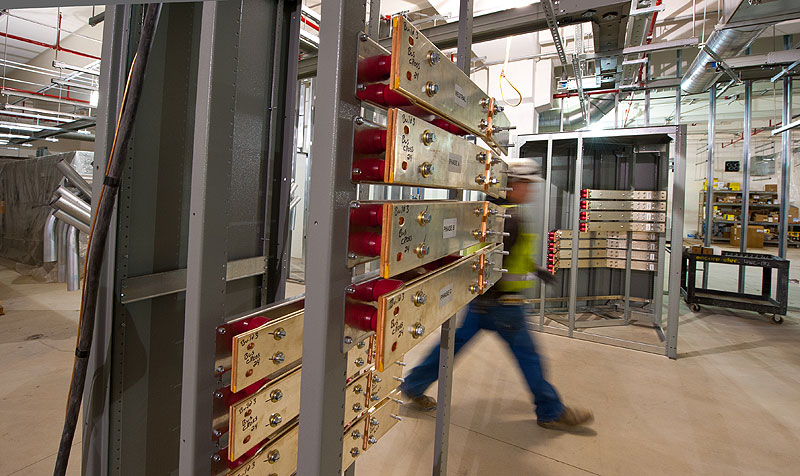
 An electrical contractor walks between two racetrack switchboards, which are being installed in the REDB room of the Energy Systems Integration Facility (ESIF) at NREL. These switchboards are capable of 1,600 amps and are part of the 1 megawatt testing capabilities at ESIF.
Credit: Dennis Schroeder
Credit: Dennis Schroeder
Plug-n-play has become so integrated into daily life that most computer users don't give a second thought to hooking up a camera or smart phone to a laptop or tablet. Now, take the same concept and apply it to the nation's complex electrical systems when it comes to "plugging in" renewables or smart grid technologies.
To make that a reality, the U.S. Department of Energy's (DOE) National Renewable Energy Laboratory (NREL) is building electrically interconnected laboratories as part of its Energy Systems Integration Facility (ESIF) where research partners can literally plug in and test new energy technologies on real and simulated power systems before hooking them up to the grid.
This plug-n-play adaptability is possible because of the Research Electrical Distribution Bus (REDB) at ESIF, which will function as a power integration circuit capable of connecting multiple sources of energy, interconnecting laboratories and experiments. All of this will allow NREL and its partners to test and simulate what happens when components, such as solar inverters, are connected to the grid.
"Each lab in ESIF has its own niche with different kinds of equipment and functionality fostering research on all aspects of energy integration," NREL Electrical Engineer Greg Martin said. "There is nowhere else where you can bring in a piece of equipment, connect it up, and be testing in a matter of days — along with the type of data acquisition we can provide."
Think Big
 Enlarge image
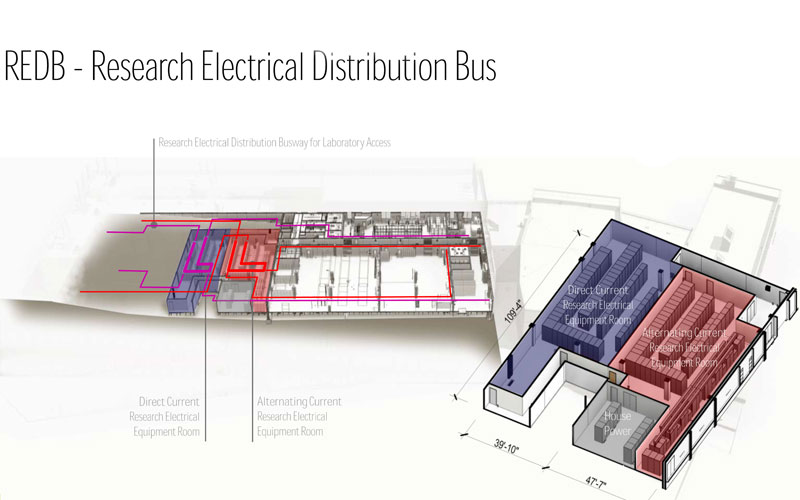
 The Research Electrical Distri¬bution Bus (REDB) is the electrical back bone interconnecting many of the laboratories at ESIF. This state-of-the-art facility will enable NREL and industry to work together to develop and evaluate their individual technologies on a controlled integrated energy system platform.
Credit: Rendering courtesy of SmithGroupJJR
Credit: Rendering courtesy of SmithGroupJJR
Made up of four ring buses — two for AC current and two for DC current — the REDB will be the backbone for all of NREL's energy systems integration testing.
"You can think of the ESIF equipped with the REDB as a place where you can bring your equipment and with our real time simulation tools, we can make your equipment think that is connected electrically to another piece of equipment, a utility distribution feeder, or even the grid," Acting Group Manager for Distributed Energy Systems Integration Bill Kramer said.
The scale of the laboratories in the ESIF and the size of the equipment to be tested are hard to visualize, but according to Kramer, a real test scenario for the REDB could include the following.
A research partner delivers an experimental device to ESIF on a flatbed truck. The truck enters the ESIF through large overhead doors that lead into the high bay area of the Power Systems Integration Laboratory where a bridge crane lifts the experiment, which contains a battery in a 40 foot container, off the truck and places it in the lab. The battery is connected to DC power with a programmable switch that is connected to the REDB. Running parallel with the REDB is a Supervisory Control and Data Acquisition (SCADA) system. SCADA enables the researchers safely to turn power on and off, and track the data flowing during the experiment. At this point, using the SCADA and REBD systems, researchers can interconnect that large battery with another laboratory, or to a transformer connected to a solar array in the Outdoor Testing Facility. The battery can be charged and discharged thanks to the ESIF's power hardware in the loop.
SCADA Brings Testing into View
A key element to the testing power systems and components at ESIF is the SCADA, which will serve as the computer control system for the REDB. In addition to controlling the REDB safely, the SCADA also provides high resolution data output. The SCADA will support a large visualization screen in the control room allowing researchers and partners to watch the experiment in real-time.In a control room, researchers can see the electrical bus, close switches, and checkout grid simulators. Research partners will be able to control the systems on portions of the REBD checked out specifically to them. The data from the experiment is streamed to secure servers, so if a utility is working with the lab that information can remain with the researcher and their partner. It's easily compartmentalized so that an experiment has its own power system and data.
Safety is key at NREL and the SCADA will constantly run safety checks to make sure that no equipment is damaged or pushed beyond its safety limits.
ESIF is Not Just for Renewables, or NREL
 Enlarge image
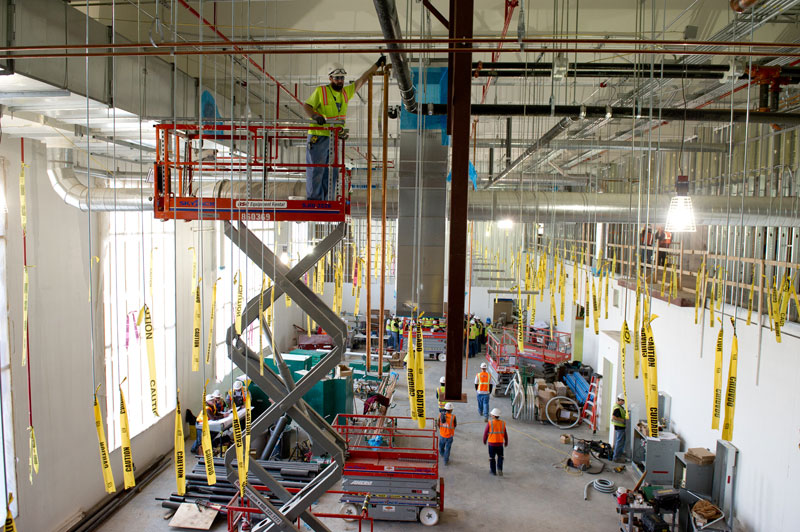
 The 5,300 square foot Smart Power Laboratory in ESIF is connected to the REDB. Like most labs in ESIF, the Smart Power Laboratory will be highly configurable and can test anything from home automation technology to advanced inverters.
Credit: Dennis Schroeder
Credit: Dennis Schroeder
"The ESIF labs are reconfigurable so that as technologies advance, we can change with them," Kramer said.
"The design of ESIF in and of itself is an integrated system. ESIF bridges the gap between electrical, thermal, and fuels disciplines."
The nation's utility infrastructure currently is driven by fossil fuels. An objective for ESIF is to make it so industry can use and modify existing pieces of equipment to work with new technologies such as solar and wind.
"We are here to help utilities and companies that want to design new equipment that will increase the penetration of renewables into the energy grid," Kramer said. "However, we won't work just with renewables at the ESIF. We could also test natural gas field generators. This type of testing will also help us move forward because if you don't take into consideration the overall system and only work on a component at a time, you will never come up with the optimal solution."
"At the end of the day, we want to provide a platform to allow other laboratories, government, industry, utilities, to all develop technologies for the future energy marketplace," Martin added. "It is important for everyone to be able to do testing before putting something out in the field and discovering that it didn't work they way they thought. Instead they can bring their equipment to the ESIF, hook it up and it is going to think it is part of the power system."
ESIF also is working to make virtual connections to other laboratories across the country in an effort to share expertise. "If you have a lab, and want to have a virtual connection into the ESIF with your equipment being tested in your lab, you will still be able to make use of ESIF and all of the equipment that is in it," Kramer said.
"We have this amazing capability that no one has ever had before," Martin said. "If you have an idea for novel system, bring it in and we'll test it, or we'll partner with you on some other types of research."
This state-of-the-art facility is scheduled for completion by the end of the year. It will enable NREL and industry to work together to develop and evaluate their individual technologies on a controlled integrated energy system platform. Testing at the ESIF is intended to facilitate widespread adoption of renewable energy and smart grid technologies and help reduce risks associated with early market penetration.
Sunday, January 15, 2012
EV Technology Accelerates in Colorado
From U.S. Dept. of Energy blog:
 Arun Majumdar speaks at Idaho National Lab (INL) during a visit to the site earlier this week. | Photo courtesy of INL.
Arun Majumdar speaks at Idaho National Lab (INL) during a visit to the site earlier this week. | Photo courtesy of INL.
What does this mean for me?
- One of 48 advanced battery and electric drive projects across the country funded by Recovery Act.
- U.S. will have increased capacity to produce electric-drive vehicles batteries from virtually zero in 2008 up to 500,000 per year in 2015.
While the North American International Auto Show began this week in Detroit, ARPA-E Director Arun Majumadar is visiting another town on the cutting edge of vehicle R&D – Longmont, Colorado, home of UQM Technologies.
Beginning with their first all-composite, battery-electric passenger vehicle in the 1970s, the company has been in the electrification business for 35 years, and is no stranger to the benefits of government-industry partnerships.
Over the years, both the Energy Department and the federal government at large have successfully collaborated with UQM – which has received Small Business Innovation Research (SBIR) awards from the Defense Department as far back as 1983 and received SBIR funding from Energy for eight different projects in electric motors and machines. In 2006, UQM received funding from EERE’s Vehicle Technologies Program via the FreedomCAR and Fuel Partnership to design an advanced permanent magnet motor for use in electric drive vehicles.
In 2009, following the success of the FreedomCAR project, UQM was awarded $45 million in Recovery Act funding to support the development of two types of Electric Vehicle (EV) systems: a propulsion/generator system for battery electric, hybrid, and plug-in hybrid passenger vehicles, and power assist motor/generators for parallel hybrid trucks and buses. As a result of this funding, UQM was able to build the Longmont, CO facility that Dr. Majumdar is visiting today. This site alone has the capacity to produce systems for 120,000 electric drive vehicles a year.
In keeping with emerging EV technologies, last year the Vehicles Technology Program also awarded $3 million to UQM to develop a non-rare-earth permanent magnet motor architecture, which will enable the use of low energy magnet technology. Engineering teams at several national labs will work with UQM’s engineers to develop the technology, which will support more affordable and efficient EV technologies and eliminate the need to utilize rare earth metals in these advanced engines.
It’s partnerships like this that are powering the commercialization of emerging EV technology. In fact, UQM’s recent agreement with Electric Vehicles International (EVI) and UPS to produce systems for 100 all-electric delivery vans is not only a great business success, but will be the largest deployment of a zero-tailpipe delivery fleet in California. As a National Clean Fleets Partner, UPS is a leader in reducing oil use in their fleet, and estimates that the use of these vehicles will displace 126,000 gallons of fuel a year that would have been burned running diesel trucks.
Partnerships like these across the private and public sectors are the kind of investments that are helping America win the clean energy race. Including UQM, the Recovery Act provided $2.4 billion in funding to 48 advanced battery and electric drive projects across the country, funding 30 new manufacturing plants like the one Dr. Majumdar is visiting today. Because of these investments, the U.S. will have increased our capacity to produce electric-drive vehicles batteries from virtually zero in 2008 up to 500,000 per year in 2015.
Subscribe to:
Posts (Atom)