Search This Blog

Showing posts with label clean. Show all posts

Monday, September 17, 2012

NREL's Industry Growth Forum Attracts Clean Energy Investors 25th Forum to Feature 30 Clean Energy Companies

News release:


NREL's Industry Growth Forum Attracts Clean Energy Investors

25th Forum to Feature 30 Clean Energy Companies

Monday, September 17, 2012

Thirty clean energy companies will present their business cases to a panel of investors and industry experts in Denver Oct. 23-24 as the U.S. Department of Energy's National Renewable Energy Laboratory (NREL) hosts the 25th NREL Industry Growth Forum.
The 30 companies were selected through an application and review process and will compete for the 2012 NREL Clean Energy Venture Awards. NREL's Industry Growth Forum is one of the nation's premier clean energy investment forums. NREL's unique approach and interactive format make the forum a must-attend event for the clean energy business and investment community. Since 2003, presenting companies have raised more than $4 billion in investment.
 
In addition to the business case presentations, NREL's two-day forum will highlight clean energy technology and business developments with a comprehensive agenda of speakers and panels that will address the most important topics in the industry today.
 
"It's critical for us to create opportunities that connect the key players in the clean energy startup community"said Richard Adams, director of NREL's Innovation and Entrepreneurship Center, which organizes the forum. "We are bringing entrepreneurs directly together with financiers, policymakers and technology experts. By doing this we are laying the foundation for future conversations, partnerships and eventual business decisions that will strengthen the industry as a whole."
 
For more information, including the agenda, list of companies, list of sponsors and registration information see the 25th NREL Industry Growth Forum website at http://www.industrygrowthforum.org.
           
NREL is the U.S. Department of Energy's primary national laboratory for renewable energy and energy efficiency research and development. NREL is operated for DOE by The Alliance for Sustainable Energy, LLC.
 
###

Thursday, June 21, 2012

United States, Canada Announce Next Phase of U.S.-Canada Clean Energy Dialogue

Press release:


United States, Canada Announce Next Phase of U.S.-Canada Clean Energy Dialogue

June 21, 2012 - 2:15pm

WASHINGTON -- Today, the U.S. Department of Energy (DOE) and Environment Canada released the U.S.-Canada Clean Energy Dialogue (CED) Action Plan II, outlining the next phase of activities the two countries will undertake to jointly advance clean energy technologies.

The new action plan renews the commitment between the United States and Canada to work together on carbon capture and storage technologies; build more efficient, clean, “smart” electrical grids; and advance clean energy research and development.  Action Plan II also places a greater emphasis on energy efficiency to take advantage of the approaches and tools in each country to help facilitate the uptake of energy efficient technologies and practices.

“This plan is ambitious and demonstrates our continued commitment to international collaboration to accelerate the transition to a low-carbon economy and ensure that both of our nations benefit from the tremendous opportunities in clean energy,” said Energy Secretary Steven Chu. “The United States and Canada are working together to continue to address technology gaps to support the development and deployment of new clean energy technologies into the marketplace.”

The accomplishments to date under the CED include completing the final phase of the Weyburn-Midale Carbon Dioxide Monitoring and Storage Project, as well as the North American Carbon Storage Atlas.  The final phase of the Weyburn Project focuses on best practices for the safe and permanent storage of carbon dioxide used in enhanced oil recovery.  The Atlas is the first-ever to map the potential carbon dioxide (CO2) storage capacity in North America.

Ongoing and new initiatives under Action Plan II will include projects to enhance collaboration to ensure the integrity of permanent CO2 storage in geological formations, an initiative to clarify U.S. and Canadian regulatory authorities for deployment of offshore renewable energy and technologies, and further investigating the potential of power storage technologies.

The CED was established in 2009 by President Obama and Canadian Prime Minister Stephen Harper to encourage the development of clean energy technologies to reduce greenhouse gases and combat climate change in both countries.

The Clean Energy Dialogue Action Plan II is available HERE.

Tuesday, May 8, 2012

Honeywell Opens New Interactive Technology Experience Center In China


Press Releases
  Back to Index
5/8/2012 
Honeywell Opens New Interactive Technology Experience Center In China 

Visitors to Learn How Honeywell's Technologies Are Helping to Solve Some of The World’s Biggest Challenges such as Energy Efficiency, Energy Generation, Safety and Security 
SHANGHAI, May 8, 2012 – Honeywell (NYSE: HON) today opened its largest technology experience center, an immersive experience for customers and visitors to interact with technologies that make communities in China safer and more secure, more comfortable and energy efficient, more innovative and productive. Located in Honeywell's Asia Pacific headquarters at Zhangjiang Hi-Tech Park in Shanghai, the Honeywell Technology Experience underscores the company's commitment to China, its fastest growing market. Honeywell’s total sales revenue in China reached approximately U.S. $1.9 billion in 2011, or a 20% growth over 2010.

The Honeywell Technology Experience features a flight simulator, an interactive cityscape, and a modern home equipped with smart home technologies. Visitors can take the controls of a modern jet and perform a virtual take-off, hold a 3-D turbocharger, watch how an industrial control room manages an emergency, enter a modern home to see Honeywell controls that manage everything from lighting and water systems, to intrusion detection and temperature. A “barrel of oil” exhibit demonstrates how to squeeze more high value products from crude oil and how to produce green energy using Honeywell’s refining technologies.

The Center is divided into six neighborhoods: transportation; industry; commercial; home; energy, and a community area where visitors can see how Honeywell is connecting directly with its local hometowns, through its science and math education; housing and shelter; family safety and security; habitat and conservation; and humanitarian relief efforts as part of its Honeywell Hometown Solutions corporate social responsibilities.

“Globalization, especially in High Growth Regions like China, has been key to our Growth for the past decade. Today, about 55% of our sales come from outside the U.S., making Honeywell a truly global company. China represents a significant share of our global growth story, and I see this new Honeywell Technology Experience as a symbol of our commitment to China, one of our biggest and fastest growing markets,” said Shane Tedjarati, president and CEO of Honeywell High Growth Regions at the grand opening ceremony.

“With this new center, we’ve created a powerful tool to help our China team engage our customers and partners in China and in high growth regions like India, Vietnam, Indonesia, and others,” continued Tedjarati. “We look forward to innovating and implementing new technologies to solve some of the world’s toughest challenges, such as energy efficiency, clean energy generation, safety and security.”

“We take great pride that Honeywell has been part of China’s extraordinary growth and transformation. Through our East-for-East and East-to-West strategies, we have enabled a growing number of Chinese customers to achieve success both at home and abroad,” said Stephen Shang, president of Honeywell China. “I’m confident that the new center will bring us closer to our customers, and elevate public awareness of technologies that can be leveraged to help China cope with energy and safety challenges brought by its fast economic growth and massive urbanization.”

The 1,500-square-meter Honeywell Technology Experience center is Honeywell’s second and largest technology experience center. The company opened its first center in Washington, D.C. in 2005.

Honeywell (www.honeywell.com) is a Fortune 100 diversified technology and manufacturing leader, serving customers worldwide with aerospace products and services; control technologies for buildings, homes and industry; turbochargers; and specialty materials. Honeywell has a long history in China that goes back to 1935 when it established the first franchise in Shanghai. Today, all of Honeywell’s four Strategic Business Groups are represented in China, and all of them have relocated their Asia Pacific headquarters to China. Over the years, Honeywell has set up subsidiaries and joint ventures in more than 20 cities across the country. Honeywell employs approximately 12,000 people in China. For more news and information on Honeywell, please visit www.honeywell.com.cn

Sunday, March 11, 2012

Post from Dept. of Energy Blog

Veolia and Johnson Controls Get the Job Done with Clean, Fuel Efficient Fleets

March 9, 2012 


With their presence in almost every neighborhood and community, refuse trucks, like the one shown above, can benefit from alternative fuels and advanced technology. | Photo courtesy of Veolia Environmental Services. With their presence in almost every neighborhood and community, refuse trucks, like the one shown above, can benefit from alternative fuels and advanced technology. | Photo courtesy of Veolia Environmental Services.
With a total of 18 members that run more than a million vehicles across the country, the National Clean Fleets Partnership addresses a wide variety of transportation needs.  The program, part of the Vehicle Technologies Program’s Clean Cities initiative, works to help partners reduce their vehicle fleet’s petroleum use, whether they use telecommunications repair vans or soda delivery trucks.  With Secretary Chu’s announcement on Monday of the Partnership’s expansion, this is the second of two posts highlighting our four new members.

Veolia Environmental Services

With their presence in almost every neighborhood and community, refuse trucks can benefit from alternative fuels and advanced technology, which this National Partner knows well.  The Solid Waste division of Veolia Environmental Services maintains a fleet of more than 3,000 trucks, heavy equipment, and support vehicles that service both households and businesses. The company is dedicated to reducing petroleum use and emissions through route optimization, alternative fuels, and hybrid vehicles. As of 2012, the company operates four compressed natural gas (CNG) fueling stations and more than 100 CNG refuse-collection and support vehicles. Veolia joined the partnership in December 2011.

Johnson Controls, Inc. 

As a leading supplier of battery systems for hybrid electric vehicles, Johnson Controls is committed to designing and delivering increasingly sustainable products, services and solutions that will help its customers improve their energy efficiency, reduce their carbon footprint, and achieve their environmental goals. Leading by example, Johnson Controls has implemented several greenhouse gas reduction strategies in its global fleet of 19,000 vehicles. It first introduced hybrid electric vehicles into its fleet in 2009. Today, it operates more than 500 hybrids, each reducing greenhouse gas (GHG) emissions by 30%, and together saving $500,000 in fuel costs during the first two-and-a-half years of operation. In 2011, it deployed 20 all-electric vans, which are estimated to achieve a 61% GHG reduction per vehicle. Other strategies include the use of CNG vans, and higher MPG vans and trucks. In 2012, Johnson Controls will pilot the use of telematics —allowing them to better collect and share geographic and other data with drivers—and continue with the deployment of additional alternative fuel vehicles, including propane-fueled units. Johnson Controls joined the partnership in February 2012.

Wednesday, February 29, 2012

New York to Renew Push for Wind Power

Excerpt from an article in

The New York Times
Wednesday, February 29, 2012

New York to Renew Push for Wind Power

By MIREYA NAVARRO

Despite Mayor Michael R. Bloomberg’s long-expressed dream of putting wind turbines on skyscrapers and bridges, the constraints of an urban landscape have so far proved too challenging for reliable wind power in the city, energy experts said. As a result, New York City has been largely inactive — and behind the national curve — in embracing wind power.

But that is about to change. This spring, the city’s Department of Environmental Protection will solicit plans for the first major wind project, the installation of turbines atop the Fresh Kills landfill in Staten Island. And city planners are working on zoning changes, now under review by the City Planning Commission, to allow turbines up to 55 feet high on the rooftops of buildings taller than 100 feet, and even taller turbines on commercial and industrial sites along the waterfront.

But the biggest potential for supplying wind power to the city lies offshore, where the Bloomberg administration is supporting an application filed last September by a coalition led by the New York Power Authority to lease a swath of the ocean floor for a wind farm 13 miles off the coast of the Rockaways in Queens.

City officials say they are ready to take advantage of their coastal proximity to seek bigger renewable-energy projects and quicken the pace toward cleaner air and the jobs and economic benefits that would accompany those projects. A study commissioned by the city last year said wind farms could play a major role in replacing power now generated by the Indian Point nuclear power plant in Westchester County. The plant supplies up to 25 percent of consumption in Consolidated Edison’s service area, including New York City.

Tuesday, February 28, 2012

Post from Dept. of Energy Blog

Taking a Tour of Wilmington's Energy-Efficient Spaces

February 28, 2012 - 11:30am


Roya Stanley (left) on a tour of the Snipes Academy of Arts and Design with the building's architect -- Thomas Hughes. Through interactive real-time energy data tools, Snipes students incorporate energy use data in their classroom projects and studies. | Photo Courtesy of the Cape Fear Green Building Alliance. Roya Stanley (left) on a tour of the Snipes Academy of Arts and Design with the building's architect -- Thomas Hughes. Through interactive real-time energy data tools, Snipes students incorporate energy use data in their classroom projects and studies. | Photo Courtesy of the Cape Fear Green Building Alliance.
I
n Wilmington, North Carolina, local institutions are leading the way in building efficiency and sustainability. From the WAVE Transit Forden Station to the Wilmington Convention Center to the city’s street sweeper complex, Wilmington is saving money by saving energy and supporting job growth in energy efficiency technologies. 


Last week, I experienced first-hand how Wilmington public buildings are leveraging energy efficiency and clean energy technologies to save money and reduce energy waste. I joined Representative Mike McIntyre, Mayor Bill Saffo and Joy Allen, executive director of the Cape Fear Green Building Alliance, on a tour of the city’s energy efficient buildings. 


At the Forden Station -- the first LEED Gold registered public building to break ground in the state of North Carolina -- on-site geothermal heating and cooling systems have helped reduce energy consumption by 45 percent. Snipes Academy of Arts and Design utilizes a water source heat pump system and outside air system for the school’s heating and cooling. Through interactive real-time energy data tools, Snipes students incorporate energy use data in their classroom projects and studies. 


Reducing energy waste in buildings is an important element for a sustainable energy future. In the United States, buildings consume about 40 percent of all U.S. energy, contributing a significant amount to overall energy costs. In Wilmington, the Cape Fear Green Building Alliance is helping train local energy auditors and building analysts to conduct energy efficiency upgrades and capture the savings. 


Nationally, through the Better Buildings Challenge, more than 60 companies, cities, universities, hospitals and other partners have committed to upgrading more than 1.6 billion square feet of building space across the country -- which will jobs, eliminate waste and help make our commercial and industrial buildings 20 percent more efficient by 2020. 


Check out more on the Better Buildings Challenge HERE.

Monday, February 27, 2012

Energy Innovation Summit

Business, Government and Tech Leaders Give the Full Perspective

February 24, 2012 

Secretary of Energy Steven Chu speaking at the 2011 ARPA-E Energy Innovation Summit. | Energy Department file photo. Secretary of Energy Steven Chu speaking at the 2011 ARPA-E Energy Innovation Summit. | Energy Department file photo.

When the third annual ARPA-E Energy Innovation Summit convenes in Washington, DC, next week, key innovators from across the country and around the world will meet to share ideas for solving our greatest energy challenges.

While recent ARPA-E award winners and finalists will be on display at the Technology Showcase, the keynote speakers will offer a personal perspective on innovation in the energy sector.

One of the highlights of the conference will be a "fireside chat" between Bill Gates, chairman of Microsoft Corporation, and Secretary of Energy Steven Chu. Under Gates' leadership, Microsoft has led the computer industry with investments in research and development each year. Check Energy.gov after the Summit for a video of the conversation that you can watch, share, and offer your perspective on.

Former President Bill Clinton will deliver remarks on Wednesday. As the 42nd President of the United States, President Clinton oversaw the longest period of peacetime economic expansion in U.S. history and the creation of more than 22 million jobs. 

We'll also hear from Dr. Arun Majumdar, Director of ARPA-E, and Dr. Susan Hockfield, President of the Massachusetts Institute of Technology (MIT) and co-chair of the President's Advanced Manufacturing Partnership.
From the private sector, we will be joined by Ursula M. Burns, Chairman and CEO of the Xerox Corporation; Frederick W. Smith, Chairman, President and CEO of the FedEx Corporation; and Lee Scott, chairman of BDT Capital and former CEO of Walmart. Each of these individuals has been an innovative leader in their field and will offer their own perspectives on what it takes for innovators and entrepreneurs to succeed in the clean energy economy.

The Summit will also highlight the winning startup companies that competed in DOE’s “America’s Next Top Energy Innovator Challenge," which leverages cutting-edge technologies from the Energy Department’s national laboratories to support new startup companies across the country. The Secretary will present the winners with awards on Monday during the luncheon, and you can learn more about their innovations at their booth in the Technology Showcase.

You can find more information on the ARPA-E Energy Innovation Summit and the full program for the three-day conference here. 

Saturday, February 25, 2012

News Release from Illinois EPA

FOR IMMEDIATE RELEASE
February 23, 2012


Illinois EPA Designates 15 Chicago Area “Green Fleets”


Oak Park—The Illinois EPA, in coordination with the Chicago Area Clean Cities coalition, designated 15 new Chicago area Green Fleets at an event held today in Oak Park. 

The Illinois Green Fleets program provides for “Green Environment, Green Energy, & Green Economics for a Green Illinois,” through the use of clean alternate fuels, such as natural gas, biodiesel, ethanol, propane and electricity in their fleet vehicles, as well as retrofiting existing diesel trucks with clean technology options to reduce diesel particulates. Information regarding the program can be found at http://www.illinoisgreenfleets.org/

“These are family-owned and larger businesses, as well as public bodies, that have seen the value in supporting clean air, energy independence, jobs and providing insurance against the concern about high prices for gasoline and diesel,” said Interim Illinois EPA Director John Kim.

“These new Green Fleets join an elite fraternity of over 100 designated fleets throughout the state. We see more and more family-owned small businesses that are taking the initiative to purchase and convert their vehicles and equipment to run on a clean American fuel,” said Darwin Burkhart, program manager for the Illinois EPA and Chairman of Chicago Area Clean Cities.

The 15 new Illinois Green Fleets are:

Abt Electronics, a family-owned electronics and appliance store based in Glenview, uses biodiesel in its diesel truck fleet and has 30 vans that use E85 ethanol fuel and two vans that run on natural gas. In addition, the Abt family installed diesel oxidation catalysts on eight diesel delivery trucks to further reduce particulate emissions.

Groot Industries, a family operated waste hauler based in Elk Grove Village, has 33 refuse trucks that run on natural gas and has installed two natural gas refueling stations to share with other fleets. Other waste companies being recognized are Waste Management in Wheeling and Veolia ES Solid Waste in Northbrook with 33 and 20 natural gas refuse trucks, respectively.

Competitive Lawn Service, a small commercial lawn business in Downers Grove, is the first lawn and landscaping business in the country to convert many of its pickup trucks and mower equipment to propane. 
Doreen’s Pizzeria, a family-owned business in Calumet City, has seven natural gas-powered delivery trucks that display “Green Pizza Machines” on the sides of the vehicles.

Ozinga Ready Mix, a family-owned business in Mokena, is believed to be the first concrete company in the country to convert 14 of its mixing trucks to run on natural gas.

SCR Medical Transportation, a family run paratransit service in the Chicago area, operates 20 natural gas vans and shuttles for people needing mobility assistance. In addition, GO Airport Express operates two propane and two natural gas-powered shuttle vans and Yellow Cab Chicago has 79 natural gas taxis; both companies operate from O’Hare and Midway airports.

Other Green Fleets that are being acknowledged at the event are Northern Illinois University in DeKalb that uses E85, biodiesel, natural gas, and hybrid vehicles in many of its trucks, buses, campus police cars, and other campus vehicles and equipment; Chicago Park District that has E85, biodiesel, natural gas, hybrids and electric vehicles; Dillon Transport of Burr Ridge that uses E85 in the company’s flex fuel vehicles; Foodliner of Franklin Park that operates six Freightliner trucks on natural gas; and the DuPage County Division of Transportation that has nearly half its fleet running on E85, biodiesel, natural gas and electricity.   
###

Friday, February 24, 2012

News Release from the DOE - Energy Efficiency Training Centers

President Obama Highlights Energy Department Efficiency Training Centers That Save U.S. Manufacturers $5.6 Billion

February 23, 2012 

WASHINGTON, D.C. – During a visit to the University of Miami to highlight his administration’s all-out, all-of-the-above approach to American energy, President Obama today touted the Energy Department’s cost-cutting Industrial Assessment Program. The program supports university-based Industrial Assessment Centers (IACs) across the country, which provide students with critical skills and training to conduct energy assessments in a broad range of facilities, while producing real cost savings for small to mid-size manufacturers. To date, these assessments have helped save over 530 trillion BTUs of energy – enough to meet the energy needs of 5.5 million American homes – and have helped participating manufacturers save more than $5.6 billion in energy costs.

“As President Obama made clear, an American economy built to last will depend on American manufacturing, American energy and skills for American workers,” said U.S. Energy Secretary Steven Chu. “This is why the Energy Department invests in innovative initiatives like the Industrial Assessment Centers that help to train the clean energy workforce of tomorrow, while cutting energy waste for American businesses and making our manufacturing companies more competitive.”

Through Industrial Assessment Centers at universities throughout the U.S., engineering students receive practical training in industrial processes, energy assessment procedures, and energy management principles, and gain real-world experience by working directly with small and medium-sized industrial and manufacturing facilities in their communities.

For more than 30 years, the Industrial Assessment Program has provided valuable training and experience for students, while saving money for manufacturing plants. Since the program began in 1976, the university teams have conducted more than 15,000 energy assessments at U.S. manufacturing plants nationwide. To date, more than 3,000 students have graduated from the Industrial Assessment Center program, with more than 60 percent going on to careers in the energy industry.

More information and a full list of Industrial Assessment Centers across the U.S. can be found HERE.

Tuesday, February 21, 2012

News Release from Duke Energy

Duke Energy Receives Federal License for Nantahala Hydro Project
Feb. 17, 2012

FRANKLIN, N.C. -
Duke Energy has received the final of six new federal hydro licenses from the Federal Energy Regulatory Commission (FERC) for Nantahala Area hydro stations.

The latest license covers Nantahala Hydroelectric Project, located substantially in Macon County, N.C., but with waters also in Clay County.

The new 30-year license triggers a variety of public recreation and aquatic habitat enhancements in the Nantahala River watershed. Additionally, as part of a settlement agreement with relicensing stakeholders, in 2004 Duke Energy altered Nantahala Project operations to keep the lake higher during summer months, enhance downstream whitewater recreation, and help stabilize the lake level during fish spawning season.

The primary dam covered by the license is on the Nantahala River, forming 1605-acre Nantahala Lake. Two much smaller diversion dams, Dicks Creek and Diamond Valley, are on Dicks Creek, and Whiteoak Creek Dam is on its namesake creek.

“This final new license is a credit to all who worked together to develop comprehensive plans for balancing numerous water needs. We value their insight and are deeply grateful to their commitment to this effort,” said Steve Jester, vice president of hydro strategy, licensing and lake services. “From our initial review of the new license, it appears stakeholders' interests have been addressed, while preserving the area’s clean, renewable hydroelectric generation.”

“The relicensing process is good public policy. It allows an open, formal review of specific projects, rivers, public recreation needs and new scientific information so we can arrive at the appropriate balance among all interests,” Jester said.

With all the licenses now issued, Duke Energy is well under way with plans for recreational facilities and preparing other documents requiring FERC approval. Nantahala Project-specific items are likely to take about two to three years from start to finish.

Overall, Duke Energy is in the process of implementing numerous enhancements which will cost an estimated $10.5 million. These include:

Increased continuous minimum flow releases for the Nantahala and Tuckasegee Rivers, enhancing some of the most popular catch-and-release trout streams in the Southeast
Special flow releases on a few days each year for high-skill boating downstream from Nantahala and Glenville Dams
New or enhanced public access areas on the Nantahala and Tuckasegee Rivers
Transfer of about 150 acres of Duke Energy property upstream of Wolf Creek Lake to the U.S. Forest Service for enhanced public recreation and protection of native brook trout habitat
Canoe portages around dams at the Bryson (Oconaluftee River), Franklin (Little Tennessee River) and Mission Dams (Hiwassee River) and Western Carolina University-owned Cullowhee Dam (Tuckasegee River)
Primitive camping, handicapped-accessible docks, restrooms, improved parking and other improvements at larger lakes, including Nantahala
In addition to activities required in new licenses, Duke Energy and stakeholders from 30 organizations formed the Nantahala and Tuckasegee Cooperative Stakeholder Teams. Between 2000 and 2003, team members invested more than 9,000 person hours visiting sites, guiding study needs, reviewing reports and collaborating to address environmental concerns and public recreation needs.

The resulting Nantahala and Tuckasegee settlement agreements, signed in 2003, were keys to successfully relicensing the hydro stations.

In keeping with these legally-binding agreements, Duke Energy will implement settlement agreement provisions FERC did not include as new license requirements.  These provisions include:

Transfer of about 150 acres of Duke Energy property upstream of Wolf Creek Lake to the U.S. Forest Service for enhanced public recreation and protection of native brook trout habitat
Improved Nantahala Gorge boating access, in cooperation with the U.S. Forest Service
Reimbursement of up to $50,000 for the Forest Service’s construction of primitive campsites
$40,000 to fund studies by the US Fish & Wildlife Service and the NC Wildlife Resources Commission to determine the range and distribution of the sicklefin redhorse
$40,000 for restoration of brook trout in a stream near the Tennessee Creek, a tributary of the Tuckasegee River
$200,000 for riparian habitat enhancement along  Nantahala Area rivers
$40,000 each to Soil and Water Conservation Districts of Cherokee, Clay, Jackson, Macon, and Swain counties for the improvement of soil and water conservation programs
Thirty-year FERC operating licenses have now been issued for Nantahala area hydro projects that were initially licensed in 1980-81. These cover 12 hydro reservoirs and nine hydroelectric stations primarily in Clay, Jackson, Macon and Swain counties. Their combined installed generating capacity is about 98.5 megawatts. This is about 99.5 percent of the total Duke Energy hydro generation in the Nantahala Area.

The remainder is from Queens Creek Hydro Project in Macon County, which received its initial license in 1976 and was relicensed in 2002.

Project reservoirs are in Clay County (Mission Lake); Jackson County (Bear Creek, Cedar Cliff, Glenville, Tanasee Creek, Tuckasegee and Wolf Creek lakes); Macon County (Diamond Valley, Dicks Creek and Whiteoak Creek reservoirs, Lake Emory and Nantahala and Queens Creek Lakes); and Swain County (Lake Ela). A very small portion of Nantahala Lake is also in Clay County.

The initial FERC licenses were issued to Nantahala Power and Light Company, which Duke Power purchased from Alcoa in 1988. With the Nantahala Hydro Project license issued last week, all Nantahala Area hydro projects have completed their first relicensing process.

Duke Energy is one of the largest electric power holding companies in the United States. Its regulated utility operations serve approximately 4 million customers located in five states in the Southeast and Midwest, representing a population of approximately 12 million people. Its commercial power and international business segments own and operate diverse power generation assets in North America and Latin America, including a growing portfolio of renewable energy assets in the United States.

Headquartered in Charlotte, N.C., Duke Energy is a Fortune 500 company traded on the New York Stock Exchange under the symbol DUK. More information about the company is available on the Internet at: www.duke-energy.com.

Thursday, February 16, 2012

Tribal Clean Energy Projects Awarded $6.5 Million

News release from the U.S. Dept. of Energy:


Tribal Clean Energy Projects Awarded $6.5 Million from U.S. Energy Department

February 16, 2012 - 11:46am

WASHINGTON, D.C. – As part of the Obama Administration’s commitment to strengthening partnerships with Tribal Nations and supporting tribal energy development, U.S. Energy Secretary Steven Chu today announced that 19 clean energy projects to receive more than $6.5 million. These competitively selected projects will allow Native American Tribes to advance clean energy within their communities by assessing local energy resources, developing renewable energy projects and deploying clean energy technologies. These projects will help Tribal communities across the country save money and create new job and business opportunities.

“As President Obama highlighted in the State of the Union, the Administration is committed to building an American economy that lasts and leverages our nation’s clean energy resources,” said Secretary Chu. “The awards announced today will help Tribes across the country advance a sustainable energy future for their local communities, spur economic development, and advance innovative clean energy technologies.”

The Energy Department has taken a number of steps to strengthen its support for Tribal energy development and empower Tribal leaders to make informed decisions that promote community economic development. Over the past year, the Department has established the Indian Country Energy Infrastructure Working Group with Tribal leaders from across the country and launched programs to provide technical assistance and support to help Tribal communities, colleges and universities deploy energy projects and gain skills in energy development and financing.

Since 2002, the Energy Department’s Tribal Energy Program has provided $36 million to 159 tribal energy projects.

The projects selected for negotiation of award today fall under three project areas:

$3.6 Million for Feasibility Studies – Thirteen projects will receive $3.6 million to assess the technical and economic viability of developing renewable energy resources on tribal lands to generate utility-scale power or study the feasibility of installing renewable energy systems on buildings to reduce energy use by 30 percent.

$1.7 Million for Renewable Energy Development Projects – Four projects will receive $1.7 million for pre-construction development activities.  Three are developing more than 250 megawatts of new renewable energy generation, and one, when implemented, would reduce the need for diesel fuel for heating by 80 percent – or 9,600 gallons annually.

$1.3 Million for Installation Projects – Two projects will receive $1.3 million to deploy renewable energy technologies to convert waste and other biomass to energy.  Once installed, the projects will generate 5 megawatts of energy per hour using municipal solid waste and using cordwood for heating to save between 2,500 and 3,200 gallons of propane.

The tribal energy projects announced today were selected as a result of a DOE funding opportunity announcement issued last year. A summary of all 19 selected tribal energy projects is available HERE.
Under the authority of Title V of the Energy Policy Act of 2005, the DOE Office of Energy Efficiency and Renewable Energy’s Tribal Energy Program, in coordination with the Office of Indian Energy Policy and Programs, provides financial and technical assistance to Indian Tribes for the evaluation and development of their renewable energy resources, implementation of energy efficiency to reduce energy use, and provides education and training to help build the knowledge and skills essential for sustainable tribal energy projects.

Tuesday, February 14, 2012

Norfolk Southern Deploys Renewable Diesel

News release from Norfolk Southern:

February 14, 2012

Norfolk Southern pens deal with Dynamic Fuels and Mansfield Oil
Norfolk Southern becomes first fleet user in the U.S. to deploy clean renewable diesel

NORFOLK, VA. - Dynamic Fuels, LLC and Mansfield Oil Company have signed an agreement to supply renewable diesel to Norfolk Southern Corporation (NYSE / NSC), one of the nation’s largest transporters of coal and industrial products. Norfolk Southern has primarily been using a 100% pure Dynamic Fuels renewable diesel at its Meridian, Mississippi rail yard since early January.
Dynamic Fuels, a 50/50 venture owned by Tyson Foods, Inc. (NYSE / TSN) and Syntroleum Corporation (NASDAQ / SYNM), recently signed commercial off-take and strategic alliance agreements with Mansfield to market renewable diesel to fleet customers. Dynamic Fuels, operator of the first commercial advanced biofuels plant in the United States, produces next-generation renewable and synthetic fuels from animal fats and greases. The company’s Geismar, La., plant produces renewable diesel as “drop in” fuel that can replace 100% of petroleum diesel in a diesel engine without engine modification.
“Norfolk Southern is pleased to be the first fleet user of renewable diesel in the United States,” said Gerhard Thelen, Norfolk Southern vice president operations planning and support. “Our locomotive engines are completely compatible with the pure renewable diesel provided by Dynamic Fuels and Mansfield. Together, they have provided seamless integration of renewable diesel supply into our Meridian, Miss., yard. Norfolk Southern has been at the forefront of the railroad industry in evaluating synthetic and renewable diesel fuels for many years. This effort exemplifies Norfolk Southern’s commitment to reducing carbon and other emissions, while further integrating sustainability throughout the operations of the company.”
“The contract with Norfolk Southern is the first manifestation of Dynamic Fuels’ partnership with Mansfield,” said Ron Stinebaugh, senior vice president of Syntroleum Corporation. "We look forward to working with Norfolk Southern to lower their emissions and increase the renewable content of the fuel they burn. Renewable diesel is a sustainable, ultra clean burning, high cetane fuel that reduces carbon emissions and significantly reduces particulates and NOx when combusted in existing diesel engines. Supplying a prestigious company like Norfolk Southern validates our belief that customers are looking for renewable options that increase sustainability and lower emissions without sacrificing fuel quality.”
Doug Haugh, president of Mansfield Oil Company added, “Mansfield and Norfolk Southern have had a strong relationship on the refined products side and we’re excited to supply them with a next-generation fuel like renewable diesel. We believe Dynamic Fuels is a leader in renewable diesel production and our partnership affords us the opportunity to further diversify our portfolio of transportation fuels for our customers.”
Norfolk Southern Corporation is one of the nation’s premier transportation companies. Its Norfolk Southern Railway subsidiary operates approximately 20,000 route miles in 22 states and the District of Columbia, serves every major container port in the eastern United States, and provides efficient connections to other rail carriers. Norfolk Southern operates the most extensive intermodal network in the East and is a major transporter of coal and industrial products.
About Mansfield Oil Company
Ranked as one of the Top 50 privately held companies in America by Forbes magazine and a multiple category finalist in the 2009, 2010 and 2011 Platts Global Energy Awards, Mansfield defines the next generation transportation fuels company. Founded in 1957, the company has achieved double-digit growth for three decades by focusing on optimizing and controlling fuel-related costs for its customers using innovation, technology and high touch service. For more information, visitwww.mansfieldoil.com.
About Tyson Foods 
Tyson Foods, Inc., founded in 1935 with headquarters in Springdale, Arkansas, is one of the world's largest processors and marketers of chicken, beef and pork, the second-largest food production company in the Fortune 500 and a member of the S&P 500. The company produces a wide variety of protein-based and prepared food products and is the recognized market leader in the retail and foodservice markets it serves. Tyson provides products and services to customers throughout the United States and more than 130 countries. The company has approximately 115,000 Team Members employed at more than 400 facilities and offices in the United States and around the world. Through its Core Values, Code of Conduct and Team Member Bill of Rights, Tyson strives to operate with integrity and trust and is committed to creating value for its shareholders, customers and Team Members. The company also strives to be faith-friendly, provide a safe work environment and serve as stewards of the animals, land and environment entrusted to it. The Tyson Foods, Inc. logo is available athttp://www.globenewswire.com/newsroom/prs/?pkgid=3224.
About Syntroleum 
Syntroleum Corporation owns the Syntroleum® Process for Fischer-Tropsch (FT) conversion of synthesis gas derived from biomass, coal, natural gas and other carbon-based feedstocks into liquid hydrocarbons, the Synfining® Process for upgrading FT liquid hydrocarbons into middle distillate products such as synthetic diesel and jet fuels, and the Bio-Synfining(R) technology for converting animal fat and vegetable oil feedstocks into middle distillate products such as renewable diesel and jet fuel using inedible fats and greases as feedstock. The 50/50 venture -- known as Dynamic Fuels -- was formed to construct and operate multiple renewable synthetic fuels facilities, with production on the first site beginning in 2010. The Company plans to use its portfolio of technologies to develop and participate in synthetic and renewable fuel projects. For additional information, visit the Company's web site at www.syntroleum.com.
###

Monday, February 13, 2012

NREL Seeks Leaders


National Renewable Energy Laboratory (NREL) - Innovation for Our Energy Future
News Release

NREL Seeks Leaders for National Executive Academy

Monday, February 13, 2012

Applications are currently being accepted for the U.S. Department of Energy's National Renewable Energy Laboratory's (NREL) 2012 Executive Energy Leadership Academy (Energy Execs). Energy Execs is a leadership program focused on educating business, community, and government leaders about clean energy solutions through energy efficiency and renewable energy technologies.
The two Energy Execs learning opportunities are the Leadership Program and the Leadership Institute. Both programs are designed to provide executive decision-makers with information and tools to guide their organizations and communities in energy-related planning.
"NREL plays an important role in engaging a cross-section of industry and community leaders in transforming our energy systems," NREL Director Dan Arvizu said. "It's a critical time in the United States and globally to accelerate understanding about the opportunities and challenges of market-viable energy solutions for secure, clean electricity, and fuel."
Representatives from 120 industry, government, and non-profit organizations have completed the program since 2007. Participants are selected from a national pool of candidates.
Apply online for the 2012Leadership ProgramandLeadership Instituteor via fax or mail. The application deadline is March 30, 2012.
NREL is the U.S. Department of Energy's primary national laboratory for renewable energy and energy efficiency research and development. NREL is operated for DOE by the Alliance for Sustainable Energy, LLC.
###
Visit NREL online at www.nrel.gov

NREL is a national laboratory of the U.S. Department of Energy, Office of Energy Efficiency and Renewable Energy, operated by the Alliance for Sustainable Energy, LLC. NRELU.S. Department of EnergyOffice of Energy Efficiency and Renewable EnergyOffice of Energy Efficiency and Renewable EnergyAlliance for Sustainable Energy, LLC

Wednesday, February 8, 2012

The Rise of Landfill Gas to Energy

The following is an excerpt of an article with the above title in the January 2012 issue of Waste Age magazine:


Landfill gas (LFG) provides power for one million homes and heat for 737,000 homes across the country.  It provides 14 billion kilowatt-hours of electricity and 102 billion cu. ft of LFG for direct use by industry.  It contributes to the nation’s supply of natural gas and clean-burning fuel for vehicles.

The environmental benefits of these LFG uses are huge.  According to the U.S. Environmental Protection Agency (EPA), the use of LFG reduced the consumption of oil in the United States by about 229 million barrels of oil last year.

Using LFG also reduces greenhouse gas emissions.  EPA says that landfills rank as the third-largest human-generated source of methane emissions in the United States.  Among greenhouse gases, methane, the fuel component of LFG, is one of the most potent.  For instance, it is 21 times stronger than carbon dioxide.

The EPA also estimates that a typical LFG energy project collects and uses 60 to 90 percent of the methane emitted by a landfill.

Thanks to the environmental benefits of putting LFG to use, landfill-gas-to-energy has begun to emerge as a renewable energy industry.

Consider the landfill-gas-to-energy (LFGTE) project at the Newton County Landfill in Brook, Ind., for example.  There, LFG is helping to manufacture egg cartons.

One of the largest landfills in the country, Newton County, owned by Phoenix-based Republic Services, Inc., receives nearly 2.7 million tons of trash per year.  Recently, the landfill began sending LFG to the neighboring Newton County Renewable Energy Park through a 2,500-foot pipeline.

At the industrial park, Canadian firm Urban Forestf Recyclers Inc. (UFR) of Swift Current, Sask., manufactures packaging, such as egg cartons, from recycled fiber.  The process blends mixed newsprint and cardboard into a slurry that is poured into molds.  The LFG fuels the system of blowers used to dry the molds.

Tuesday, February 7, 2012

Energy Innovation Hubs

News release from the U.S. Dept. of Energy:


Energy Department to Launch New Energy Innovation Hub Focused on Advanced Batteries and Energy Storage

February 7, 2012 

Washington, D.C. – U.S. Secretary of Energy Steven Chu announced today plans to launch a new Energy Innovation Hub for advanced research on batteries and energy storage with an investment of up to $120 million over five years. The hub, which will be funded at up to $20 million in fiscal year 2012, will focus on accelerating research and development of electrochemical energy storage for transportation and the electric grid.  The interdisciplinary research and development through the new Energy Innovation Hub will help advance cutting-edge energy storage and battery technologies that can be used to improve the reliability and the efficiency of the electrical grid, to better integrate clean, renewable energy technologies as part of the electrical system, and for use in electric and hybrid vehicles that will reduce the nation’s dependence on foreign oil.

“As part of the Obama Administration’s investments in science and innovation, this Energy Innovation Hub will bring together scientists, engineers, and industry to develop fresh concepts and new approaches that will ensure America is at the leading-edge of the growing global market for battery technology,” said Secretary Chu.  “With the advances from this research and development effort, we will be able to design and produce batteries here in America that last longer, go farther, and cost less than today’s technologies.”

Energy Innovation Hubs are designed to bring together teams of scientists and engineers across intellectual disciplines to rapidly accelerate scientific discoveries and shorten the path from laboratory innovation to technological development and commercial deployment of critical energy technologies. The hubs are part of the Obama Administration’s broad-based clean energy research strategy aimed at harnessing American innovation to achieve needed breakthroughs in important energy technologies to grow the clean energy economy and generate new clean energy jobs.

The goal of the Batteries and Energy Storage Hub will be to deliver research leading to revolutionary new technologies.  While advancing the current understanding and underlying science around energy storage, the role of the new hub will be to develop radically new scientific approaches, including the exploration of new materials, devices, systems and novel approaches for transportation and utility-scale storage. The hub should foster new energy storage designs and develop working, scalable prototype devices that demonstrate radically new approaches for electrochemical storage, overcoming current manufacturing limitations through innovation to reduce complexity and cost. The ultimate goal will be to surpass the current technical limits for electrochemical energy storage and reduce the risk level enough for industry to further develop the innovations discovered by the hub and deploy these new technologies into the marketplace.

Letters of Intent to apply are due on March 1, 2012 with full applications due on May 31, 2012.

Universities, national laboratories, nonprofit organizations, and private firms are eligible to compete and are encouraged to form partnerships when submitting their proposals.  The award selection is expected this summer.  The full Funding Opportunity Announcement (FOA) is available HERE.

This will be the fourth such hub established by the Department since 2010.  Other hubs include the Joint Center for Artificial Photosynthesis, which focuses on advanced research to develop fuels directly from sunlight; the Consortium for Advanced Simulation of Light Water Reactors, which is seeking to improve nuclear reactors through sophisticated computer-based modeling and simulation; and the Greater Philadelphia Innovation Cluster for Energy-Efficient Buildings, which is working to achieve major breakthroughs in energy efficient building design.  Information on the existing hubs can be found on the Energy Innovation Hubs website: http://energy.gov/hubs.

Monday, February 6, 2012

Meeting with USDA Officials to Discuss Renewable Energy Opportunities

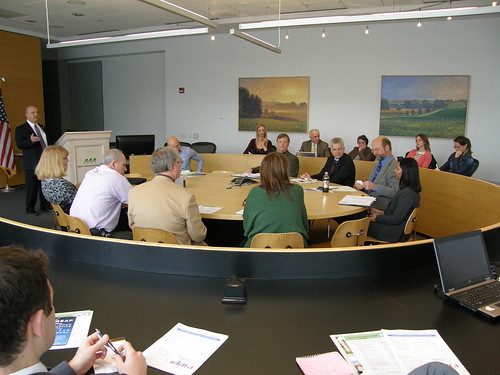
Earlier this week, I had the opportunity to facilitate a meeting with many rural energy stakeholders that USDA Rural Development works closely with here in Iowa.
Joining me in the discussion were representatives from the Environmental Law and Policy Center, Iowa Farm Bureau Federation, MidAmerican Energy, USDA Farm Service Agency, Community Vitality Center at Iowa State University, the Iowa Economic Development Authority, the Iowa Department of Natural Resources and many more.
Also in attendance were representatives from Senator Tom Harkin’s and Congressman Leonard Boswell’s offices.  Senator Harkin helped draft the original Energy Title in the 2002 Farm Bill.
During the conversation it was very clear that USDA Rural Development’s energy programs are making significant impacts on rural communities throughout Iowa.  The business owners and farmers benefitting from this assistance are decreasing their energy footprint, converting renewable resources into cleaner energy, and creating and saving jobs.
Since 2002, USDA Rural Development has awarded $130 million in guaranteed loans and grants to help more than 700 small businesses and producers in Iowa reduce energy costs by making energy-efficiency improvements, as well as installing renewable energy systems such as wind turbines, geothermal and solar.
I was excited to hear from LaVon Griffieon, owner of Griffieon Farms and a past recipient of the agency’s Rural Energy for America Program (REAP). LaVon had tremendous praise for the program, as well as how helpful Rural Development staff was throughout the entire application and awarding process. Griffieon Farms’ fresh meat direct-market business is now using 34 percent less energy thanks to three new commercial freezers purchased with assistance from REAP.
Iowa Rural Development State Director Bill Menner (Standing, Left) addresses participants in a renewable energy meeting in Des Moines.
Mark Edelman with Iowa State University’s Community Vitality Center, and Jennifer Reutzel with the Iowa Department of Natural Resources (DNR), both talked about the importance of energy audits for small businesses in rural America.  This year REAP dollars are helping fund a pollution prevention program sponsored by the Iowa DNR that helps companies reduce water use and save energy, among other things.
Also during the meeting Andy Olsen with Environmental Law and Policy Center emphasized the important role solar technologies and small wind projects could play with producers and businesses looking to save energy costs.
USDA is currently accepting application for REAP funding.  For more information please visitwww.rurdev.usda.gov or click here.

Wednesday, February 1, 2012

Be a Lean, Mean, Green Eating Machine

From the DOE Energy Savers blog:


Be a Lean, Mean, Green Eating Machine

clock January 31, 2012 15:53

Like most Americans, I watched the State of the Union to hear President Obama outline his goals for the year ahead, to understand his energy outlook and plans, and of course, to see what Michelle would be wearing (a stunning royal blue, of course).

When listening to the President highlight his administration’s clean energy initiatives, I couldn’t help but remember the First Family's goals to reduce childhood obesity in America. By no surprise, the link between nationwide health improvement and energy efficiency efforts is strong. By reducing our demand for processed and imported foods, we can improve the health of generations to come, extend our overall lifespan and reduce the energy we waste on packaging.

In the First Lady's health program, she outlines goals of improving the quality of food in schools and making healthy foods more affordable and accessible for families. The message resonates with many of us who are steadfastly moving forward with our new year’s resolution to drop the pounds – and save some energy along the way.

If you were born in 1975 or later, you are probably well-versed on the topic of organic growing and eating. We’ve heard it a million times: Organic foods are foods that have not been produced using pesticides, chemicals or unnatural ingredients. So, what exactly is it about organic food that is green-friendly? Research has shown that foods grown by sustainable agricultural methods avoid unnecessary pollution and oil consumption caused by synthetic, petroleum-based fertilizers and pesticides.

In addition to the energy savings that comes from producing organic foods, growing them locally (perhaps in your own garden) saves the energy cost of shipping and importing. And while we're on the topic of growing in your backyard, it really is the least expensive option, as opposed to buying the sometimes overpriced organic produce in your grocery store.

Gardening websites suggest that many of your regular vegetables can be successfully grown in late winter/early spring, such as broccoli, beets, potatoes, radishes, collards, lettuce, peas and turnips. We've talked about composting several times – it's important to remember that your garden will benefit from the rich in nutrient soil you can obtain from composting.

While it isn't scientifically proven that organic food is more nutritious or can promote weight loss, there are thousands of testimonies online from people who have experienced firsthand that an organic diet can vastly improve health. From the reduction in pesticides and hormones to the fresher and “cleaner” taste of the foods, Americans have seen the difference in selecting organic for the foods they consume.

Looking ahead to rest of 2012, I hope we can all work alongside each other to improve our health and energy outlook and begin taking those baby steps to reach our goals – both as individuals and as a country.


Kristin Swineford supports DOE's Weatherization & Intergovernmental Program in Communications & Outreach.

GM to Build New CNG Vans for AT&T

News release from AT&T.  Once again, while natural gas is not really renewable energy, its use may be of interest to readers because of its lower carbon footprint, as compared to gasoline or diesel.


GM Wentzville Plant to Build New CNG Vans for AT&T

Order shows AT&T's "continued commitment to alternative fuels and to investing right here in Missouri," says AT&T Missouri President John Sondag

St. Louis, Missouri, February 01, 2012


Fresh on the heels of the announcement that is has deployed its 5,000th alternative fuel vehicle, AT&T* announced today that it plans to take delivery of 1,200 Chevrolet Express dedicated compressed natural gas (CNG) cargo vans to be deployed to AT&T service centers nationwide. It is the largest-ever order of GM CNG vehicles.

“St. Louis is home to AT&T’s Fleet Operations and we have more than 200 alternative fuel vehicles in the state,” said AT&T Missouri President John Sondag.  “This order shows AT&T’s continued commitment to alternative fuels and to investing right here in Missouri.”

AT&T, which has announced its intention to invest up to $565 million to deploy approximately 15,000 alternative fuel vehicles over a 10-year period through 2018, will use the vans to provide and maintain communications, high-speed Internet and television services for AT&T customers. Last week, the company announced the milestone deployment of its 5,000th alternative-fuel vehicle, a Chevrolet Express van, as part of the commitment.

 “CNG technology is important to AT&T because it helps us reduce our fleet-based carbon emissions,” said Jerome Webber, AT&T vice president of Fleet Operations. “It is also cost-effective and readily available in our country right now.” 

According to the U.S Environmental Protection Agency, CNG-powered vans can produce approximately 25 percent fewer carbon dioxide emissions than similar gasoline and diesel-powered vans, which supports AT&T’s corporate commitment to minimize its impact on the environment.

In 2010, AT&T and other large U.S. fleet operators joined in the Department of Energy’s Clean Cities’ National Clean Fleets Partnership as part of a national challenge launched by President Obama to cut America’s petroleum imports by one-third by 2025. Through 2013, AT&T anticipates it will have purchased up to 8,000 CNG vehicles at an estimated cost of $350 million. Additionally, over the life of the commitment, AT&T expects to invest $215 million to replace approximately 7,100 fleet passenger cars with alternative-fuel models.

According to a 2009 Center for Automotive Research report, AT&T’s planned alternative-fuel vehicle initiative would:

  • Save 49 million gallons of gasoline over the 10-year deployment period
  • Reduce carbon emissions by 211,000 metric tons – the greenhouse gas equivalent of removing 38,600 passenger vehicles from the road for one year
More Sustainable Service Garages

Beyond the AFV deployments, AT&T is turning to its service garages to help minimize its environmental footprint and cut operating costs within its overall fleet. These programs include:
  • Redirecting an estimated 60,000 old tires annually through a new recycling program that turns old rubber into fuel and consumer products
  • Recycling all primary garage products, including 180,000 pounds of oil filters; 200,000 gallons of oil; and 23,000 gallons of antifreeze annually
  • Eliminating the purchase of 9,000 pounds of lead annually that were being used to balance new fleet vehicle tires at high speeds
For more information about AT&T’s sustainability efforts and to view a copy of AT&T’s 2010 Sustainability Report, please visit www.att.com/csr.