Search This Blog

Showing posts with label environment. Show all posts

Tuesday, May 8, 2012

Northrop Grumman Announces Significant Achievements in Environmental Sustainability, Diversity & Inclusion and Community Engagement


News Releases

Bookmark and Share

Northrop Grumman Announces Significant Achievements in Environmental Sustainability, Diversity & Inclusion and Community Engagement

Company Releases 2011 Corporate Responsibility Report

FALLS CHURCH, Va., May 8, 2012 (GLOBE NEWSWIRE) -- Northrop Grumman Corporation (NYSE:NOC) has released its 2011 Corporate Responsibility Report (CRR), a comprehensive publication that highlights the company's ongoing commitment to corporate responsibility, including environment sustainability, support for science, technology, engineering and mathematics (STEM) education, community service, corporate philanthropy and employee volunteerism, among other activities. It is the fifth year the company has published this report.
"At Northrop Grumman, responsibility is at the forefront of everything we do. It exists in the way we serve our customers, our employees, our shareholders, the communities where we live and operate, and our business partners," said Wes Bush, chairman, chief executive officer and president. "In all that we are doing to position our company for continued success, corporate responsibility is central–a key component of the value of performance we provide to all of our stakeholders."
The report also details several aspects of the company's corporate responsibility mission, including ethics leadership and governance; inclusion and diversity in the workplace; supply chain management; community partnerships; support for education; commitment to our troops and military families; and environmental, health and safety stewardship.
"Corporate responsibility has been a long-standing commitment and is very important for Northrop Grumman's business and operating strategies," said Sandra Evers-Manly, vice president of Corporate Responsibility. "As we continue to grow as a company, we remain focused on maintaining the highest of ethical standards, embracing diversity and becoming an ideal corporate citizen of the environment and of our communities. This report highlights the company's range of activities, and our continuing growth as a socially conscious enterprise."
Northrop Grumman's CRR is available online at: http://www.northropgrumman.com/corporate-responsibility/reports/index.html. Here are some key highlights:
Northrop Grumman's performance in environmental sustainability produced several important outcomes in 2011 
  • Northrop Grumman's score from the Carbon Disclosure Project has improved from 42 in 2009 to 80 (out of a top score of 100) in 2011. The company's greenhouse gas reduction performance has been ahead of plan and continues to be a primary objective of its sustainability strategy.
  • The company rose from #337 in 2009 to #51 in Newsweek magazine's 2011 comprehensive environmental ranking of the 500 largest American businesses. 
  • Computerworld magazine ranked Northrop Grumman #7 in its list of top 12 Green IT organizations in 2011, moving up from #11 in 2010.
For commitment to a diverse and inclusive workforce, and supply chain, the company has been recognized by several organizations
  • Ranked #37 among Top 50 Companies in Diversity by DiversityInc magazine.
  • Ranked #2 among Top 50 Employers by Minority Engineer magazine.
  • Ranked #3 in the Top 50 for positive working environment for members of minority groups by Minority Engineer.
  • Ranked Top 3 most admired companies for minority engineers by Black Engineer magazine.
  • Ranked Top 100 corporations for providing opportunities for Hispanics by Hispanic Network magazine.
  • Ranked #9 as best employer for graduating engineers by Black Collegiate magazine.
  • Ranked #7 Top 50 for "Multicultural Business Opportunities for 2011" by DiversityBusiness.com.
Northrop Grumman is a leading global security company providing innovative systems, products and solutions in aerospace, electronics, information systems and technical services to government and commercial customers worldwide. Please visit www.northropgrumman.com for more information.

Friday, March 30, 2012

USDA Works to Reduce Its Environmental Footprint

Did you know that USDA manages 193 million acres of land; occupies approximately 89 million square feet of office and laboratory space and operates over 23,000 buildings?  And if this isn’t enough, USDA also operates a fleet of over 40,000 motor vehicles and equipment.
Photo of green roof on court 5 of the South Building.  Saves energy and reduces excessive stormwater runoff (which supports our efforts to restore the Chesapeake Bay).
Photo of green roof on court 5 of the South Building. Saves energy and reduces excessive stormwater runoff (which supports our efforts to restore the Chesapeake Bay).
With statistics like these, it is no wonder that USDA remains focused on reducing its rather significant environmental footprint by using clean energy while working towards improving the environment.   To accomplish this, USDA conducts its operations in a sustainable manner, complies with environmental laws and regulations and walks its talk.
In order to realize these goals, USDA works on many fronts to:
  • Reduce its reliance on nonrenewable energy by improving energy conservation;
  • Increase efficiency and promote renewable energy projects and programs;
  • Support green transportation and travel practices that reduce harmful emissions;
  • Increase operational and fuel efficiency; and
  • Reduce nonrenewable fuel use.
To better coordinate this effort and build on past success, the Department created the USDA Sustainable Operations Council.  This Council includes representatives from each USDA mission area which represents each of USDA’s agencies.  The efforts of the Council are supported through several other groups, specifically, USDA’s Asset Management Council, Procurement Council, employee green teams and various workgroups throughout the Department.
Photo of one of our new “Cool Roofs” (made from biobased materials) at the USDA HQ Complex Facility - helps save energy.
Green teams embody USDA’s efforts to achieve sustainable operations at the grass roots level.  A USDA green team is a group of employees, regardless of discipline or organizational level, specifically chartered by leadership to promote and foster sustainable operations that reduce a unit’s environmental footprint.  For example, some successes which can be attributed to USDA green teams include:
  • Reductions in electricity use by seven percent and natural gas use by 26 percent in the Pike-San Isabel National Forest; and
  • Installing electric steam kettles and electric hot water heaters within the USDA Headquarters Complex for summer mode use which yielded an annual savings of $194,000.
And another success can be illustrated through USDA’s energy initiative, the “USDA Unplugged Challenge,” which was designed to bring awareness to USDA employees about the energy usage and waste that occurs at the USDA facilities during the evenings and on weekends.  The “USDAUnplugged Challenge” demonstrated that employees can make a significant difference in reducing electric consumption and costs. USDA energy managers found that employees within the Headquarters Complex were able to reduce electric use by 9,000 kilowatt-hours in a 24 hour period during the work week and by 24,000 kilowatt-hours over the weekend during the “USDA Unplugged Challenge.
USDA has synergistically combined its strategic plans and policies with the services that the U.S. Department of Energy’s Federal Energy Management Program (FEMP) provides to create effective management tools and energy initiatives.  Examples include FEMP-sponsored Energy Savings Performance Contracts and Utility Energy Service Contracts, green power purchase agreements, internal USDA Agency scorecards, corporate energy data management systems and environmental management systems.  Specific energy initiatives entail increasing the use of alternative transportation fuels, procuring more energy efficient replacement vehicles, performing facility energy evaluations and strategically disseminating energy-related outreach and awareness materials.
The Forest Service is building net-zero energy installations, including the San Dimas Technology and Development Center, shown.

Tuesday, March 27, 2012

IBM and Hydro One Team to Improve the Power Grid in Ontario

IBM and Hydro One Team to Improve the Power Grid in Ontario

Smarter technologies to be tested on Hydro One's distribution power grid


ARMONK, N.Y. and TORONTO - 27 Mar 2012: IBM (NYSE: IBM) and its Business Partner Telvent announced that they have been selected by Hydro One, the largest distributor of electricity in Ontario (Canada), for a new smart grid project that will help transform the province's electrical system. Together, the companies will run simulations and tests to determine the smart grid technologies that have the potential to improve power efficiency and reliability.
Installed in the 1950s, many components of Ontario's current electricity distribution system have reached the end of their service life. More recently, technological advancements, provincial governmental policy, market forces and increased environmental awareness have added pressure to the demands on Ontario's electricity distribution system.
"As equipment on our distribution system ages, it needs to be replaced. This creates an opportunity to create a world-class network with new, intelligent and sophisticated technologies to meet the changing needs of our customers," Rick Stevens, Vice President, Asset Management, Hydro One. "Our collaboration with IBM and Telvent will help Hydro One assess the next generation of distribution equipment and make the right choices for our customers looking for more reliable electricity, particularly in rural areas."
The Advanced Distribution System (ADS) project will help the utility identify and assess equipment, test new delivery models for electricity, validate the costs and benefits anticipated with a new smart grid and recommend changes to cost effectively modernize Ontario's distribution system.
The project intends to enable an increased amount of Distributed Generation into the grid as well as help increase the reliability of the current distribution system and improve outage management during large scale situations. By taking advantage of the insights gained from new data sources based on analytics, Hydro One will be able to optimize energy utilization and management for greater efficiency while accommodating consumer demand.
"Utilities around the world are investigating new smart grid technologies to help solve complex challenges caused by an aging infrastructure and increasing demand," said Guido Bartels, General Manager of IBM's Energy & Utilities Industry and Chairman of the Global Smart Grid Federation. "Together with Hydro One, we are paving the way for transformation by testing new sophisticated monitoring and control technologies that will enable the integration of renewable energy in the distribution grid while improving its reliability and responsiveness, and ensuring customer satisfaction. This will prepare Hydro One and the province of Ontario for further growth and deliver more affordable and reliable renewable energy for Ontarians."
As the overall system integrator, IBM will provide expertise in smart grid technologies, planning and implementation to oversee the reliability of the network solution. Hydro One will use the Advanced Distribution Management System (ADMS), from Telvent, a real-time solution that will provide complete functionality for planning, operation and analysis of its distribution system. This will allow Hydro One to more accurately manage and plan their grid investments.
According to Telvent's Chairman and CEO, Ignacio Gonzalez, "In addition to the ADMS solution, Hydro One will benefit from the strategic collaboration between Telvent and IBM. Over the years, we have provided solutions to several large utilities to help make mid-project technology adjustments while increasing the speed of the solution development."
The project is in line with the requirements of Ontario's Green Energy and Green Economy 2009 Act ("GEGEA"), which fosters the growth of renewable and cleaner sources of energy while promoting a greener economy.
About Hydro One Hydro One provides services to 1.2 million residents of Ontario with the vast majority of its rural customers in low-density areas. Hydro One is the largest distributor of electricity with about 120,000 km of distribution lines over a rural service territory of about 640,000 square kilometers covering 75% of the province.
About IBM
IBM is involved in more than 150 smart grid engagements around the world, in both mature and emerging markets. IBM is the founding member of the Global Intelligent Utility Network Coalition, a unique collaboration of utilities from around the globe who are working to accelerate the use of smart grid technologies and move the industry forward through its most challenging transformation. More about IBM's vision to bring a new level of intelligence to how the world works—how every person, business, organization, government, natural system, and man-made system interacts, can be found here: http://www.ibm.com/smarterplanet
For more information about Smarter Energy at IBM, please visit:www.ibm.com/press/smarterenergy. Follow us on Twitter and LinkedIn.

Tuesday, March 20, 2012

GE’s New Line of French Door Refrigerators Offers Most Sophisticated Ice and Water Technology Available Today

20 March 2012
GE’s New Line of French Door Refrigerators Offers Most Sophisticated Ice and Water Technology Available Today
 

  • From dispensing hot water to Hands-free Autofill, GE refrigerators make life more convenient at home
  • Advanced technology keeps foods and beverages fresher longer
  • The refrigerators will roll off the line in Louisville, Kentucky, creating hundreds of new jobs

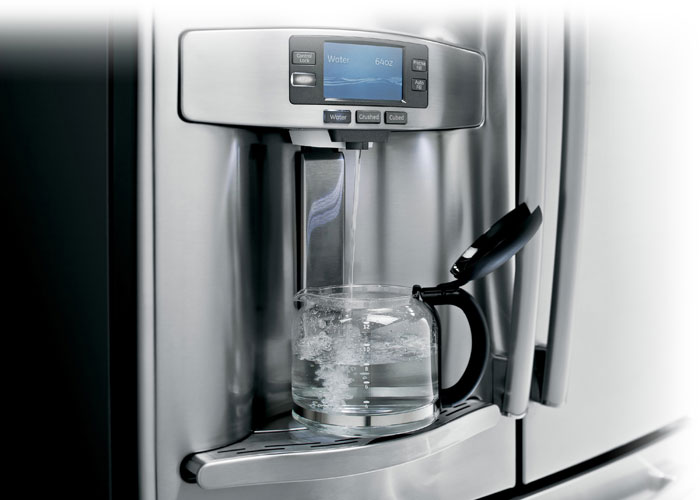
LOUISVILLE, Ky. – March 20, 2012 – (NYSE:GE) – As technological competition in refrigeration heats up, GE has risen above the rest. Featuring the most advanced ice and water technology on the market today, the newGE French door refrigerators offer intelligent home technology that makes your world work better. Breaking new ground, the GE Profile™ model’sHands-free Autofill system eliminates the need to stand and wait, automatically filling any container with filtered water. In addition, the GE Café™ model is the first refrigerator to feature a hot water dispenser, capable of serving up tea and oatmeal in minutes. And in yet another industry breakthrough, the model’s easy-to-access advanced filtration system is the first to remove harmful pharmaceuticals from water and ice.
“Our commitment first and foremost is to simplify and streamline the consumer’s world, applying innovations in a way that makes home life easier,” said John Boyd, refrigeration marketing manager for GE Appliances. “There’s more to a refrigerator than just storing food and beverages and keeping them cold. The industry-first features in our new French door models provide convenience, efficiency and bring ease to the hectic lives of busy consumers.”
Industry’s most advanced ice and water system
  • In an industry-first, the 29 cubic foot GE Profile model features a Hands-free Autofill system that fully fills a glass, water bottle, coffee pot or pitcher. The dispenser’s pull-out tray holds a container so you can press the button and walk away while it fills up automatically. The technology behind the feature uses sound waves from ultrasonic sensors and proximity detectors similar to those used to fill up fuel tanks in locomotives. The model also includes a PreciseFill™ feature that dispenses filtered water in accurate measurements for easy food and drink preparation.
  • The 29 cubic foot GE Café model is the first refrigerator in the industry to feature a hot water dispenser, which can heat up to 12 ounces of water in two minutes – ideal for oatmeal, a cup of tea, or a bottle of baby formula. The hot water dispenser lets you accurately choose the perfect temperature or select one of the four pre-programmed settings to simplify hot food and drink preparation.
  • As concern for water quality grows, all of the new GE French door refrigerators feature the most advanced water filtration system in the industry. The system has been tested and verified by an independent third party to remove 98 percent of five trace pharmaceuticals from drinking water and ice.1 The GE Profile model filter is conveniently and newly located on the inside of the refrigerator door, allowing for quick and easy filter replacement.
Foods and beverages stay fresher, longerThe 29-cubic-foot Profile and Café models include a full-width, adjustabletemperature-controlled drawer with five settings for meat, beverage, produce, cheese and citrus and temperatures ranging from 32 to 40 degrees, The drawer is designed to keep specific foods and drinks at the proper storage temperature, but can also be set as the same temperature as the overall refrigerator. Colored LED lights in the drawer – red, green, blue, aqua and purple – can be set to remind you of the temperature setting you have chosen.
The French door refrigerators also feature TwinChill™ evaporators, which separate airflow and climates in the fresh food and freezer sections to help maintain temperature and humidity levels to keep foods fresh. The separation of the air limits the amount of humidity in the freezer, reducing freezer burn while keeping freezer odors from mixing with refrigerator odors.
Designed to make our world work betterConsistent with GE’s fundamental focus of making the consumer’s world work better, the new GE French door refrigerator models exceed ENERGY STAR ® standards. These new models are the first bottom-freezers in the U.S. to use cyclopentane foam, which reduces the greenhouse gas emissions during manufacturing and at the end of the product’s life cycle, ultimately making this line better for the environment.
Some GE French door refrigerator models will also feature GE’s Brillion™connected home technology. On this product, Brillion technology, when coupled with a GE Nucleus, enables a consumer to receive maintenance and service alerts, monitor energy consumption, and adjust some appliance settings remotely.
Additionally, showcase LED lighting produces lighter, crisper illumination throughout the refrigerator’s interior. And the line includes many extra storage features, such as a drop-down tray, three freezer baskets, a second icemaker in the freezer and a space-saving icemaker in the door.
GE’s new French door refrigerators will be available in 27 and 29 cubic feet models in GE and GE Profile brands, and a 29 cubic foot model will be available in the GE Café brand.
The GE Profile refrigerators will be available in June, and the GE Café models will be available in the fourth quarter of this year. The range of estimated retail prices is from $1,699 to $2,999.2
Follow us on Facebook and Twitter or check out our website for more information Friend GE Appliances on Facebook to view how-to videos; learn about new GE appliances, and join in the discussion with other GE appliance owners. Join today and follow @GE_Appliances on Twitter or just locate detailed information about our products at www.geappliances.com.
About GE AppliancesGE Appliances is at the forefront of building innovative, energy-efficient appliances that improve people’s lives. GE Appliances’ products include refrigerators, freezers, cooking products, dishwashers, washers, dryers, air conditioners, water filtration systems and water heaters. General Electric (NYSE: GE) works on things that matter to build a world that works better. For more information on GE Appliances, visit www.ge.com/appliances.
1Removes ibuprofen, atenolol, fluoxetine, progesterone, and trimethoprim.Not all pharmaceuticals may be present in your water
2Retailers set their own prices.

Saturday, February 25, 2012

News Release from Illinois EPA

FOR IMMEDIATE RELEASE
February 23, 2012


Illinois EPA Designates 15 Chicago Area “Green Fleets”


Oak Park—The Illinois EPA, in coordination with the Chicago Area Clean Cities coalition, designated 15 new Chicago area Green Fleets at an event held today in Oak Park. 

The Illinois Green Fleets program provides for “Green Environment, Green Energy, & Green Economics for a Green Illinois,” through the use of clean alternate fuels, such as natural gas, biodiesel, ethanol, propane and electricity in their fleet vehicles, as well as retrofiting existing diesel trucks with clean technology options to reduce diesel particulates. Information regarding the program can be found at http://www.illinoisgreenfleets.org/

“These are family-owned and larger businesses, as well as public bodies, that have seen the value in supporting clean air, energy independence, jobs and providing insurance against the concern about high prices for gasoline and diesel,” said Interim Illinois EPA Director John Kim.

“These new Green Fleets join an elite fraternity of over 100 designated fleets throughout the state. We see more and more family-owned small businesses that are taking the initiative to purchase and convert their vehicles and equipment to run on a clean American fuel,” said Darwin Burkhart, program manager for the Illinois EPA and Chairman of Chicago Area Clean Cities.

The 15 new Illinois Green Fleets are:

Abt Electronics, a family-owned electronics and appliance store based in Glenview, uses biodiesel in its diesel truck fleet and has 30 vans that use E85 ethanol fuel and two vans that run on natural gas. In addition, the Abt family installed diesel oxidation catalysts on eight diesel delivery trucks to further reduce particulate emissions.

Groot Industries, a family operated waste hauler based in Elk Grove Village, has 33 refuse trucks that run on natural gas and has installed two natural gas refueling stations to share with other fleets. Other waste companies being recognized are Waste Management in Wheeling and Veolia ES Solid Waste in Northbrook with 33 and 20 natural gas refuse trucks, respectively.

Competitive Lawn Service, a small commercial lawn business in Downers Grove, is the first lawn and landscaping business in the country to convert many of its pickup trucks and mower equipment to propane. 
Doreen’s Pizzeria, a family-owned business in Calumet City, has seven natural gas-powered delivery trucks that display “Green Pizza Machines” on the sides of the vehicles.

Ozinga Ready Mix, a family-owned business in Mokena, is believed to be the first concrete company in the country to convert 14 of its mixing trucks to run on natural gas.

SCR Medical Transportation, a family run paratransit service in the Chicago area, operates 20 natural gas vans and shuttles for people needing mobility assistance. In addition, GO Airport Express operates two propane and two natural gas-powered shuttle vans and Yellow Cab Chicago has 79 natural gas taxis; both companies operate from O’Hare and Midway airports.

Other Green Fleets that are being acknowledged at the event are Northern Illinois University in DeKalb that uses E85, biodiesel, natural gas, and hybrid vehicles in many of its trucks, buses, campus police cars, and other campus vehicles and equipment; Chicago Park District that has E85, biodiesel, natural gas, hybrids and electric vehicles; Dillon Transport of Burr Ridge that uses E85 in the company’s flex fuel vehicles; Foodliner of Franklin Park that operates six Freightliner trucks on natural gas; and the DuPage County Division of Transportation that has nearly half its fleet running on E85, biodiesel, natural gas and electricity.   
###

Friday, February 17, 2012

Ag Under Secretary Hosts SD Mtg on Renewable Energy Funding

This afternoon, USDA Rural Development in South Dakota convened a Rural Energy for America Program (REAP) meeting in Sioux Falls.  Rural Development Under Secretary Dallas Tonsager addressed the group of 25 stakeholders.  Tonsager shared with the group that over the next couple of months, USDA Rural Development will be convening a total of 47 energy roundtables with stakeholders across the country to talk about energy opportunities.
“Our country is moving more and more toward renewable energy sources,” stated Tonsager. “Those of us at USDA want to stand up that renewable energy industry in America’s rural backyard, and we want to work with all of you to make it happen.”
South Dakota has shown its strength in the renewable energy arena with hydro and wind power.  These projects create a win-win situation.  They’re good for the environment; they reduce our reliance on foreign oil; and they’re good for the economy.
The group also heard from past REAP recipient and Senior Vice President of American Coalition for Ethanol Ron V. Lamberty.   The American Coalition for Ethanol (ACE) is the grassroots voice of the U.S. ethanol industry, the nation’s largest association dedicated to the production and use of ethanol.
ACE is a non-profit, membership-based organization of more than 1,500 members nationwide, including: ethanol producers, farmers, investors, the agriculture community, industry suppliers, rural electric cooperatives, and others supportive of the increased production and use of ethanol across America.
In conjunction with the meeting, Under Secretary Tonsager and South Dakota State Director Elsie Meeks awarded Jackson Winery and Vineyards, L.L.C. dba Belle Joli’ Winery with a business assistance grant funded through the Value Added Producer Grant program.  Co-owner Matthew Jackson and his wife Choi were on-site for the presentation.  The working capital grant will allow the business to expand and tap into new markets for its products and services.
On Saturday, February 18, Tonsager will participate in the South Dakota Farmer’s Union Convention held in Huron.  He will provide an update on the work Rural Development is doing to ensure that our rural communities are strong and sustainable now and well into the future.  USDA remains committed to rebuilding and revitalizing rural America.

Tuesday, February 14, 2012

Walking's Urban Potential

Excerpt from an article in The New York Times
Tuesday, February 14, 2012

Denver Pedestrians Promote Walking’s Urban Potential 

By KIRK JOHNSON DENVER — Quite a few of the frighteningly fit live around here. On a balmy Saturday, or for that matter a frigid winter weekday before dawn, an army of them emerges to run and bike. And in their intimidating long strides and whirring spokes, they underscore why Colorado is the least obese state in the nation.

But walking to get somewhere? Different story.

People like Gosia Kung and Dr. Andrew M. Freeman are trying to change that. In very different ways and for different reasons — she is an architect, he a cardiologist — they are trying to reincorporate physical activity into the sinews of a place that, despite its fantastic body mass index, lost touch like most American cities with the idea of walking as transportation.

Last year, Ms. Kung co-founded a nonprofit group called Walk Denver, which is trying to get the city certified as a “Walk Friendly Community.” It is also an advocate for a previously voiceless group, the ordinary walker — whispering into the ears of city planners, or nagging if need be, and preaching to the public.

It is the physical space of a city, Ms. Kung said on a recent walk through downtown, that creates a pedestrian’s view of the world. Ample sidewalks are crucial, she said, but they provide only the means of access to an environment that must then reward walkers through attractions like shopping and entertainment that cater specifically to foot traffic.

More walkers, whether strolling or striding, in turn reinforce an old idea that Ms. Kung said many cities have forgotten: better public health and improved economic life go together.

“I’ve always been interested in urban design — how we interact with built environments and how it affects us,” said Ms. Kung, who grew up in Krakow, Poland, and never got over the example of its dense and tangled medieval walking streets. Her experience in America, in turn, was immediately intertwined with the downside of the car culture.

“When I moved from Poland to the U.S. in 1997, I got my driver’s license and I gained 20 pounds,” she said.

Tuesday, February 7, 2012

China Balking at EU Airline Emissions Charges

Excerpt from an article in The New York Times
Tuesday, February 07, 2012

E.U. Rebuffs China's Challenge to Airline Emission System

By JAMES KANTER

BRUSSELS — The European Commission said Monday that it would continue charging airlines for their greenhouse gas emissions, despite an announcement from China that its carriers would be forbidden to pay without its permission.

The E.U. program, which began Jan. 1, requires airlines to account for all emissions on flights using European airports and represents the Union’s boldest move to protect the environment.

“We’re not backing down in our legislation,” said Isaac Valero-Ladrón, a spokesman for the commission, the executive body of the European Union. “We’ll apply this to companies operating in Europe.”

Europe says its system is less costly than portrayed and would speed up the adoption of greener technologies at a time when air traffic, which represents about 3 percent of global carbon dioxide emissions, is growing much faster than gains in efficiency.

Earlier Monday, the Chinese air regulator effectively prohibited the country’s carriers from paying those charges or other fees, or increasing ticket prices in response to the E.U. system, without permission from the government.

The Chinese government said it was also considering unspecified measures to protect Chinese companies, something Europe can ill afford as it looks to China to help ease its debt crisis. European countries also want access to China’s fast-growing economy, including free-spending Chinese tourists who might not show up.

The intensifying dispute is another sign that European environmental regulations could lead to a trade war if governments start retaliating against carriers or products.

==========

Wednesday, February 1, 2012

GM to Build New CNG Vans for AT&T

News release from AT&T.  Once again, while natural gas is not really renewable energy, its use may be of interest to readers because of its lower carbon footprint, as compared to gasoline or diesel.


GM Wentzville Plant to Build New CNG Vans for AT&T

Order shows AT&T's "continued commitment to alternative fuels and to investing right here in Missouri," says AT&T Missouri President John Sondag

St. Louis, Missouri, February 01, 2012


Fresh on the heels of the announcement that is has deployed its 5,000th alternative fuel vehicle, AT&T* announced today that it plans to take delivery of 1,200 Chevrolet Express dedicated compressed natural gas (CNG) cargo vans to be deployed to AT&T service centers nationwide. It is the largest-ever order of GM CNG vehicles.

“St. Louis is home to AT&T’s Fleet Operations and we have more than 200 alternative fuel vehicles in the state,” said AT&T Missouri President John Sondag.  “This order shows AT&T’s continued commitment to alternative fuels and to investing right here in Missouri.”

AT&T, which has announced its intention to invest up to $565 million to deploy approximately 15,000 alternative fuel vehicles over a 10-year period through 2018, will use the vans to provide and maintain communications, high-speed Internet and television services for AT&T customers. Last week, the company announced the milestone deployment of its 5,000th alternative-fuel vehicle, a Chevrolet Express van, as part of the commitment.

 “CNG technology is important to AT&T because it helps us reduce our fleet-based carbon emissions,” said Jerome Webber, AT&T vice president of Fleet Operations. “It is also cost-effective and readily available in our country right now.” 

According to the U.S Environmental Protection Agency, CNG-powered vans can produce approximately 25 percent fewer carbon dioxide emissions than similar gasoline and diesel-powered vans, which supports AT&T’s corporate commitment to minimize its impact on the environment.

In 2010, AT&T and other large U.S. fleet operators joined in the Department of Energy’s Clean Cities’ National Clean Fleets Partnership as part of a national challenge launched by President Obama to cut America’s petroleum imports by one-third by 2025. Through 2013, AT&T anticipates it will have purchased up to 8,000 CNG vehicles at an estimated cost of $350 million. Additionally, over the life of the commitment, AT&T expects to invest $215 million to replace approximately 7,100 fleet passenger cars with alternative-fuel models.

According to a 2009 Center for Automotive Research report, AT&T’s planned alternative-fuel vehicle initiative would:

  • Save 49 million gallons of gasoline over the 10-year deployment period
  • Reduce carbon emissions by 211,000 metric tons – the greenhouse gas equivalent of removing 38,600 passenger vehicles from the road for one year
More Sustainable Service Garages

Beyond the AFV deployments, AT&T is turning to its service garages to help minimize its environmental footprint and cut operating costs within its overall fleet. These programs include:
  • Redirecting an estimated 60,000 old tires annually through a new recycling program that turns old rubber into fuel and consumer products
  • Recycling all primary garage products, including 180,000 pounds of oil filters; 200,000 gallons of oil; and 23,000 gallons of antifreeze annually
  • Eliminating the purchase of 9,000 pounds of lead annually that were being used to balance new fleet vehicle tires at high speeds
For more information about AT&T’s sustainability efforts and to view a copy of AT&T’s 2010 Sustainability Report, please visit www.att.com/csr.

Tuesday, January 17, 2012

Austin Using Green Innovation to Beat the Utility Blues

U.S. Dept of Energy blog post:


Austin Using Green Innovation to Beat the Utility Blues

January 17, 2012 - 1:03pm

An aerial view of the Hornsby Bend Biosolids Management Plant in Austin, Texas. | Photo courtesy of Austin Water.

An aerial view of the Hornsby Bend Biosolids Management Plant in Austin, Texas. | Photo courtesy of Austin Water.
Sewage treatment has always been a dirty business, dating back to the frontier days when "waste management" meant the guy who followed after the horses with a bucket and shovel.

However, thanks to modern technology, there are ways to turn some of the treatment processes into clean energy that can power public infrastructure facilities.

The Hornsby Bend Biosolids Management Plant in Austin, Texas, located on 1,200 acres of land along the Colorado River, is a national model for innovative approaches to improve the environment, such as reducing waste, producing compost, and protecting ecosystems.

Each year, thousands of tons of biosolids, the nutrient-rich organic materials resulting from the treatment of sewage sludge, are anaerobically digested and composted with Austin's yard trimmings into an EPA-certified soil conditioner called "Dillo Dirt" (as in armadillo). This popular product is sold to commercial vendors for sale and use in public landscaping projects across the city. Demand for "Dillo Dirt" often exceeds available supply.

During the 1980s, an initial effort to improve energy efficiency at the plant started when two 400 kW converted diesel generators were installed. The generators were fueled by a mixture of digester biogas from the site and diesel fuel. This worked fairly well, but after 20+ years the old generators are no longer serviceable or repairable, and in recent years the gas has had to be flared.

Austin decided to use $1.2 million of its Energy Efficiency and Conservation Block Grant from the American Recovery and Reinvestment Act to replace the old equipment with modern "biogas rated" generation equipment.

The new generator equipment will generate clean electricity by utilizing digester methane from the sludge treatment process without the use of fossil fuels. In short, the same anerobic digesting process used to create the Dillo Dirt will also make the biogas used to power the generators. The result will demonstrate distributed clean power generation, reduce the facility's operating costs, and offset on-peak operation of the plant, thereby contributing to Austin's effort to avoid building new conventional power generation plants.

The new equipment is on order and the city intends for the project to be fully operational by the middle of next year. This single generator should generate more energy than the entire Hornsby Bend facility uses, thereby offsetting the plant's total energy use and generating a credit to the water utility.

Wednesday, January 11, 2012

2010 Greenhouse Gas Emissions Data Available

News Release form U.S. EPA:


2010 Greenhouse Gas Emissions Data from Large Facilities Now Available / First release of data through the national GHG reporting program

Release Date: 01/11/2012
Contact Information: Cathy Milbourn (News Media Only), Milbourn.cathy@epa.gov, 202-564-7849, 202-564-4355


WASHINGTON – For the first time, comprehensive greenhouse gas (GHG) data reported directly from large facilities and suppliers across the country are now easily accessible to the public through EPA’s GHG Reporting Program. The 2010 GHG data released today includes public information from facilities in nine industry groups that directly emit large quantities of GHGs, as well as suppliers of certain fossil fuels.

“Thanks to strong collaboration and feedback from industry, states and other organizations, today we have a transparent, powerful data resource available to the public,” said Gina McCarthy, assistant administrator for EPA’s Office of Air and Radiation. “The GHG Reporting Program data provides a critical tool for businesses and other innovators to find cost- and fuel-saving efficiencies that reduce greenhouse gas emissions, and foster technologies to protect public health and the environment.”

EPA’s online data publication tool allows users to view and sort GHG data for calendar year 2010 from over 6,700 facilities in a variety of ways—including by facility, location, industrial sector, and the type of GHG emitted. This information can be used by communities to identify nearby sources of GHGs, help businesses compare and track emissions, and provide information to state and local governments.

GHG data for direct emitters show that in 2010:

•Power plants were the largest stationary sources of direct emissions with 2,324 million metric tons of carbon dioxide equivalent (mmtCO2e), followed by petroleum refineries with emissions of 183 mmtCO2e.

•CO2 accounted for the largest share of direct GHG emissions with 95 percent, followed by methane with 4 percent, and nitrous oxide and fluorinated gases accounting for the remaining 1 percent.

•100 facilities each reported emissions over 7 mmtCO2e, including 96 power plants, two iron and steel mills and two refineries.

Mandated by the FY2008 Consolidated Appropriations Act, EPA launched the GHG Reporting Program in October 2009, requiring the reporting of GHG data from large emission sources across a range of industry sectors, as well as suppliers of products that would emit GHGs if released or combusted. Most reporting entities submitted data for calendar year 2010. However, an additional 12 source categories will begin reporting their 2011 GHG data this year.

Access EPA’s GHG Reporting Program Data and Data Publication Tool: http://epa.gov/climatechange/emissions/ghgdata/

Information on the GHG Reporting Program: http://epa.gov/climatechange/emissions/ghgrulemaking.html

Information on the U.S. Inventory of Greenhouse Gas Emissions Sources and Sinks: http://epa.gov/climatechange/emissions/usinventoryreport.html

Wednesday, December 21, 2011

EPA News Release on New Air Pollution Standards

The previous post contains an excerpt from an article published by The Hill describing how dozens of electrical power plants, most of them coal-burning, will close down, rather than upgrade, to meet new air pollution regulations.  In this post, I am presenting an EPA news release to provide that agency's perspective on the matter.  I would recommend reading the EPA news release and the article from The Hill in its entirety before forming an opinion.


EPA Issues First National Standards for Mercury Pollution from Power Plants/ Historic ‘mercury and air toxics standards’ meet 20-year old requirement to cut dangerous smokestack emissions

Release Date: 12/21/2011

Contact Information: Enesta Jones (News Media Only,jones.enesta@epa.gov, 202-564-7873, 202-564-4355 Doretta Reaves (Non Press Inquiries), Reaves.doretta@epa.gov, 202-564-7829 En español: Lina Younes, younes.lina@epa.gov, 202-564-9924, 202-564-4355

EPA estimates that the new safeguards will prevent as many as 11,000 premature deaths and 4,700 heart attacks a year. The standards will also help America’s children grow up healthier – preventing 130,000 cases of childhood asthma symptoms and about 6,300 fewer cases of acute bronchitis among children each year.

"By cutting emissions that are linked to developmental disorders and respiratory illnesses like asthma, these standards represent a major victory for clean air and public health– and especially for the health of our children. With these standards that were two decades in the making, EPA is rounding out a year of incredible progress on clean air in America with another action that will benefit the American people for years to come," said EPA Administrator Lisa P. Jackson. "The Mercury and Air Toxics Standards will protect millions of families and children from harmful and costly air pollution and provide the American people with health benefits that far outweigh the costs of compliance."

“Since toxic air pollution from power plants can make people sick and cut lives short, the new Mercury and Air Toxics Standards are a huge victory for public health,” said Albert A. Rizzo, MD, national volunteer chair of the American Lung Association, and pulmonary and critical care physician in Newark, Delaware. “The Lung Association expects all oil and coal-fired power plants to act now to protect all Americans, especially our children, from the health risks imposed by these dangerous air pollutants.”

More than 20 years ago, a bipartisan Congress passed the 1990 Clean Air Act Amendments and mandated that EPA require control of toxic air pollutants including mercury. To meet this requirement, EPA worked extensively with stakeholders, including industry, to minimize cost and maximize flexibilities in these final standards. There were more than 900,000 public comments that helped inform the final standards being announced today. Part of this feedback encouraged EPA to ensure the standards focused on readily available and widely deployed pollution control technologies, that are not only manufactured by companies in the United States, but also support short-term and long-term jobs. EPA estimates that manufacturing, engineering, installing and maintaining the pollution controls to meet these standards will provide employment for thousands, potentially including 46,000 short-term construction jobs and 8,000 long-term utility jobs.

Power plants are the largest remaining source of several toxic air pollutants, including mercury, arsenic, cyanide, and a range of other dangerous pollutants, and are responsible for half of the mercury and over 75 percent of the acid gas emissions in the United States. Today, more than half of all coal-fired power plants already deploy pollution control technologies that will help them meet these achievable standards. Once final, these standards will level the playing field by ensuring the remaining plants – about 40 percent of all coal fired power plants - take similar steps to decrease dangerous pollutants.

As part of the commitment to maximize flexibilities under the law, the standards are accompanied by a Presidential Memorandum that directs EPA to use tools provided in the Clean Air Act to implement the Mercury and Air Toxics Standards in a cost-effective manner that ensures electric reliability. For example, under these standards, EPA is not only providing the standard three years for compliance, but also encouraging permitting authorities to make a fourth year broadly available for technology installations, and if still more time is needed, providing a well-defined pathway to address any localized reliability problems should they arise.

Mercury has been shown to harm the nervous systems of children exposed in the womb, impairing thinking, learning and early development, and other pollutants that will be reduced by these standards can cause cancer, premature death, heart disease, and asthma.

The Mercury and Air Toxics Standards, which are being issued in response to a court deadline, are in keeping with President Obama’s Executive Order on regulatory reform. They are based on the latest data and provide industry significant flexibility in implementation through a phased-in approach and use of already existing technologies.

The standards also ensure that public health and economic benefits far outweigh costs of implementation. EPA estimates that for every dollar spent to reduce pollution from power plants, the American public will see up to $9 in health benefits. The total health and economic benefits of this standard are estimated to be as much as $90 billion annually.

The Mercury and Air Toxics Standards and the final Cross-State Air Pollution Rule, which was issued earlier this year, are the most significant steps to clean up pollution from power plant smokestacks since the Acid Rain Program of the 1990s.

Combined, the two rules are estimated to prevent up to 46,000 premature deaths, 540,000 asthma attacks among children, 24,500 emergency room visits and hospital admissions. The two programs are an investment in public health that will provide a total of up to $380 billion in return to American families in the form of longer, healthier lives and reduced health care costs.

More information: http://www.epa.gov/mats/

Dozens of Power Plants Closing

The following is an excerpt from an article by The Hill.  I am not sure that imposing tough new environmental regulations in a fragile economy with high unemployment is the smartest thing that we could be doing as a nation. But no one asked me for my opinion.


Dozens of Power Plants Closing Due to New EPA Rules
December 21, 2011
BRIAN KOENIG
Due to new federal air pollution regulations, more than 32 power plants across the country will be forced to close their doors, according to a recent Associated Press survey. Those plants, which are mostly coal-fired, discharge enough electricity to supply more than 22 million households, the survey notes, and their closure will lead to job layoffs, depleted tax revenues, and a considerable hike in electric bills. The areas that will be hit hardest are the Midwest and in the coal belt (Virginia, West Virginia, and Kentucky), where dozens of plants will likely be retired.

Two regulations are in question: One aims to curb air pollution in states downwind from pollutant-heavy power plants; and the second, which was finalized last week, would enact the first standards for mercury, acid gas, and other pollutants from plant smokestacks. In total, the new regulations could eliminate more than eight percent of coal-fired generation nationwide.

AP’s survey, the first of its kind, looked at the analyses by the Environmental Protection Agency (EPA) of plant retirements and interviewed 55 power plant operators about the effects on power supply and about their plans to deal with the new regulations.

Basing their assertions on energy analyses, congressional reports, and government regulators, critics have predicted that the new EPA regulations will lead to widespread blackouts, and possibly the retirement of coal as a power source altogether. However, proponents of the rules claim that those studies inflate closure numbers by considering plants shutting down for reasons other than the EPA’s new restrictions.