Search This Blog

Showing posts with label FS. Show all posts

Friday, May 27, 2016

California’s Clean Energy Pioneers Come in Black and White

From the #USDA:


Cows
New recruits in the battle against climate change.
California has a pioneering spirit. Rural folks there have been on the frontier for generations. That frontier may have been gold mines and cattle grasslands in the past, but today that frontier is the very air, soil and water of California itself. Climate change is transforming California like it’s transforming our globe. But Californians are leading the pioneer charge to transform, with pragmatism, ingenuity and a commitment to rural communities.
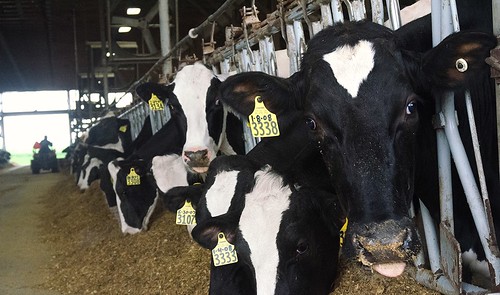
Just recently, I visited a small dairy farm in Elk Grove, California, the site of an anaerobic digester. Case Van Steyn’s operation of around 700 cows produces manure, and the Maas Energy digester, secluded in an unobtrusive red shipping container, uses the manure to produce methane. That methane creates enough electricity to power 125 homes—and enough to sell electricity back to the Sacramento Municipal Utility District, or SMUD.
SMUD unveiled the Van Steyn anaerobic digester project last Thursday as its newest dairy-fueled renewable energy plant, financed in part by USDA’s Renewable Energy for America Program. Van Steyn works the cows and Maas Energy works the digester. It’s a new model, where every player does what they do best, and it may mean many more digesters will crop up in the future.
For the sake of California and our nation’s struggle with climate change, I hope we see a lot more successes just like the Van Steyns’. Dairies are a backbone of California agriculture; milk and cream products are the second largest agricultural export and represented over $9.4 billion in production value in 2014. Turning dairies into clean energy plants positions them in a new, more sustainable niche—one that supports California families and one that is better for the state’s air, the water, and the soil. With a digester, local dairies can produce milk for the world and clean energy for their own communities.
“Dairying isn’t farming,” said Van Steyn when I visited him. “Dairying is a way of life. If you don’t want to wake up at two in the morning on a Sunday to pull a calf, then this isn’t for you.”
Van Steyn’s commitment shows in the dairy itself, from the hand-built dairy sheds to the bright red digester. He inherited the land, the buildings, the cows, and the way of life from his parents, who bought the dairy in the 1970s. Now his son works with him to run the farm today.
Digesting on the dairy is certainly a new way of doing business. But the high-tech system helps Van Steyn to manage the manure and makes money, too. He calls it a win-win. And he says he couldn’t have done it without help from the USDA.
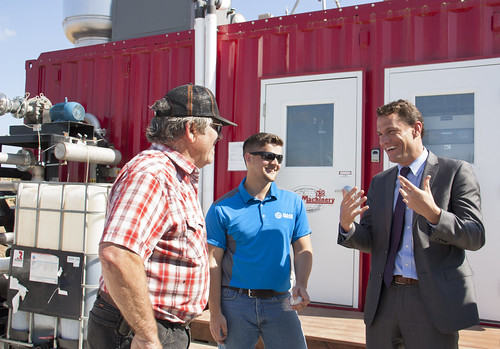
Dairyman Case Van Steyn, Nathan Nisly of Maas Energy, and RBS Administrator Sam Rikkers
Dairyman Case Van Steyn, Nathan Nisly of Maas Energy, and RBS Administrator Sam Rikkers.

Saturday, April 12, 2014

Ready, Set, Charge! Mt. Hood National Forest Welcomes First Electric Vehicle Charging Station

USDA Blog Post:

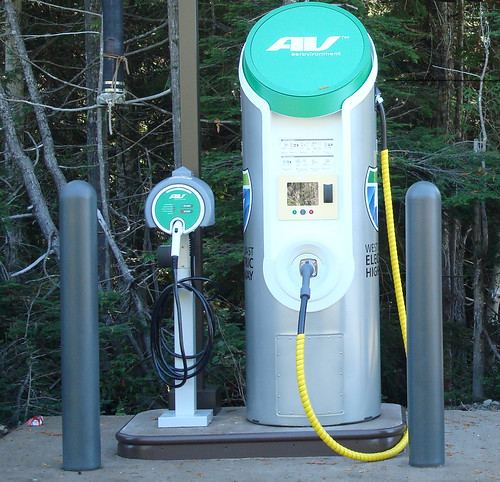
Mt. Hood National Forest is home to the nation’s first electric vehicle fast charger installed on land managed by the U.S. Forest Service and on a ski resort. (Courtesy Oregon Department of Transportation)
Oregon, home to the nation’s first border-to-border electric highway, continues its emergence as the ultimate travel destination for electric vehicle (EV) drivers. The Forest Service, the Oregon Department of Transportation and their partners recently unveiled America’s first EV fast-charger installed on U.S. Forest Service land and at a ski resort.
By using the growing West Coast Electric Highway fast-charger network, EV drivers can now travel up Mt. Hood’s rugged slopes, looming large at 11,250 feet and located just over an hour from Portland, Ore. The charging station, at Mt. Hood Skibowl West, completes Oregon’s Mt. Hood-Columbia River Gorge Electric Byway.
“It’s a natural fit to support infrastructure that promotes clean energy near forest recreation sites,” said Bill Westbrook of the Forest Service’s Zigzag Ranger District.
Partners in this accomplishment include Travel Oregon, the U.S. Department of TransportationU.S. Senator Jeff Merkley, the U.S. Forest Service, AeroVironment, Portland General Electric and the Oregon Office of the Governor.
“The opening of the Mt. Hood fast-charger marks a major milestone in Oregon’s efforts to support electric vehicle travel across the state, including to wild and scenic places and recreation destinations,” said Oregon Gov. John Kitzhaber. “This not only helps minimize our environmental impact, it also creates an economic boost for small businesses located along Oregon Electric Byways.”
Ashley Horvat, Oregon’s electric vehicle officer, said Oregonians aren’t content to relegate electric vehicles to just city driving.
“We see the potential to use EVs for long distance travel, helping us preserve Oregon’s landscapes for future generations to travel Oregon forever,” she said.
One of the keys to success in supporting and growing electric vehicle adoption is reducing range anxiety, or concern about how far an electric vehicle can go before it needs re-charging.

Monday, March 31, 2014

USDA to Co-Host Paccific Northwest Wood-to-Biofuel Conference

USDA Blog Post:

In conjunction with Washington State University Extension, USDA is co-hosting the Northwest Wood-Based Biofuels/Co-Products Conference in late April. The conference will be April 28-30, 2014 in Seattle, Wash.
The goal of the conference is to bring together the community of researchers, business leaders, government agencies, and economic development personnel to share and exchange research findings, ideas, and strategies for the common goal of sustainable development of wood-based bio-refineries for production of biofuels and co-products in the Pacific Northwest.
As Secretary Vilsack has noted, advanced biofuels are a key component of President Obama’s ‘all-of-the-above’ energy strategy to reduce the nation’s reliance on foreign oil and take control of America’s energy future.  Energy derived from woody biomass has enormous potential benefits for reducing greenhouse gas emissions, developing clean, home-grown energy, and providing economic opportunities for rural America. Markets for woody biomass can also bolster forest restoration activities on both public and private lands, improving the ecological health of our forests and reducing the impacts of global climate change.
For more information, contact Vikram Yadama at 509-335-6261 or email: vyadama@wsu.edu

Thursday, March 20, 2014

U.S. Forest Service Helps Fund Harvard Forest Green Energy Project

USDA Blog Post:

Harvard Forest staff renovated a pole barn to house the boiler room and modern wood shop. The new boiler room (left side of the building) contains three wood gasification boilers, a 2,500-gallon thermal storage tank, a propane-fired backup boiler and associated pumps and system controls. The sloped roof on the left of the building provides a dry storage area for racks of firewood prior to loading in the boilers. (U.S. Forest Service/Rob Clark)
I recently had the opportunity to speak at the dedication ceremony for the Harvard Forest Wood Energy Project, an exciting venture partially supported by the U.S. Forest Service Northeastern Area. This woody-biomass heating system will support 50,000 square feet of the central campus buildings and five dormitories, replacing fuel-oil with renewable wood chips that come from Harvard Forest, a 3,500-acre laboratory and classroom in Petersham, Mass., and owned by Harvard University.
A unique aspect of this project is that it is at the heart of a long-term forest carbon research project. Not only are carbon flows in the Harvard Forest where the wood for the new energy system will come from already being closely studied, but now every aspect of the new installation will be very closely monitored and studied as well.
This high-profile project will help spread the word on just how efficient and cost effective woody-biomass energy can be, but it’s also just the latest in a recent U.S. surge in the use of this form of green energy. Since 2005, the Forest Service’s woody biomass utilization grant program has helped start more than 160 woody biomass projects that support rural economies and have created hundreds of new jobs. In 2012 and 2013 alone, the program funded the start-up costs of 30 facilities across the United States.
These projects remove and use excess wood – the same trees and brush that fuel the catastrophic wildfires we’ve seen in the last several years – from our nation’s forests. They also use material from invasive pests like emerald ash borer and the Asian long-horned beetle. The program has contributed to the restoration of more than 500,000 acres and removed and used nearly 5 million green tons of biomass. The results: small businesses, non-profits, tribes and local state agencies have better access to green, affordable energy, and we help improve the health of our forests.
The clean, efficient use of wood instead of burning piles of debris improves air quality and thus human health by reducing the amount of fine particles released into the atmosphere by more than 99 percent. Additionally, the use helps mitigate climate change by reducing the amount of fossil fuel consumed. Wood energy at a new power plant in Gypsum, Colo., will use hundreds of thousands of tons of bark-beetle killed trees in the area. At $10 per ton for burning piles, it will save the Forest Service, state and private landowners more than $1 million per year.
As we look toward America’s future of green energy and energy independence, biofuels are an important part of the equation. The Harvard Forest project is an important step in the right direction, and it’s my hope that it will help spur more projects in public and private forests across the country.

Friday, September 13, 2013

Funds Promote Development of Rural Wood to Energy Projects

USDA Blog Post:

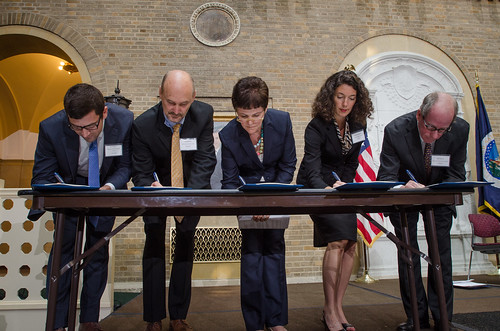
U.S. Department of Agriculture (USDA) Bioenergy Memorandum of Understanding is signed by wood energy partners (left - right) Biomass Thermal Energy Council, Executive Director Joseph Seymour; Alliance for Green Heat, President John Ackerly; USDA Deputy Agriculture Secretary Krysta Harden; Pellet Fuels Institute Executive, Director Jennifer Hedrick; Biomass Power Association, President and CEO Bob Cleaves, at the USDA Headquarters in Washington, D.C. on September 11, 2013. USDA Photo by Lance Cheung.
Earlier this week, USDA, U.S. Forest Service and partners took a major step to improve forest management, create rural jobs, prevent wildfires, and expand promising renewable energy opportunities.
Deputy Secretary Krysta Harden joined leaders from the Alliance for Green Heat, the Biomass Power Association, the Biomass Thermal Energy Council, and the Pellet Fuels Institute here in Washington for the announcement of a new partnership agreement. Acting as master of ceremonies for the signing event was Acting USDA Rural Development Under Secretary Doug O’Brien.  Through the Rural Energy for America program and other programs, Rural Development has been a leader in promoting deployment of wood-to-energy projects.
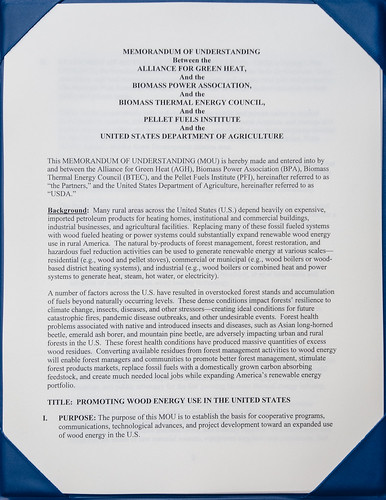
This agreement focuses on promoting wood energy nationwide to reduce fire risk, bolster rural economic development, improve air quality and help meet the Obama Administration’s “All of the Above” renewable energy and energy efficiency goals. The organizations support the use of wood energy across the scale of users – from residential users, to commercial and institutional facilities, to industrial production of heat and/or electricity to drive businesses and feed the electrical grid.
For more than a decade, USDA has supported wood energy as part of a forest restoration economy. Since 2009 USDA has invested over $956 million (nearly $1 billion) through grants, loans, and loan guarantees to support over 200 wood energy projects across the country.
Led by the Forest Service, this work helps to restore the health of forests and watersheds, provide rural areas with cost-effective energy alternatives, and create new income and employment opportunities in sectors ranging from engineering and construction, to manufacturing and forestry. It also provides an economical alternative to fuel oil heating in areas where natural gas supplies are limited. USDA’s Rural Development mission area and the Farm Services Agency also support wood energy through a variety of grants, loans, and loan guarantees. All told, USDA agencies contributed over $500 million last year to support wood energy.
The Deputy Secretary also announced the award of over $1 million dollars in grants to develop wood energy teams with Alaska, California, Idaho, Minnesota and New Hampshire. These cooperative agreements signal that successful wood energy projects and forest restoration efforts demand partnership at all levels as well as the sustained commitment of many and diverse forest users.  The federal funds will leverage $1.8 million in non-federal investments.
Grant recipients are:
Idaho Governor’s Office of Energy Resources, Boise
The Watershed Research & Training Center, Hayfork, Calif.
Minnesota Department of Natural Resources, Saint Paul
North Country Resource Conservation & Development Council, Gilford, N.H.
The Alaska Energy Authority, Anchorage
For more information on the cooperative agreement program, visit http://na.fs.fed.us/werc/wood-energy/. For more information on USDA’s renewable energy programs click here.
U.S. Department of Agriculture (USDA) Deputy Secretary Krysta Harden hosts the signing of the USDA Bioenergy Memorandum of Understanding and was joined by leaders for the announcement of the new partnership agreement at the USDA Headquarters in Washington, D.C. on September 11, 2013. USDA Photo by Lance Cheung.

Wednesday, July 31, 2013

Renewable Energy on Farms Study Released - First to Look at Role of State-Level Policies


Organize your life with FranklinCovey!


USDA Blog Post:

USDA has published a study examining states’ adoption rates of distributed generation for solar and wind energy on U.S. farms. The results show that states with higher energy prices, more organic acres per farm, and more Internet connectivity adopt renewable electricity at higher rates.  For solar systems, full-farm ownership and solar resources were also significant factors.  Renewable Portfolio Standards (RPS) targets were found to increase state level renewable electricity adoption at the distributed-generation scale while electric cooperative prevalence in the state was found to have a negative relationship to renewable electricity adoption share.
The results of this study highlight the importance of coordinating approaches to policy formulation, and can assist states in refining their policies for promoting renewable electricity, particularly during an era of declining government budgets.
To read the study, please go to:  www.usda.gov/oce/.