Search This Blog

Showing posts with label Rural Development. Show all posts

Friday, May 27, 2016

California’s Clean Energy Pioneers Come in Black and White

From the #USDA:


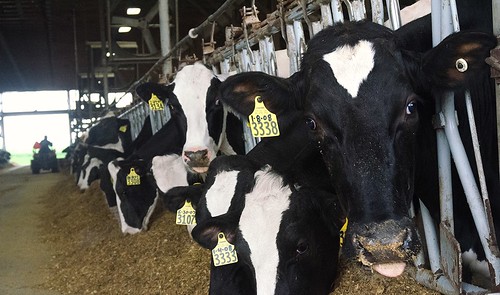
Cows
New recruits in the battle against climate change.
California has a pioneering spirit. Rural folks there have been on the frontier for generations. That frontier may have been gold mines and cattle grasslands in the past, but today that frontier is the very air, soil and water of California itself. Climate change is transforming California like it’s transforming our globe. But Californians are leading the pioneer charge to transform, with pragmatism, ingenuity and a commitment to rural communities.
Just recently, I visited a small dairy farm in Elk Grove, California, the site of an anaerobic digester. Case Van Steyn’s operation of around 700 cows produces manure, and the Maas Energy digester, secluded in an unobtrusive red shipping container, uses the manure to produce methane. That methane creates enough electricity to power 125 homes—and enough to sell electricity back to the Sacramento Municipal Utility District, or SMUD.
SMUD unveiled the Van Steyn anaerobic digester project last Thursday as its newest dairy-fueled renewable energy plant, financed in part by USDA’s Renewable Energy for America Program. Van Steyn works the cows and Maas Energy works the digester. It’s a new model, where every player does what they do best, and it may mean many more digesters will crop up in the future.
For the sake of California and our nation’s struggle with climate change, I hope we see a lot more successes just like the Van Steyns’. Dairies are a backbone of California agriculture; milk and cream products are the second largest agricultural export and represented over $9.4 billion in production value in 2014. Turning dairies into clean energy plants positions them in a new, more sustainable niche—one that supports California families and one that is better for the state’s air, the water, and the soil. With a digester, local dairies can produce milk for the world and clean energy for their own communities.
“Dairying isn’t farming,” said Van Steyn when I visited him. “Dairying is a way of life. If you don’t want to wake up at two in the morning on a Sunday to pull a calf, then this isn’t for you.”
Van Steyn’s commitment shows in the dairy itself, from the hand-built dairy sheds to the bright red digester. He inherited the land, the buildings, the cows, and the way of life from his parents, who bought the dairy in the 1970s. Now his son works with him to run the farm today.
Digesting on the dairy is certainly a new way of doing business. But the high-tech system helps Van Steyn to manage the manure and makes money, too. He calls it a win-win. And he says he couldn’t have done it without help from the USDA.
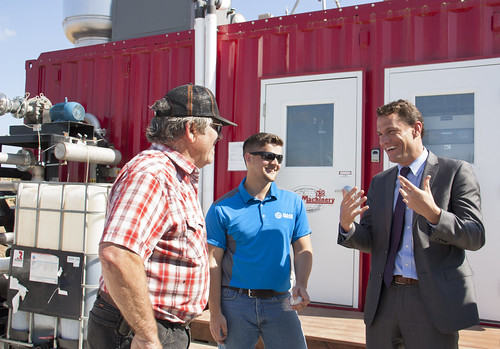
Dairyman Case Van Steyn, Nathan Nisly of Maas Energy, and RBS Administrator Sam Rikkers
Dairyman Case Van Steyn, Nathan Nisly of Maas Energy, and RBS Administrator Sam Rikkers.

Thursday, March 20, 2014

U.S. Forest Service Helps Fund Harvard Forest Green Energy Project

USDA Blog Post:

Harvard Forest staff renovated a pole barn to house the boiler room and modern wood shop. The new boiler room (left side of the building) contains three wood gasification boilers, a 2,500-gallon thermal storage tank, a propane-fired backup boiler and associated pumps and system controls. The sloped roof on the left of the building provides a dry storage area for racks of firewood prior to loading in the boilers. (U.S. Forest Service/Rob Clark)
I recently had the opportunity to speak at the dedication ceremony for the Harvard Forest Wood Energy Project, an exciting venture partially supported by the U.S. Forest Service Northeastern Area. This woody-biomass heating system will support 50,000 square feet of the central campus buildings and five dormitories, replacing fuel-oil with renewable wood chips that come from Harvard Forest, a 3,500-acre laboratory and classroom in Petersham, Mass., and owned by Harvard University.
A unique aspect of this project is that it is at the heart of a long-term forest carbon research project. Not only are carbon flows in the Harvard Forest where the wood for the new energy system will come from already being closely studied, but now every aspect of the new installation will be very closely monitored and studied as well.
This high-profile project will help spread the word on just how efficient and cost effective woody-biomass energy can be, but it’s also just the latest in a recent U.S. surge in the use of this form of green energy. Since 2005, the Forest Service’s woody biomass utilization grant program has helped start more than 160 woody biomass projects that support rural economies and have created hundreds of new jobs. In 2012 and 2013 alone, the program funded the start-up costs of 30 facilities across the United States.
These projects remove and use excess wood – the same trees and brush that fuel the catastrophic wildfires we’ve seen in the last several years – from our nation’s forests. They also use material from invasive pests like emerald ash borer and the Asian long-horned beetle. The program has contributed to the restoration of more than 500,000 acres and removed and used nearly 5 million green tons of biomass. The results: small businesses, non-profits, tribes and local state agencies have better access to green, affordable energy, and we help improve the health of our forests.
The clean, efficient use of wood instead of burning piles of debris improves air quality and thus human health by reducing the amount of fine particles released into the atmosphere by more than 99 percent. Additionally, the use helps mitigate climate change by reducing the amount of fossil fuel consumed. Wood energy at a new power plant in Gypsum, Colo., will use hundreds of thousands of tons of bark-beetle killed trees in the area. At $10 per ton for burning piles, it will save the Forest Service, state and private landowners more than $1 million per year.
As we look toward America’s future of green energy and energy independence, biofuels are an important part of the equation. The Harvard Forest project is an important step in the right direction, and it’s my hope that it will help spur more projects in public and private forests across the country.

Wednesday, July 31, 2013

Renewable Energy on Farms Study Released - First to Look at Role of State-Level Policies


Organize your life with FranklinCovey!


USDA Blog Post:

USDA has published a study examining states’ adoption rates of distributed generation for solar and wind energy on U.S. farms. The results show that states with higher energy prices, more organic acres per farm, and more Internet connectivity adopt renewable electricity at higher rates.  For solar systems, full-farm ownership and solar resources were also significant factors.  Renewable Portfolio Standards (RPS) targets were found to increase state level renewable electricity adoption at the distributed-generation scale while electric cooperative prevalence in the state was found to have a negative relationship to renewable electricity adoption share.
The results of this study highlight the importance of coordinating approaches to policy formulation, and can assist states in refining their policies for promoting renewable electricity, particularly during an era of declining government budgets.
To read the study, please go to:  www.usda.gov/oce/.