Search This Blog

Showing posts with label FSA. Show all posts

Friday, September 13, 2013

Funds Promote Development of Rural Wood to Energy Projects

USDA Blog Post:

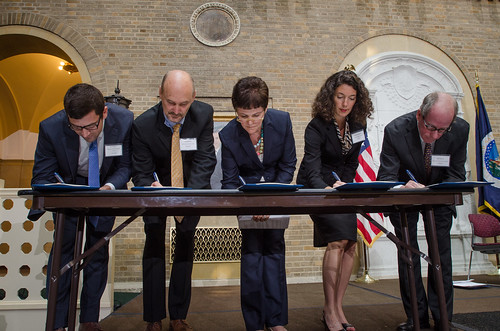
U.S. Department of Agriculture (USDA) Bioenergy Memorandum of Understanding is signed by wood energy partners (left - right) Biomass Thermal Energy Council, Executive Director Joseph Seymour; Alliance for Green Heat, President John Ackerly; USDA Deputy Agriculture Secretary Krysta Harden; Pellet Fuels Institute Executive, Director Jennifer Hedrick; Biomass Power Association, President and CEO Bob Cleaves, at the USDA Headquarters in Washington, D.C. on September 11, 2013. USDA Photo by Lance Cheung.
Earlier this week, USDA, U.S. Forest Service and partners took a major step to improve forest management, create rural jobs, prevent wildfires, and expand promising renewable energy opportunities.
Deputy Secretary Krysta Harden joined leaders from the Alliance for Green Heat, the Biomass Power Association, the Biomass Thermal Energy Council, and the Pellet Fuels Institute here in Washington for the announcement of a new partnership agreement. Acting as master of ceremonies for the signing event was Acting USDA Rural Development Under Secretary Doug O’Brien.  Through the Rural Energy for America program and other programs, Rural Development has been a leader in promoting deployment of wood-to-energy projects.
This agreement focuses on promoting wood energy nationwide to reduce fire risk, bolster rural economic development, improve air quality and help meet the Obama Administration’s “All of the Above” renewable energy and energy efficiency goals. The organizations support the use of wood energy across the scale of users – from residential users, to commercial and institutional facilities, to industrial production of heat and/or electricity to drive businesses and feed the electrical grid.
For more than a decade, USDA has supported wood energy as part of a forest restoration economy. Since 2009 USDA has invested over $956 million (nearly $1 billion) through grants, loans, and loan guarantees to support over 200 wood energy projects across the country.
Led by the Forest Service, this work helps to restore the health of forests and watersheds, provide rural areas with cost-effective energy alternatives, and create new income and employment opportunities in sectors ranging from engineering and construction, to manufacturing and forestry. It also provides an economical alternative to fuel oil heating in areas where natural gas supplies are limited. USDA’s Rural Development mission area and the Farm Services Agency also support wood energy through a variety of grants, loans, and loan guarantees. All told, USDA agencies contributed over $500 million last year to support wood energy.
The Deputy Secretary also announced the award of over $1 million dollars in grants to develop wood energy teams with Alaska, California, Idaho, Minnesota and New Hampshire. These cooperative agreements signal that successful wood energy projects and forest restoration efforts demand partnership at all levels as well as the sustained commitment of many and diverse forest users.  The federal funds will leverage $1.8 million in non-federal investments.
Grant recipients are:
Idaho Governor’s Office of Energy Resources, Boise
The Watershed Research & Training Center, Hayfork, Calif.
Minnesota Department of Natural Resources, Saint Paul
North Country Resource Conservation & Development Council, Gilford, N.H.
The Alaska Energy Authority, Anchorage
For more information on the cooperative agreement program, visit http://na.fs.fed.us/werc/wood-energy/. For more information on USDA’s renewable energy programs click here.
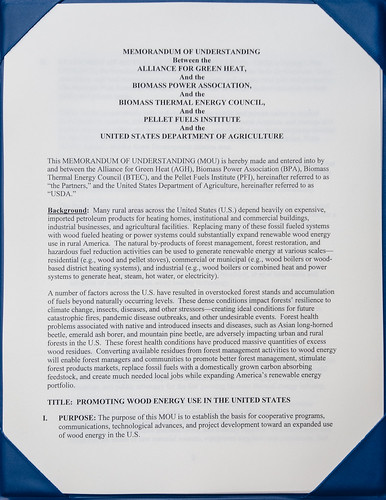
U.S. Department of Agriculture (USDA) Deputy Secretary Krysta Harden hosts the signing of the USDA Bioenergy Memorandum of Understanding and was joined by leaders for the announcement of the new partnership agreement at the USDA Headquarters in Washington, D.C. on September 11, 2013. USDA Photo by Lance Cheung.

Wednesday, July 31, 2013

Renewable Energy on Farms Study Released - First to Look at Role of State-Level Policies


Organize your life with FranklinCovey!


USDA Blog Post:

USDA has published a study examining states’ adoption rates of distributed generation for solar and wind energy on U.S. farms. The results show that states with higher energy prices, more organic acres per farm, and more Internet connectivity adopt renewable electricity at higher rates.  For solar systems, full-farm ownership and solar resources were also significant factors.  Renewable Portfolio Standards (RPS) targets were found to increase state level renewable electricity adoption at the distributed-generation scale while electric cooperative prevalence in the state was found to have a negative relationship to renewable electricity adoption share.
The results of this study highlight the importance of coordinating approaches to policy formulation, and can assist states in refining their policies for promoting renewable electricity, particularly during an era of declining government budgets.
To read the study, please go to:  www.usda.gov/oce/.

Thursday, March 29, 2012

The Energy Behind Alternative Energy

The Biomass Crop Assistance Program, or BCAP, is still in its infancy, but its potential success has producers and businesses wanting more.
“We have people on a waiting list,” said Tim Wooldridge, Arkansas project manager with MFA Oil Biomass. MFA was selected by USDA to manage three of nine project areas in fiscal year 2011. Each project area was awarded federal funding to provide incentives to farmers to grow non-food crops that can be processed into biofuels. “Our initial target in the Arkansas project was 5,000 acres, which we surpassed in signing up 6,588 acres. We now have 1,500 acres on a waitlist. We could easily get another 6,000.”
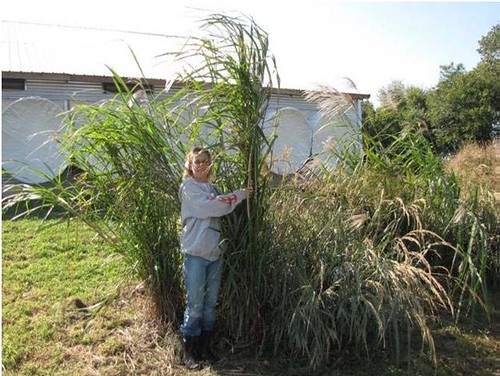
Those 6,588 acres will be planted this spring with Miscanthus, a perennial grass that can be dried and compressed into fuel pellets. These pellets will work toward President Obama’s goal of increased energy independence by decreasing U.S. dependence on foreign oil. The harvesting and processing of the grass will have an economic impact on communities by creating jobs.
This photo shows giant miscanthus (measuring seven feet tall). Photo courtesy of NRCS
“It has been a phenomenal success in Arkansas,” said Wooldridge. “I receive calls daily from farmers hoping that we expand.”
Scott Coye-Huhn, senior vice president of corporate development and chief legal officer of Aloterra Energy LLC, mirrors that sentiment. Aloterra Energy manages four project areas — three of which are through the MFA Oil Biomass partnership — in Ohio, Missouri, Arkansas and a portion of Pennsylvania.
Coye-Huhn said it took a lot of hard work and long hours to initially educate farmers about BCAP and how it will help the community. But once it took hold, producers jumped at the chance to participate.
“It has exceeded our expectations. We are surprised at the number of ideas and spin offs that [BCAP] has created. It is really exciting.”
Aloterra also has a waitlist, and together the two companies have hired more than 100 employees to plant Miscanthus on 18,000 acres in the four project areas. Aloterra and MFA Oil Biomass expect to grow each project area to 50,000 acres, which will produce 2.4 million tons of biomass per year.
“To put these initial 18,000 acres into oil and gas terms, they can produce a reserve of 10,000,000 barrels of liquid fuels.  At full maturity, these projects will be ten times larger and will have a real impact on our fuel supplies.”
According to Coye-Huhn, based on a third party projection, the BCAP project is expected to produce 3,600 new jobs in all four project areas, which will have a $200 million economic impact.
USDA is currently accepting applications for the next round of BCAP project areas. For more information, visit http://www.fsa.usda.gov/bcap.
BCAP, administered by USDA’s Farm Service Agency (FSA), is an important element of our national energy strategy to address high fuel prices and reduce reliance on petroleum. To create jobs in rural communities, drive economic growth, and help reduce our dependence on foreign oil, USDA is aggressively pursuing investments in renewable energy, investing in or making payments to over 5,700 renewable energy and energy efficiency improvement projects. More than 130 biodiesel and ethanol projects funded by USDA are currently producing almost 3.7 billion gallons of biodiesel and ethanol annually, enough fuel – in equivalence to gasoline – to keep five million vehicles on the road every year. In addition, USDA provided financial assistance for blender fuel pumps so drivers can pump fuels with higher ethanol mix into their gas tanks. This year, these programs provided financial assistance to help support nearly 250 blender fuel pumps.