Search This Blog

Showing posts with label MOU. Show all posts

Friday, September 13, 2013

Funds Promote Development of Rural Wood to Energy Projects

USDA Blog Post:

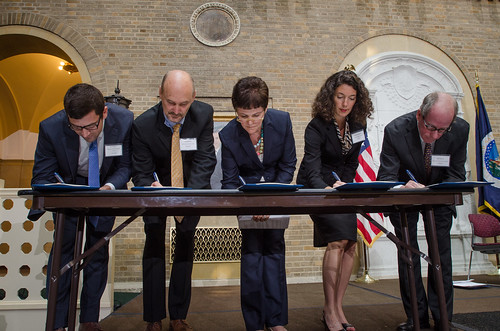
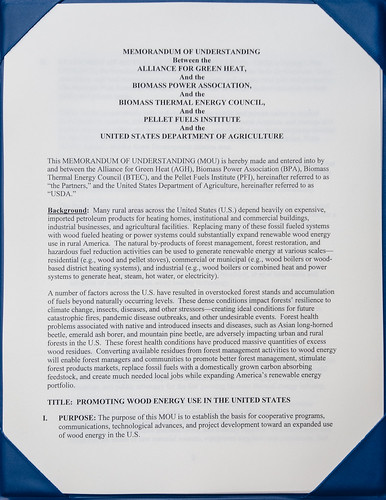
U.S. Department of Agriculture (USDA) Bioenergy Memorandum of Understanding is signed by wood energy partners (left - right) Biomass Thermal Energy Council, Executive Director Joseph Seymour; Alliance for Green Heat, President John Ackerly; USDA Deputy Agriculture Secretary Krysta Harden; Pellet Fuels Institute Executive, Director Jennifer Hedrick; Biomass Power Association, President and CEO Bob Cleaves, at the USDA Headquarters in Washington, D.C. on September 11, 2013. USDA Photo by Lance Cheung.
Earlier this week, USDA, U.S. Forest Service and partners took a major step to improve forest management, create rural jobs, prevent wildfires, and expand promising renewable energy opportunities.
Deputy Secretary Krysta Harden joined leaders from the Alliance for Green Heat, the Biomass Power Association, the Biomass Thermal Energy Council, and the Pellet Fuels Institute here in Washington for the announcement of a new partnership agreement. Acting as master of ceremonies for the signing event was Acting USDA Rural Development Under Secretary Doug O’Brien.  Through the Rural Energy for America program and other programs, Rural Development has been a leader in promoting deployment of wood-to-energy projects.
This agreement focuses on promoting wood energy nationwide to reduce fire risk, bolster rural economic development, improve air quality and help meet the Obama Administration’s “All of the Above” renewable energy and energy efficiency goals. The organizations support the use of wood energy across the scale of users – from residential users, to commercial and institutional facilities, to industrial production of heat and/or electricity to drive businesses and feed the electrical grid.
For more than a decade, USDA has supported wood energy as part of a forest restoration economy. Since 2009 USDA has invested over $956 million (nearly $1 billion) through grants, loans, and loan guarantees to support over 200 wood energy projects across the country.
Led by the Forest Service, this work helps to restore the health of forests and watersheds, provide rural areas with cost-effective energy alternatives, and create new income and employment opportunities in sectors ranging from engineering and construction, to manufacturing and forestry. It also provides an economical alternative to fuel oil heating in areas where natural gas supplies are limited. USDA’s Rural Development mission area and the Farm Services Agency also support wood energy through a variety of grants, loans, and loan guarantees. All told, USDA agencies contributed over $500 million last year to support wood energy.
The Deputy Secretary also announced the award of over $1 million dollars in grants to develop wood energy teams with Alaska, California, Idaho, Minnesota and New Hampshire. These cooperative agreements signal that successful wood energy projects and forest restoration efforts demand partnership at all levels as well as the sustained commitment of many and diverse forest users.  The federal funds will leverage $1.8 million in non-federal investments.
Grant recipients are:
Idaho Governor’s Office of Energy Resources, Boise
The Watershed Research & Training Center, Hayfork, Calif.
Minnesota Department of Natural Resources, Saint Paul
North Country Resource Conservation & Development Council, Gilford, N.H.
The Alaska Energy Authority, Anchorage
For more information on the cooperative agreement program, visit http://na.fs.fed.us/werc/wood-energy/. For more information on USDA’s renewable energy programs click here.
U.S. Department of Agriculture (USDA) Deputy Secretary Krysta Harden hosts the signing of the USDA Bioenergy Memorandum of Understanding and was joined by leaders for the announcement of the new partnership agreement at the USDA Headquarters in Washington, D.C. on September 11, 2013. USDA Photo by Lance Cheung.

Friday, March 30, 2012

Obama Administration and Great Lakes States Announce Agreement to Spur Development of Offshore Wind Projects

Obama Administration and Great Lakes States Announce Agreement to Spur Development of Offshore Wind Projects

March 30, 2012 - 12:00pm

Washington, D.C. – As part of President Obama’s all of the above approach to energy, the Obama Administration today joined with the governors of Illinois, Michigan, Minnesota, New York and Pennsylvania to announce the signing of a Memorandum of Understanding (MOU) that will streamline the efficient and responsible development of offshore wind resources in the Great Lakes.  This effort underscores the President’s commitment to American made energy, increasing energy independence, and creating jobs.

“President Obama is focused on leveraging American energy sources, including increased oil and gas production, the safe development of nuclear power, as well as renewable energy from sources like wind and solar, which is on track to double in the President’s first term,” said Nancy Sutley, Chair of the White House Council on Environmental Quality.  “This agreement among Federal agencies and Great Lakes states is a smart, practical way to encourage the development of homegrown energy that will create jobs, power homes, and help increase our nation’s energy security.”

 “As the President has made clear, an American economy that lasts is one built on American energy, designed and produced by American workers,” said Deputy Energy Secretary Daniel Poneman.  “This effort will allow us to tap into our abundant offshore resources, enhancing our energy security through an all-of-the-above strategy that develops every available source of American energy.”

The MOU will enhance collaboration between Federal and State agencies to speed review of proposed offshore wind projects.  Specifically, Federal and State agencies will develop an action plan that sets priorities and recommends steps for achieving efficient and responsible evaluation of proposed offshore wind power projects in the Great Lakes region.

Unlocking the Great Lakes’ offshore wind energy resources could yield tremendous economic and environmental benefits throughout the region, and has the potential to produce more than 700 gigawatts of energy from offshore wind, about one fifth of the total offshore wind potential in the U.S.  The development of even a small portion of the area’s offshore wind potential could create tens of thousands of clean energy jobs and generate revenue for local businesses.  These efforts are in line with the steps the Administration has taken to increase domestic energy production, including increased production of our nation’s oil and natural gas resources – with domestic oil production higher than any time in the last eight years and natural gas at an all-time high.  The Administration is also supporting the construction of the first nuclear power plant in 30 years, and today’s announcement builds on the extensive effort by the Administration to increase energy from renewable sources like wind and solar, which will double by the end of the President’s first term.

The National Renewable Energy Laboratory estimates that each gigawatt of offshore wind installed could produce enough electricity to power 300,000 homes.  The efforts made possible by today’s agreement will also bolster existing investments in offshore wind technologies by promoting a consistent and predictable regulatory environment that inspires innovation and helps to bring clean energy solutions to market.
“In Illinois, we believe investing in clean energy projects and the development of wind resources helps promote economic development and create jobs, while reducing our dependence on foreign energy sources,” Illinois Governor Pat Quinn said.  “We are extremely pleased to collaborate with the U.S. DOE and our fellow Great Lakes states to harness the clean, natural power of our offshore wind.”

“Minnesota has been a leader in developing wind energy for nearly two decades.  We now have more than 2.7 thousand megawatts of wind projects online, and we rank fifth among the states for the most installed wind capacity,” said Minnesota Governor Mark Dayton.  “We look forward to sharing our expertise with other states and federal agencies, to learning from them, and to collaborating on the further development of offshore wind resources.”

“The Great Lakes have the potential to provide clean energy from offshore wind and related green jobs in upstate New York,” said New York Governor Andrew Cuomo.  “This MOU offers a responsible mechanism for enhanced and efficient collaboration among federal, state and local interests in evaluating processes and proposals for development of this resource.”

“This agreement will enable states to work together to ensure that any proposed off-shore wind projects are reviewed in a consistent manner, and that the various state and federal agencies involved collaborate and coordinate their reviews,” said Pennsylvania Governor Tom Corbett.

To safely and responsibly develop offshore wind resources, Federal and State agencies – which share jurisdiction in the Great Lakes – must fully evaluate the potential social, environmental, safety and security impacts of projects.  The agreement signed today will enhance collaboration between Federal and State agencies to speed review of proposed offshore wind projects and accelerate the development of clean, American energy from offshore wind energy resources in the Great Lakes region.  Under the MOU, Federal and State agencies will develop an action plan that sets priorities and recommends steps for achieving efficient and responsible evaluation of proposed offshore wind power projects in the Great Lakes region.

The following participants have signed the MOU:

State of Illinois
State of Michigan
State of Minnesota
State of New York
Commonwealth of Pennsylvania
White House Council on Environmental Quality
U.S. Department of Energy
U.S. Department of Defense
U.S. Department of the Army
Advisory Council on Historic Preservation
U.S. Coast Guard
U.S. Environmental Protection Agency
U.S. Fish and Wildlife Service
Federal Aviation Administration
National Oceanic and Atmospheric Administration
A fact sheet can be found HERE, and the MOU can be read in full HERE.