Search This Blog

Showing posts with label save. Show all posts

Thursday, July 12, 2012

Suffolk Life and IBM Work Together to Reduce Power and Save Money

Press release:


Suffolk Life and IBM Work Together to Reduce Power and Save Money

Smarter Computing and streamlined storage delivers improved flexibility and business agility
London - 12 Jul 2012: IBM (NYSE: IBM) today announced that Suffolk Life, one of the U.K.’s leading providers and administrators of specialist pensions, has decreased energy consumption while meeting increased customer demand after adopting IBM's Smarter Computing approach to IT several months ago. In the four weeks following completion of the project in April, overall power consumption at Suffolk Life had reduced by 37 percent, delivering projected savings of approximately £30k per year.
Suffolk Life is one of the U.K.’s leading providers and administrators of Self Invested Personal Pensions (SIPPs), administering more than 16,000 self-invested plans with gross assets in excess of £4.5 billion. IBM's Smarter Computing approach to IT is designed to provide customers greater system efficiencies and performance, while lowering costs, through the use of optimized systems. In the case of Suffolk Life, the company is now able to quickly increase infrastructure based on consumer and business demand while lowering energy consumption.   
IBM upgraded and consolidated the Suffolk Life IT server and storage infrastructure to deliver increased flexibility in handling and accessing pension data across the business while significantly decreasing their carbon footprint and energy costs. The improvements also allow for easy expansion as their customer database grows.  
“We are continually looking to find new ways of improving our business processes and infrastructure in order to deliver top class propositions and services for our customers,” said Ian Long, Head of Information Technology for Suffolk Life. “This project has been a resounding success for Suffolk Life. IBM delivered an updated infrastructure ahead of schedule that enabled us to significantly reduce our power consumption and associated running costs.”  
IBM migrated 84 percent of the existing physical environment to a new virtualized server and storage environment, switching from HP servers to energy efficient IBM System x3650 M3 servers. As a result, Suffolk Life has consolidated the physical servers from 66 boxes to only six across two sites, plus the additional nine IBM hosts providing the new virtual environment. As well as providing a new server and storage infrastructure, the project included the migration of 60 business applications to the new environment.  
“IBM has been able to apply our services expertise to provide Suffolk Life the IT flexibility needed to keep up with increased customer demand and provide the foundation of flexibility, efficiency and capacity to significantly grow the business into the future,” said Andrew Brierley, Vice President of Integrated Technology Services, IBM U.K. & Ireland.  
As a result of the project, data indicates that overall power consumption at Suffolk Life has reduced by approximately 37 percent since the implementation of the new infrastructure with a potential cost saving per year of up to £30k. The power reduction seen during the first 4 weeks of running the new environment equates to almost 13 tons of C02 (12,888kg).  
The System x3650 server is part of IBM’s Smarter Computing initiative. Through cloud technologies and systems optimized for their specific workload, IBM is helping organisations better access, organize, and utilize their own large amounts of data.  
About Suffolk Life
Suffolk Life is one of the UK’s leading providers and administrators of specialist pension products, primarily Self-Invested Personal Pensions (SIPPs). It has total assets exceeding £4 billion. Suffolk Life owns over 2,500 properties for over 4,000 SIPP investors. All figures are as at January 2012. Suffolk Life is part of the Legal & General Group. Established in 1971 and based in Ipswich, Suffolk Life employs around 200 people and has built an enviable reputation based on its expertise and knowledge of the SIPP market. 
About IBM
For more information about IBM, please visit www.ibm.com/uk/services.

Wednesday, May 16, 2012

New Energy Efficiency Standards for Residential Clothes Washers and Dishwashers to Save Consumers Billions on Energy Bills

Press release from DOE:


New Energy Efficiency Standards for Residential Clothes Washers and Dishwashers to Save Consumers Billions on Energy Bills

May 16, 2012

WASHINGTON – As part of the Obama Administration’s focus on taking sensible steps to save families money while also reducing energy consumption,  the Department of Energy today announced common-sense energy efficiency standards for residential clothes washers and dishwashers that will save consumers $20 billion in energy and water costs. The new standards for both clothes washers and dishwashers were informed by important feedback from manufacturers, consumer groups and environmental advocates, producing significant savings while retaining consumer choice. The clothes washers standard announced today will save households approximately $350 over the lifetime of the appliance, while offering consumers a variety of more efficient machine choices, and as a result of the standards for dishwashers, home dishwashers will use approximately 15 percent less energy and more than 20 percent less water, directly providing consumers with savings on monthly bills.

Today’s announcement is only the most recent in a series of common-sense efficiency standards made by the Obama Administration that have covered nearly 40 different products, and will together save consumers nearly $350 billion on their energy bills through 2030.

“Working with consumer, industry and environmental groups to develop common-sense energy-saving appliance standards is an important part of the Obama Administration’s all-of-the-above approach to American energy and the Energy Department’s efforts to reduce energy costs for consumers,” said Secretary Chu. “Collectively, these energy efficiency standards for everyday appliances have saved American families hundreds of billions of dollars and offered consumers more efficient, less costly appliances without sacrificing performance.”

“DOE’s implementation of these new standards reflects the consensus agreement reached by stakeholders. It will result in tremendous energy savings for the consumer while preserving product choice and minimizing manufacturer impact. The home appliance industry is proud of its long history of energy efficiency advancements benefiting consumers and applauds DOE for working with stakeholders to increase energy efficiency,” said Joseph McGuire, President of the Association of Home Appliance Manufacturers.
“Clothes washer and dishwasher energy efficiency has improved dramatically over the past two decades while also improving clothes washing performance and maintaining dish washing performance,” said Steve Nadel, Executive Director of the American Council for an Energy-Efficient Economy.  “These improvements have been driven by a combination of manufacturer and utility efforts, Energy Star, federal tax incentives and minimum efficiency standards.  We support the new DOE minimum efficiency standards which will raise the floor, helping to spur further efficiency improvements.

The new standards – developed in partnership with companies like Whirlpool, General Electric and LG Electronics, industry advocates, national environmental organizations, consumer groups and other stakeholders – build on previous minimum energy efficiency requirements for clothes washers and dishwashers and go into effect starting in 2015 and 2013, respectively.

Today, clothes washers and dishwashers account for approximately 3 percent of residential energy use and more than 20 percent of indoor water use in homes across the country.  The new standards for clothes washers will reduce the energy consumption of front-loading clothes washers by 15 percent and reduce water consumption by 35 percent, while top-loading washers will save 33 percent on energy and 19 percent on water use.

As companies look for ways to further boost the efficiency of their products,  companies will continue to undertake additional research and development, partner with entrepreneurs working on new efficiency technologies and invest in manufacturing innovations that will help drive better, more efficient appliances and broader job creation across the economy. For example, according to a 2011 trade report, standards laws signed by President Reagan and both Presidents Bush and DOE rulemakings generated approximately 340,000 jobs in 2010 alone.

The standards announced today are part of the Obama Administration’s broader all-of-the-above approach to American energy and the Department of Energy’s efforts to help families save money by saving energy.  Other energy and cost-saving standards adopted under the Obama Administration include:
  • March 2009 - 14 consumer and commercial products with standards prescribed in the Energy Independence and Security Act of 2007 (EISA 2007), including dishwashers, general service incandescent lamps and residential clothes washers
  • April 2009 - Microwaves, kitchen ranges and ovens
  • July 2009 - General service fluorescent lamps and incandescent reflector lamps
  • July 2009 - Commercial heating, air-conditioning and water-heating equipment
  • August 2009 - Beverage vending machines
  • December 2009 - Commercial clothes washers
  • February 2010 - Small electric motors
  • March 2010 - Residential water heaters, direct heating equipment and pool heaters
  • April 2011 - Residential clothes dryers and room air conditioners
  • June 2011 - Residential furnaces and residential central air conditioners and heat pumps
  • September 2011 - Residential refrigerators, freezers, and refrigerator-freezers
  • October 2011 - Fluorescent lamp ballasts
  • November 2011 - Direct heating equipment
  • May 2012 - Residential clothes washers
  • May 2012 – Residential dishwashers
A full list of appliance efficiency standards is available on the Department of Energy website HERE.
DOE’s Office of Energy Efficiency and Renewable Energy invests in clean energy technologies that strengthen the economy, protect the environment, and reduce dependence on foreign oil. Learn more about the test procedures and minimum efficiency standards for residential appliances and commercial equipment developed by DOE’s Appliances and Commercial Equipment Standards Program and other building technologies projects

Tuesday, March 20, 2012

March Madness: Slam Dunk Energy Efficiency

March Madness: Slam Dunk Energy Efficiency


March 19, 2012 

The month of March represents many activities to celebrate: St. Patrick's Day, the first day of spring, the beginning of Lent, Daylight Savings Time, the month Coca Cola was invented, and most importantly, NCAA brackets! Now, with the understanding that it is unfair to place a higher importance on any of these things as its relative to each individual's beliefs, the one concept many of us forget is that there is life beyond March Madness. In fact, there is so much life that we must act now to preserve the wonderful resource that's been given to us for this life: our energy environment.

Much of this may not be new to you but now is an opportune time to revisit the ways we can get MAD about energy savings in MARCH.

Many states along the east coast have experienced a significantly warmer winter than usual and quite an abrupt transition to sunny, springtime weather. That said, one way to keep the house cool (along with your energy bill) for those Friday night "game nights" is to plant some shade around the outside of your house, especially near windows. We've talked before about how a little shade can go a long way, but it's really important to remember just how much of an impact this can have. Trees can cool the surrounding air temperatures by as much as 9°F.

On your way to a Game Five barbeque? Great—consider riding your bike there! While National Bike Month (or Bike-to-work day) is in May, there is never a better time, especially when it's warm, to keep your carbon footprint low by getting that foot in gear! Understanding the energy impact you are having is one way to get motivated.

Some of us are lucky enough to have friends who will host every game at their place, but the more likely situation is that sometimes we have to "take one for the team" and prepare the house to host the championship party. First things first, check your bracket. Wait, that's second! First, ensure that any sliding glass doors from the inside of the house to the outside have clean tracks. Built-up dirt can cause damage to the door seal resulting in microscopic gaps that allow the cool air in the house to escape. Consider weatherstripping the door if you foresee a loss of energy conservation—then go check your bracket.

Use the time between games and parties to do a little extra spring cleaning. Eliminating dust bunnies and debris from behind your major appliances, such as the refrigerator, will improve operating efficiency thus saving energy in the long run. Keeping light bulbs dust free will ensure maximum illumination and minimal energy waste.

So, while our calendars are full this month with a variety of wonderful activities, let's keep in mind the importance of sparing the real madness by working toward a sustainable energy future.

Kristin Swineford supports DOE's Weatherization & Intergovernmental Program in Communications & Outreach.

Wednesday, March 14, 2012

USDA Blog Post

Rural New Mexico Businesses Saving Energy and Going Green!


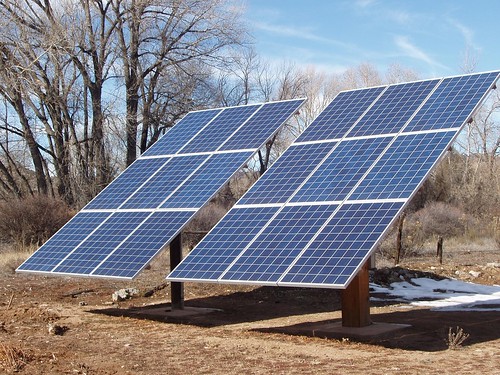
This eighteen solar panel array is generating more than enough electricity to offset the cost of energy it takes to run the Los Ebanistas, Inc. contracting firm’s woodshop and offices in Dixon, NM on an everyday basis.  The extra energy that is generated is then routed back into the electric grid allowing Los Ebanistas to make a profit on the additional energy.
This eighteen solar panel array is generating more than enough electricity to offset the cost of energy it takes to run the Los Ebanistas, Inc. contracting firm’s woodshop and offices in Dixon, NM on an everyday basis. The extra energy that is generated is then routed back into the electric grid allowing Los Ebanistas to make a profit on the additional energy.
It’s 8:20 AM and Jo Ann Shelby, the manager of Compass Components, in Deming, New Mexico is beginning her day by going over her latest work production and business expense reports.  She finds the cost of electricity to light the 90,000 square foot assembly plant is down 50 percent.
At the exact same time across the state in Dixon, New Mexico, Mark Johnson the owner of Los Ebanistas, Incorporated construction firm is in his office and hears the sound of a table saw ripping a piece of oak.  He knows even though he’s using the same amount of electricity as he did last year, he’s actually making money.
What do these two businesses have in common?  The answer is simple.  They both invested in energy efficient and renewable energy systems with the help of the federal government.
Both businesses applied for and received financial help to offset the cost of installing these new energy systems through the Rural Energy for America Program (REAP) administered by USDA Rural Development.  The REAP program was created to help  agricultural producers and small rural businesses take advantage of installing alternative energy systems to help them be more competitive in their business dealings and at the same time help America become more energy independent.
This program can offset the cost of installing energy efficiency or an alternative energy system with a 25 percent grant.  REAP can be used to pay for the installation of energy efficient air conditioners, heaters and lighting systems. It can also be used to pay for the installation of bioenergy, flexible fuel pumps, small and large wind and solar; geothermal-electric generation and direct use; hydropower, hydrogen, and anaerobic digester systems.
The main assembly plant building at Compass Components, Inc. in Deming, New Mexico is now equipped with a new more efficient lighting system.  By replacing the old fluorescent light system the company is now saving 50 percent on its lighting bill.
The main assembly plant building at Compass Components, Inc. in Deming, New Mexico is now equipped with a new more efficient lighting system. By replacing the old fluorescent light system the company is now saving 50 percent on its lighting bill.
Using the REAP program Compass Components Incorporated (CCI) installed a new lighting system at the Deming assembly plant.  CCI received a grant to offset the cost of installing the new energy efficient lighting system. The system replaces 630 fluorescent tube lights with 48 energy-efficient T-8 Hi-Bay lights. Since installing the new lighting system CCI has seen enough savings in its electric bill to recoup its investment in a few years.
Los Ebanistas, Inc. received a grant to help pay for the cost of the installation of an 18 panel solar power system. The new system provides enough electricity to power the Los Ebanistas offices and woodworking shop where they manufacture custom cabinets and furniture. By making the investment to install the solar power array, Los Ebanistas has become more energy efficient and more profitable at the same time because it sells the extra power its solar array produces to the Jemez Mountains Electric Cooperative.
USDA is currently accepting applications for funding through the REAP program.  To find out more, call your local USDA Rural Development State Office.

Saturday, February 25, 2012

News Release from the DOE - Energy Efficiency Training Centers

President Highlights Smart Energy Training at U. of Miami

February 24, 2012 


President Barack Obama tours the University of Miami Industrial Assessment Center in Miami, Florida, Feb. 23, 2012. The IAC is where students learn how to become industrial energy-efficiency experts as they help small to mid-sized manufacturers reduce their energy costs. | Official White House Photo by Chuck Kennedy. President Barack Obama tours the University of Miami Industrial Assessment Center in Miami, Florida, Feb. 23, 2012. The IAC is where students learn how to become industrial energy-efficiency experts as they help small to mid-sized manufacturers reduce their energy costs. | Official White House Photo by Chuck Kennedy.
During his visit to Florida, yesterday, President Obama highlighted the University of Miami's Industrial Assessment Center (IAC) as a smart and important piece of the administration's "all-of-the-above" approach to domestic energy sources.

In September of last year, the Energy Department gave 24 universities a total of $30M in grants to help train the next generation of industrial energy-efficiency experts. Each school will receive $200,000 to $300,000 per year for up to 5 years to train students on core energy management concepts. The teams conduct energy assessments in a broad range of manufacturing facilities, which prepare students to compete in today's economy while helping local companies and factories reduce energy waste, save money, and become more competitive.

As President Obama said yesterday, "We're taking a step that will make it easier for companies to save money by investing in energy solutions that have been proven here at the University of Miami -- new lighting systems; advanced heating and cooling systems that can lower a company's energy bills and make them more competitive."

Since the Industrial Assessment Center program began in 1976, university teams have conducted more than 15,000 energy assessments at U.S. manufacturing plants nationwide. To date, more than 3,000 students have graduated from the Industrial Assessment Center program, with more than 60 percent going on to careers in the energy industry. Critically, these assessments have helped save over 530 trillion BTUs of energy -- enough to meet the energy needs of 5.5 million American homes -- and have helped participating manufacturers save more than $5.6 billion in energy costs.

If you'd like to apply for an assessment, you can contact one of the 24 schools across the country that currently participate in the IAC Program.

Tuesday, February 7, 2012

Oh, the (Energy-Related) Stories I Have Heard...

From the Energy Savers blog of the U.S. Dept. of Energy:


I don't have an interesting tidbit, video, or page to link to today, so I thought I would share a few things I've heard people say about saving energy. I'd call them "stories," except I'm paraphrasing and summarizing so much that it's more like random advice that I've heard people give. I think they're kind of fun reminders that, well, we are all pretty energy-savvy here, but there's still a lot of education that needs to be done.
Let's get this started!

Once upon a time, I knew someone who was sure that it would cost less to use a gas fireplace to heat their living room than it would to let the central heating run. They figured the fireplace could heat a small area better than the central air, which would have to heat the whole house.

Is that true? It depends! You need to check your utilities to know that, because they charge you differently for gas than for electricity. But to do that, you need to know how much gas your fireplace actually uses. (And that's useful information. I wonder if my apartment could tell me that much about my fireplace?) For me, though? Gas is kind of pricy. If I had a wood and pellet-burning fireplace I could at least look that up on Energy Savers.

I once knew someone who thought they could turn the heat off and use a space heater instead. This would only be the case if you had a space heater that used less energy while it was on than your central heating did. So! Look into how much energy your space heater uses. Learn about your space heater. I can assure you that every single one of the cheap-o brands I've bought were so grossly inefficient that they couldn't be used as my primary heating source.

...Of course, there's another reason to not try to heat your entire house with a space heater. And that's because most of you live in a place where it will freeze, and you can't decide to just turn your heat off to save money.

Because, you see, I also knew someone who thought it was fine to just turn the heat off all winter and rely on blankets and sweaters instead. Think of your pipes before you do that!

And, finally, here's a weird one. I knew someone who had heard the truism that running the oven heats up your kitchen. That's true! This person decided that, consequentially, this meant that running the oven with nothing in it was a good way to heat a kitchen. And... yeah, don't do that. If you want to heat your house, do it with something that's designed for heating. If you try to be creative about it you might burn down your house.

I think the lesson is this: If you're serious about saving energy, you have to do a little research. Yes, yes, "research" is a word that makes some people cringe. Sorry. But you have to know how much energy you use to know how to cut back in the right places.

Figure out where you're wasting energy. Read your utility bill. Know how much you have to pay for electricity or gas. Know how much it costs to run your appliances. (If you want to do the math, you can estimate your energy use with this handy formula) Then you can decide what you should heat your home with and for how long.

Elizabeth Spencer is a communicator at DOE's National Renewable Energy Laboratory, which assists EERE in providing technical content for many of its websites.

Monday, December 19, 2011

Wrapping Up Energy Savings

This is from the U.S. Department of Energy's Energy Savers blog.


We’ve Got Saving Energy All Wrapped Up

clock December 19, 2011
Every year at holiday time thousands of pounds of wrapping paper is produced, using exorbitant amounts of energy, and quickly discarded just moments after opening your shiny new object. The colorful gift wrap loses energy through production, shipment and storage; a thought that is not exactly glittering. In fact, each ream of paper takes approximately the energy equivalent of 2 gallons of gasoline to produce.

A few years ago I realized how much wrapping paper is wasted during the holidays and made a personal quest to no longer purchase any more of the festive paper. It was a challenge, but I knew I was saving a lot of energy and money, and I was no longer contributing to deforestation. I had to think creatively, and searching the web for ideas, successfully found new ways to wrap my gifts. Each year since then I’ve done my best to continue the tradition, and my gifts are always quite an array of different papers. One of my favorite gift wrapping ideas included outdated grocery advertisements (collected from family) that highlighted specials on meats and poultry; I used this paper to wrap a grill.
photo of gift wrapped in found paper
For smaller gifts such as jewelry, I have used discarded magazine pages with pictures of trees and snow. This year I’ll be wrapping my gifts with white packing paper that I have saved from past mail orders. I ironed the paper to release the crinkles and may decorate it with holiday stamps or paint to add to the festive look; I will encourage the recipients to recycle it once the gifts are opened. For larger and bulkier items, I will be reusing a couple of gift bags from previous gifts, and I’ve even thought of putting some gifts in tote bags to be used later for groceries. Bows and ribbons can be trickier; I have sometimes used ribbons from products, old clothes, or simply used an accent like a sprig of greenery.

Wrapping gifts in fabric can be a great choice, but only if the fabric is going to someone who will reuse it to say, sew into a new shirt. Buying fabric just for the sake of wrapping is not any more energy efficient than paper. However, if the gift can be wrapped in something that is also part of the gift, then problem solved, such as kitchen utensils wrapped in cloth napkins, or bath products wrapped in a fluffy new towel. For bonus points, make one of those gifts something that’s energy efficient!

Don’t forget about the other packaging involved in your gift-giving. Try to recycle cardboard boxes, buy items with less packaging, and use biodegradable or recycled packing materials when you ship gifts (and we are hoping that delivery service has chosen to implement more energy efficient delivery trucks. Of course the most energy efficient way to wrap gifts is not at all! Choose presents that don’t need wrapping. Donations to charities, classes on a fun new hobby, and tickets to events can be given in a simple card made from recycled paper or a paper alternative.