A ruling by a state panel in Maine appears poised to help keep four biomass energy plants in that state operating into 2017 and 2018.
Maine state regulators approve $13 million biomass subsidy - Renewable Energy From Waste
Friday, December 16, 2016

Thursday, November 3, 2016
Closed East Texas power plant sold for $5 million - Renewable Energy From Waste
The facility originally opened in 2011 and was officially shuttered in early 2016 after an attempted revival.
Closed East Texas power plant sold for $5 million - Renewable Energy From Waste
Closed East Texas power plant sold for $5 million - Renewable Energy From Waste
Friday, October 28, 2016
Celebrating 80 Years of Partnership
From the #USDA:


Yesterday, Secretary Vilsack and RUS Administrator McBride announced an Energy Efficiency and Conservation Loan Program award to Pedernales Electric Co-op of Johnson City, TX. Left to right: RUS Administrator Brandon McBride, Secretary Vilsack, John Hewa (CEO, Pedernales Electric Cooperative, Inc.), Emily Pataki (Board President, Pedernales Electric Cooperative, Inc.), and Cindy Thyfault (Founder & CEO, Westar Trade Resources)
This is a special year for rural electric cooperative utilities. Eighty years ago, Congress passed and President Roosevelt signed the Rural Electrification Act of 1936.
The REA brought electricity to rural America, ultimately making the United States the source of the world’s food, fuel and fiber—the breadbasket for the world.
Today’s cooperatives not only provide electricity, but build stronger and more vital communities, particularly in rural areas. Rural electric co-ops are leading the way with their commitment to communities, investment in infrastructure to deliver reliable, affordable power and deployment of smart grid technologies, energy efficiency and renewable energy programs.
Energy Efficiency
Rural electric cooperatives are using energy efficiency—the fifth fuel—to reduce power use and costs. Cooperatives have been very strategic in implementing energy efficiency programs to meet growing electric demand and the increasing costs of power, using nearly $127 million of RUS loans to help increase our energy independence and strengthen rural economies.
Smart Grid
To improve electric utility resiliency and efficiency, rural electric cooperatives are investing in smart grid technologies. Co-ops used over $1.5 billion of RUS loans to deploy fiber connections to provide for smart grid needs.
Investments Improve the Quality of Life in Rural America
Rural electric cooperatives are the power that helps drives investment in the rural economy—an investment that builds the foundation for a vibrant future. Since 2009, rural electric cooperatives have invested over $38 billion in rural electric infrastructure, improving over 196,000 miles of line, and connecting 1.5 million new customers.
The economic stability of rural America continues to rely on the availability of affordable and reliable electricity to serve families, businesses, and attract new opportunities to these areas.
Cooperatives understand that America is strongest when we work together. That’s why 80 years after the REA became law, co-ops remain strong and successful.
To find out more about how USDA is Powering America with a More Sustainable Energy Future, visit the latest chapter in our USDA Results page. October is Co-op Month. See Secretary Vilsack’s Proclamation. See today’s electric program award announcement.
RUS Energy Efficiency and Loan Conservation Program can help rural electric consumers reduce energy costs by blowing insulation into an attic, benefitting both rural electric cooperatives and their members. Photo courtesy of North Carolina’s Roanoke Membership Corporation.
Thursday, October 27, 2016
REAPing America’s Clean Energy Future
From the #USDA:
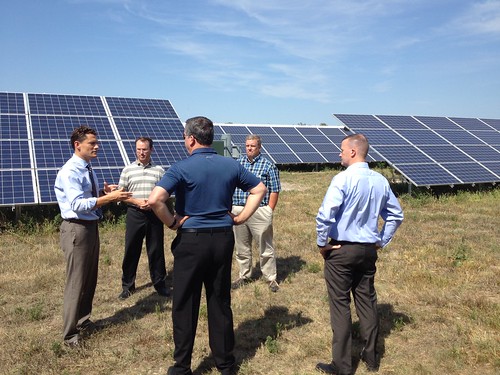
Administrator Sam Rikkers (left) discusses the Central City Solar Garden Project with (L-R) City Administrator Chris Anderson, Cliff Mesner of Mesner Development Company (with his back to the camera), and Bill Sheppard and Jeff Carpenter of USDA Rural Development’s Nebraska offices.
USDA Rural Development’s Rural Energy for America Program, commonly referred to as ‘REAP’, provides financial resources for rural agricultural producers and small businesses to help them improve their bottom line. REAP provides loan guarantees and small grants to support these producers and owners as they improve the energy efficiency of their operations and develop renewable energy sources.
Today, Secretary Vilsack announced hundreds of new projects like the one I visited over the summer in Central City, Nebraska. It exemplifies the strategic thinking our rural communities use daily to find new ways to prosper. A community just shy of 3,000 residents, Central City is home to the first community solar garden project ever developed in Nebraska.
Our USDA staff worked with a forward thinking public/private partnership between Cliff Mesner of Mesner Development, and Central City Administrator Chris Anderson to finance the project. Three small businesses: Mesner Development, Co.; Central City Scale, Inc.; and D Bar K, P.C. were awarded small grants they leveraged with low-interest loans from the State of Nebraska’s Energy Office.
Using a concept called ‘virtual net metering’ where the energy produced at the solar array can be applied directly toward the owner’s off-site meter, this partnership has been able to lower electric costs for these businesses, help the environment, and establish an effective price hedge against rising electricity costs. The solar garden initially has eight systems tied together generating nearly 300,000 kWh annually, and the City is planning to develop at least double that amount before the end of 2016.
The business model works like this: The solar panels are owned by what is, essentially, a cooperative partnership comprised of local businesses, individuals, and Central City itself. The array of panels are located in the city’s industrial park, which gives room for growth of the project. Since each of the respective partners own a share of the power, they can assign and reassign it as needed for their homes or businesses, and if they move, they can transfer the power to the new property without having to move the panels.
I spoke with project developer Cliff Mesner about the project, and he pointed out the diversity of ownership, ranging from small business owners looking to improve their bottom line to homeowners – grandmothers, even – who want to use ecologically friendly power sources to preserve the earth for their grandchildren. I’m glad USDA could be a part of making this project possible.
To read more about USDA’s investments in renewable energy and the bio-based economy, visit USDA’s entry on Medium.com, Powering America with a More Sustainable Energy Future.
Tuesday, October 25, 2016
Duke Energy seeks request for proposals - Renewable Energy From Waste
Furthering efforts to provide renewable energy to customers, Duke Energy Carolinas (DEC), Charlotte, North Carolina, issued a request for 750,000 megawatt-hours of energy located in its territory.
Duke Energy seeks request for proposals - Renewable Energy From Waste
Duke Energy seeks request for proposals - Renewable Energy From Waste
Friday, October 14, 2016
Gevo completes production of wood waste-derived jet fuel - Renewable Energy From Waste
Gevo, Inc., Englewood, Colorado, has completed production of cellulosic renewable jet fuel that is specified for commercial flights. Gevo successfully adapted its patented technologies to convert cellulosic sugars derived from wood waste into renewable isobutanol, which was then further converted into Gevo’s alcohol-to-jet fuel (ATJ) fuel. This ATJ meets the ASTM D7566 specification allowing it to be used for commercial flights. The revisions to the ASTM D7566 specification, which occurred earlier this year, includes ATJ derived from renewable isobutanol, regardless of the carbohydrate feedstock (i.e. cellulosics, corn, sugar cane, molasses and so on).
Gevo completes production of wood waste-derived jet fuel - Renewable Energy From Waste
Gevo completes production of wood waste-derived jet fuel - Renewable Energy From Waste
Tuesday, October 11, 2016
UPS Adds 200 Hybrid Electric Vehicles To Alternative Fuel Fleet
UPS (NYSE:UPS) today announced it plans to add 200 new hybrid electric delivery trucks to the company’s growing alternative fuel and advanced technology fleet. The vehicles have the same 2-cylinder engine and E-GENTM chassis as the 125 vehicles UPS announced earlier this year.
UPS Adds 200 Hybrid Electric Vehicles To Alternative Fuel Fleet
UPS Adds 200 Hybrid Electric Vehicles To Alternative Fuel Fleet
Subscribe to:
Posts (Atom)