Tuesday, April 15, 2014

GE AND SAUDI ARAMCO LAUNCH GLOBAL INNOVATION CHALLENGE TO FIND RENEWABLE ENERGY SOLUTIONS FOR SEAWATER DESALINATION
GE Press Release:
GE AND SAUDI ARAMCO LAUNCH GLOBAL INNOVATION CHALLENGE TO FIND RENEWABLE ENERGY SOLUTIONS FOR SEAWATER DESALINATION
April 15, 2014
New York, NY; April 15, 2014: GE ecomagination and Aramco Entrepreneurship today launched an open global technology challenge to accelerate the development of solutions focused on improving the energy efficiency of seawater desalination. The US$200,000 challenge will be awarded to four winners with a prize of US$50,000 each, and further investments towards commercialization of the best ideas among all submissions will be considered.
Current desalination techniques are typically very energy intensive: energy consumption can account for up to 70 per cent of the desalination costs. The global production of desalinated water uses approximately 75.2 terawatt-hours of electricity per year, enough to power nearly 7 million homes. The goal of this challenge is to identify novel ways to lower these costs around the world, either through technology advances, process improvements, or both.
Nabil Al-Khowaiter, Aramco Entrepreneurship's Director of Special Projects, stated that "Finding a more efficient method of desalinating seawater will be a game-changer in our collective pursuit of a more sustainable energy future across the globe. Due to increased water scarcity, countries around the world are poised to rely more and more heavily on desalination as a means to provide fresh water. With current techniques, this increased reliance could contribute dramatically to increased energy use. Aramco Entrepreneurship is partnering with GE not only to identify new solutions to lowering desalination costs, but also to invest in and attract new technologies and industries to Saudi Arabia."
Deb Frodl, GE's global executive director, ecomagination said, "GE ecomagination is investing to speed up the development of more sustainable solutions for water desalination. Through this challenge, we hope to inspire scientists, engineers, entrepreneurs, and innovators around the world to bring their talents to this effort and help drive greater outcomes for customers."
The open innovation challenge aims to identify new solutions to lower total desalination costs and emissions through: cleaner energy sources; incorporating advanced materials; and integrating processes better. Solutions must be innovative, impactful, feasible and scalable across the globe.
Entries are being immediately accepted at www.ninesights.com/community/ecomagination. The deadline to submit entries is July 16, 2014, and winners will be announced in November 2014.
The challenge is the fifth ecomagination open innovation challenge since ecomagination launched in 2005. GE has a successful history with open innovation challenges; most recently launching an advanced manufacturing challenge to use 3D printing to improve the production of a GE aircraft engine bracket and two healthcare challenges to advance work in breast cancer and traumatic brain injury diagnosis.
Since its 2005 launch, ecomagination -- the company's commitment to technology solutions that save money and reduce environmental impact for its customers and GE's own operations -- has generated more than US$160 billion in revenue. GE's own operations have seen a 34 per cent reduction in greenhouse gas (GHG) emissions since 2004 and a 47 per cent reduction in freshwater use since 2006, realizing US$300 million in savings. Building off this success, in February 2014, GE renewed its ecomagination focus by committing to reduce GE's GHG emissions and freshwater use by 20 per cent, from the 2011 baseline, by 2020 and announcing the continuation of GE's R&D investment committing to invest US$10 billion additional in ecomagination technologies to reach a total investment of US$25 billion by 2020.
About GE
GE (NYSE: GE) works on things that matter. The best people and the best technologies taking on the toughest challenges. Finding solutions in energy, health and home, transportation and finance. Building, powering, moving and curing the world. Not just imagining. Doing. GE works. www.ge.com.
About Aramco Entrepreneurship
The Saudi Aramco Entrepreneurship Center (Aramco Entrepreneurship) is a wholly owned subsidiary of Saudi Aramco, which supports high impact entrepreneurs and small and medium-sized enterprises (SMEs) by providing non-collateralized loans through its Wa'ed loan program and equity investments through its Wa'ed VC program. www.waed.net
Current desalination techniques are typically very energy intensive: energy consumption can account for up to 70 per cent of the desalination costs. The global production of desalinated water uses approximately 75.2 terawatt-hours of electricity per year, enough to power nearly 7 million homes. The goal of this challenge is to identify novel ways to lower these costs around the world, either through technology advances, process improvements, or both.
Nabil Al-Khowaiter, Aramco Entrepreneurship's Director of Special Projects, stated that "Finding a more efficient method of desalinating seawater will be a game-changer in our collective pursuit of a more sustainable energy future across the globe. Due to increased water scarcity, countries around the world are poised to rely more and more heavily on desalination as a means to provide fresh water. With current techniques, this increased reliance could contribute dramatically to increased energy use. Aramco Entrepreneurship is partnering with GE not only to identify new solutions to lowering desalination costs, but also to invest in and attract new technologies and industries to Saudi Arabia."
Deb Frodl, GE's global executive director, ecomagination said, "GE ecomagination is investing to speed up the development of more sustainable solutions for water desalination. Through this challenge, we hope to inspire scientists, engineers, entrepreneurs, and innovators around the world to bring their talents to this effort and help drive greater outcomes for customers."
The open innovation challenge aims to identify new solutions to lower total desalination costs and emissions through: cleaner energy sources; incorporating advanced materials; and integrating processes better. Solutions must be innovative, impactful, feasible and scalable across the globe.
Entries are being immediately accepted at www.ninesights.com/community/ecomagination. The deadline to submit entries is July 16, 2014, and winners will be announced in November 2014.
The challenge is the fifth ecomagination open innovation challenge since ecomagination launched in 2005. GE has a successful history with open innovation challenges; most recently launching an advanced manufacturing challenge to use 3D printing to improve the production of a GE aircraft engine bracket and two healthcare challenges to advance work in breast cancer and traumatic brain injury diagnosis.
Since its 2005 launch, ecomagination -- the company's commitment to technology solutions that save money and reduce environmental impact for its customers and GE's own operations -- has generated more than US$160 billion in revenue. GE's own operations have seen a 34 per cent reduction in greenhouse gas (GHG) emissions since 2004 and a 47 per cent reduction in freshwater use since 2006, realizing US$300 million in savings. Building off this success, in February 2014, GE renewed its ecomagination focus by committing to reduce GE's GHG emissions and freshwater use by 20 per cent, from the 2011 baseline, by 2020 and announcing the continuation of GE's R&D investment committing to invest US$10 billion additional in ecomagination technologies to reach a total investment of US$25 billion by 2020.
About GE
GE (NYSE: GE) works on things that matter. The best people and the best technologies taking on the toughest challenges. Finding solutions in energy, health and home, transportation and finance. Building, powering, moving and curing the world. Not just imagining. Doing. GE works. www.ge.com.
About Aramco Entrepreneurship
The Saudi Aramco Entrepreneurship Center (Aramco Entrepreneurship) is a wholly owned subsidiary of Saudi Aramco, which supports high impact entrepreneurs and small and medium-sized enterprises (SMEs) by providing non-collateralized loans through its Wa'ed loan program and equity investments through its Wa'ed VC program. www.waed.net
Monday, April 14, 2014
PNNL: News - Making dams safer for fish around the world
Fish-friendly hydropower is the goal of international team
PNNL: News - Making dams safer for fish around the world
PNNL: News - Making dams safer for fish around the world
Shiny quantum dots brighten future of solar cells
The project demonstrates that superior light-emitting properties of quantum dots can be applied in solar energy by helping more efficiently harvest sunlight.
Berkeley Lab Launches Building Energy Performance Research Project at New FLEXLAB Testing Facility
Lawrence Berkeley National Laboratory News Release:
The research will take place in FLEXLAB’s rotating testbed, a unit that rotates 270 degrees to allow the study of building energy use and environmental parameters change in a variety of orientations relative to the sun. FLEXLAB’s newly completed outdoor facility consists of four testbeds, consisting of two cells each, that can be outfitted in almost any combination of building envelope materials, windows and shade structures, lights, heating and cooling equipment, and controls to test new technology in real conditions. Two other testbeds, one for lighting and controls testing, and one for collaborative building design have opened in an existing building at Berkeley Lab.
 Berkeley Lab and Webcor will build a section of the building in the rotating testbed, collect data, and use these measurements to develop an accurate energy simulation model of the building. This practice allows the design team to better understand and predict the actual performance of the building, both for energy and comfort. The lab is the only facility in the U.S. that provides side-by-side, outdoor testing of fully integrated building systems (envelope, lighting, HVAC) in a fully reconfigurable space.
The U.S. Department of Energy’s David Danielson, Assistant Secretary for Energy Efficiency and Renewable Energy, was on hand in Berkeley to tour the facility, meet with Webcor executives, Lab Director Paul Alivisatos and Berkeley Lab researchers, and view the start of the installation.
“The Energy Department’s FLEXLAB is an exciting contribution that will help industry test comfortable, low-energy-use buildings technologies,” said Danielson. “By advancing technologies that reduce our energy use in built environments, this project also brings us closer to meeting the ambitious goals of the President’s Climate Action Plan and keeps America on the path to a clean energy future.”
“We have to agree with other experts that this building, this facility, could be the most important building in the country. The DOE, Berkeley Lab and its team have handed us a uniquely powerful tool and now it is the architecture and engineering community’s opportunity to put it to use,” says Phil Williams, Webcor’s Vice President for Building Systems and Sustainability.
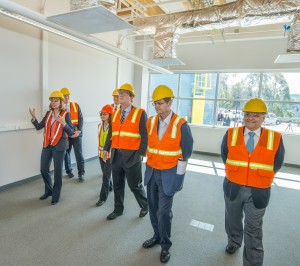 Webcor will ensure that the building operates according to specification when construction is finished. Operations and maintenance staff, and occupants will provide input on the design early on, understanding how the integrated systems will work in operation. They will provide input on operations as well as functionality and comfort. This allows the team to identify potential performance and cost issues early on and address them, lowering the risk of delivered performance and the potential for costly change orders during the construction process.
“FLEXLAB will bring industry, DOE national lab scientists, manufacturers and investors together all working hand in hand on cutting-edge energy efficiency technologies and solutions,” says Berkeley Lab Director Paul Alivisatos. “These partners can use the results from their FLEXLAB demonstrations to help encourage design, construction and operation of high-performance buildings.”
 Mocking up and testing advanced designs will allow the buildings industry to build a case for new advanced technology, and scale up the opportunities for construction and operations cost reduction. Ultimately, this benefits consumers, by leading to better designed and operated, more comfortable buildings with lower energy costs.
As part of his visit to Berkeley Lab, Danielson also toured the Molecular Foundry.
For more information about FLEXLAB, seehttp://flexlab.lbl.gov/.
APRIL 14, 2014
510-486-4014 jrweiner@lbl.gov
5
News Release
FLEXLAB™, the Facility for Low Energy experiments in Buildings, run by Lawrence Berkeley National Laboratory’s (Berkeley Lab) Environmental Energy Technologies Division (EETD), has partnered with construction firm Webcor to test building energy performance. The testing will allow Webcor’s engineers to predict and improve the energy performance for a new building constructed for biotech company, Genentech, a member of the Roche Group. A building mockup for Genentech will be studied at different building orientations, specific to the actual construction site.The research will take place in FLEXLAB’s rotating testbed, a unit that rotates 270 degrees to allow the study of building energy use and environmental parameters change in a variety of orientations relative to the sun. FLEXLAB’s newly completed outdoor facility consists of four testbeds, consisting of two cells each, that can be outfitted in almost any combination of building envelope materials, windows and shade structures, lights, heating and cooling equipment, and controls to test new technology in real conditions. Two other testbeds, one for lighting and controls testing, and one for collaborative building design have opened in an existing building at Berkeley Lab.

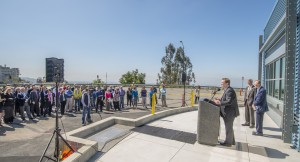
EERE's David Danielson talks to the crowd gathered outside of FLEXLAB
The U.S. Department of Energy’s David Danielson, Assistant Secretary for Energy Efficiency and Renewable Energy, was on hand in Berkeley to tour the facility, meet with Webcor executives, Lab Director Paul Alivisatos and Berkeley Lab researchers, and view the start of the installation.
“The Energy Department’s FLEXLAB is an exciting contribution that will help industry test comfortable, low-energy-use buildings technologies,” said Danielson. “By advancing technologies that reduce our energy use in built environments, this project also brings us closer to meeting the ambitious goals of the President’s Climate Action Plan and keeps America on the path to a clean energy future.”
“We have to agree with other experts that this building, this facility, could be the most important building in the country. The DOE, Berkeley Lab and its team have handed us a uniquely powerful tool and now it is the architecture and engineering community’s opportunity to put it to use,” says Phil Williams, Webcor’s Vice President for Building Systems and Sustainability.
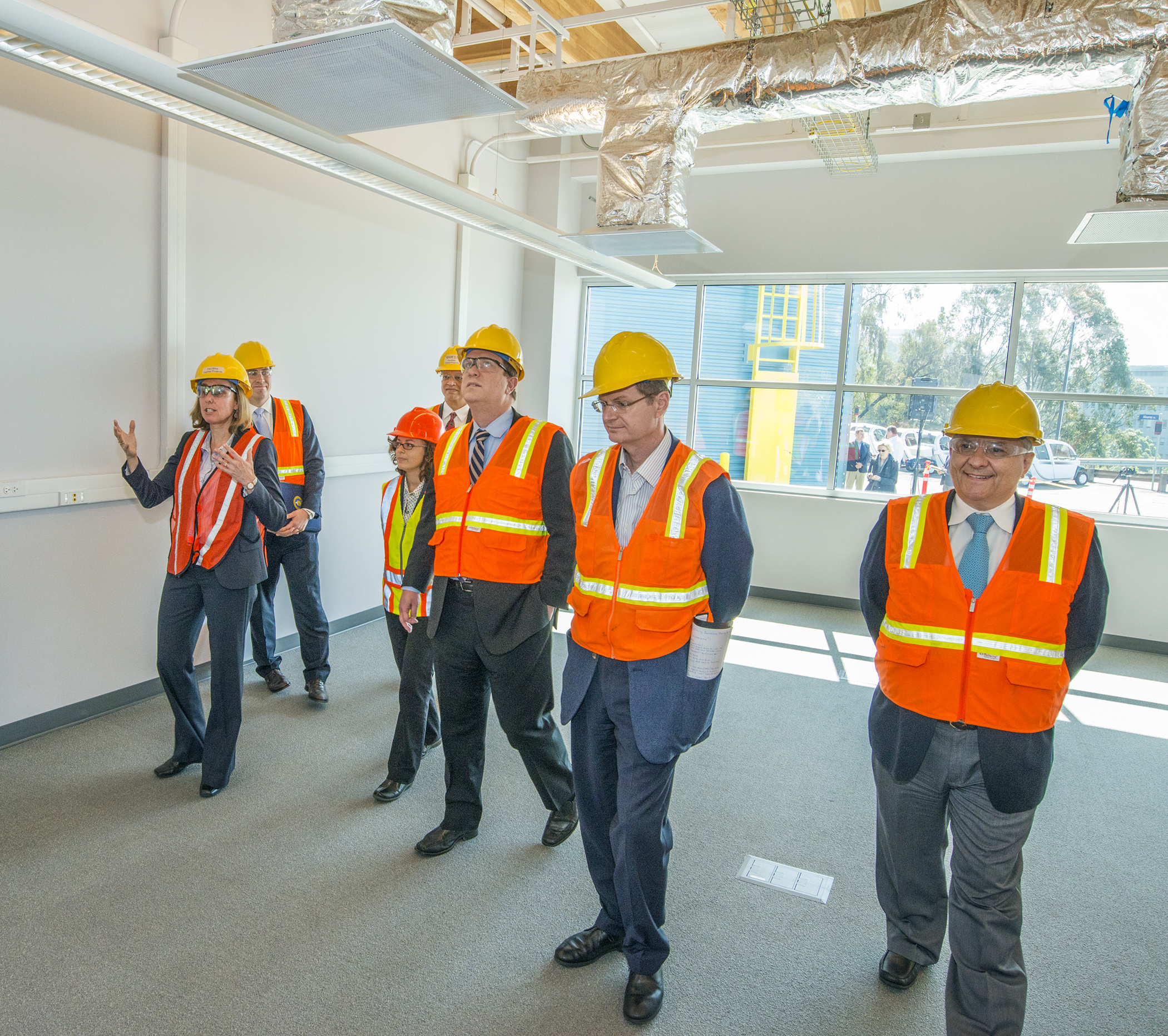
EETD's Mary Ann Piette (left) describes FLEXLAB's capabilities to EERE's David Danielson (center).
“FLEXLAB will bring industry, DOE national lab scientists, manufacturers and investors together all working hand in hand on cutting-edge energy efficiency technologies and solutions,” says Berkeley Lab Director Paul Alivisatos. “These partners can use the results from their FLEXLAB demonstrations to help encourage design, construction and operation of high-performance buildings.”

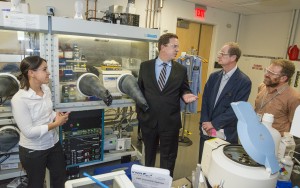
The Molecular Foundry's Delia Milliron (left) and Ron Zuckermann (rt.), along with Lab Director Alivisatos, join EERE's David Danielson.
As part of his visit to Berkeley Lab, Danielson also toured the Molecular Foundry.
For more information about FLEXLAB, seehttp://flexlab.lbl.gov/.
# # #
Lawrence Berkeley National Laboratory addresses the world’s most urgent scientific challenges by advancing sustainable energy, protecting human health, creating new materials, and revealing the origin and fate of the universe. Founded in 1931, Berkeley Lab’s scientific expertise has been recognized with 13 Nobel prizes. The University of California manages Berkeley Lab for the U.S. Department of Energy’s Office of Science. For more, visit www.lbl.gov.GE's Landfill Gas Engine Technology Powers Waste-to-Energy Project in Latin America
GE Press Release:
GE's Landfill Gas Engine Technology Powers Waste-to-Energy Project in Latin America
April 14, 2014
São Paulo, BRAZIL---April 10, 2014---GE's Distributed Power business (NYSE: GE) today announced that commissioning for three of its Jenbacher gas engines is expected to take place this month at Estre Ambiental's landfill in Guatapara City, São Paulo, Brazil. Once the facility begins commercial operation in May, it will be the first waste-to-energy project at an Estre landfill, one of the largest municipal solid waste operations in Latin America.
Under the scope of the project, GE will provide three 1.4-megawatt (MW) ecomagination qualified J420 Jenbacher gas engines for an estimated total output of 4.2 MW, with the potential to be expanded to 10 MW in the next five years. The current configuration may produce enough energy to support about 13,000 average Brazilian homes. GE's fuel-flexible gas engines are powered by landfill gas, which is created from solid waste decompositiong and then recovered as a valuable renewable fuel.
"This project will support São Paulo and Brazil's goals to increase the production of renewable and alternative, distributed power within the state and country. GE's solution provides us with a cost-effective, cleaner way to produce energy," said Alexandre Alvim, director, waste-to-energy and business development, Estre Ambiental.
GE's Jenbacher landfill gas engines use the gas---consisting of methane, carbon dioxide (CO2) and nitrogen---created during the decomposition of organic substances in a landfill. Methane has a global warming factor 21 times greater than CO2, the most widely recognized greenhouse gas affecting climate change. The new Estre Ambiental landfill project supports the initiatives of the Brazilian government to increase the production of electricity from renewable sources and may reduce the country's greenhouse gas emissions by between 36.1 and 38.9 percent from projected amounts in 2020. It may reduce the equivalent of about 70,000 tons of CO2 emissions into the atmosphere.
"GE's alternative gas-to-power portfolio is designed to accommodate the use of alternative fuels, such as landfill gas, while offering high levels of electrical efficiency," said Juan Galan, general manager, Brazil---GE's Distributed Power business. "Our Jenbacher gas engines are quick to install, easy to relocate, more reliable and fuel-flexible to best meet the energy, environmental and economic needs of our customers, such as those in Brazil and throughout Latin America."
GE's Jenbacher units are part of GE's ecomagination portfolio. To qualify for the portfolio, products and services must demonstrate both improved economic value and environmental performance. Ecomagination is GE's commitment to provide innovative solutions that maximize resources, drive efficiencies and make the world work better.
The announcement comes just days after GE launched its Distributed Power business in Latin America on April 8, 2014, in Mexico City. The business is focused on power generation at or near the point of use, including a potential $1.4 billion investment in technology to develop new and improved products for customers.
The new Distributed Power product portfolio includes GE's aeroderivative gas turbines and Jenbacher and Waukesha gas engines, which generate 100 kilowatts to 100 MW of power for numerous industries globally. Headquartered in Cincinnati, Ohio, Distributed Power employs about 5,000 people around the world.
About GE
GE (NYSE: GE) works on things that matter. The best people and the best technologies taking on the toughest challenges. Finding solutions in energy, health and home, transportation and finance. Building, powering, moving and curing the world. Not just imagining. Doing. GE works. For more information, visit the company's website at www.ge.com.
About GE Power & Water
GE Power & Water provides customers with a broad array of power generation, energy delivery and water process technologies to solve their challenges locally. Power & Water works in all areas of the energy industry including renewable resources such as wind and solar, biogas and alternative fuels; and coal, oil, natural gas and nuclear energy. The business also develops advanced technologies to help solve the world's most complex challenges related to water availability and quality. Power & Water's six business units include Distributed Power, Nuclear Energy, Power Generation Products, Power Generation Services, Renewable Energy and Water & Process Technologies. Headquartered in Schenectady, N.Y., Power & Water is GE's largest industrial business.
Follow GE Power & Water on Twitter @GE_PowerWater and on LinkedIn. To hear the latest news and conversations for Distributed Power, use the Twitter hashtag #DistributedPower.
Saturday, April 12, 2014
Ready, Set, Charge! Mt. Hood National Forest Welcomes First Electric Vehicle Charging Station
USDA Blog Post:
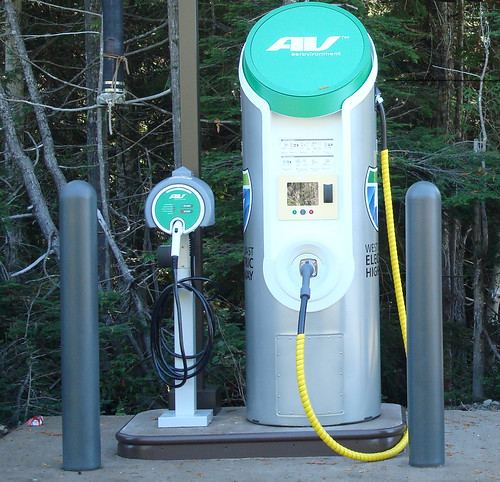
Mt. Hood National Forest is home to the nation’s first electric vehicle fast charger installed on land managed by the U.S. Forest Service and on a ski resort. (Courtesy Oregon Department of Transportation)
Oregon, home to the nation’s first border-to-border electric highway, continues its emergence as the ultimate travel destination for electric vehicle (EV) drivers. The Forest Service, the Oregon Department of Transportation and their partners recently unveiled America’s first EV fast-charger installed on U.S. Forest Service land and at a ski resort.
By using the growing West Coast Electric Highway fast-charger network, EV drivers can now travel up Mt. Hood’s rugged slopes, looming large at 11,250 feet and located just over an hour from Portland, Ore. The charging station, at Mt. Hood Skibowl West, completes Oregon’s Mt. Hood-Columbia River Gorge Electric Byway.
“It’s a natural fit to support infrastructure that promotes clean energy near forest recreation sites,” said Bill Westbrook of the Forest Service’s Zigzag Ranger District.
Partners in this accomplishment include Travel Oregon, the U.S. Department of Transportation, U.S. Senator Jeff Merkley, the U.S. Forest Service, AeroVironment, Portland General Electric and the Oregon Office of the Governor.
“The opening of the Mt. Hood fast-charger marks a major milestone in Oregon’s efforts to support electric vehicle travel across the state, including to wild and scenic places and recreation destinations,” said Oregon Gov. John Kitzhaber. “This not only helps minimize our environmental impact, it also creates an economic boost for small businesses located along Oregon Electric Byways.”
Ashley Horvat, Oregon’s electric vehicle officer, said Oregonians aren’t content to relegate electric vehicles to just city driving.
“We see the potential to use EVs for long distance travel, helping us preserve Oregon’s landscapes for future generations to travel Oregon forever,” she said.
One of the keys to success in supporting and growing electric vehicle adoption is reducing range anxiety, or concern about how far an electric vehicle can go before it needs re-charging.
Subscribe to:
Posts (Atom)